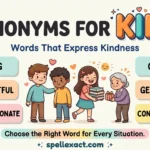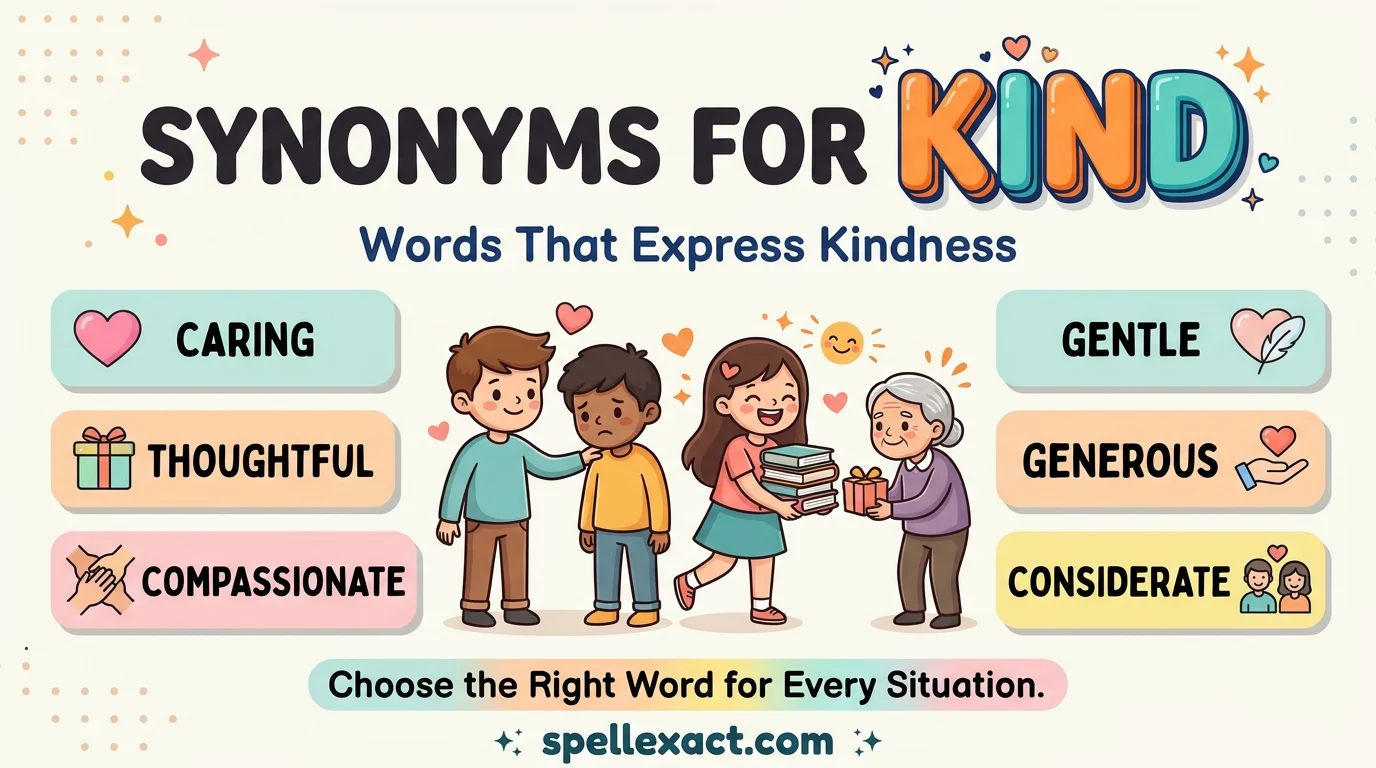
A synonym for kind is a word that describes someone who cares about others, treats people well, or shows compassion and consideration. Common synonyms include caring, compassionate, thoughtful, considerate, generous, gentle, and benevolent. The best choice depends on whether you want to describe a person’s character, a helpful action, emotional understanding, or polite behavior.
In this guide, you will discover 60 synonyms and related words for kind, including their simple meanings, example sentences, and the situations in which they work best. You will also learn the differences between similar words, find alternatives for formal and informal writing, and understand which expressions sound most natural in everyday English.
Quick Answer:
The best general synonyms for kind are caring, compassionate, thoughtful, considerate, friendly, generous, gentle, helpful, sympathetic, and kindhearted.
Here are the most useful alternatives at a glance:
- Caring: Shows concern for other people.
- Compassionate: Cares about people who are suffering.
- Thoughtful: Pays attention to another person’s needs.
- Considerate: Think about how actions affect others.
- Friendly: Acts warmly and pleasantly toward people.
- Generous: Gives or shares willingly.
- Gentle: Behaves in a soft, calm, or careful way.
- Helpful: Provides assistance or support.
- Sympathetic: Shows understanding and concern for someone’s difficulties.
- Kindhearted: Has a naturally caring and generous character.
- Benevolent: Wishes to do good for others.
- Altruistic: Acts for the benefit of others, often without expecting a reward.
For everyday English, caring, nice, friendly, and thoughtful are easy choices. Emotional situations, compassionate, empathetic, and sympathetic may be more precise. For formal writing, benevolent, charitable, and altruistic can be useful.
What Does Kind Mean?
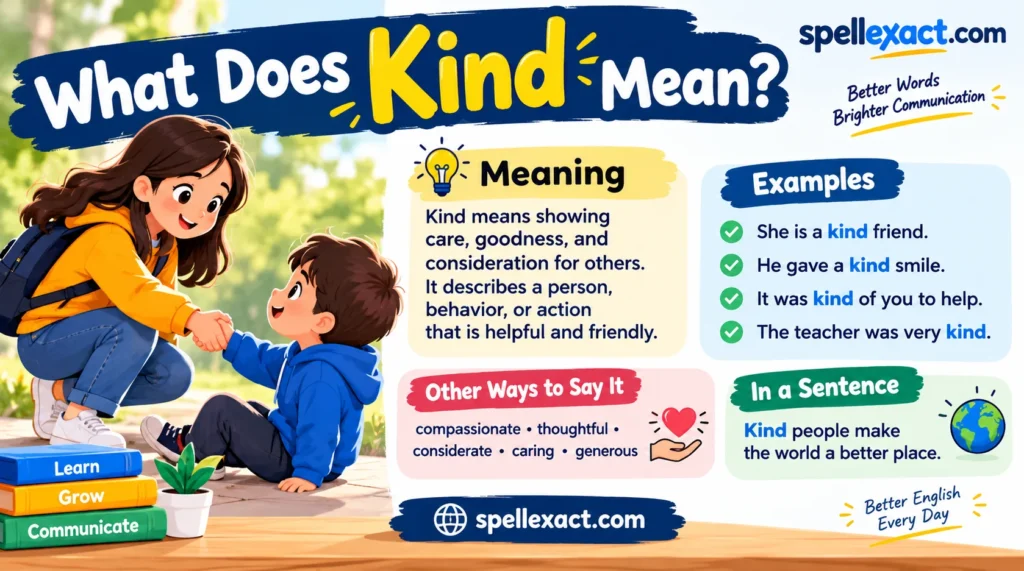
The word kind is an adjective that describes someone who treats others with care, respect, sympathy, and consideration. A kind person may offer help, speak gently, share what they have, or make an effort to protect another person’s feelings.
Example: “My neighbor was kind enough to help me carry my groceries.”
In this sentence, kind describes a helpful action. It can also describe a person’s character, words, or behavior.
- Kind person: Someone who treats others well.
- Kind words: Words that comfort, encourage, or make someone feel valued.
- Kind gesture: An action intended to help or please someone.
- Kind treatment: Behavior that shows care and consideration.
- Kind offer: An offer made with a helpful or generous intention.
Kindness does not always involve giving money or doing something extraordinary. Listening patiently, welcoming a new student, checking on a friend, and respecting someone’s feelings can all be examples of kindness.
60 Synonyms and Related Words for Kind
The following words are organized by their main meanings. Each entry includes a simple definition, an example, and guidance on when to use it.
1. Caring
Meaning: Showing concern for another person’s needs, feelings, or well-being.
Example: My caring sister always checks on me when I feel unwell.
Best use: Describe people who regularly look after others or show concern for their well-being.
2. Compassionate
Meaning: Feeling concern for people who are suffering and wanting to ease their difficulties.
Example: The compassionate nurse comforted the frightened patient.
Best use: Use this word when discussing illness, grief, hardship, or emotional pain.
3. Thoughtful
Meaning: Showing that you have considered another person’s feelings or needs.
Example: It was thoughtful of Maya to bring lunch for her busy coworker.
Best use: Describe meaningful gestures, considerate decisions, personal gifts, and supportive messages.
4. Considerate
Meaning: Thinking about how your actions affect other people.
Example: He was considerate enough to turn down the music while his neighbors were sleeping.
Best use: Use it when someone respects other people’s comfort, time, feelings, or boundaries.
5. Friendly
Meaning: Pleasant, welcoming, and easy to talk to.
Example: The friendly receptionist greeted every visitor with a smile.
Best use: Describe welcoming behavior, pleasant conversations, and approachable personalities.
6. Generous
Meaning: Willing to give or share time, money, attention, or resources.
Example: Our generous neighbor donated food to families in need.
Best use: Use it when kindness involves sharing or giving more than is expected.
7. Gentle
Meaning: Soft, calm, and careful rather than rough or harsh.
Example: The teacher used a gentle voice to reassure the nervous child.
Best use: Describe someone’s manner, voice, touch, or approach to a sensitive situation.
8. Helpful
Meaning: Willing or able to make something easier for another person.
Example: My helpful classmate explained the difficult question.
Best use: Use it when someone provides practical assistance, advice, information, or support.
9. Benevolent
Meaning: Wanting to do good and promote the well-being of others.
Example: The benevolent donor funded a library for the local community.
Best use: Suitable for formal writing about charitable people, leaders, organizations, or actions.
10. Sympathetic
Meaning: Showing understanding and concern for another person’s difficulties.
Example: Her manager was sympathetic when she explained her family emergency.
Best use: Use it when someone responds with concern, understanding, or emotional support.
11. Kindhearted
Meaning: Naturally caring, generous, and concerned about others.
Example: The kindhearted woman regularly helped older people in her neighborhood.
Best use: Describe a person’s overall character rather than one isolated action.
12. Nice
Meaning: Pleasant, agreeable, or considerate.
Example: Our new neighbor is very nice and always greets us warmly.
Best use: A simple, informal alternative to kind in everyday conversations.
13. Good-hearted
Meaning: Having a naturally kind and caring character.
Example: Everyone trusted the good-hearted shopkeeper.
Best use: Describe someone whose intentions and general behavior are positive.
14. Warmhearted
Meaning: Naturally affectionate, welcoming, and caring.
Example: Our warmhearted host made every guest feel at home.
Best use: Use it when emphasizing warmth, affection, and personal connection.
15. Tenderhearted
Meaning: Easily moved by another person’s suffering or emotions.
Example: The tenderhearted child felt sad when he saw an injured bird.
Best use: Describe someone who is emotionally sensitive and compassionate.
16. Sweet
Meaning: Pleasant, affectionate, or thoughtful in a way that makes others feel good.
Example: That was so sweet of you to remember my birthday.
Best use: Common in informal conversations about affectionate words, thoughtful gestures, and pleasant behavior.
17. Good-natured
Meaning: Naturally pleasant, cheerful, and not easily annoyed.
Example: His good-natured response helped everyone relax.
Best use: Describe a person’s temperament, especially when they remain pleasant in difficult situations.
18. Amiable
Meaning: Friendly, pleasant, and easy to get along with.
Example: The amiable guide made the entire tour enjoyable.
Best use: Suitable for descriptive and slightly formal writing about someone’s personality.
19. Gracious
Meaning: Polite, courteous, and considerate, often in a generous or dignified way.
Example: She was gracious enough to thank everyone who had helped her.
Best use: Describe polite responses, generous hospitality, and good manners.
20. Pleasant
Meaning: Enjoyable, agreeable, or pleasing to be around.
Example: We had a pleasant conversation with our new colleague.
Best use: Use it when emphasizing an agreeable manner or experience. It does not necessarily imply deep compassion.
21. Humane
Meaning: Showing compassion and concern for the dignity and welfare of people or animals.
Example: The organization promoted humane treatment of abandoned animals.
Best use: Appropriate when discussing ethical treatment, dignity, welfare, and the prevention of suffering.
22. Merciful
Meaning: Showing mercy instead of giving harsh punishment or causing unnecessary suffering.
Example: The judge considered the circumstances and made a merciful decision.
Best use: Use it when kindness involves forgiveness, leniency, or relief from punishment.
23. Charitable
Meaning: Willing to help people in need, often by giving money, time, or resources.
Example: The charitable organization provided warm clothing to homeless families.
Best use: Ideal for discussions of donations, fundraising, community service, and assistance to disadvantaged people.
24. Altruistic
Meaning: Acting to benefit others, often without expecting personal gain.
Example: Her altruistic decision to volunteer every weekend helped many families.
Best use: Use it when emphasizing selflessness and concern for other people’s welfare.
25. Selfless
Meaning: Putting other people’s needs ahead of your own interests.
Example: His selfless act gave the injured passenger time to receive help.
Best use: Describe sacrifices, acts of service, and decisions made for another person’s benefit.
26. Unselfish
Meaning: Willing to share, help, or consider others rather than thinking only about yourself.
Example: Her unselfish attitude made her a trusted team member.
Best use: A straightforward alternative to selfless in everyday and educational writing.
27. Humanitarian
Meaning: Concerned with improving people’s lives and relieving human suffering.
Example: The humanitarian group delivered emergency supplies after the flood.
Best use: Most appropriate for charitable work, disaster relief, human welfare, and organized efforts to help others.
28. Philanthropic
Meaning: Involving the donation of money, resources, or support to benefit society.
Example: The foundation supported philanthropic projects in education and healthcare.
Best use: Use it when discussing donations, foundations, public welfare, and organized charitable giving.
29. Beneficent
Meaning: Producing good results or actively doing good for others.
Example: The beneficent program provided free meals to struggling families.
Best use: A formal word for people, actions, or programs that bring benefits to others.
30. Magnanimous
Meaning: Generous and forgiving, especially toward someone who has wronged you or with whom you compete.
Example: The magnanimous winner praised her opponent’s strong performance.
Best use: Use it when kindness involves forgiveness, dignity, or generosity after a disagreement or competition.
31. Forgiving
Meaning: Willing to let go of resentment after someone makes a mistake or causes hurt.
Example: His forgiving attitude helped the friends repair their relationship.
Best use: Describe someone who does not hold on to anger or blame after being hurt.
32. Understanding
Meaning: Patiently recognizing another person’s feelings, problems, or mistakes.
Example: My understanding teacher gave me another chance to complete the assignment.
Best use: Use it when someone responds with patience rather than immediate criticism.
33. Tolerant
Meaning: Willing to accept differences in opinions, beliefs, or behavior.
Example: A tolerant classroom allows students to discuss different viewpoints respectfully.
Best use: Describe acceptance of differences. Tolerance does not mean agreeing with every opinion or accepting harmful behavior.
34. Patient
Meaning: Able to remain calm when something takes time or becomes difficult.
Example: The patient instructor explained the instructions several times.
Best use: Useful when kindness involves teaching, waiting, listening, or dealing calmly with mistakes.
35. Supportive
Meaning: Giving encouragement, reassurance, or practical help.
Example: Her supportive friends encouraged her to continue her studies.
Best use: Describe people who help others cope with difficulties or work toward their goals.
36. Nurturing
Meaning: Providing care and encouragement that help someone grow or develop.
Example: A nurturing teacher helps students feel safe enough to ask questions.
Best use: Common in discussions of parenting, education, mentoring, and personal development.
37. Empathetic
Meaning: Able to understand or share another person’s feelings.
Example: The empathetic counselor listened carefully to the student’s concerns.
Best use: Use it when emphasizing emotional understanding and the ability to see a situation from another person’s perspective.
38. Respectful
Meaning: Showing respect for another person’s rights, feelings, opinions, or boundaries.
Example: The respectful student listened even when he disagreed with his classmate.
Best use: Ideal for discussions of manners, dignity, personal boundaries, and fair treatment.
39. Courteous
Meaning: Polite and considerate in speech and behavior.
Example: The courteous driver allowed the pedestrians to cross first.
Best use: Suitable for professional, formal, and public situations where good manners matter.
40. Neighborly
Meaning: Friendly and helpful toward neighbors or members of a community.
Example: Our neighborly community organized meals for a family whose home had been damaged.
Best use: Describe local cooperation, community spirit, and friendly assistance.
41. Big-hearted
Meaning: Generous, caring, and willing to help others.
Example: The big-hearted volunteer spent her weekends helping older residents.
Best use: An informal, expressive way to praise someone’s generosity and compassion.
42. Softhearted
Meaning: Easily affected by the suffering or emotions of others.
Example: My softhearted grandfather always stopped to help stray animals.
Best use: Describe someone who feels sympathy easily and finds it difficult to ignore suffering.
43. Tender
Meaning: Showing affection, gentleness, or emotional care.
Example: She gave her younger brother a tender hug.
Best use: Use it for affectionate gestures, gentle care, and emotional moments. It is not a direct replacement for kind in every sentence.
44. Mild
Meaning: Gentle in manner or temperament, without being severe or harsh.
Example: His mild manner made difficult conversations easier.
Best use: Describe someone’s temperament or manner. Mild does not necessarily mean generous or compassionate.
45. Mild-mannered
Meaning: Calm, gentle, and not aggressive or easily angered.
Example: The mild-mannered librarian spoke politely to every visitor.
Best use: Use it when describing a calm personality rather than a specific act of kindness.
46. Benign
Meaning: Gentle, harmless, or not intending to cause harm.
Example: His benign manner helped the new employees feel comfortable.
Best use: Can describe a gentle manner or harmless intention, but it is not a general substitute for kind. In medicine, it has a more specific meaning.
47. Kindly
Meaning: In a kind or considerate manner; it can also describe a person’s gentle disposition.
Example: The teacher kindly offered to explain the lesson again.
Best use: Most commonly used as an adverb to describe how someone acts or speaks.
48. Solicitous
Meaning: Showing attentive care and concern for someone’s comfort or well-being.
Example: The solicitous nurse checked whether the patient needed anything.
Best use: A formal word for attentive, concerned care. It can sometimes suggest excessive concern depending on the context.
49. Forbearing
Meaning: Patient and self-controlled when dealing with another person’s mistakes or irritating behavior.
Example: Her forbearing response prevented the disagreement from becoming worse.
Best use: Use it when someone shows restraint and patience instead of reacting angrily.
50. Lenient
Meaning: Not as strict or severe as might be expected.
Example: The teacher was lenient with students who had experienced an unexpected emergency.
Best use: Best for rules, punishments, and judgments. It describes a particular type of kindness rather than kindness in general.
51. Clement
Meaning: Merciful or inclined to show leniency.
Example: The clement ruler reduced the punishment for the first offense.
Best use: A rare, formal word most suitable for literary or historical writing about mercy.
52. Noble
Meaning: Showing high moral character, courage, or generosity.
Example: Helping the injured stranger was a noble thing to do.
Best use: Use it when an action reflects admirable principles or moral courage.
53. Openhearted
Meaning: Open, sincere, and emotionally generous toward others.
Example: Her openhearted welcome made the visitors feel accepted.
Best use: Describe emotional openness, warmth, and sincere friendliness.
54. Greathearted
Meaning: Generous, noble, or unusually compassionate in character.
Example: The greathearted volunteer devoted years to helping disadvantaged children.
Best use: A less common, expressive word for exceptional generosity or compassion.
55. Freehanded
Meaning: Willing to give or spend generously.
Example: The freehanded host paid for the group’s dinner.
Best use: A relatively uncommon expression for generosity, particularly with money or gifts. Generous is more natural in most modern writing.
56. Liberal
Meaning: Willing to give generously or allow considerable freedom, depending on context.
Example: She was liberal with her praise when the team performed well.
Best use: In the expression liberal with, it can mean generous. The word has other meanings, so context matters.
57. Amicable
Meaning: Friendly and peaceful, especially when people disagree or end a relationship.
Example: The two business partners reached an amicable agreement.
Best use: Use it for peaceful relationships, negotiations, separations, or resolutions.
58. Cordial
Meaning: Warm, polite, and friendly.
Example: The manager gave us a cordial welcome.
Best use: Suitable for formal greetings, professional relationships, and pleasant social interactions.
59. Genial
Meaning: Cheerful, friendly, and pleasant.
Example: The genial host made conversation with every guest.
Best use: Describe a cheerful and welcoming personality, especially in social settings.
60. Affable
Meaning: Friendly, approachable, and pleasant to talk to.
Example: The affable professor encouraged students to ask questions.
Best use: Use it in descriptive writing about someone who is easy to approach and talk with.
More Synonyms and Similar Words for Kind
The following words are also related to kindness, compassion, generosity, or friendly behavior. They can be useful when you need a more specific expression.
| Word | Simple meaning |
| Pitying | Showing pity for someone’s suffering |
| Companionable | Pleasant to spend time with |
| Comradely | Showing friendly support among companions |
| Brotherly | Showing affection or solidarity like a brother |
| Good-tempered | Usually calm and not easily irritated |
| Affectionate | Showing love or fondness |
| Congenial | Pleasant and compatible in character or interests |
| Neighborly-minded | Inclined to help people in the community; less common than neighborly |
| Soft | Gentle or not harsh, depending on context |
| Liberal-minded | Open to different ideas; not necessarily kind |
| Good | Morally admirable or helpful, depending on context |
| Unassuming | Modest and not seeking attention |
| Reassuring | Helping someone feel less worried |
| Encouraging | Giving someone confidence or hope |
| Accommodating | Willing to adjust to another person’s needs |
| Cooperative | Willing to work with others |
| Peaceable | Inclined to avoid conflict |
| Receptive | Willing to listen to or consider others |
| Attentive | Paying careful attention to someone’s needs |
| Giving | Willing to share time, attention, or resources |
Important distinction: These words are related to kindness, but they are not all exact synonyms. For example, cooperative emphasizes working together, reassuring emphasizes reducing worry, and unassuming describes modesty. Choose the word that communicates your intended meaning most accurately.
Comparison Table: Which Synonym for Kind Should You Use?
Use this table to find the best alternative for a specific situation.
| If you mean… | Best word | Example |
| Someone cares about others | Caring | She is a caring friend. |
| Someone helps people in pain | Compassionate | He is a compassionate doctor. |
| Someone notices what others need | Thoughtful | That was a thoughtful gift. |
| Someone respects other people’s comfort | Considerate | It was considerate of you to call first. |
| Someone gives freely | Generous | She made a generous donation. |
| Someone is welcoming | Friendly | The staff were friendly. |
| Someone behaves gently | Gentle | He spoke in a gentle voice. |
| Someone understands feelings | Empathetic | She is an empathetic listener. |
| Someone offers emotional support | Supportive | My family is supportive. |
| Someone treats people politely | Courteous | The employee was courteous. |
| Someone wishes to do good | Benevolent | The benevolent donor helped the town. |
| Someone puts others first | Selfless | It was a selfless act. |
| Someone forgives easily | Forgiving | He was forgiving after the mistake. |
| Someone accepts differences | Tolerant | They created a tolerant environment. |
| Someone is pleasant to talk to | Affable | The affable host welcomed us. |
| Someone shows mercy | Merciful | The decision was merciful. |
| Someone gives to help society | Philanthropic | She supported philanthropic projects. |
| Someone is calm and gentle | Mild-mannered | He is mild-mannered and patient. |
| Someone is polite and warm | Gracious | She gave a gracious reply. |
| Someone acts peacefully | Amicable | They reached an amicable settlement. |
How to Choose the Right Synonym for Kind
Choosing the right word becomes easier when you consider the tone, meaning, and purpose of your sentence.
Choose a Synonym Based on Tone
For everyday conversation
Use nice, friendly, caring, helpful, or thoughtful. These words sound natural in most casual situations.
Example: “My new neighbor is friendly and helpful.”
For warm, personal descriptions
Use kindhearted, warmhearted, big-hearted, sweet, or good-hearted.
Example: “She is a kindhearted person who always makes time for her friends.”
For formal writing
Use benevolent, compassionate, courteous, charitable, or altruistic when the meaning fits.
Example: “The foundation recognized his charitable contributions to the community.”
For literary or expressive writing
Use magnanimous, tenderhearted, gracious, genial, or greathearted when the word fits the intended tone.
Example: “The magnanimous winner congratulated the person who came second.”
Choose a Synonym Based on Meaning
- Care and concern: caring, thoughtful, considerate, attentive.
- Compassion for suffering: compassionate, sympathetic, humane, tenderhearted.
- Generosity and giving: generous, charitable, beneficent, big-hearted.
- Selflessness: altruistic, unselfish, selfless, philanthropic.
- Politeness: courteous, gracious, respectful, cordial.
- Friendliness: amiable, affable, genial, good-natured.
- Patience and acceptance: patient, tolerant, understanding, forbearing.
- Mercy and forgiveness: merciful, forgiving, clement, lenient.
- Emotional support: empathetic, supportive, nurturing, reassuring.
- Gentle behavior: gentle, mild-mannered, tender, softhearted.
Choose a Synonym Based on Intent
Ask yourself what you want the reader to notice.
If you want to praise an action, thoughtful or considerate may be best. If you want to describe a person’s character, try caring or kindhearted. Weather the person gives money or resources, generous or charitable may be more precise. If someone listens and understands another person’s feelings, empathetic or sympathetic can communicate that quality more clearly.
For example:
- “She made a kind decision” → “She made a thoughtful decision.”
- “He is a kind person who gives to charity” → “He is a generous and charitable person.”
- “The nurse was kind to the patient” → “The nurse was compassionate toward the patient.”
- “The teacher was kind when correcting mistakes” → “The teacher was considerate and patient.”
- “They ended their disagreement in a kind way” → “They reached an amicable resolution.”
The best synonym is the one that preserves your original meaning while making the sentence more precise.
Common Mistakes When Using Synonyms for Kind
1. Assuming Nice and Kind Mean Exactly the Same Thing
Nice usually means pleasant or agreeable. Kind more strongly suggests care, consideration, or helpful behavior.
- Nice: “The receptionist was nice to me.”
- Kind: “The receptionist helped me find my lost wallet.”
Both words are positive, but kind more clearly emphasizes a caring action in the second example.
2. Confusing Empathetic and Sympathetic
Empathetic emphasizes understanding or sharing someone’s feelings. Sympathetic often emphasizes concern for someone experiencing a difficult situation.
- Empathetic: “She understood why he felt anxious.”
- Sympathetic: “She expressed concern when he lost his job.”
The meanings overlap, but the emphasis is different.
3. Using Generous When You Mean Courteous
Generous describes giving or sharing. Courteous describes polite behavior.
- Generous: “He generously shared his lunch.”
- Courteous: “He courteously held the door open.”
A person can be courteous without giving anything away.
4. Using Benevolent in Every Situation
Benevolent is a useful formal word, but it may sound unnatural in ordinary conversations.
Instead of “My friend is benevolent,” you could say “My friend is caring and generous.”
Choose vocabulary that matches the setting and your audience.
5. Confusing Kindness With Tolerance
A tolerant person accepts differences in opinions, beliefs, or behavior. A kind person treats others with care and consideration.
Someone can be tolerant without being especially warm, and someone can be kind while disagreeing with another person’s opinion.
6. Assuming Every Related Word Is an Exact Synonym
Words such as mild, benign, amicable, and philanthropic have specific uses. A mild person may be gentle, an amicable agreement is peaceful, and a philanthropic act benefits society through charitable giving.
These words can relate to kindness, but they cannot replace kind in every sentence.
What Is the Opposite of Kind?
The most common opposite of kind is unkind. Other antonyms include cruel, mean, harsh, heartless, inconsiderate, and unkindhearted.
| Opposite | Meaning | Example |
| Unkind | Not considerate or caring | His unkind remark hurt her feelings. |
| Cruel | Causing suffering or showing little concern for it | The cruel behavior upset the children. |
| Mean | Intentionally unpleasant or hurtful | It was mean to laugh at his mistake. |
| Harsh | Severe, rough, or unkind in manner | Her harsh response discouraged the student. |
| Heartless | Showing little sympathy or compassion | The heartless comment ignored their grief. |
| Inconsiderate | Failing to think about other people’s needs | It was inconsiderate to interrupt repeatedly. |
| Unfriendly | Not warm or welcoming | The unfriendly response ended the conversation. |
| Selfish | Mainly concerned with one’s own interests | His selfish decision affected the entire group. |
Use unkind for a general opposite, cruel for behavior that causes suffering, and inconsiderate when someone fails to think about how their actions affect others.
Frequently Asked Questions
1. What is the best synonym for kind?
Caring is one of the best general alternatives because it describes concern for other people. Thoughtful, considerate, compassionate, and generous are excellent choices when you want to emphasize a particular quality.
2. What are five synonyms for kind?
Five common synonyms are caring, compassionate, thoughtful, considerate, and generous. Each highlights a different aspect of kindness, from emotional concern to practical help.
3. What is another word for kind in simple English?
Use nice, caring, friendly, helpful, or gentle. These words are easy to understand and work well in everyday conversations.
4. What is a more formal word for kind?
Benevolent, compassionate, courteous, and altruistic are useful formal alternatives. Use benevolent to emphasize a desire to do good, courteous for polite behavior, and altruistic for selfless actions.
5. What is a synonym for kind when describing a person?
Use kindhearted for someone’s general character, friendly for a welcoming personality, generous for someone who gives freely, or empathetic for someone who understands other people’s feelings.
6. What is the difference between kind and kindhearted?
Kind can describe a person, action, comment, or gesture. Kindhearted usually describes a person’s naturally caring character.
Examples: “She made a kind gesture” and “She is a kindhearted person.”
7. Can generous be used as a synonym for kind?
Yes, when kindness involves giving or sharing. However, generous specifically emphasizes willingness to give, while kind has a broader meaning that includes compassion, politeness, and consideration.
8. What is the difference between compassionate and empathetic?
Compassionate emphasizes concern for another person’s suffering and a desire to help. Empathetic emphasizes understanding or sharing that person’s feelings. Someone can be empathetic without taking action, while compassion often includes a desire to ease suffering.
9. What is a synonym for kind in a professional setting?
Considerate, courteous, respectful, supportive, and compassionate can work well in professional writing. Choose courteous for manners, supportive for encouragement, and considerate for respecting colleagues’ needs.
10. What is the opposite of kind?
The most direct opposite is unkind. Depending on the context, cruel, mean, harsh, heartless, and inconsiderate may also work.
Conclusion
There are many synonyms for kind, but the best choice depends on the exact quality you want to describe. Caring emphasizes concern for others, compassionate highlights concern for suffering, thoughtful describes attention to another person’s needs, generous focuses on giving, and considerate emphasizes respect for other people’s feelings and comfort.
For everyday English, start with words such as nice, friendly, caring, and helpful. For formal writing, consider benevolent, courteous, or altruistic. When describing emotional support, empathetic, sympathetic, and compassionate may communicate your meaning more clearly.
Learning these distinctions will help you choose more precise words, write more naturally, and express different forms of kindness with confidence.

Aaron Adam is the Administrator of SpellExact, dedicated to helping readers improve their spelling and writing accuracy. He oversees content quality, ensures reliable language resources, and works to make spelling guidance simple, practical, and accessible for everyone.