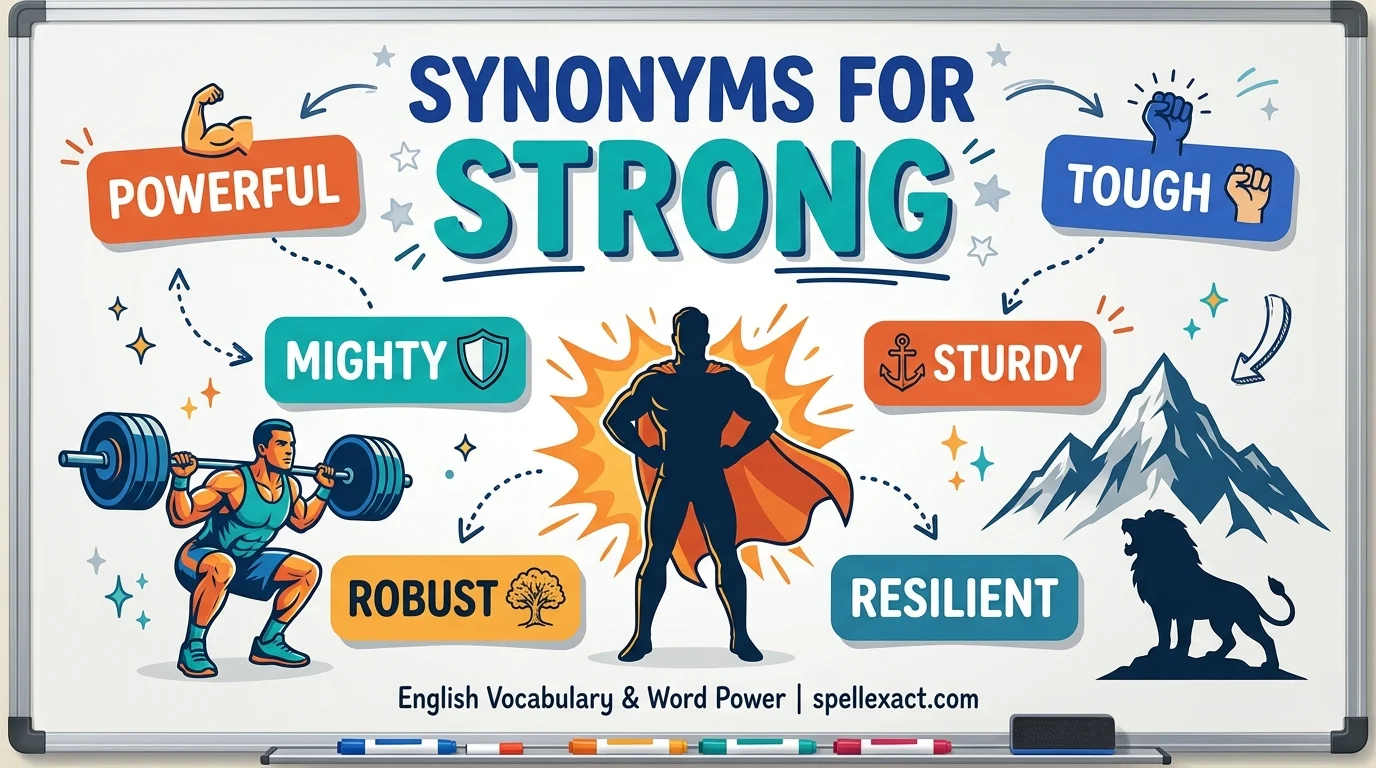
Learning a synonym for strong helps English learners improve vocabulary and express ideas clearly in different situations. The word strong is a commonly used adjective in English with several meanings, including physical power, mental toughness, deep emotions, convincing arguments, lasting relationships, and rich flavors.
This useful word appears frequently in everyday conversations, essays, articles, and creative writing. However, repeating the same word can make your writing sound repetitive. Exploring synonyms for strong allows students, ESL learners, writers, and content creators to express ideas more accurately and add variety to their language.
To improve your vocabulary, understand the meaning of each alternative before deciding how to use it. For example, powerful can describe convincing arguments, resilient can describe mental toughness, and robust can describe a healthy person or a reliable system.
In my experience, understanding context helps writers create clear and effective sentences. This guide will help you discover 30 useful synonyms through practical examples, making it easier to choose words that fit naturally.
Quick Answer: What Is a Synonym for Strong?
A synonym for strong is a word with a similar meaning to strong in a particular context. It may describe physical power, emotional resilience, durability, intensity, influence, or persuasive ability.
Here are 10 useful words similar to strong:
- Powerful: Having great force or influence.
- Tough: Able to endure hardship or pressure.
- Sturdy: Strongly built and unlikely to break easily.
- Robust: Strong, healthy, or able to function effectively.
- Resilient: Able to recover after difficulties.
- Durable: Able to last a long time.
- Mighty: Possessing impressive strength or power.
- Convincing: Able to make someone believe something.
- Intense: Very strong in degree or feeling.
- Determined: Firmly committed to achieving a goal.
The best choice depends on the noun you are describing. Use powerful for a leader, sturdy for a chair, resilient for someone who recovers from setbacks, and convincing for an argument.
What Does Strong Mean?
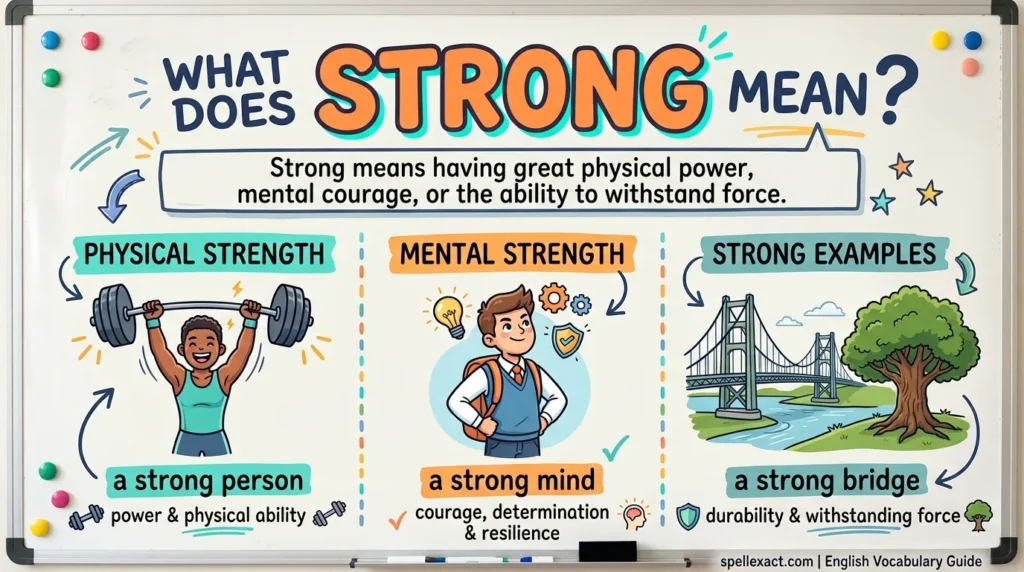
The word strong is an adjective with several related meanings. It can describe physical power, the ability to withstand damage, emotional resilience, a persuasive argument, or something that has a noticeable effect.
Understanding the strong meaning helps you choose an appropriate replacement instead of using the same word in every sentence.
Physical strength
Physical strength is the ability to lift, carry, push, pull, or resist force.
Example: The strong athlete lifted the heavy weight.
Suitable alternatives include powerful, muscular, brawny, and mighty.
Emotional strength
Emotional strength means being able to handle difficulties, manage setbacks, and continue working toward a goal.
Example: She remained strong after receiving disappointing news.
Suitable alternatives include resilient, tough, steadfast, and determined.
Strength of materials
When describing an object, strong can mean able to support weight, resist damage, or withstand pressure.
Example: We need a strong box to carry these books safely.
Suitable alternatives include sturdy, solid, durable, and hard-wearing.
Strength of an argument
A strong argument is supported by good reasons or evidence and can persuade others.
Example: The student presented a strong argument supported by research.
Suitable alternatives include convincing, compelling, cogent, and persuasive.
Intensity and influence
Strong can also describe feelings, smells, flavors, opinions, and effects.
Example: The coffee has a strong flavor.
Suitable alternatives include intense, potent, pronounced, and powerful, depending on the intended meaning.
30 Synonyms for Strong With Meanings and Examples
The following list includes strong word alternatives for physical strength, emotional qualities, materials, arguments, and intensity. Each entry explains when the word is most appropriate.
1. Powerful
Meaning: Having great force, influence, or effect.
Example: The powerful engine pulled the truck up the steep hill.
Best usage: Use powerful for people, machines, leaders, speeches, emotions, and ideas that have a significant effect. It is one of the most versatile alternatives to strong.
2. Tough
Meaning: Able to withstand hardship, pressure, pain, or difficult conditions.
Example: The tough competitor continued playing until the final whistle.
Best usage: Use tough in everyday English to describe people who endure difficulties, materials that resist damage, or opponents who are difficult to defeat.
3. Sturdy
Meaning: Strongly built and unlikely to break or collapse easily.
Example: We bought a sturdy desk that could support several heavy books.
Best usage: Use sturdy for furniture, buildings, shoes, tools, and equipment. It is especially useful when describing solid construction.
4. Robust
Meaning: Strong, healthy, or capable of functioning effectively under demanding conditions.
Example: The company developed a robust system that continued working during heavy demand.
Best usage: Use robust in professional, technical, business, and academic contexts. It can describe systems, processes, economies, and health.
5. Resilient
Meaning: Able to recover after difficulties or adapt to challenging circumstances.
Example: The resilient student learned from failure and prepared for the next examination.
Best usage: Use resilient for people, communities, organizations, and systems that recover from setbacks. It is particularly appropriate when discussing emotional strength.
6. Durable
Meaning: Able to last a long time without becoming damaged or worn out.
Example: These durable hiking boots can withstand frequent outdoor use.
Best usage: Use durable for products, clothing, furniture, materials, and tools. Choose it when longevity matters more than force or influence.
7. Mighty
Meaning: Extremely powerful or impressive in strength.
Example: The mighty river flowed through the valley after the heavy rain.
Best usage: Use mighty in dramatic, literary, or expressive writing. It often suggests impressive force or scale.
8. Convincing
Meaning: Able to make someone believe that something is true or reasonable.
Example: The researcher presented convincing evidence to support the conclusion.
Best usage: Use convincing for arguments, evidence, explanations, and performances. It is a natural choice when describing persuasive reasoning.
9. Intense
Meaning: Very strong in degree, concentration, or feeling.
Example: The players experienced intense pressure during the final minutes of the match.
Best usage: Use intense for emotions, competition, pain, heat, concentration, and experiences that are particularly powerful.
10. Determined
Meaning: Firmly committed to achieving a goal.
Example: The determined student continued studying despite several setbacks.
Best usage: Use determined when describing persistence and a clear intention to succeed. It is a useful strong-minded synonym.
11. Muscular
Meaning: Having well-developed muscles or relating to physical muscle strength.
Example: The muscular athlete trained regularly for the competition.
Best usage: Use muscular for physical appearance, anatomy, and athletic development. It is more specific than strong because it emphasizes muscles.
12. Brawny
Meaning: Physically strong, usually with large, well-developed muscles.
Example: The brawny workers carried the heavy timber across the site.
Best usage: Use brawny for people with substantial physical strength. It is more descriptive and less neutral than strong.
13. Hardy
Meaning: Able to survive difficult conditions or withstand hardship.
Example: Hardy plants can survive cold winters and limited rainfall.
Best usage: Use hardy for plants, animals, and people that tolerate harsh conditions.
14. Solid
Meaning: Firm, stable, dependable, or well constructed.
Example: The engineers built a solid foundation for the new house.
Best usage: Use solid for structures, plans, evidence, relationships, and dependable performance. In expressions such as solid evidence, it emphasizes reliability.
15. Forceful
Meaning: Expressing an idea, opinion, or action with strength and energy.
Example: The lawyer delivered a forceful argument in court.
Best usage: Use forceful for speeches, statements, arguments, and actions that communicate determination or authority.
16. Potent
Meaning: Having a powerful effect or influence.
Example: The spice has a potent flavor that dominates the dish.
Best usage: Use potent for flavors, medicines, chemicals, and influences. In medical contexts, potency does not automatically mean a substance is safe or suitable.
17. Steadfast
Meaning: Firm, loyal, and consistent in beliefs or commitment.
Example: Her steadfast support helped the volunteers finish the project.
Best usage: Use steadfast for loyalty, support, principles, and commitments that remain firm over time.
18. Unyielding
Meaning: Refusing to give way, weaken, or change under pressure.
Example: He showed unyielding determination when the project encountered difficulties.
Best usage: Use unyielding for determination, resistance, firm attitudes, and materials that do not bend easily. It can imply stubbornness when describing a person’s attitude.
19. Vigorous
Meaning: Full of energy, strength, and activity.
Example: The team began the morning with vigorous exercise.
Best usage: Use vigorous for physical activity, exercise, debate, movement, and energetic efforts.
20. Energetic
Meaning: Having or showing a lot of energy.
Example: The energetic volunteer helped organize the entire event.
Best usage: Use energetic for active people, lively performances, and enthusiastic work. It emphasizes energy rather than the ability to withstand pressure.
21. Stout
Meaning: Strong, sturdy, or capable of withstanding pressure.
Example: The hikers carried stout walking sticks along the trail.
Best usage: Use stout for sturdy objects and certain traditional descriptions of resistance. When describing people, it can also mean thickset, so choose the word carefully.
22. Hard-wearing
Meaning: Able to withstand frequent use without wearing out quickly.
Example: The workers chose hard-wearing trousers for the construction site.
Best usage: Use hard-wearing for clothing, footwear, flooring, fabrics, and equipment. It is especially common in British English.
23. Indomitable
Meaning: Extremely difficult to defeat, discourage, or control.
Example: Her indomitable spirit helped her continue through repeated setbacks.
Best usage: Use indomitable in formal, literary, or inspirational writing to emphasize exceptional determination.
24. Invincible
Meaning: Seemingly impossible to defeat.
Example: After winning every match, the team began to feel invincible.
Best usage: Use invincible for people, teams, or forces that appear unbeatable. It is often figurative rather than a literal guarantee of victory.
25. Unstoppable
Meaning: Continuing with such force or determination that stopping it seems impossible.
Example: The runner seemed unstoppable during the final lap.
Best usage: Use unstoppable for momentum, progress, successful teams, and people who continue despite obstacles.
26. Compelling
Meaning: So persuasive, interesting, or powerful that it attracts attention or influences people.
Example: The researcher presented a compelling case for changing the policy.
Best usage: Use compelling for arguments, stories, evidence, and ideas that have a powerful effect on an audience.
27. Persuasive
Meaning: Able to convince someone to accept an idea or take action.
Example: Her persuasive presentation encouraged the audience to support the proposal.
Best usage: Use persuasive for speeches, writing, communication, and reasoning intended to influence others.
28. Cogent
Meaning: Clear, logical, and convincing.
Example: The student gave a cogent explanation of why the proposed solution would work.
Best usage: Use cogent in formal and academic writing, especially when describing arguments, explanations, and reasoning. It is more specific than strong because it emphasizes logic and clarity.
29. Tenacious
Meaning: Determined to continue and unwilling to give up easily.
Example: The tenacious journalist continued investigating until she found reliable evidence.
Best usage: Use tenacious for people who persist through obstacles, difficult tasks, or long investigations. It emphasizes persistence rather than physical power.
30. Pronounced
Meaning: Easily noticeable, distinct, or especially marked.
Example: The sauce has a pronounced garlic flavor.
Best usage: Use pronounced for noticeable differences, features, effects, and flavors. It works when strong means clearly noticeable, not when it means physically powerful.
Comparison Table: Which Synonym for Strong Should You Choose?
The most suitable alternative depends on what you want to describe. This table highlights common choices for everyday and academic writing.
| Synonym | Main meaning | Best context | Example phrase |
| Powerful | Force or influence | People, machines, ideas | A powerful leader |
| Tough | Endurance | People, opponents, conditions | A tough competitor |
| Sturdy | Solid construction | Furniture, structures | A sturdy chair |
| Robust | Reliable performance | Systems, processes | A robust system |
| Resilient | Recovery from setbacks | People, communities | A resilient person |
| Durable | Long-lasting quality | Products, materials | Durable footwear |
| Mighty | Impressive strength | Literary descriptions | A mighty warrior |
| Convincing | Believable reasoning | Arguments, evidence | Convincing evidence |
| Intense | High degree or feeling | Emotions, competition | Intense pressure |
| Determined | Commitment to a goal | People, efforts | A determined student |
| Forceful | Expressive power | Speeches, statements | A forceful response |
| Compelling | Strong persuasive effect | Arguments, stories | A compelling case |
| Cogent | Clear and logical reasoning | Academic writing | A cogent explanation |
| Tenacious | Persistence | People, investigations | A tenacious researcher |
| Hard-wearing | Resistance to wear | Clothing, equipment | Hard-wearing fabric |
Strong vs. Powerful vs. Tough vs. Robust
These four words are common synonyms for strong, but they emphasize different qualities.
- Strong is the general term. It can describe physical ability, emotional resilience, materials, arguments, and intense flavors.
- Powerful emphasizes force, influence, or impact.
- Tough emphasizes the ability to endure hardship, pressure, or damage.
- Robust emphasizes health, reliability, or effective performance under demanding conditions.
Compare these examples:
- The strong athlete lifted the weight.
- The powerful engine pulled the truck uphill.
- The tough competitor continued despite difficult conditions.
- The robust system continued operating during heavy demand.
Although the words overlap, replacing one with another can change the meaning of the sentence.
How to Choose the Right Synonym for Strong
To select the right alternative, consider three things: meaning, tone, and intention.
1. Choose according to meaning
For physical strength: Choose powerful, muscular, brawny, or mighty.
Example: The powerful boxer won the match.
For emotional strength: Choose resilient, steadfast, determined, or tenacious.
Example: The resilient student recovered from disappointment and continued studying.
For materials and objects: Choose sturdy, durable, solid, or hard-wearing.
Example: The manufacturer produces durable outdoor equipment.
For arguments and evidence: Choose convincing, compelling, cogent, or persuasive.
Example: The researcher presented compelling evidence to support the conclusion.
For feelings and effects: Choose intense or potent when you mean a high degree or a powerful effect. Use pronounced when a feature is particularly noticeable.
Example: The spice has a potent flavor.
2. Choose according to tone
Different situations call for different formal synonyms for strong or everyday alternatives.
| Tone | Suitable alternatives | Example |
| Everyday English | Tough, powerful, solid | He is a tough competitor. |
| Academic writing | Cogent, compelling, robust | The study presents a cogent argument. |
| Professional writing | Robust, durable, resilient | The team developed a robust process. |
| Formal writing | Steadfast, indomitable, tenacious | She remained steadfast in her commitment. |
| Creative writing | Mighty, unstoppable, invincible | An unstoppable force crossed the valley. |
| Descriptive writing | Sturdy, intense, pronounced | The room had a pronounced smoky smell. |
3. Choose according to your intention
If you want to describe a person, consider whether you mean physical power, courage, persistence, or recovery from hardship.
If you want to describe a product, consider whether it is solidly built, long-lasting, or resistant to damage.
Weather you want to strengthen an argument, choose a word that communicates the quality of the reasoning, such as cogent or convincing.
If you want to describe an unwavering commitment, choose steadfast, determined, or tenacious.
This approach helps you find a better word than strong without accidentally changing the meaning of your sentence.
Positive Synonyms for Strong
If you need positive synonyms for strong to describe a person, leader, student, or colleague, choose a word that communicates the specific quality you admire.
- Resilient: Recovers after difficult experiences.
- Determined: Remains focused on a goal.
- Courageous: Faces danger or difficulty bravely.
- Steadfast: Remains loyal and committed.
- Capable: Has the ability to do something successfully.
- Confident: Trusts one’s abilities or judgment.
- Tenacious: Continues despite obstacles.
- Indomitable: Refuses to give up despite serious difficulties.
- Reliable: Can be trusted to perform consistently.
- Resolute: Firmly determined to follow a decision.
For example, instead of writing, “She is a strong woman,” you could write, “She is a resilient and determined woman who continues to pursue her goals.”
The second sentence gives the reader a clearer idea of the qualities being described.
Another word for a strong person
The best choice depends on the person’s qualities.
- A powerful person may have considerable physical force or influence.
- A muscular person has well-developed muscles.
- A resilient person recovers from difficulties.
- A tenacious person persists through challenges.
- A courageous person faces fear or danger bravely.
These alternatives are more informative than simply describing someone as strong.
Common Mistakes When Using Synonyms for Strong
Learning synonyms involves more than memorizing definitions. You also need to understand how each word works in a sentence.
1. Using powerful instead of durable
Less precise: These shoes are powerful.
Better: These shoes are durable.
Powerful usually describes force or influence, while durable describes something that lasts through regular use.
2. Using tough instead of convincing
Less precise: She presented a tough argument.
Better: She presented a convincing argument.
Tough argument can describe an argument that is difficult to answer, but convincing argument emphasizes the ability to persuade.
3. Confusing resilient with unbreakable
A resilient person can recover after a setback. An unbreakable object is extremely difficult to break, while an unbreakable bond describes a relationship believed to be exceptionally strong.
The words overlap figuratively, but they are not interchangeable in every context.
4. Using intense for structural strength
Incorrect or unnatural: The intense chair supports heavy equipment.
Better: The sturdy chair supports heavy equipment.
Intense normally describes feelings, activity, or effects. It is not the natural word for the structural strength of furniture.
5. Using formal words in casual situations
Words such as cogent, indomitable, and stalwart can be useful in formal writing, but they may sound unnatural in ordinary conversation.
For example, “My tough friend helped me move the sofa” sounds more natural in everyday English than “My indomitable friend helped me move the sofa.”
Choose words that suit your audience and purpose.
6. Assuming every synonym means exactly the same thing
A synonym shares a meaning with another word in at least one context. It does not necessarily fit every sentence.
Compare these examples:
- Strong coffee: potent coffee or concentrated coffee, depending on the intended meaning.
- Strong evidence: convincing evidence or compelling evidence.
- Strong building: sturdy building or solid building.
- Strong determination: unyielding determination.
- Strong recovery after setbacks: describe someone as resilient.
Always consider the noun being described before choosing a replacement.
Opposite of Strong: Antonyms and Examples
Understanding the opposite of strong can help you recognize the different meanings of the word.
| Antonym | Meaning | Example |
| Weak | Lacking strength or power | The weak branch broke under the weight. |
| Fragile | Easily damaged or broken | The fragile glass needs careful handling. |
| Feeble | Lacking physical strength or effectiveness | He spoke in a feeble voice. |
| Frail | Physically delicate or weak | The frail plant needed extra support. |
| Powerless | Unable to influence or control a situation | The powerless witness could not stop the decision. |
| Unconvincing | Not persuasive or believable | The explanation was unconvincing. |
The correct antonym depends on the context. Fragile is a natural opposite of sturdy when discussing objects, while powerless contrasts with powerful when discussing influence.
Frequently Asked Questions
1. What is the best synonym for strong?
Powerful is a versatile alternative when describing force or influence. However, the best synonym depends on the context. Use sturdy for objects, resilient for recovery after setbacks, durable for long-lasting products, and convincing for arguments.
2. What are 10 common synonyms for strong?
Ten common alternatives are powerful, tough, sturdy, robust, resilient, durable, mighty, intense, determined, and forceful. Each emphasizes a different quality, from physical power to emotional resilience.
3. What is another word for a strong person?
Depending on the intended meaning, use powerful, muscular, tough, resilient, determined, or courageous. Muscular describes physical development, resilient emphasizes recovery from setbacks, and determined emphasizes commitment to a goal.
4. What is a positive synonym for strong?
Positive alternatives include resilient, determined, courageous, steadfast, and capable. These words emphasize qualities that help people face challenges and achieve goals.
5. What is a synonym for physically strong?
Common physically strong synonyms include powerful, muscular, brawny, and mighty. Use muscular when describing developed muscles and powerful when emphasizing the ability to exert force.
6. What are strong-minded synonyms?
Useful strong-minded synonyms include determined, resolute, steadfast, and tenacious. Resolute emphasizes firm determination, while tenacious highlights persistence through obstacles.
7. What are formal synonyms for strong in academic writing?
Useful alternatives include robust, cogent, compelling, and substantial, depending on the sentence. For example, “The researchers presented a cogent argument” emphasizes clear reasoning, while “The study provides substantial evidence” emphasizes the amount or significance of the evidence.
8. What is the opposite of strong?
Common antonyms include weak, fragile, feeble, frail, and powerless. Use the word that contrasts with the intended meaning: fragile for easily damaged objects, weak for a lack of strength, and powerless for a lack of influence or control.
Conclusion
Finding the right synonym for strong helps you communicate more clearly, avoid repetition, and develop a more precise English vocabulary. Words such as powerful, tough, sturdy, robust, and resilient are useful alternatives, but each highlights a different aspect of strength.
Use powerful for force and influence, durable for long-lasting materials, resilient for recovery after difficulties, and cogent or convincing for well-reasoned arguments. When describing commitment, steadfast, determined, and tenacious may express your meaning more accurately.
The best way to learn synonyms for strong is to study their meanings alongside natural example sentences. Instead of replacing strong with the first alternative you find, consider the context, tone, and intended meaning. This habit will help you choose better words and communicate with greater confidence.

Caleb Carter is a passionate language enthusiast and content writer specializing in spelling mistakes, grammar, and vocabulary. He creates clear, practical guides that help readers improve their writing skills and communicate confidently every day.