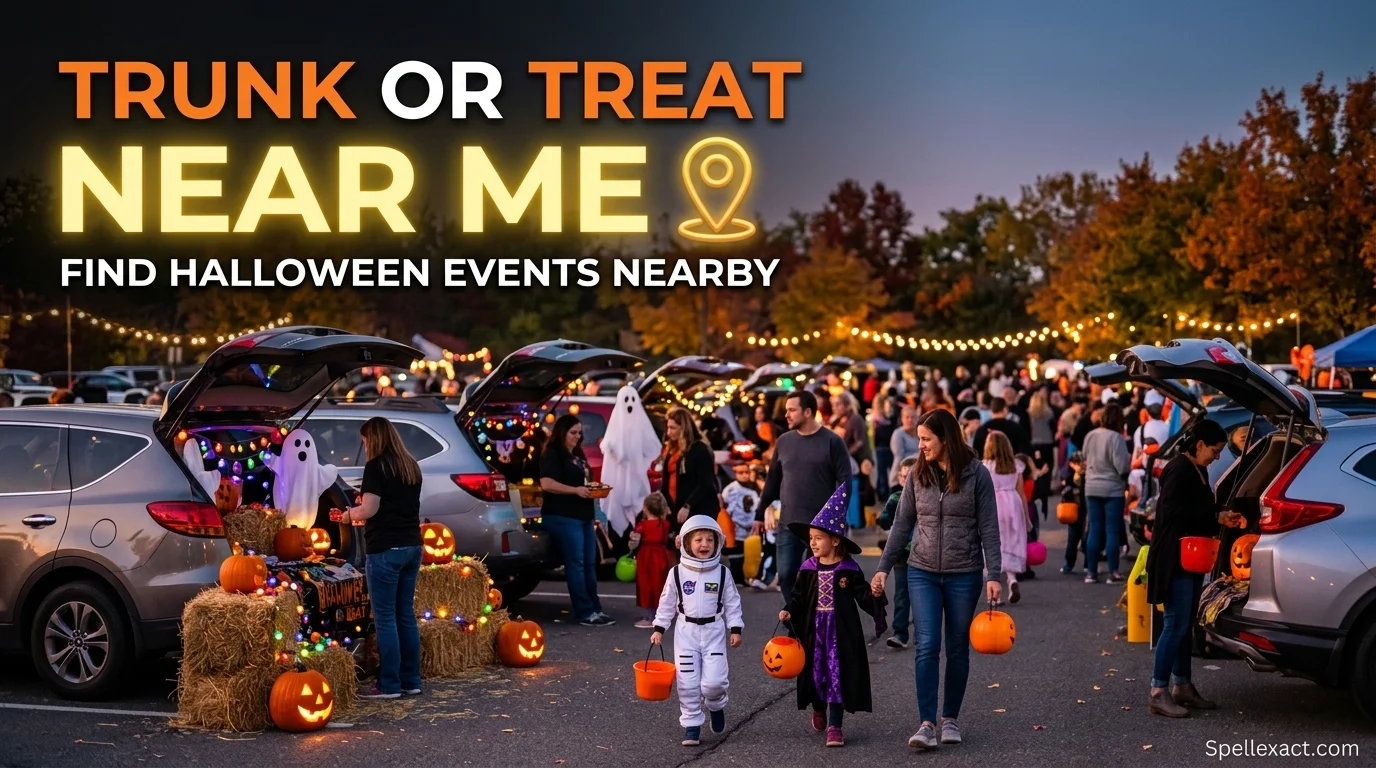
If you are searching for a trunk or treat near me, the fastest way to find one is to check local churches, schools, community centers, and town social media pages. Most events happen in the last two weeks of October, often on a weekend afternoon or early evening. They are usually free or low-cost, and families walk from car to car in a parking lot to collect candy.
A trunk or treat is a safe, simple version of trick-or-treating. Instead of knocking on doors, children visit decorated car trunks lined up in one place. This guide explains what the event is, how it differs from classic trick-or-treating, and how to find one in your area. It also covers the English words and phrases people use around it. It is written in plain English, so students, beginners, and busy parents can follow it easily.
Quick Answer
A trunk or treat is a Halloween event where people decorate the open trunks of their cars in a parking lot and hand out candy to children. To find one near you, search your city name with “trunk or treat,” and check church, school, library, and community center announcements.
Why Do People Confuse Trunk or Treat and Trick-or-Treat?
The two phrases sound almost the same. Only one word changes: “trunk” replaces “trick.” Both events happen at Halloween, both involve costumes, and both end with children holding bags of candy.
The confusion also comes from the way the name was created. “Trunk or treat” is a playful twist on “trick or treat.” It borrows the rhythm of the older phrase but changes the setting from front doors to car trunks.
What Is Trunk or Treat?
Trunk or treat is a community event, usually held in a parking lot. Adults park their cars in rows, open the trunks, and decorate them with themes such as pirates, haunted forests, or favorite cartoon characters. Children in costume walk from trunk to trunk and receive candy or small treats.
Key points about trunk or treat:
- It takes place in one location, not around a neighborhood.
- It is often organized by churches, schools, libraries, or local groups.
- It usually happens in daylight or early evening.
- Many events add extra activities, such as costume contests, games, and snacks.
What Is Trick-or-Treating?
Trick-or-treating is the traditional Halloween activity. Children in costume walk through a neighborhood, knock on doors, and say “trick or treat.” Neighbors give them candy. It usually takes place on October 31 after dark, though some towns choose different hours.
The word “trick” comes from a playful idea: if you do not give a treat, the children might play a trick. Today, almost nobody plays tricks. The phrase is simply part of the tradition.
Trunk or Treat vs. Trick-or-Treating: Comparison Table
| Feature | Trunk or Treat | Trick-or-Treating |
| Location | One parking lot or event site | Many homes in a neighborhood |
| Candy comes from | Decorated car trunks | Neighbors at their front doors |
| Usual time | Weekend afternoon or early evening | Evening of October 31 |
| Walking distance | Short and easy | Can be long |
| Safety | Easier to supervise, no street crossing | Requires watching traffic and dark streets |
| Cost | Often free or low-cost | Free, but you buy your own candy to give out |
| Best for | Young children, large families, rainy weather | Neighborhoods with many houses close together |
Whichever option you choose, a few simple habits keep Halloween safer, such as adding reflective tape to costumes and staying close to young children. The National Safety Council’s Halloween safety tips explain these habits in more detail.
How Do I Find a Trunk or Treat Near Me?
Try these steps in order:
- Search your city or town name plus “trunk or treat,” for example “trunk or treat in [your city].”
- Check the websites and social media pages of local churches, schools, and community centers.
- Look at your town or city event calendar.
- Ask at your local library, which often posts Halloween flyers.
- Search local parent groups online, where people share event times and locations.
- Look for flyers at grocery stores, coffee shops, and school bulletin boards.
Dates and times change every year, so confirm details with the organizer before you go. Check the start time, the age range, and whether you need to register.
When to Use Each
Choose trunk or treat when:
- Your child is very young and cannot walk far.
- Your neighborhood has few houses or no sidewalks.
- The weather is cold or rainy.
- You want a safer place with other families nearby.
- Your child has a food allergy and you want to talk to hosts directly.
Choose trick-or-treating when:
- You live in a neighborhood where many homes give out candy.
- Your children enjoy walking and knocking on doors.
- You want the traditional Halloween night experience.
Many families do both. They attend a trunk or treat on a weekend and go trick-or-treating on Halloween night.
Examples You Can Use
Here are 12 natural sentences using these words:
- “Is there a trunk or treat near me this Saturday?”
- “Our church is hosting a trunk or treat in the parking lot.”
- “We decorated our trunk like a pirate ship.”
- “The kids filled their bags at the trunk or treat in under an hour.”
- “My daughter wants to go trick-or-treating in our neighborhood this year.”
- “Do you prefer trunk or treat or classic trick-or-treating?”
- “The school trunk or treat starts at five o’clock.”
- “We handed out candy from the back of our car.”
- “Please bring a flashlight if the trunk or treat runs after dark.”
- “She wore a witch costume to the trunk or treat.”
- “The trunk or treat had a costume contest and a snack table.”
- “We went to a trunk or treat first, then trick-or-treated on Halloween night.”
Common Mistakes
- Writing “trunk or treat” with the wrong word. Some people write “truck or treat.” The correct word is “trunk,” the storage area of a car.
- Using it as a verb the wrong way. People say “we went trick-or-treating,” but for the car event, say “we went to a trunk or treat.” It is usually treated as a noun for an event.
- Missing hyphens. “Trick-or-treat” and “trick-or-treating” are normally hyphenated. “Trunk or treat” is often written without hyphens, though “trunk-or-treat” is also used.
- Assuming it happens on October 31. Many trunk or treat events are on other dates in October.
- Forgetting to check the details. Not every event welcomes all ages, and some require advance sign-up.
Memory Trick
Link each word to its place:
- Trunk means car. You walk to the car.
- Trick means door. You knock on the door.
If you see cars, it is a trunk or treat. If you see doorbells, it is trick-or-treating.
American vs. British English
Trunk or treat is mainly an American and Canadian event. In American English, the storage area at the back of a car is called the trunk. In British English, it is called the boot, so the name “trunk or treat” can sound unusual to British speakers.
Trick-or-treating is known in both countries, though Halloween traditions can be less widespread in some parts of the UK. Similar community events there may simply be called Halloween parties, Halloween fairs, or autumn fun days. If you are in a country where the term is unfamiliar, searching for “Halloween event for kids near me” may bring better results.
Similar Words and Phrases
- Fall festival: An autumn community event, often with games, food, and treats. It may or may not include Halloween themes.
- Harvest festival: A celebration of the fall season. Some churches and schools host this as an alternative to Halloween.
- Halloween party: A general event with costumes, snacks, and games.
- Costume parade: A group walk where children show off their costumes.
- Haunted house: A decorated place made to look spooky, usually for older children and adults.
- Pumpkin patch: A farm area where families pick pumpkins, often with autumn activities.
Final Verdict
Trunk or treat and trick-or-treating are not the same, but they share the same spirit. Trunk or treat is easier, safer, and more organized. Trick-or-treating is the classic neighborhood tradition. For young children, bad weather, or families who want convenience, a trunk or treat is often the better choice.
Frequently Asked Questions
What does trunk or treat mean?
It is a Halloween event where people decorate their car trunks and give candy to costumed children in a parking lot. It is a safer, more organized alternative to going door to door.
How do I find a trunk or treat near me?
Search your town name with “trunk or treat,” and check local churches, schools, libraries, and community pages. Event calendars and parent groups often list times and places.
Is trunk or treat free?
Many are free, especially at churches and schools. Some community or business events may ask for a small fee or a donation. Check with the organizer.
When is trunk or treat held?
Most take place in October, often on a weekend. Times vary by location, so check the event details before you go.
What should I bring to a trunk or treat?
Bring a candy bag or bucket, a costume, and comfortable shoes. A flashlight is useful if the event runs after dark. Bring a jacket if the weather is cool.
Is trunk or treat safe for young children?
It is generally easier to supervise because everyone is in one place and there are no streets to cross between houses. Parents should still stay close to their children.
Can I host my own trunk or treat?
Yes. Ask your church, school, or neighborhood group, and check whether the parking lot owner allows it. Plan decorations, enough candy, and safe parking and walking areas.
Is trunk or treat only for children?
It is mainly designed for children, but adults often join in by decorating cars, helping organize, and enjoying the costumes.
Remember This
- Trunk or treat happens at cars; trick-or-treating happens at doors.
- Search “trunk or treat” with your city name to find local events.
- Check dates, times, and age rules with the organizer.
- Trunk is American English for the back storage area of a car; British English says boot.
- Both traditions are about fun, costumes, and community.
Conclusion
Finding a trunk or treat near you is simple once you know where to look. Local churches, schools, libraries, and community groups are the best sources, and a quick online search with your town name often shows upcoming events. Plan ahead, confirm the details, and enjoy a fun and safe Halloween.
Understanding the difference between trunk or treat and trick-or-treating also helps you speak and write about Halloween with confidence. Remember the simple trick: trunk means car, and trick means door. With that in mind, you can choose the event that fits your family, your weather, and your schedule.

Liam Noah is a passionate language writer at SpellExact, specializing in spelling mistakes, grammar, word confusion, and American vs. British English. He creates clear, practical content that helps readers write and communicate with confidence.