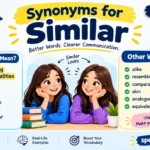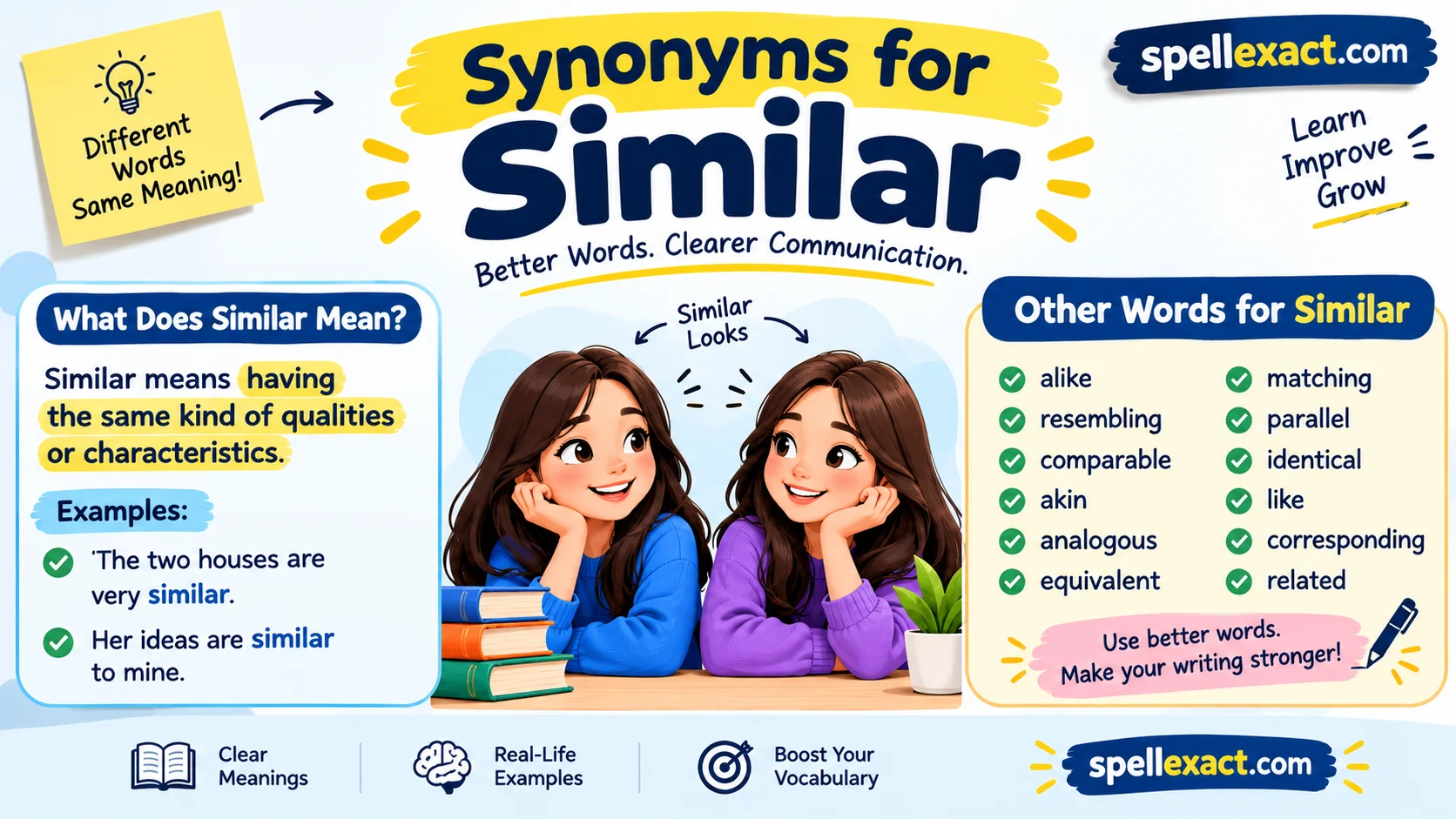
Finding the right synonym for similar helps you describe shared qualities, compare ideas, and make your writing clearer. The best alternatives include alike, comparable, resembling, related, equivalent, analogous, corresponding, and parallel.
Although these words have related meanings, they are not always interchangeable. For example, alike describes shared qualities, comparable means suitable for comparison, and equivalent suggests equal value or function. This guide explains 30 synonyms for similar, their simple meanings, example sentences, and the best situations for using each word.
Quick Answer: What Is a Synonym for Similar?
The most useful synonyms for similar are alike, comparable, resembling, related, equivalent, analogous, corresponding, parallel, matching, and nearly identical.
Choose your word according to the context:
- Alike: When two people or things share qualities.
- Comparable: When two things can be compared meaningfully.
- Resembling: When something looks or behaves like something else.
- Related: When ideas, subjects, or things have a connection.
- Equivalent: When two things have equal value, meaning, or function.
- Analogous: When two things have similar functions or relationships.
- Parallel: When events, processes, or developments follow similar patterns.
- Matching: When features or details correspond.
- Nearly identical: When two things are almost exactly the same.
Example: “The two products have similar features.”
Alternative: “The two products have comparable features.”
What Does Similar Mean?
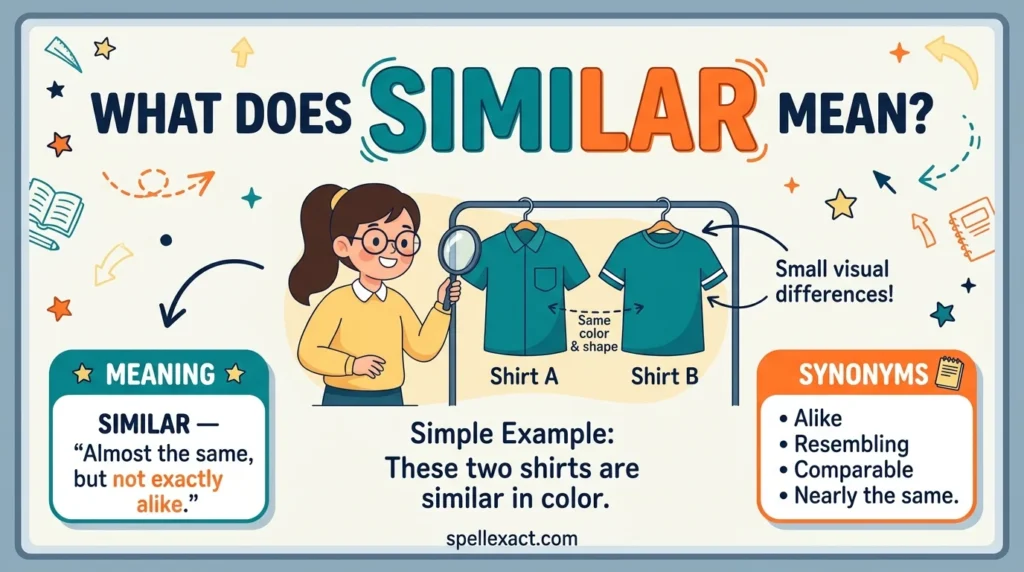
Similar is an adjective that describes two or more things that share certain qualities, characteristics, appearances, functions, or ideas. It means that things are alike in some ways, but they do not have to be exactly the same.
For example, two mobile phones may have similar designs but different cameras and prices. Likewise, two students may have similar interests while having different personalities and abilities.
The word similar is commonly used when discussing appearance, behavior, opinions, experiences, products, results, and relationships.
Examples of Similar in Sentences
- Appearance: The two houses have similar designs.
- Ideas: We have similar opinions about education.
- Behavior: The children displayed similar behavior.
- Results: Both experiments produced similar results.
- Products: These laptops offer similar features.
- Experiences: We had similar experiences during our first year at university.
Understanding the meaning of similar makes it easier to select an alternative that fits your intended meaning.
30 Synonyms for Similar With Meanings and Examples
The following list includes common alternatives, formal expressions, and specialized terms. Each entry explains the meaning, gives an example, and identifies the most suitable context.
1. Alike
Meaning: Having the same or nearly the same qualities, appearance, or characteristics.
Example: The two brothers look very much alike.
Best usage: Everyday conversations and descriptions of people, objects, and shared characteristics.
2. Comparable
Meaning: Similar enough to be compared fairly or meaningfully.
Example: Both restaurants offer comparable prices and service.
Best usage: Business writing, product reviews, academic comparisons, and performance evaluations.
3. Resembling
Meaning: Looking or behaving like someone or something else.
Example: The child drew a picture resembling her family home.
Best usage: Describing physical appearance, shapes, patterns, and behavior.
4. Related
Meaning: Connected through a subject, quality, origin, or relationship.
Example: Grammar and punctuation are related aspects of writing.
Best usage: Academic subjects, ideas, concepts, and connected topics.
5. Equivalent
Meaning: Equal in value, meaning, function, or effect in a particular context.
Example: The two measurements are equivalent when expressed in different units.
Best usage: Mathematics, education, measurements, qualifications, and technical comparisons.
6. Analogous
Meaning: Similar in function, structure, or relationship, even when the things themselves are different.
Example: The teacher used an analogous situation to explain the difficult concept.
Best usage: Academic writing, scientific explanations, and comparisons between systems or ideas.
7. Corresponding
Meaning: Matching or relating to another item in a specific way.
Example: Each application was matched with its corresponding document.
Best usage: Formal writing, data, records, paired items, and organized systems.
8. Parallel
Meaning: Similar in structure, development, direction, or progression.
Example: The two companies experienced parallel patterns of growth.
Best usage: Business, history, literature, research, and comparisons between events or processes.
9. Matching
Meaning: Having features, colors, details, or qualities that go together.
Example: The designer selected matching colors for both rooms.
Best usage: Clothing, design, patterns, records, and paired objects.
10. Identical
Meaning: Exactly the same in the relevant details, rather than merely similar.
Example: The factory produced two identical components.
Best usage: Exact comparisons involving appearance, design, structure, or specifications.
Note: Identical is a stronger term than similar because it suggests that there are no meaningful differences in the details being discussed.
11. Uniform
Meaning: Consistent or the same throughout a group, system, or process.
Example: The school introduced uniform rules for all students.
Best usage: Standards, procedures, measurements, appearances, and consistency.
12. Kindred
Meaning: Similar in nature, character, interests, or spirit.
Example: The writer found a kindred spirit in her fellow poet.
Best usage: Literature, personality descriptions, shared values, and personal connections.
13. Closely Related
Meaning: Strongly connected or similar in subject, nature, or characteristics.
Example: These two research questions are closely related.
Best usage: Academic writing, educational explanations, and discussions of connected concepts.
14. Nearly Identical
Meaning: Almost exactly the same, with only small differences.
Example: The two reports contain nearly identical descriptions.
Best usage: Detailed comparisons of documents, designs, products, and results.
15. Approximate
Meaning: Close to an exact amount, value, or measurement but not necessarily exact.
Example: The two estimates were approximate matches.
Best usage: Calculations, measurements, numerical comparisons, and estimates.
Note: Approximate is not a general replacement for similar. It is most suitable when the comparison involves closeness to a value or standard.
16. Compatible
Meaning: Able to work, exist, or function together without conflict.
Example: The new application is compatible with older devices.
Best usage: Technology, equipment, systems, relationships, and ideas that can work together.
17. Interchangeable
Meaning: Able to replace one another without a significant change in function or result.
Example: These two parts are interchangeable in this machine.
Best usage: Tools, machine parts, products, and expressions that can substitute for one another.
Note: Two things may be similar without being interchangeable.
18. Indistinguishable
Meaning: So similar that it is difficult or impossible to tell the difference.
Example: The copies were indistinguishable from the original at first glance.
Best usage: Appearance, sound, visual details, and close comparisons.
19. Homogeneous
Meaning: Made up of parts that are alike or consistent in important respects.
Example: The study examined a homogeneous group of samples.
Best usage: Science, statistics, chemistry, and technical descriptions.
20. Homologous
Meaning: Corresponding in structure or origin, especially in biology.
Example: Researchers compared homologous structures in different species.
Best usage: Biology, anatomy, genetics, and other specialized scientific fields.
21. Cognate
Meaning: Related by origin, particularly words that developed from the same linguistic source.
Example: The English word “mother” and the German word “Mutter” are cognates.
Best usage: Linguistics, language learning, etymology, and historical language studies.
22. Consonant
Meaning: In agreement or harmony with something else.
Example: Her decision was consonant with the organization’s principles.
Best usage: Formal writing about beliefs, policies, values, arguments, and actions.
23. Similar-Looking
Meaning: Having a similar appearance or visual style.
Example: The two buildings are similar-looking structures.
Best usage: Everyday descriptions of faces, buildings, objects, designs, and images.
24. Of the Same Kind
Meaning: Belonging to the same general type or category.
Example: The store sells several products of the same kind.
Best usage: Classification, descriptions, educational writing, and general comparisons.
25. Much the Same
Meaning: Almost alike in general character, meaning, or result.
Example: Both proposals are much the same in their main objectives.
Best usage: Everyday conversation, summaries, and informal comparisons.
26. Nearly the Same
Meaning: Very close in value, appearance, or characteristics, but not necessarily exactly equal.
Example: The two students received nearly the same scores.
Best usage: Numerical comparisons, everyday descriptions, and explanations for beginners.
27. Comparable in Nature
Meaning: Similar enough in essential characteristics to allow a meaningful comparison.
Example: The two studies examined comparable situations.
Best usage: Research, formal discussions, and comparisons involving conditions or characteristics.
28. Kindred in Spirit
Meaning: Sharing similar interests, values, attitudes, or feelings.
Example: The two artists were kindred in spirit despite their different backgrounds.
Best usage: Creative writing, personal relationships, literature, and shared beliefs.
29. Analogous in Function
Meaning: Performing a similar role or serving a similar purpose.
Example: The two systems are analogous in function, although their designs differ.
Best usage: Technical explanations, academic comparisons, and descriptions of systems.
30. Corresponding in Character
Meaning: Sharing features or qualities that match in a particular way.
Example: The two characters have corresponding qualities that shape their decisions.
Best usage: Literary analysis, formal comparisons, and descriptions of matching characteristics.
Comparison Table: Similar and Its Best Alternatives
Choosing the right word for similar depends on the relationship you want to describe.
| Word or phrase | Main meaning | Best context |
| Alike | Sharing qualities | Everyday English |
| Comparable | Suitable for comparison | Products and performance |
| Resembling | Looking or behaving like something | Appearance and behavior |
| Related | Connected in some way | Ideas and subjects |
| Equivalent | Equal in value or function | Formal and technical writing |
| Analogous | Similar in function or relationship | Academic explanations |
| Corresponding | Matching a particular item | Documents and data |
| Parallel | Similar in development or structure | Events and processes |
| Matching | Having features that go together | Colors and objects |
| Identical | Exactly the same in relevant details | Exact comparisons |
| Uniform | Consistent throughout | Rules and procedures |
| Compatible | Able to work together | Technology and systems |
| Interchangeable | Able to replace one another | Parts and products |
| Indistinguishable | Difficult to tell apart | Appearance and details |
| Kindred | Similar in nature or spirit | Literature and relationships |
| Homogeneous | Consistent in important characteristics | Scientific descriptions |
| Homologous | Corresponding in structure or origin | Biology |
| Cognate | Related by linguistic origin | Language studies |
| Nearly identical | Almost exactly the same | Detailed comparisons |
| Much the same | Nearly alike overall | Everyday English |
How to Choose the Right Synonym for Similar
The best synonym for similar is not always the most formal word. Choose an alternative that communicates your meaning accurately and sounds natural in the sentence.
Choose by Meaning
For appearance: Use alike, resembling, similar-looking, or indistinguishable.
Example: The two paintings look alike.
For ideas and subjects: Use related, closely related, or analogous.
Example: The two theories are closely related.
For value and performance: Use comparable or equivalent when appropriate.
Example: Both computers offer comparable performance.
For function: Use compatible, interchangeable, or analogous in function when the context supports that meaning.
Example: The new software is compatible with the existing system.
For exact resemblance: Use identical or nearly identical according to whether the things are exactly or almost the same.
Example: The two documents are nearly identical.
Choose by Tone
Casual English: Alike, matching, nearly the same, and much the same are simple and natural.
Professional English: Comparable, corresponding, compatible, and equivalent are useful for business communication and reports.
Academic English: Analogous, homogeneous, homologous, and cognate are appropriate in their specific technical contexts.
Creative writing: Resembling, kindred, and parallel can help describe characters, ideas, experiences, and patterns.
Choose by Writing Purpose
- For students: Prefer clear words such as alike, related, and comparable.
- For ESL learners: Start with similar, alike, and nearly the same before learning specialized alternatives.
- For business writers: Use comparable for evaluations and equivalent for equal value or function.
- For creative writers: Use resembling for appearance and parallel for comparable developments.
- For technical writers: Use compatible for systems that work together and interchangeable for things that can replace each other.
The key is to preserve the original meaning instead of replacing a word simply to avoid repetition.
Common Mistakes When Using Synonyms for Similar
1. Confusing Similar With Identical
Similar means sharing some qualities. Identical means exactly the same in the relevant details.
Incorrect: The two phones are identical because they have similar screens.
Better: The two phones have similar screens, but their other features differ.
2. Confusing Comparable With Equivalent
Comparable means suitable for comparison, while equivalent means equal in a particular respect.
Example: The two courses are comparable in difficulty, but their qualifications may not be equivalent.
3. Using Related When You Mean Alike
Things can be related without sharing many visible characteristics.
Example: Biology and chemistry are related subjects, but they study different aspects of the natural world.
4. Assuming Similar Things Are Interchangeable
Two products may look alike but have different functions or specifications.
Example: These chargers look similar, but they are not interchangeable because their connectors differ.
5. Using Technical Words in Everyday Sentences
Words such as homogeneous, homologous, and cognate have specific meanings. Using them incorrectly can make a sentence confusing.
Instead of saying, “The two everyday objects are homologous,” write, “The two objects are similar in appearance,” unless you are discussing a relevant technical relationship.
6. Writing “Alike Things” Instead of “Similar Things”
In standard English, similar normally comes before a noun, while alike usually appears after a linking verb.
Example Correct : The two designs are alike.
Correct: The two designs are similar.
Correct: These are similar designs.
Incorrect: These are alike designs.
Frequently Asked Questions
1. What is the best synonym for similar?
Alike is one of the most common synonyms for similar. Other useful alternatives include comparable, resembling, related, and analogous. The best choice depends on the sentence.
2. What is a formal word for similar?
Comparable, analogous, corresponding, and equivalent can work in formal writing. However, each expresses a different relationship, so select the word that accurately matches your meaning.
3. What is another word for similar but not the same?
Use alike, comparable, resembling, or nearly identical. These expressions communicate shared qualities without necessarily suggesting complete equality.
4. What is the difference between similar and alike?
Both words describe shared qualities. However, similar can come before a noun or after a linking verb, while alike generally appears after a linking verb.
Examples:
- The two houses are similar.
- The two houses are alike.
- The houses have similar designs.
5. Is comparable a synonym for similar?
Yes. Comparable is useful when two things share enough characteristics to be compared meaningfully.
Example: The two phones offer comparable battery life.
It does not necessarily mean that they are identical or equal in every feature.
6. What is the opposite of similar?
Common antonyms for similar include different, dissimilar, unlike, distinct, and contrasting.
Example: The two proposals have different objectives.
7. Can similar describe people?
Yes. Similar can describe people’s interests, personalities, experiences, opinions, habits, or goals.
Example: My classmates and I have similar interests in literature.
8. How can I avoid repeating the word similar?
Choose a more precise alternative when appropriate. Use alike for shared qualities, comparable for meaningful comparisons, related for connections, and resembling for appearance.
For example, instead of writing, “The two products are similar and have similar features,” you could write, “The two products are alike and share several features.”
Conclusion
The best synonym for similar depends on the qualities, characteristics, or relationships you want to describe. Alike is useful in everyday English, comparable works well for evaluations, related describes connections, resembling emphasizes appearance, and equivalent expresses equality in value or function.
Learning these synonyms for similar helps students, ESL learners, writers, and content creators express ideas more precisely. Remember that similar does not always mean identical, comparable does not always mean equivalent, and related does not always mean alike. By choosing the word that best fits your context, you can make your writing more natural, accurate, and engaging.

Andrew Anthony is a language enthusiast and content writer specializing in spelling mistakes, grammar, and English usage. He creates clear, practical, and well-researched guides that help readers improve their writing skills with confidence.