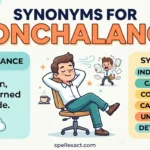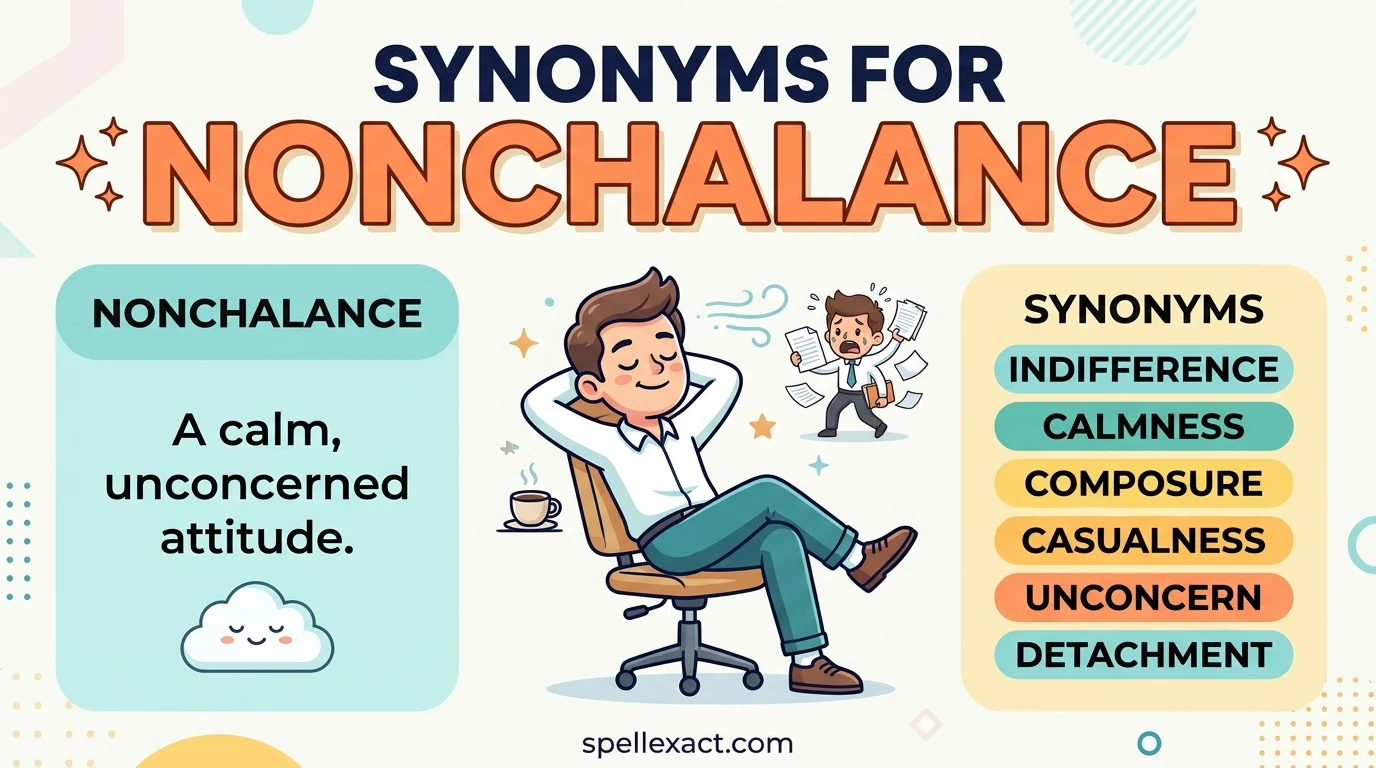
Synonyms for nonchalance include indifference, disregard, casualness, insouciance, unconcern, apathy, and detachment. These words describe different forms of appearing relaxed, showing little interest, or acting as though something is not important.
Other alternatives, such as composure, equanimity, and poise, emphasize staying calm under pressure. The best synonym depends on whether you mean a carefree attitude, a lack of concern, emotional control, or a lack of interest.
Quick Answer: What Are the Best Synonyms for Nonchalance?
The closest synonyms for nonchalance are indifference, casualness, insouciance, unconcern, and disregard when the meaning involves appearing unconcerned or showing little interest. For a more positive meaning, use composure, calmness, or poise. For a negative meaning, consider apathy, carelessness, heedlessness, or callousness, depending on the context.
What Does Nonchalance Mean?
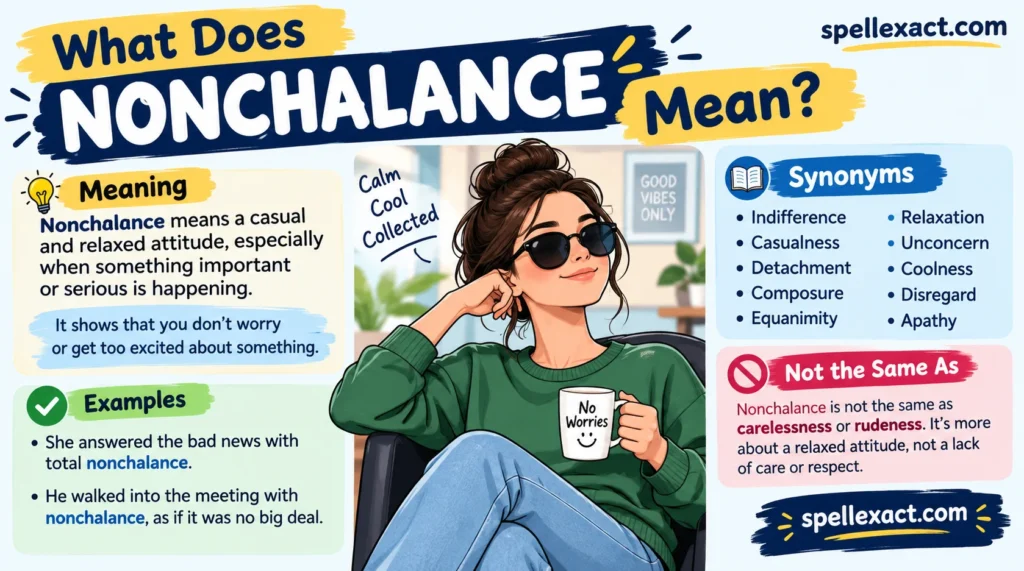
Nonchalance is a noun that describes a relaxed, casual, or unconcerned manner. Someone who displays nonchalance may appear calm even when a situation would normally cause worry, excitement, or surprise.
For example: “She accepted the unexpected news with nonchalance.”
This means that she appeared relaxed and did not show a strong emotional reaction.
Nonchalance can have a positive, neutral, or negative meaning. It may suggest confidence and emotional control, but it can also make someone seem uninterested, careless, or insensitive.
Nonchalance Meaning in Simple English
In simple English, nonchalance means acting as if something does not worry you or matter very much.
For example:
- Positive: He answered the difficult question with nonchalance, showing that he felt confident.
- Neutral: She mentioned the change with nonchalance, without showing much emotion.
- Negative: His nonchalance about the safety rules made his coworkers uncomfortable.
The context determines whether nonchalance suggests confidence, relaxation, or a lack of concern.
What Is the Difference Between Nonchalance and Nonchalant?
Nonchalance is a noun, while nonchalant is an adjective.
- Nonchalance: She handled the criticism with nonchalance.
- Nonchalant: She gave a nonchalant response to the criticism.
Both words describe an apparently relaxed or unconcerned attitude, but they have different grammatical uses.
40 Synonyms for Nonchalance With Meanings and Examples
The following words include close synonyms, related expressions, and alternatives that convey specific aspects of nonchalance. Some describe a relaxed manner, while others suggest indifference, carelessness, emotional distance, or calmness under pressure. They are related, but they are not interchangeable in every sentence.
1. Indifference
Meaning: A lack of interest, concern, or emotional involvement.
Example: His indifference toward the criticism surprised his colleagues.
Best use: Choose indifference when someone seems not to care about something that matters to other people. It often carries a negative tone.
2. Disregard
Meaning: A failure to pay attention to, respect, or consider something.
Example: Her disregard for the safety instructions worried the supervisor.
Best use: Use disregard when nonchalance involves ignoring rules, advice, responsibilities, or possible consequences. Unlike nonchalance, it often suggests an action rather than merely an attitude.
3. Casualness
Meaning: A relaxed, informal, or unconcerned manner.
Example: He discussed the unexpected announcement with surprising casualness.
Best use: Choose casualness when someone behaves informally or without making a situation seem overly important.
4. Insouciance
Meaning: A carefree attitude that shows little worry about problems or responsibilities.
Example: Her youthful insouciance made even difficult situations seem manageable.
Best use: Use insouciance in descriptive or literary writing when you want to emphasize carefree behavior. It can suggest charm or irresponsibility.
5. Unconcern
Meaning: A lack of worry or apparent concern about something.
Example: His unconcern about the approaching deadline frustrated his manager.
Best use: Choose unconcern when the main idea is that someone does not appear worried about a situation.
6. Apathy
Meaning: A lack of interest, enthusiasm, or motivation.
Example: Public apathy made it difficult to encourage people to participate.
Best use: Use apathy when someone shows little interest in an activity, issue, or responsibility. It suggests more than simply staying calm.
7. Complacency
Meaning: A feeling of satisfaction that prevents someone from recognizing risks or the need for improvement.
Example: The team’s complacency after an early victory led to mistakes.
Best use: Choose complacency when someone becomes too comfortable or confident and stops taking necessary precautions. It is more specific than nonchalance.
8. Disinterestedness
Meaning: A lack of personal interest or involvement; in some contexts, impartiality.
Example: The judge’s disinterestedness helped ensure a fair decision.
Best use: Use this word carefully. It can describe impartiality, but it can also refer to a lack of interest. If you simply mean that someone does not care, indifference is usually clearer.
9. Incuriosity
Meaning: A lack of curiosity or desire to learn.
Example: His incuriosity about other cultures limited his understanding of the world.
Best use: Choose incuriosity when the person shows little desire to ask questions, explore ideas, or discover new information.
10. Torpor
Meaning: A state of sluggishness, inactivity, or reduced energy.
Example: The long afternoon meeting was marked by a sense of torpor.
Best use: Use torpor when nonchalance seems connected to sluggishness or inactivity. It does not simply mean calmness or indifference.
11. Carelessness
Meaning: A failure to give enough attention or take enough care.
Example: His carelessness with important documents caused unnecessary delays.
Best use: Choose carelessness when someone neglects details or fails to act carefully. It is appropriate when apparent unconcern leads to mistakes.
12. Recklessness
Meaning: Behavior that ignores danger or the possibility of harmful consequences.
Example: Her recklessness behind the wheel put other drivers at risk.
Best use: Use recklessness when a person takes unnecessary risks. It is stronger than nonchalance and implies dangerous behavior.
13. Unawareness
Meaning: A lack of knowledge or understanding about something.
Example: His unawareness of the new rules caused confusion.
Best use: Choose unawareness when someone does not know about a situation. Do not use it as a direct replacement for nonchalance when the person knows about the situation but simply does not seem concerned.
14. Lethargy
Meaning: A lack of energy, alertness, or enthusiasm.
Example: The team’s lethargy during training affected its performance.
Best use: Use lethargy when the focus is on low energy or sluggish behavior rather than a relaxed attitude.
15. Lukewarmness
Meaning: A lack of enthusiasm, strong interest, or wholehearted support.
Example: The proposal received a lukewarm response from the audience.
Best use: Choose lukewarmness when a person responds with limited enthusiasm. The adjective lukewarm is more natural in many everyday sentences.
16. Coldness
Meaning: A lack of warmth, friendliness, or emotional expression.
Example: His coldness during the conversation made her feel unwelcome.
Best use: Use coldness when someone’s apparent unconcern feels unfriendly or emotionally distant.
17. Heedlessness
Meaning: A failure to pay attention to warnings, advice, or consequences.
Example: Her heedlessness of the warning signs created serious problems.
Best use: Choose heedlessness when someone ignores information that should guide their behavior. It often suggests carelessness.
18. Aloofness
Meaning: A quality of appearing distant, unfriendly, or emotionally unavailable.
Example: His aloofness made it difficult for new colleagues to approach him.
Best use: Use aloofness when a person seems socially or emotionally distant from others.
19. Callousness
Meaning: A lack of sympathy or concern for other people’s feelings.
Example: His callousness toward the family’s suffering upset everyone.
Best use: Choose callousness when the lack of concern appears insensitive or unkind. It is much stronger and more negative than nonchalance.
20. Detachment
Meaning: Emotional distance or a lack of personal involvement.
Example: The journalist described the incident with professional detachment.
Best use: Use detachment when someone keeps an emotional distance from a person or situation. It can suggest useful objectivity or unwanted distance.
21. Tepidity
Meaning: A lack of warmth, energy, or enthusiasm.
Example: The announcement was met with tepidity rather than excitement.
Best use: Choose tepidity in formal or literary contexts when describing a weak or unenthusiastic response. It is less common than lack of enthusiasm.
22. Stoicism
Meaning: The ability or tendency to endure difficulty without showing much emotion.
Example: She faced the disappointing result with stoicism.
Best use: Use stoicism when someone accepts hardship without openly expressing distress. It emphasizes endurance rather than a casual attitude.
23. Impassivity
Meaning: The quality of showing little or no emotion.
Example: The detective listened with impassivity as the witness explained what happened.
Best use: Choose impassivity when describing a facial expression or reaction that reveals very little emotion.
24. Dispassion
Meaning: A lack of strong emotion, especially when considering or judging something.
Example: The researcher examined the evidence with dispassion.
Best use: Use dispassion when someone approaches a subject calmly and without strong emotional involvement. It often suits analytical or formal writing.
25. Halfheartedness
Meaning: A lack of full interest, effort, or commitment.
Example: His halfheartedness during the project disappointed the team.
Best use: Choose halfheartedness when a person participates without much enthusiasm or effort.
26. Stolidity
Meaning: A tendency to show little emotion or reaction.
Example: His stolidity made it difficult to tell whether he was pleased with the news.
Best use: Use stolidity when someone appears emotionally unresponsive or unusually expressionless. It is a formal, less common word.
27. Insensitivity
Meaning: A lack of awareness or concern for other people’s feelings.
Example: Her insensitivity toward his disappointment damaged their friendship.
Best use: Choose insensitivity when a person’s unconcern affects others emotionally. It implies a failure to recognize or respect their feelings.
28. Listlessness
Meaning: A lack of energy, enthusiasm, or interest.
Example: The students’ listlessness suggested that they needed a more engaging activity.
Best use: Use listlessness when someone appears inactive, tired, or unenthusiastic rather than calmly confident.
29. Phlegm
Meaning: Calmness and self-control, especially during a difficult or stressful situation.
Example: The experienced pilot handled the unexpected delay with phlegm.
Best use: In this sense, phlegm is a formal, somewhat old-fashioned word for calmness and composure. It also has a common medical meaning, so the context matters.
30. Coolness
Meaning: Calmness and control, especially in a tense situation.
Example: She responded to the challenging question with impressive coolness.
Best use: Choose coolness when someone remains collected under pressure. In other contexts, the word can also describe emotional distance or a fashionable attitude.
31. Hard-heartedness
Meaning: A lack of sympathy, kindness, or compassion.
Example: His hard-heartedness was clear when he refused to help someone in need.
Best use: Use hard-heartedness when a person’s lack of concern appears deliberately unkind or uncompassionate.
32. Composure
Meaning: The ability to remain calm and control your emotions.
Example: She maintained her composure throughout the difficult interview.
Best use: Choose composure when you want to emphasize emotional control and confidence, rather than a lack of interest.
33. Calmness
Meaning: A peaceful state without agitation, anger, or anxiety.
Example: His calmness helped the team deal with the unexpected problem.
Best use: Use calmness as a simple, familiar alternative when the focus is on remaining peaceful.
34. Equanimity
Meaning: Mental balance and emotional steadiness, especially during difficulties.
Example: The manager responded to the complaint with equanimity.
Best use: Choose equanimity for formal writing when someone maintains a balanced attitude through pressure or disappointment.
35. Poise
Meaning: Calm confidence and controlled behavior.
Example: The speaker answered difficult questions with poise.
Best use: Use poise when someone appears confident and composed in public, professional, or challenging situations.
36. Serenity
Meaning: A peaceful state of mind.
Example: She listened to the disagreement with serenity.
Best use: Choose serenity when emphasizing inner peace rather than a lack of concern.
37. Self-possession
Meaning: The ability to remain confident and in control of yourself.
Example: He answered the unexpected question with remarkable self-possession.
Best use: Use self-possession when someone handles pressure with confidence and emotional control.
38. Unflappability
Meaning: The ability to remain calm when unexpected difficulties occur.
Example: Her unflappability helped the team manage the emergency.
Best use: Choose unflappability when someone remains steady despite confusion, surprises, or stressful circumstances.
39. Carefreeness
Meaning: The quality of being relaxed and free from worry.
Example: Her carefreeness made the holiday feel especially enjoyable.
Best use: Use carefreeness when describing a relaxed, happy attitude. It usually sounds warmer and more positive than indifference.
40. Cool-headedness
Meaning: The ability to think clearly and make sensible decisions under pressure.
Example: His cool-headedness prevented the disagreement from escalating.
Best use: Choose cool-headedness when someone stays calm and thinks rationally instead of reacting emotionally.
Comparison Table: Nonchalance and Its Closest Synonyms
| Synonym | Main meaning | Typical tone | Best context |
| Indifference | Lack of interest or concern | Often negative | Attitudes and reactions |
| Disregard | Failure to consider or respect something | Negative | Rules and warnings |
| Casualness | Relaxed or informal manner | Neutral | Everyday behavior |
| Insouciance | Carefree unconcern | Neutral or negative | Literary descriptions |
| Unconcern | Lack of worry | Neutral | Problems and risks |
| Apathy | Lack of interest or motivation | Negative | Engagement and participation |
| Complacency | Excessive satisfaction that prevents action | Negative | Risks and performance |
| Carelessness | Insufficient attention or care | Negative | Mistakes and responsibilities |
| Recklessness | Ignoring danger or consequences | Strongly negative | Risky behavior |
| Aloofness | Emotional or social distance | Often negative | Relationships |
| Callousness | Lack of sympathy | Strongly negative | Other people’s suffering |
| Detachment | Emotional distance or noninvolvement | Neutral | Analysis and relationships |
| Composure | Emotional control | Positive | Stressful situations |
| Equanimity | Balanced emotions | Positive | Difficult circumstances |
| Poise | Calm confidence | Positive | Public speaking and interviews |
| Stoicism | Enduring hardship without outward emotion | Neutral or positive | Pain and disappointment |
| Cool-headedness | Clear thinking under pressure | Positive | Decisions and conflict |
| Unflappability | Remaining calm during surprises | Positive | Emergencies and challenges |
Which Synonym Is Closest to Nonchalance?
The closest synonym depends on the intended meaning.
- For a general lack of concern, use unconcern.
- For a lack of interest, use indifference.
- For a relaxed manner, use casualness.
- For a carefree attitude, use insouciance.
- For ignoring rules or warnings, use disregard.
- For calmness under pressure, use composure or equanimity.
- For a lack of sympathy, use callousness.
How to Choose the Right Synonym for Nonchalance
The most suitable word depends on the meaning, tone, and purpose of your sentence.
1. Choose by Tone
Positive alternatives: composure, poise, equanimity, self-possession, and unflappability describe calmness and emotional control.
Example: “She handled the difficult conversation with composure.”
Neutral alternatives: casualness, calmness, coolness, and unconcern can describe a relaxed manner without necessarily judging it.
Example: “He mentioned the change with casualness.”
Negative alternatives: indifference, apathy, carelessness, heedlessness, and callousness may suggest a lack of interest, responsibility, or sympathy.
Example: “His indifference toward the team’s concerns caused frustration.”
2. Choose by Meaning
If you mean someone does not seem worried, use unconcern or carefreeness.
If you mean someone does not seem interested, use indifference, apathy, or incuriosity.
Weather you mean someone ignores instructions or risks, use disregard, heedlessness, or recklessness.
If you mean someone stays calm under pressure, use composure, equanimity, poise, or cool-headedness.
If you mean someone shows little emotion, use impassivity, stolidity, or stoicism.
Weather you mean someone lacks sympathy, use callousness, insensitivity, or hard-heartedness.
3. Choose by Writing Context
For everyday English: Use calmness, casualness, indifference, or lack of concern. These expressions are easy to understand.
For academic or professional writing: Consider composure, equanimity, detachment, or dispassion, depending on the intended meaning.
Creative writing: Use insouciance, aloofness, stolidity, or coolness to create a more specific impression of a character.
For workplace situations: Use composure or cool-headedness to praise calm behavior. Use complacency or disregard when someone neglects important responsibilities.
Common Mistakes When Using Synonyms for Nonchalance
1. Confusing Nonchalance With Indifference
Nonchalance describes an apparently relaxed or unconcerned manner. Indifference more directly describes a lack of interest or concern.
For example, a person can accept an award with nonchalance while still appreciating it. A person who shows indifference toward the award may not care about receiving it.
2. Using Apathy When You Mean Calmness
Apathy means a lack of interest, enthusiasm, or motivation. It does not simply mean staying calm.
Instead of “She showed apathy during the emergency,” when you mean she stayed calm, write, “She maintained her composure during the emergency.”
3. Confusing Disregard With Unconcern
Disregard often means failing to consider or respect something. Unconcern means a lack of worry.
For example, someone may feel unconcerned about a minor delay without disregarding any instructions. Someone who ignores a safety warning demonstrates disregard for that warning.
4. Treating Carelessness and Recklessness as Exact Synonyms
Carelessness means not paying enough attention. Recklessness involves ignoring danger or possible consequences.
Neither word simply means appearing relaxed. Use them when the sentence involves negligence or risk.
5. Confusing Disinterestedness With Disinterest
Disinterestedness can refer to impartiality or a lack of personal involvement. Disinterest generally means a lack of interest.
For clarity, use impartiality when you mean fairness and lack of interest when you mean that someone does not care about a subject.
6. Assuming Nonchalance Is Always Positive
Nonchalance can suggest confidence, but it can also imply that someone is not taking a situation seriously.
For example, “His nonchalance about the safety warning angered his coworkers” presents his behavior negatively.
Frequently Asked Questions
1. What is the closest synonym for nonchalance?
Indifference, unconcern, casualness, and insouciance are close alternatives, depending on context. Indifference emphasizes a lack of interest, unconcern emphasizes a lack of worry, and casualness emphasizes a relaxed manner.
2. What are the best synonyms for nonchalance in a positive sense?
Composure, poise, equanimity, self-possession, and cool-headedness are useful when nonchalance means staying calm and confident under pressure.
3. What are the negative synonyms for nonchalance?
Indifference, apathy, disregard, carelessness, heedlessness, callousness, and recklessness can express negative meanings. The right word depends on whether the problem is a lack of interest, attention, sympathy, or concern for consequences.
4. Is nonchalance the same as indifference?
No. Nonchalance describes a relaxed or unconcerned appearance, while indifference indicates a lack of interest or care. A person can act nonchalant without being indifferent.
5. What is the difference between nonchalance and composure?
Composure emphasizes emotional control, especially under pressure. Nonchalance emphasizes a casual or unconcerned manner. Composure is generally positive, whereas nonchalance can be positive, neutral, or negative.
6. What is the adjective form of nonchalance?
The adjective form is nonchalant.
Example: “He gave a nonchalant answer to the difficult question.”
The noun describes the attitude; the adjective describes the person, response, or behavior.
7. What does nonchalance mean in a sentence?
In “She accepted the unexpected result with nonchalance,” the word means she appeared relaxed and did not show a strong emotional reaction.
8. What is a formal synonym for nonchalance?
Equanimity, composure, and dispassion may work in formal writing. Equanimity means emotional balance, composure means self-control, and dispassion means an absence of strong emotion when considering something.
Conclusion
The best synonyms for nonchalance express different shades of calmness, unconcern, indifference, and emotional distance. Casualness, insouciance, and unconcern are useful when describing a relaxed or carefree attitude. Indifference, apathy, and disregard emphasize different forms of limited interest or concern, while carelessness, heedlessness, and recklessness suggest problems with attention or responsibility.
For a positive description of someone who remains calm under pressure, choose composure, poise, equanimity, or cool-headedness. For a negative description, choose a word that identifies the actual problem, such as callousness for a lack of sympathy or complacency for excessive satisfaction that leads to inaction.
Understanding these distinctions helps you choose accurate words, write clearer sentences, and express the intended meaning naturally.

Aaron Adam is the Administrator of SpellExact, dedicated to helping readers improve their spelling and writing accuracy. He oversees content quality, ensures reliable language resources, and works to make spelling guidance simple, practical, and accessible for everyone.