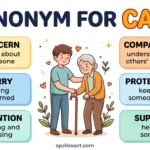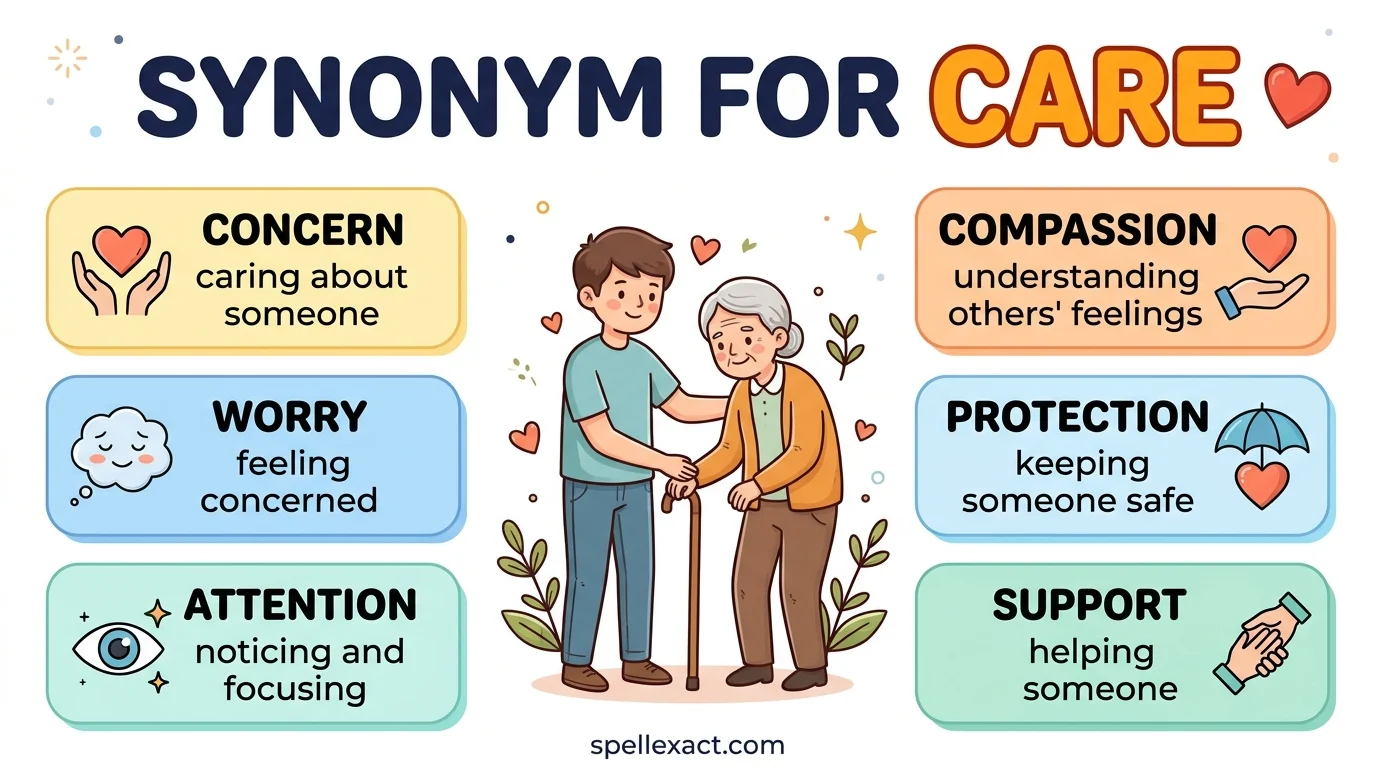
A synonym for care can be concern, attention, compassion, kindness, responsibility, or support, depending on the meaning of the sentence. If you mean looking after someone, “support” or “nurturing” may fit.
If you mean feeling worried about someone, “concern” or “worry” may be more accurate. For careful work, words such as “attention,” “caution,” and “diligence” are useful. Understanding these differences helps you choose the right word for essays, conversations, professional writing, and everyday English.
Quick Answer: What Is a Synonym for Care?
The most useful synonyms for care include:
- Concern — interest in someone’s well-being.
- Attention — focus on a person, task, or detail.
- Compassion — sympathy for someone who is suffering.
- Kindness — friendly and helpful behavior.
- Responsibility — a duty to look after someone or something.
- Worry — concern about a possible problem.
- Solicitude — deep concern for someone’s comfort or well-being.
- Support — help or encouragement.
- Caution — care taken to avoid danger or mistakes.
- Consideration — thoughtfulness toward other people’s feelings.
The best word for care depends on your intended meaning. Use concern for someone’s well-being, compassion for suffering, attention for focus, responsibility for duties, and worry for anxiety about a possible problem.
What Does Care Mean?
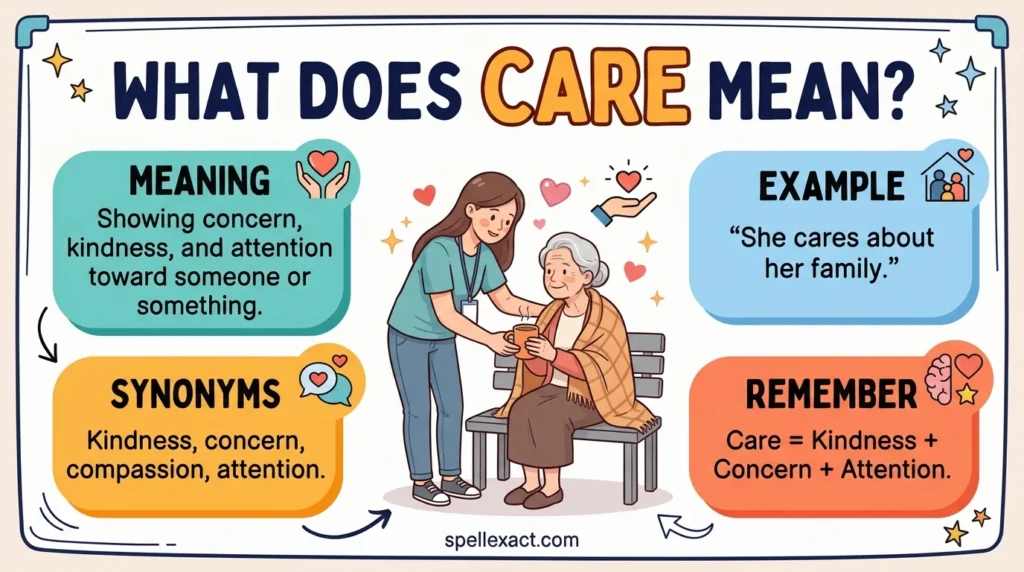
Care means feeling concern for someone or something, paying attention to a task, or looking after a person, animal, or object. It can describe an emotion, an action, or a responsibility.
Care as a Noun
As a noun, care refers to concern, attention, caution, or the act of looking after someone or something.
Examples:
- Her parents showed great care for her.
- This delicate glass needs special care.
- He completed the project with care.
- The child needs medical care.
Care as a Verb
As a verb, care can mean feeling concern, considering something important, or looking after someone.
Examples:
- I care about my family.
- She cares for her older grandmother.
- He cares about the quality of his work.
The expressions “care about” and “care for” have different uses. Care about usually means that someone or something matters to you. Care for can mean looking after someone, and it can also mean liking or having a preference for something.
30 Synonyms for Care With Meanings and Examples
Not every word related to care can replace it in every sentence. The following 30 synonyms for care cover emotional concern, kindness, careful attention, responsibility, worry, and practical assistance.
1. Concern
Meaning: Interest in someone’s well-being or worry about a situation.
Example: She expressed genuine concern for her sick friend.
Best usage: Use concern when talking about someone’s needs, health, safety, or problems.
2. Attention
Meaning: The act of focusing on someone or something.
Example: The teacher gave every student individual attention.
Best usage: Use attention when care involves listening, observing, or focusing on details.
3. Compassion
Meaning: Sympathy for someone who is suffering, often accompanied by a desire to help.
Example: The nurse treated every patient with compassion.
Best usage: Use compassion when describing kindness toward people experiencing pain, hardship, or difficulties.
4. Kindness
Meaning: The quality of being friendly, generous, and helpful.
Example: Her kindness made the new student feel welcome.
Best usage: Use kindness when care is expressed through helpful actions or a friendly attitude.
5. Responsibility
Meaning: A duty to look after someone or something or to complete a task properly.
Example: Taking care of a pet is a serious responsibility.
Best usage: Use responsibility when discussing duties, obligations, or dependable behavior.
6. Worry
Meaning: Uneasiness or anxiety about a possible problem.
Example: His worry about the exam kept him awake.
Best usage: Use worry when care involves anxiety about an uncertain outcome. Unlike kindness or compassion, worry often has a negative emotional meaning.
7. Solicitude
Meaning: Deep and attentive concern for someone’s comfort or well-being.
Example: She cared for her father with great solicitude.
Best usage: Use solicitude in formal or literary writing when emphasizing thoughtful concern. It is less common in everyday conversation.
8. Support
Meaning: Help, encouragement, or assistance given to someone.
Example: Her friends offered emotional support during a difficult time.
Best usage: Use support when care involves helping someone overcome a challenge or meet a need.
9. Caution
Meaning: Care taken to avoid danger, mistakes, or unwanted results.
Example: Drivers should exercise caution during heavy rain.
Best usage: Use caution when talking about safety, risk prevention, and careful decisions.
10. Consideration
Meaning: Thoughtful attention to other people’s feelings, needs, or circumstances.
Example: He showed consideration by keeping the office quiet.
Best usage: Use consideration when care involves respect, politeness, and thinking about others.
11. Affection
Meaning: A feeling of love, warmth, or fondness for someone.
Example: The grandmother showed affection by hugging her grandchildren.
Best usage: Use affection when describing emotional closeness between family members, friends, or partners.
12. Sympathy
Meaning: A feeling of sadness or understanding for another person’s difficulties.
Example: We expressed our sympathy to the family after their loss.
Best usage: Use sympathy when acknowledging someone’s pain, grief, or hardship.
13. Protection
Meaning: The act of keeping someone or something safe from harm.
Example: A helmet provides protection while riding a bicycle.
Best usage: Use protection when care focuses on safety and preventing harm.
14. Diligence
Meaning: Careful and persistent effort when doing something.
Example: She completed the assignment with diligence.
Best usage: Use diligence in education, professional work, and tasks requiring steady attention.
15. Precision
Meaning: The quality of being exact and accurate.
Example: The technician adjusted the machine with precision.
Best usage: Use precision when care involves exact measurements, accuracy, or detailed work.
16. Vigilance
Meaning: The state of watching carefully for possible danger or problems.
Example: Constant vigilance helped the guards protect the building.
Best usage: Use vigilance in safety, security, healthcare, and situations that require continuous monitoring.
17. Nurturing
Meaning: Giving someone or something the attention and support needed to grow.
Example: The teacher created a nurturing environment for her students.
Best usage: Use nurturing when discussing children, relationships, education, and personal development.
18. Tenderness
Meaning: Gentle affection, kindness, or sensitivity toward someone.
Example: He spoke to the frightened child with tenderness.
Best usage: Use tenderness when care is gentle, loving, and emotionally sensitive.
19. Empathy
Meaning: The ability to understand or share another person’s feelings.
Example: Good counselors listen to their clients with empathy.
Best usage: Use empathy when someone understands another person’s perspective or emotional experience.
20. Attentiveness
Meaning: The quality of paying close attention to someone’s needs or important details.
Example: The nurse’s attentiveness helped the patient feel comfortable.
Best usage: Use attentiveness when care involves noticing needs and responding appropriately.
21. Thoughtfulness
Meaning: The habit of considering other people’s needs and feelings before acting.
Example: Her thoughtfulness was evident when she prepared a meal for her sick neighbor.
Best usage: Use thoughtfulness when care is shown through considerate actions or meaningful gestures.
22. Regard
Meaning: Respect, esteem, or consideration for someone or something.
Example: The manager showed regard for every employee’s opinion.
Best usage: Use regard in formal writing about respect and consideration. It is not a direct substitute for care in every sentence.
23. Devotion
Meaning: Strong love, loyalty, or commitment to someone or something.
Example: His devotion to his family was clear in everything he did.
Best usage: Use devotion when care involves lasting commitment to family, relationships, or a meaningful cause.
24. Burden
Meaning: A responsibility or problem that is difficult to manage.
Example: Looking after the property became a heavy burden.
Best usage: Use burden when emphasizing the difficulty or weight of a responsibility. It is related to the responsibilities associated with care, but it is not a positive synonym for caring.
25. Charge
Meaning: Responsibility or control over someone or something.
Example: The children were placed in the teacher’s charge.
Best usage: Use charge in expressions such as “in someone’s charge” or “take charge of” when referring to responsibility or supervision.
26. Anxiety
Meaning: A feeling of nervousness, fear, or uneasiness about something.
Example: Her anxiety about her son’s health made it difficult to sleep.
Best usage: Use anxiety when concern becomes nervousness or fear. It usually describes an uncomfortable feeling rather than the act of caring.
27. Uneasiness
Meaning: A feeling that something may be wrong or may not turn out well.
Example: He felt uneasiness about the sudden change in plans.
Best usage: Use uneasiness when describing mild worry, discomfort, or uncertainty.
28. Stress
Meaning: Mental or emotional pressure caused by difficult circumstances.
Example: The additional caregiving duties caused considerable stress.
Best usage: Use stress when describing the pressure that responsibilities or worries can create. It is a related concept, not a direct synonym for care.
29. Assistance
Meaning: Help provided to someone who needs it.
Example: The older man received assistance with his shopping.
Best usage: Use assistance when care involves practical help with daily activities or difficult tasks.
30. Maintenance
Meaning: The work of keeping something in good condition.
Example: Regular maintenance keeps the machine working properly.
Best usage: Use maintenance when care refers to buildings, vehicles, equipment, or other physical objects.
Comparison Table: Which Synonym for Care Is Best?
| Synonym | Main meaning | Best context |
| Concern | Interest in someone’s well-being | Personal needs and problems |
| Attention | Focus on details or needs | Work, study, and relationships |
| Compassion | Sympathy for suffering | Emotional support |
| Kindness | Friendly and helpful behavior | Everyday interactions |
| Responsibility | A duty or obligation | Family and work |
| Worry | Anxiety about a problem | Uncertain situations |
| Solicitude | Deep, attentive concern | Formal writing |
| Support | Help and encouragement | Difficult situations |
| Caution | Avoiding risks | Safety and decisions |
| Consideration | Thoughtfulness toward others | Social and professional settings |
| Affection | Love and fondness | Close relationships |
| Sympathy | Understanding another’s hardship | Grief and difficulties |
| Diligence | Persistent, careful effort | Study and work |
| Empathy | Understanding feelings | Communication and relationships |
| Protection | Keeping someone safe | Security and safety |
| Assistance | Practical help | Everyday tasks |
| Maintenance | Keeping something in good condition | Equipment and property |
Care vs. Concern
Care is a broad term for concern, attention, and looking after someone or something. Concern emphasizes interest in another person’s well-being or worry about a situation.
- Care: She takes care of her younger sister.
- Concern: She expressed concern about her younger sister’s health.
Care vs. Compassion
Care can involve practical help, emotional concern, or responsibility. Compassion specifically emphasizes sympathy for suffering.
- Care: The nurse checked the patient’s temperature.
- Compassion: The nurse comforted the patient during a painful treatment.
Care vs. Worry
Care can be positive and constructive, while worry usually refers to anxiety about a possible problem.
- Care: I care about my friend’s happiness.
- Worry: I worry about my friend’s health.
Attention vs. Care
Care can mean looking after someone or doing something responsibly. Attention emphasizes focus and awareness.
- Care: He takes care of the garden.
- Attention: He pays attention to the plants’ changing condition.
Care vs. Responsibility
Care can describe the act of looking after someone. Responsibility refers to the duty to do so.
- Care: She cares for her older parents.
- Responsibility: Looking after her parents is an important responsibility.
How to Choose the Right Synonym for Care
The best replacement depends on your intended meaning, tone, and sentence structure.
1. Choose by Tone
Warm and emotional: Choose compassion, affection, tenderness, empathy, or kindness.
Example: She treated the children with tenderness.
Professional and formal: Choose diligence, responsibility, consideration, or solicitude.
Example: The team handled the project with diligence.
Practical and safety-focused: Choose caution, vigilance, protection, or attention.
Example: Extra caution is necessary on icy roads.
Helpful and supportive: Choose assistance, support, kindness, or thoughtfulness.
Example: Her support helped him through a difficult period.
2. Choose by Meaning
- Emotional concern: concern, compassion, empathy, sympathy.
- Love and closeness: affection, tenderness, devotion.
- Careful work: attention, diligence, precision, caution.
- Keeping someone safe: protection, vigilance, supervision.
- Looking after people: nurturing, assistance, support.
- Looking after objects: maintenance, protection.
- Responsibility and duty: responsibility, charge.
- Worry or anxiety: worry, anxiety, uneasiness, stress.
3. Choose by Intent
Ask yourself what you want the reader to understand.
- If you mean feeling worried about someone, use concern or worry.
- If you mean understanding someone’s pain, use empathy or compassion.
- If you mean showing love, use affection or devotion.
- If you mean doing a task accurately, use precision or diligence.
- If you mean providing help, use support or assistance.
- If you mean keeping someone safe, use protection.
- If you mean looking after equipment, use maintenance.
- If you mean fulfilling a duty, use responsibility.
Synonyms for Care in Different Contexts
Synonyms for Caring About Someone
When you want to express emotional concern for another person, use concern, compassion, empathy, affection, kindness, or support.
Example: “I care about my friends” can be rewritten as “I feel genuine concern for my friends” or “I want to support my friends.”
Synonyms for Taking Care of Someone
When you mean looking after another person, use phrases such as looking after, caring for, supporting, nurturing, or assisting.
Example: “She takes care of her grandmother” can become “She looks after her grandmother.”
Synonyms for Careful Work
When care means paying attention and avoiding mistakes, use attention, caution, diligence, precision, or carefulness.
Example: “He completed the task with care” can become “He completed the task with precision.”
Synonyms for Care and Concern in Formal Writing
For formal writing, useful alternatives include consideration, responsibility, diligence, solicitude, and attentiveness.
Example: “The organization showed care for the community” can become “The organization demonstrated concern for the community.”
Synonyms for Care in Healthcare
In healthcare, the best word depends on what is being described. Treatment refers to medical care, assistance refers to help with daily needs, compassion describes a sympathetic attitude, and attention describes close observation.
Example: “The patient received excellent care” could become “The patient received excellent medical treatment,” if treatment is the intended meaning.
Common Mistakes When Using Synonyms for Care
1. Using Compassion When You Mean Responsibility
Incorrect: “My compassion is to look after the house.”
Better: “My responsibility is to look after the house.”
Compassion describes sympathy for suffering, while responsibility describes a duty.
2. Confusing Care About With Care For
Care about usually means that someone or something matters to you.
Example: I care about my friends.
Care for can mean looking after someone or something.
Example: I care for my grandmother.
It can also mean liking something in a sentence such as “I don’t care for spicy food.”
3. Using Attention Instead of Affection
Incorrect: “He showed attention by hugging his daughter.”
Better: “He showed affection by hugging his daughter.”
Attention means focus, while affection expresses warmth or fondness.
4. Using Worry as a Synonym for Every Kind of Care
Incorrect: “The nurse showed worry by helping the patient with daily tasks.”
Better: “The nurse showed compassion by helping the patient with daily tasks.”
Worry describes anxiety. Compassion describes a sympathetic response to another person’s suffering.
5. Confusing Related Words With Exact Synonyms
Words such as burden, stress, anxiety, and uneasiness can be associated with caring responsibilities, but they are not direct synonyms for care. They describe the pressure or emotional difficulty that may accompany concern.
Similarly, maintenance is appropriate for equipment or property, but not usually as a replacement for emotional care.
6. Choosing Uncommon Words When Simple Words Work Better
Words such as solicitude can be useful in formal writing, but they may sound unnatural in everyday conversation. For clear English, concern, kindness, attention, and support are often better choices.
Frequently Asked Questions
1. What is the best synonym for care?
Concern is a strong choice when you mean interest in someone’s well-being. However, compassion, kindness, attention, support, or responsibility may be more suitable in other contexts.
2. What is another word for caring?
Common alternatives include compassionate, considerate, kind, attentive, thoughtful, and supportive. These are mainly adjectives describing a caring person or attitude.
3. What is a positive synonym for care?
Positive synonyms include kindness, compassion, affection, empathy, tenderness, and support. They emphasize emotional warmth, helpfulness, or concern for others.
4. What is a formal synonym for care?
Formal alternatives include solicitude, consideration, diligence, responsibility, and attentiveness. Choose the word that accurately conveys your intended meaning.
5. What is a synonym for taking care of someone?
Useful alternatives include looking after, caring for, supporting, nurturing, and assisting. For example, “She takes care of her father” can become “She looks after her father.”
6. What is a synonym for taking care of something?
Useful alternatives include maintaining, preserving, protecting, and managing. For example, “He takes care of the equipment” can become “He maintains the equipment.”
7. What is the difference between care and concern?
Care can refer to feelings, actions, attention, and responsibilities. Concern usually emphasizes interest in someone’s well-being or worry about a particular matter.
8. What is the opposite of care?
The opposite depends on the meaning. Neglect is an opposite when care means looking after someone or something. Indifference is an opposite when care means showing concern, while carelessness is an opposite when care means acting cautiously or paying attention.
Conclusion
Choosing the right synonym for care makes your writing clearer, more natural, and more expressive. Words such as concern, compassion, kindness, attention, support, and responsibility cover many common meanings, while affection, empathy, tenderness, and devotion are useful for emotional contexts. For careful work, choose diligence, precision, or caution; for looking after objects, maintenance may be more accurate.
Remember that related words do not always have the same meaning. Consider the context, tone, and grammatical structure before replacing care with another word. This will help you communicate confidently in everyday conversations, academic assignments, and professional writing.

Liam Noah is a passionate language writer at SpellExact, specializing in spelling mistakes, grammar, word confusion, and American vs. British English. He creates clear, practical content that helps readers write and communicate with confidence.