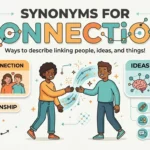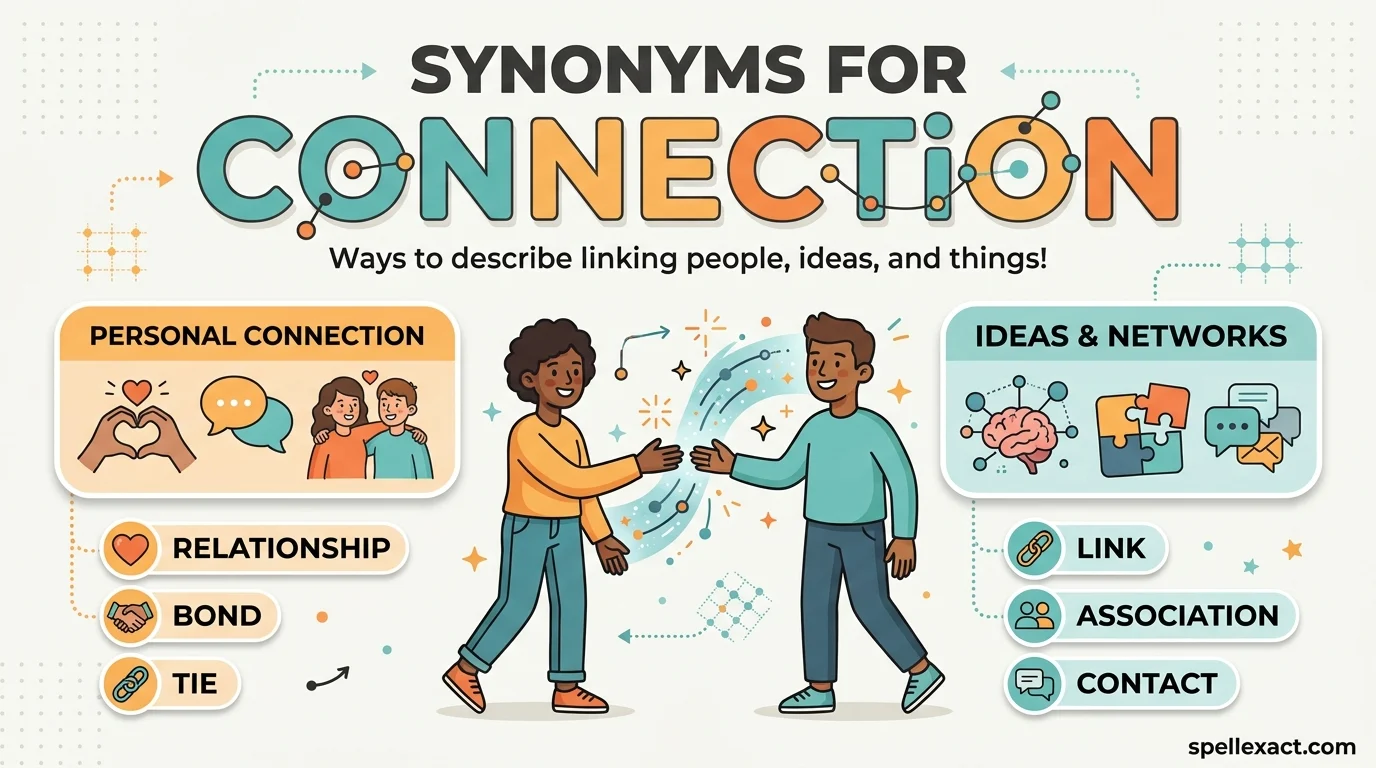
Looking for a synonym for connection? The best alternative depends on whether you mean a personal relationship, an emotional bond, a professional contact, a physical link, or a relationship between ideas. Common synonyms for connection include relationship, link, bond, association, contact, tie, network, affiliation, and rapport. Each word has a slightly different meaning, so choosing the right one can make your writing clearer and more natural.
This guide explains the most useful words for connection, with simple definitions, example sentences, usage tips, comparisons, and answers to common questions. If you are writing an essay, improving your English vocabulary, or looking for a better word for a sentence, you will find an appropriate alternative below.
Quick Answer: What Is a Synonym for Connection?
The best general synonym for connection is relationship. However, the most suitable word depends on the context.
- Relationship: A general connection between people or things.
- Link: A direct connection between two things.
- Bond: A strong emotional connection.
- Association: A relationship between ideas, events, people, or organizations.
- Contact: Communication or interaction with someone.
- Tie: A personal, social, or cultural connection.
- Network: A group of connected people, computers, or organizations.
- Affiliation: A connection with a group or organization.
- Rapport: A friendly relationship based on trust and understanding.
- Interconnection: A situation in which different parts are connected.
For everyday writing, choose relationship or link. Emotional closeness, use bond. For professional relationships, consider contact, network, or rapport.
What Does Connection Mean?
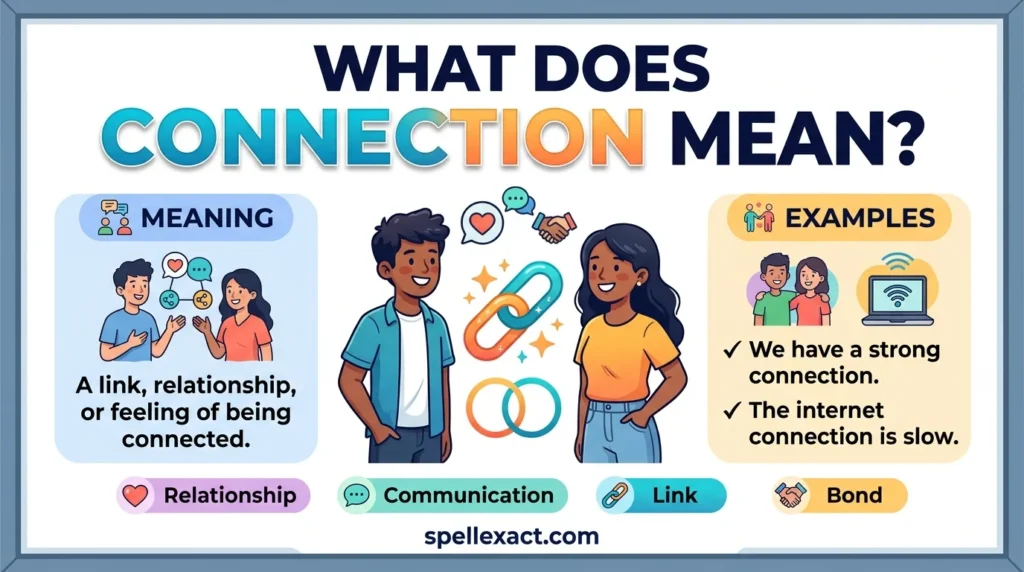
A connection is a relationship, link, or joining between two or more people, objects, ideas, places, or systems. It can describe something physical, emotional, social, professional, or logical.
The word connection has several common meanings:
- Personal connection: A relationship or feeling of closeness between people.
- Emotional connection: A feeling of trust, affection, or understanding.
- Social connection: A relationship with friends, family members, or other people.
- Professional connection: A person you know through work or business.
- Physical connection: Something that joins objects, such as a cable.
- Logical connection: A relationship between facts, ideas, or events.
- Technical connection: A link between computers, devices, or networks.
Examples of Connection in Sentences
- We formed a strong connection during our first meeting.
- There is a clear connection between exercise and better health.
- Please check the internet connection before starting the meeting.
- She used her professional connections to find a new job.
- The teacher explained the connection between ideas in the passage.
The correct alternative word for connection depends on what the sentence describes. A word that works for an emotional relationship may not be appropriate for a technical link.
50 Synonyms for Connection With Meanings and Examples
Below are 50 useful alternatives, grouped by meaning and context. Some are direct synonyms, while others describe specific types of connection.
A. General Synonyms for Connection
1. Relationship
Meaning: The way two people or things are connected or related.
Example: Their relationship became stronger over time.
Best usage: Personal relationships, family, business, and general writing.
2. Link
Meaning: Something that joins or connects two people, objects, or ideas.
Example: Researchers discovered a link between sleep and memory.
Best usage: Websites, technology, evidence, ideas, and physical connections.
3. Association
Meaning: A connection between people, ideas, events, or things.
Example: The study found an association between regular practice and better results.
Best usage: Academic writing, research, business, and formal explanations.
4. Relation
Meaning: A connection or relationship between two or more things.
Example: The report examined the relation between education and employment.
Best usage: Formal writing, logical relationships, and discussions of related topics.
5. Tie
Meaning: A relationship or connection between people, groups, or places.
Example: She maintains close ties with her former classmates.
Best usage: Family ties, cultural ties, social relationships, and international relations.
6. Linkage
Meaning: A connection between different things, often within a system.
Example: The report explains the linkage between training and performance.
Best usage: Technical writing, research, systems, and formal discussions.
7. Interconnection
Meaning: A connection in which different parts are linked to one another.
Example: The book explores the interconnection between nature and human life.
Best usage: Complex systems, technology, society, and related ideas.
8. Interrelation
Meaning: A relationship in which two or more things are connected.
Example: The lesson explains the interrelation between language and culture.
Best usage: Academic writing, social studies, and discussions of related concepts.
9. Nexus
Meaning: A central point where different things are connected.
Example: The city became a nexus of trade and transportation.
Best usage: Formal writing, business, economics, and complex networks.
10. Tie-in
Meaning: A connection between something and another subject, event, or activity.
Example: The teacher explained the tie-in between the two lessons.
Best usage: Informal explanations, marketing, entertainment, and related topics.
B. Synonyms for Emotional and Personal Connection
11. Bond
Meaning: A strong emotional relationship between people or groups.
Example: The siblings share a close bond.
Best usage: Family, friendship, trust, love, and emotional closeness.
12. Attachment
Meaning: A feeling of affection or closeness toward someone or something.
Example: The child developed a strong attachment to her grandmother.
Best usage: Family relationships, personal feelings, and emotional closeness.
13. Closeness
Meaning: A state of being emotionally near to another person.
Example: Years of friendship created a deep sense of closeness.
Best usage: Friendships, family, trust, and personal relationships.
14. Rapport
Meaning: A friendly relationship based on mutual understanding and trust.
Example: The teacher quickly built rapport with her students.
Best usage: Teaching, interviews, customer service, and professional relationships.
15. Affinity
Meaning: A natural liking for or attraction to someone or something.
Example: He has a strong affinity for classical music.
Best usage: Shared interests, preferences, and natural feelings of connection.
16. Kinship
Meaning: A relationship based on family ties or a feeling of being similar to someone.
Example: She felt a sense of kinship with people who shared her interests.
Best usage: Family relationships, shared identity, and emotional understanding.
17. Kindred
Meaning: People or things that share similar qualities, interests, or characteristics.
Example: She found kindred spirits among the other writers.
Best usage: Literature, personal interests, shared values, and similar personalities.
18. Togetherness
Meaning: A feeling of closeness, unity, or being with others.
Example: The family valued the togetherness they enjoyed during holidays.
Best usage: Family life, friendships, communities, and shared experiences.
19. Friendship
Meaning: A close relationship between people who care about one another.
Example: Their friendship continued even after they moved to different cities.
Best usage: Personal relationships, stories, and everyday conversations.
20. Kin
Meaning: Family members or relatives.
Example: She invited her closest kin to the celebration.
Best usage: Family relationships and contexts involving relatives. It is not a general synonym for every connection.
C. Synonyms for Social and Professional Connection
21. Contact
Meaning: A person you know or communication with someone.
Example: I made a useful professional contact at the conference.
Best usage: Networking, business, communication, and staying in touch.
22. Network
Meaning: A group of connected people, organizations, or systems.
Example: She built a professional network by attending industry events.
Best usage: Career development, social relationships, technology, and business.
23. Acquaintance
Meaning: A person you know but may not know very well.
Example: An acquaintance introduced me to the hiring manager.
Best usage: Social situations and relationships that are less close than friendships.
24. Associate
Meaning: A person connected with another person or organization through work or an activity.
Example: He discussed the proposal with a business associate.
Best usage: Business, professional relationships, and formal communication.
25. Affiliation
Meaning: A connection with a group, institution, or organization.
Example: She disclosed her affiliation with the research institute.
Best usage: Professional, academic, organizational, and institutional relationships.
26. Ally
Meaning: A person or group that supports another person or group.
Example: The small business found an ally in a local community organization.
Best usage: Cooperation, support, shared goals, and strategic relationships.
27. Alliance
Meaning: An agreement or relationship in which people or organizations work together.
Example: The two companies formed an alliance to develop new technology.
Best usage: Business, politics, organizations, and shared objectives.
28. Partnership
Meaning: A relationship in which people or organizations work together.
Example: Their partnership helped the project succeed.
Best usage: Business, teamwork, shared projects, and cooperation.
29. Mentor
Meaning: An experienced person who guides or advises someone.
Example: Her mentor helped her build professional relationships.
Best usage: Education, career development, personal growth, and guidance. A mentor may create a connection but is not a direct synonym for connection itself.
30. Go-between
Meaning: A person who communicates or helps arrange things between two parties.
Example: A trusted go-between helped the two groups reach an agreement.
Best usage: Negotiations, communication, and resolving disagreements.
31. Intermediary
Meaning: A person or organization that acts between two parties.
Example: An intermediary helped the companies negotiate the contract.
Best usage: Business, diplomacy, negotiations, and formal communication.
32. Agent
Meaning: A person who acts on behalf of another person or organization.
Example: Her literary agent connected her with a publisher.
Best usage: Business, representation, publishing, and professional services. An agent can facilitate a connection rather than replace the word in every sentence.
33. Sponsor
Meaning: A person or organization that supports another person, project, or activity.
Example: A local company became the event’s main sponsor.
Best usage: Events, projects, funding, and professional support.
34. Messenger
Meaning: A person or system that carries information from one party to another.
Example: The messenger delivered the invitation to the office.
Best usage: Communication, historical contexts, and the delivery of messages.
35. Reciprocity
Meaning: A mutual exchange in which people give, receive, or respond to one another.
Example: Trust grows when a relationship is built on reciprocity.
Best usage: Social relationships, cooperation, trust, and mutual support.
D. Synonyms for Physical and Technical Connection
36. Union
Meaning: The joining of people or things into one group or unit.
Example: The union of the two departments created a larger team.
Best usage: Organizations, groups, joining, and unity.
37. Junction
Meaning: A point where roads, lines, or other things meet.
Example: Turn left at the junction near the station.
Best usage: Roads, railways, electrical systems, and physical meeting points.
38. Joint
Meaning: A place where two parts meet or are joined.
Example: The carpenter strengthened the joint between the wooden pieces.
Best usage: Construction, anatomy, machinery, and physical structures.
39. Conjunction
Meaning: The act of joining things together or a state of being combined.
Example: The results were considered in conjunction with earlier research.
Best usage: Formal writing, grammar, and describing things considered together.
40. Combination
Meaning: Two or more things joined or used together.
Example: The combination of the two systems improved the process.
Best usage: Products, ideas, ingredients, methods, and joined elements.
41. Coupling
Meaning: The act or mechanism of joining two things together.
Example: The technician checked the coupling between the machine’s components.
Best usage: Engineering, machinery, technical systems, and physical connections.
42. Fastening
Meaning: Something that holds objects together or the act of securing them.
Example: The technician replaced the damaged fastening on the equipment.
Best usage: Construction, clothing, equipment, and physical objects.
43. Hookup
Meaning: A physical connection between devices or services.
Example: The technician completed the internet hookup.
Best usage: Informal conversations about equipment, utilities, and technical installations. In personal contexts, hookup can have other meanings.
44. Seam
Meaning: A line where two pieces of material are joined.
Example: The tailor repaired the seam in the jacket.
Best usage: Clothing, fabric, manufacturing, and joined materials.
45. Interface
Meaning: A point or system through which two devices, systems, or people interact.
Example: The software provides an interface between the user and the database.
Best usage: Technology, software, devices, and communication between systems.
E. Synonyms for Connections Between Ideas and Systems
46. Correlation
Meaning: A relationship in which two things change or occur together in a related way.
Example: The study found a correlation between sleep duration and concentration.
Best usage: Statistics, scientific research, and data analysis. Correlation alone does not prove causation.
47. Interdependence
Meaning: A situation in which two or more people or things depend on one another.
Example: The project demonstrated the interdependence of the two departments.
Best usage: Economics, teamwork, ecosystems, and mutually dependent systems.
48. Interplay
Meaning: The way two or more things influence or affect one another.
Example: The article explores the interplay between language and culture.
Best usage: Academic writing, psychology, art, society, and complex relationships.
49. Bearing
Meaning: A connection or relevance to a particular matter.
Example: The new evidence has a direct bearing on the decision.
Best usage: Formal writing, reasoning, legal discussions, and relevance. It is most natural in expressions such as “have a bearing on.”
50. Relevance
Meaning: The quality of being related or important to a particular subject.
Example: The teacher explained the relevance of the example to the lesson.
Best usage: Academic writing, arguments, research, and discussions of importance. Relevance describes a meaningful relationship rather than a physical connection.
Comparison Table: Which Synonym for Connection Should You Use?
Use this quick guide to select an alternative word for connection based on the situation.
| Synonym | Main meaning | Best context |
| Relationship | General connection | People and things |
| Link | Direct connection | Websites, devices, ideas |
| Bond | Emotional closeness | Family and friends |
| Association | Relationship between things | Research and formal writing |
| Relation | How things are connected | Formal explanations |
| Contact | Communication or a person you know | Work and networking |
| Tie | Social or personal relationship | Family and culture |
| Network | Group of connected people or systems | Business and technology |
| Rapport | Trust and mutual understanding | Teaching and professional settings |
| Affiliation | Connection to a group | Organizations |
| Alliance | Cooperative relationship | Business and shared goals |
| Partnership | Working together | Business and projects |
| Affinity | Natural liking or attraction | Interests and preferences |
| Kinship | Family or shared identity | Family and personal relationships |
| Linkage | A connection within a system | Technical writing |
| Interconnection | Parts linked to one another | Technology and society |
| Interdependence | Mutual dependence | Teams and ecosystems |
| Correlation | Related patterns or changes | Statistics and research |
| Junction | Meeting point | Roads and physical systems |
| Interface | Point of interaction | Software and technology |
Connection vs. Relationship vs. Link vs. Bond
These four words are among the most useful synonyms for connection, but they are not interchangeable in every situation.
Connection vs. Relationship
Connection is a broad word for a link between people, objects, or ideas. Relationship often describes how people or things relate over time.
- Connection: There is a clear connection between these two events.
- Relationship: She has a close relationship with her sister.
Connection vs. Link
A link often suggests a direct joining or a specific route between things. A connection can describe physical, emotional, social, or abstract relationships.
- Link: Click the link to open the website.
- Connection: We felt an immediate connection.
Connection vs. Bond
A bond usually emphasizes emotional closeness, trust, or shared experiences. A connection can be emotional or technical.
- Bond: The friends share a strong bond.
- Connection: The printer has a wireless connection to the computer.
Connection vs. Association
An association often describes a relationship between ideas, events, or organizations. It does not necessarily mean that one thing causes another.
- Association: Researchers observed an association between sleep and concentration.
- Connection: The writer explained the connection between the two events.
Connection vs. Contact
Contact usually refers to communication with someone or a person you know. A connection can be a broader relationship.
- Contact: I made a useful business contact at the conference.
- Connection: We developed a strong professional connection.
How to Choose the Right Synonym for Connection
The best synonym for connection depends on your meaning, tone, and purpose.
1. Choose by Meaning
For emotional connections: Use bond, closeness, attachment, affinity, or kinship.
Example: The two friends developed a deep bond.
For physical or technical connections: Use link, junction, joint, coupling, interface, or interconnection.
Example: The cable provides a direct link between the devices.
For social or professional connections: Use relationship, contact, network, affiliation, associate, or rapport.
Example: She built a professional network through industry events.
For connections between ideas or facts: Use association, correlation, relation, interrelation, or interplay.
Example: The researcher examined the relationship between variables.
For cooperation between people or organizations: Use partnership, alliance, union, or reciprocity.
Example: The companies formed a strategic alliance.
2. Choose by Tone
| Tone | Recommended synonyms |
| Everyday English | Relationship, link, tie |
| Warm and emotional | Bond, closeness, attachment |
| Friendly and personal | Friendship, rapport, kinship |
| Professional | Contact, network, partnership |
| Formal or academic | Association, correlation, interrelation |
| Technical | Interface, linkage, coupling |
| Cooperative | Alliance, union, reciprocity |
3. Choose by Writing Purpose
- To describe affection, use bond or attachment.
- To explain a general relationship, use relationship.
- To show a direct connection, use link.
- To describe someone you know professionally, use contact.
- To describe a group of professional contacts, use network.
- To explain a relationship between variables, use correlation.
- To describe mutual dependence, use interdependence.
- To describe an organizational relationship, use affiliation or partnership.
- To describe a positive working relationship, use rapport.
- To explain how several systems connect, use interconnection.
Common Mistakes When Using Synonyms for Connection
Even when words have similar meanings, they may not fit the same sentence. Avoid these common errors.
1. Using Bond for Every Connection
A bond usually describes a strong relationship or emotional closeness. It is not the usual word for a cable or internet link.
- Less natural: The computer has an emotional bond with the printer.
- Better: The computer has a stable connection to the printer.
2. Confusing Correlation With Causation
Correlation describes a relationship between patterns or variables. It does not prove that one thing causes another.
- Incorrect conclusion: The correlation proves that exercise causes happiness.
- Better: The study found a correlation between exercise and reported happiness.
3. Using Rapport for Physical Objects
Rapport describes a positive relationship between people, not a technical connection.
- Incorrect: There is good rapport between the keyboard and computer.
- Better: The keyboard connects properly to the computer.
4. Confusing Contact With a Close Relationship
Knowing someone’s contact details does not necessarily mean you have a close relationship with them.
- Example: I have her contact details, but we rarely communicate.
- Better for emotional closeness: We have a close relationship.
5. Using Formal Words in Casual Conversations
Words such as interdependence, linkage, and interconnection may sound unnecessarily technical in everyday conversation.
- Formal: The report examined the interconnection between the departments.
- Simpler: The report explained how the departments work together.
6. Assuming Association Always Means Cause
Two things can have an association without one causing the other. Use causal language only when the evidence supports it.
- Better: Researchers found an association between the two conditions.
7. Treating Every Synonym as a Perfect Replacement
Words such as mentor, agent, sponsor, and messenger describe people who perform particular roles. They may help create or maintain a connection, but they do not replace connection in every sentence.
For example, “She has a strong connection with her mentor” is natural, while “She has a strong mentor with her colleague” does not express the same meaning.
Frequently Asked Questions
1. What is the best synonym for connection?
Relationship is one of the best general synonyms for connection. Use bond for emotional closeness, link for a direct connection, and association for a relationship between ideas or events.
2. What is another word for a strong connection?
Bond, closeness, rapport, and deep relationship are useful alternatives. Choose bond for emotional closeness and rapport for mutual understanding and trust.
3. What is a formal synonym for connection?
Formal alternatives include association, affiliation, interconnection, linkage, interrelation, and interdependence. The best choice depends on whether you are discussing people, organizations, ideas, or systems.
4. What is a synonym for connection between two people?
Common choices include relationship, bond, tie, rapport, attachment, and friendship. Use rapport for mutual understanding, attachment for affection, and bond for a strong personal connection.
5. What is a synonym for connection between ideas?
Useful alternatives include link, association, relation, correlation, interrelation, and interplay. Use correlation for related patterns or variables, and link for a general connection between ideas.
6. What is the difference between connection and association?
A connection is a broad term for a link or relationship. An association often refers to a relationship between ideas, events, people, or organizations. Neither word automatically means that one thing causes another.
7. What is a synonym for professional connection?
Contact, network, associate, affiliation, partnership, and rapport can describe professional connections. A contact is someone you know professionally, while a network is a wider group of professional contacts.
8. What is the opposite of connection?
Common antonyms include separation, disconnection, detachment, isolation, and division. For example, disconnection suits a broken internet link, while isolation may describe a lack of social contact.
Conclusion
Choosing the right synonym for connection makes your writing clearer, more natural, and more precise. Relationship is a versatile general alternative, bond expresses emotional closeness, link describes a direct connection, and association works well for relationships between ideas or events.
Other alternatives, including contact, network, affiliation, rapport, partnership, kinship, linkage, interconnection, and correlation, offer more specific meanings for personal, professional, physical, and academic contexts.
Before replacing connection, consider what is being connected and what relationship you want to express. By understanding the differences between these synonyms for connection, you can choose more accurate words for everyday conversations, academic assignments, professional documents, and creative writing.

Maria Megan is a language enthusiast and content writer specializing in spelling, grammar, and English usage. She creates clear, practical articles that help readers identify common spelling mistakes, improve writing accuracy, and communicate with greater confidence.