A synonym for dissolving can describe ending a rule, canceling an action, or removing something that is no longer needed. Abolishing, repealing, revoking, rescinding, abrogating, and overruling are useful when discussing laws or rules. For official decisions, canceling, voiding, nullifying, annulling, invalidating, negating, and quashing can mean making something no longer valid.
Other terms, such as overturning, vacating, reversing, rolling back, striking down, setting aside, and overriding, describe changing an earlier decision. Choosing the right word depends on the situation, especially when legal meanings differ from everyday uses.
Some words related to dissolving describe stopping an activity or preventing something from happening. Withdrawing, dismissing, suspending, retracting, rejecting, dropping, disallowing, and countermanding can describe refusing, removing, or stopping an action. Forbidding, prohibiting, banning, outlawing, and enjoining relate to preventing an action, while recalling can mean taking something back.
Other expressions, including avoiding, removing, eliminating, abating, erasing, eradicating, and doing away with, describe reducing or getting rid of something. Calling off means canceling a planned event, whereas writing off often means treating something as a loss.
Depending on the situation, nulling, disannulling, vetoing, aborting, annihilating, liquidating, throwing out, and breaking down can refer to cancellation, destruction, rejection, or separation. Calling may mean summoning or naming someone or something, so it is not always a synonym for dissolving.
Doing away with means eliminating something, while rolling back describes reversing a change. Canceling, recalling, and withdrawing can apply to plans, offers, or decisions. When choosing a word, consider whether you mean ending an organization, canceling an agreement, invalidating a rule, stopping an activity, or physically breaking a substance apart.
Quick Answer: What Is a Synonym for Dissolving?
The closest synonym for dissolving depends on its meaning.
- Going into solution: When a substance dissolves in a liquid.
- Breaking down: When something separates into simpler parts.
- Disappearing: When something is no longer visible or present.
- Dissipating: When something spreads out and becomes weaker.
- Fading: When something gradually becomes less noticeable.
- Disintegrating: When an object breaks into smaller pieces.
- Ending: When an organization or agreement is formally brought to a close.
For everyday writing, disappearing or breaking down may work in some contexts. For scientific writing, going into solution is often more accurate when describing a substance dissolving in a solvent.
What Does Dissolving Mean?
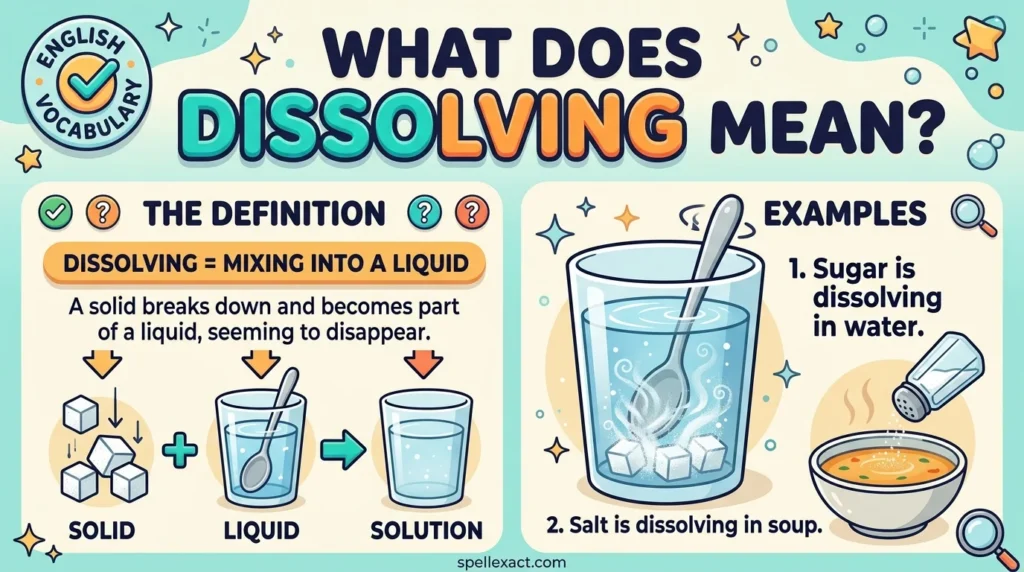
Dissolving is the process of a substance becoming distributed throughout a solvent, or the act of bringing something to an end. It can also describe something gradually disappearing in figurative language.
The word has several meanings depending on how it is used.
1. Dissolving in Chemistry
In chemistry, dissolving occurs when a substance called a solute becomes distributed throughout another substance called a solvent, forming a solution.
Example: Sugar dissolves in water.
The sugar does not simply melt. Instead, its particles become distributed throughout the water.
2. Dissolving in Everyday English
Dissolving can describe something gradually disappearing or becoming less distinct.
Example: The fog seemed to dissolve into the morning air.
Here, dissolving is used descriptively rather than as a strict scientific term.
3. Dissolving in Business and Formal English
The verb dissolve can also mean to formally end an organization, partnership, or legal arrangement.
Example: The partners decided to dissolve their business.
In this context, alternatives such as terminate or disband may be appropriate, depending on what is being ended.
30 Synonyms and Related Words for Dissolving
Not every word below is a direct synonym in every situation. The list separates close alternatives from related words that apply to specific physical, scientific, figurative, or formal meanings.
A. Words Related to Mixing and Physical Changes
1. Going Into Solution
Meaning: Becoming distributed throughout a liquid to form a solution.
Example: The sugar was going into solution as she stirred the water.
Best usage: Chemistry lessons and explanations of soluble substances.
Relationship to dissolving: A close explanatory alternative when discussing a solute and solvent.
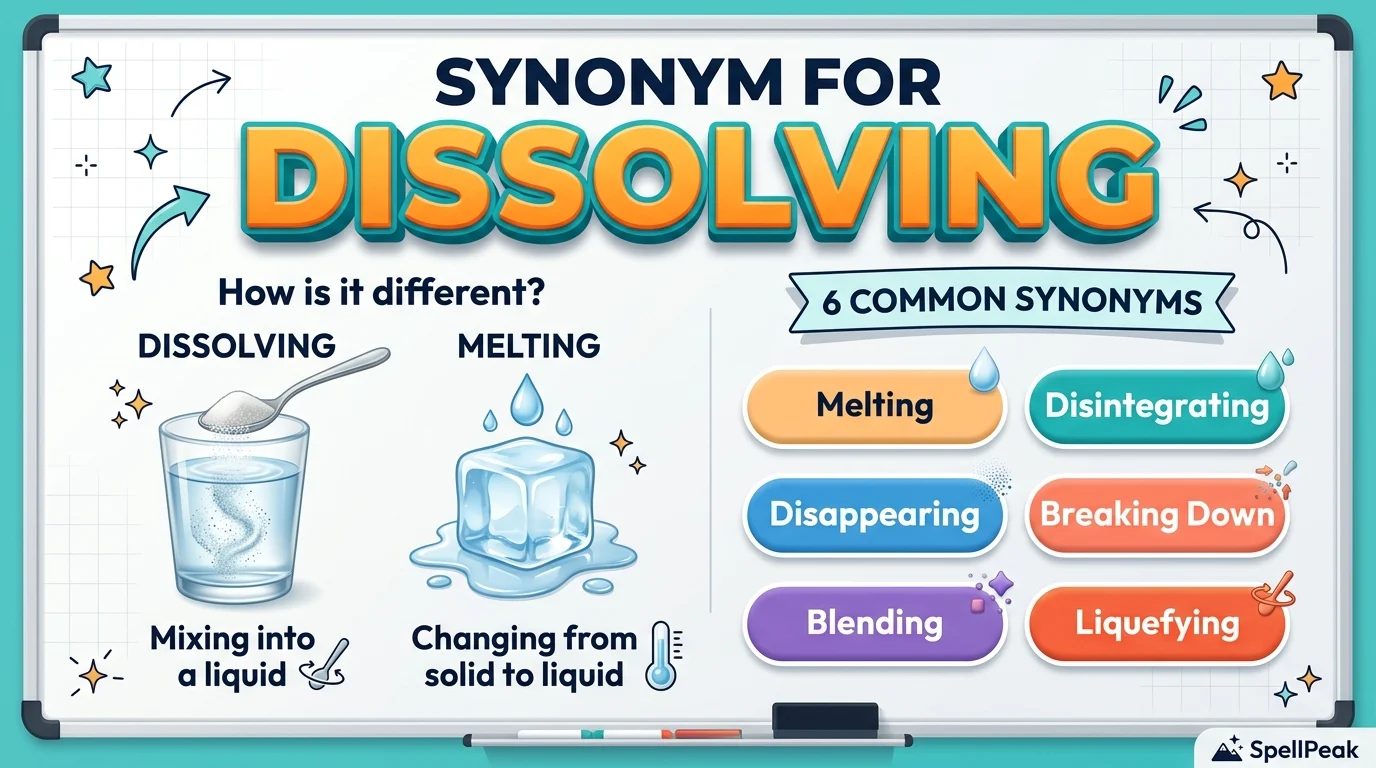
2. Melting
Meaning: Changing from a solid into a liquid because of heat or another suitable change in conditions.
Example: The ice was melting on the warm windowsill.
Best usage: Ice, snow, chocolate, butter, and wax.
Relationship to dissolving: Related but different. Melting changes a solid into a liquid; dissolving involves a substance becoming distributed in a solvent.
3. Liquefying
Meaning: Becoming or causing something to become liquid.
Example: The heat was liquefying the solid material.
Best usage: Scientific, industrial, and technical descriptions.
Relationship to dissolving: A related physical process, not a general replacement for dissolving.
4. Blending
Meaning: Mixing things together so their separate characteristics become less distinct.
Example: The colors were blending smoothly on the canvas.
Best usage: Colors, flavors, sounds, and mixtures.
Relationship to dissolving: Sometimes suitable in informal descriptions of mixing, but blending does not necessarily produce a solution.
5. Merging
Meaning: Joining two or more things to form one.
Example: The two streams were merging into a single river.
Best usage: Streams, companies, departments, and ideas.
Relationship to dissolving: Useful when describing separate things becoming one, but not a direct synonym for chemical dissolving.
6. Dispersing
Meaning: Spreading out in different directions or throughout an area.
Example: The smoke was dispersing into the air.
Best usage: Smoke, particles, crowds, and substances spreading through a space.
Relationship to dissolving: Related when a substance spreads through another material, but dispersing does not always mean dissolving.
7. Diffusing
Meaning: Spreading from an area of higher concentration to an area of lower concentration.
Example: The scent was diffusing throughout the room.
Best usage: Chemistry, physics, smells, and the movement of particles.
Relationship to dissolving: Diffusion can occur during or after dissolving, but the two processes are not identical.
B. Words Related to Breaking Down or Losing Structure
8. Disintegrating
Meaning: Breaking into smaller pieces or losing structural integrity.
Example: The old paper was disintegrating in his hands.
Best usage: Fragile objects, crumbling structures, and materials falling apart.
Relationship to dissolving: A possible alternative when the intended meaning is losing structure, not when describing a solution forming.
9. Breaking Down
Meaning: Separating into smaller or simpler parts.
Example: Bacteria help break down dead leaves.
Best usage: Biological processes, materials, and complicated systems.
Relationship to dissolving: A broad alternative when a substance or structure is separating into simpler components.
10. Decomposing
Meaning: Breaking down through chemical or biological processes, especially in organic matter.
Example: The fallen leaves were decomposing on the forest floor.
Best usage: Dead plants, food waste, and other organic materials.
Relationship to dissolving: Related to breakdown, but decomposition and dissolving are different processes.
11. Degrading
Meaning: Losing quality, strength, or integrity over time.
Example: Sunlight was degrading the plastic.
Best usage: Materials science, environmental discussions, and descriptions of declining quality.
Relationship to dissolving: Appropriate when a material breaks down or deteriorates, but not for every instance of dissolving.
12. Crumbling
Meaning: Breaking into small pieces, often because something is old, dry, or weak.
Example: The ancient wall was crumbling after years of neglect.
Best usage: Walls, buildings, dry soil, and fragile materials.
Relationship to dissolving: Suitable when a solid breaks apart rather than becoming distributed in a liquid.
13. Fragmenting
Meaning: Breaking into separate pieces or parts.
Example: The rock was fragmenting under repeated pressure.
Best usage: Physical objects, groups, information, and systems.
Relationship to dissolving: A related word when the focus is separation into pieces.
14. Unraveling
Meaning: Coming apart or becoming undone.
Example: The fabric was unraveling at the edges.
Best usage: Threads, plans, mysteries, and complicated situations.
Relationship to dissolving: Useful figuratively when an organized structure begins to come apart.
15. Eroding
Meaning: Gradually wearing away through natural or physical forces.
Example: The waves were eroding the rocky coastline.
Best usage: Soil, rocks, coastlines, and figurative descriptions of trust or confidence.
Relationship to dissolving: Related when material is gradually removed, but erosion is not the same as dissolving.
16. Deteriorating
Meaning: Becoming worse or losing quality.
Example: The condition of the abandoned building was deteriorating.
Best usage: Buildings, relationships, health, and systems.
Relationship to dissolving: Appropriate only when the intended meaning involves a decline or loss of condition.
17. Wearing Away
Meaning: Gradually becoming thinner, smaller, or weaker because of friction or repeated action.
Example: The flowing water was wearing away the riverbank.
Best usage: Surfaces, materials, patience, and resistance.
Relationship to dissolving: A related expression for gradual loss of material or strength.
C. Words Related to Disappearing or Becoming Weaker
18. Disappearing
Meaning: No longer being visible or present.
Example: The footprints were disappearing beneath the falling snow.
Best usage: Everyday English and general descriptions.
Relationship to dissolving: A useful alternative when dissolving means gradually vanishing.
19. Vanishing
Meaning: Disappearing from sight or seeming to cease to exist.
Example: The rainbow was vanishing as the clouds returned.
Best usage: Descriptive writing and situations where something disappears.
Relationship to dissolving: Suitable for figurative descriptions of something gradually or suddenly disappearing.
20. Fading
Meaning: Gradually becoming weaker, lighter, or less noticeable.
Example: The writing on the old sign was fading.
Best usage: Colors, sounds, memories, hopes, and emotions.
Relationship to dissolving: A good figurative alternative when something becomes less distinct.
21. Dissipating
Meaning: Spreading out and becoming weaker until it is no longer noticeable.
Example: The morning fog was dissipating in the sunlight.
Best usage: Fog, smoke, heat, tension, and anger.
Relationship to dissolving: One of the closer alternatives when the intended meaning is gradually disappearing or losing intensity.
22. Fizzling Out
Meaning: Gradually losing energy, strength, or effectiveness until something stops.
Example: Their conversation was fizzling out as everyone became tired.
Best usage: Informal speech about plans, excitement, arguments, and activities.
Relationship to dissolving: A figurative alternative when an event or feeling gradually loses momentum.
23. Melting Away
Meaning: Gradually melting or disappearing as if melting.
Example: The last patches of snow were melting away in the sunshine.
Best usage: Snow, ice, tension, worry, and fear.
Relationship to dissolving: Suitable for descriptive or figurative writing, but not always scientifically interchangeable with dissolving.
24. Dissolving Away
Meaning: Gradually disappearing as something dissolves or is removed.
Example: The soluble coating was dissolving away in the water.
Best usage: Substances gradually dissolving, as well as descriptive writing.
Relationship to dissolving: A close variation of the original expression, rather than a completely different synonym.
25. Evaporating
Meaning: Changing from a liquid into a gas at the surface.
Example: Water was evaporating from the shallow dish.
Best usage: Scientific explanations involving liquids and changes of state.
Relationship to dissolving: A separate physical process. A liquid may evaporate after a substance has dissolved in it, but dissolving itself is not evaporation.
26. Sublimating
Meaning: Changing directly from a solid into a gas without first becoming liquid.
Example: Dry ice was sublimating at room temperature.
Best usage: Chemistry and physics.
Relationship to dissolving: A technical term for a different physical process, not a direct synonym.
D. Words Related to Ending or Removing Something
27. Disbanding
Meaning: Ending the activities of an organized group.
Example: The committee was disbanding after completing its work.
Best usage: Teams, clubs, committees, and associations.
Relationship to dissolving: A close alternative when dissolving means formally ending a group.
28. Terminating
Meaning: Bringing something to an end.
Example: The company was terminating the agreement.
Best usage: Contracts, services, agreements, and formal arrangements.
Relationship to dissolving: Can replace dissolving in some formal contexts, depending on the type of arrangement.
29. Abolishing
Meaning: Officially ending a law, system, or established practice.
Example: The government was abolishing the outdated regulation.
Best usage: Laws, policies, rules, and institutions.
Relationship to dissolving: A related formal term when an established system or practice is brought to an end.
30. Liquidating
Meaning: Closing a business and settling its financial affairs, often by selling its assets.
Example: The owners were liquidating the company after years of losses.
Best usage: Business, finance, and accounting.
Relationship to dissolving: A related business term. Liquidation may occur when a company closes, but it is not identical to dissolving a company.
Comparison Table: Dissolving vs. Similar Words
| Word | Main meaning | Can it replace dissolving? |
| Going into solution | A substance becomes distributed in a solvent | Yes, in chemistry |
| Melting | A solid becomes liquid | No, different process |
| Breaking down | Separating into simpler parts | Sometimes |
| Disintegrating | Breaking into pieces | Sometimes, when structure is lost |
| Disappearing | No longer visible or present | Sometimes, figuratively |
| Fading | Becoming less noticeable | Sometimes, figuratively |
| Dissipating | Spreading out and weakening | Sometimes, when something fades away |
| Decomposing | Breaking down naturally or chemically | Only in relevant contexts |
| Evaporating | Liquid becomes gas | No, different process |
| Disbanding | An organized group ends | Yes, for a group |
| Terminating | Something is brought to an end | Sometimes, in formal contexts |
| Liquidating | A business’s financial affairs are settled | No, not as a general substitute |
How to Choose the Right Synonym for Dissolving
The best word depends on three things: meaning, tone, and intent.
Choose According to Meaning
- A substance mixes into a liquid: Use dissolving or going into solution.
- A solid changes into a liquid: Use melting or liquefying.
- An object breaks apart: Use disintegrating, crumbling, or fragmenting.
- Organic matter breaks down: Use decomposing.
- Something gradually disappears: Use disappearing, vanishing, or fading.
- Fog, smoke, or tension becomes weaker: Use dissipating.
- An organized group ends: Use disbanding or, where appropriate, dissolving.
- A contract or arrangement ends: Use terminating or ending, depending on the context.
Choose According to Tone
Everyday English: Words such as disappearing, fading, and breaking down are clear and easy to understand.
Scientific writing: Terms such as going into solution, decomposing, evaporating, and sublimating can be useful when they accurately describe the process.
Formal writing: Words such as terminating, abolishing, and liquidating fit specific legal, official, and business contexts.
Creative writing: Expressions such as dissipating, vanishing, and melting away can make descriptions more vivid.
Choose According to Your Intended Message
Compare these sentences:
- Original: The fog was dissolving.
- Alternative: The fog was dissipating.
Both can describe fog becoming less noticeable, although dissipating emphasizes spreading out and weakening. - Original: The sugar was dissolving in the water.
- Alternative: The sugar was melting in the water.
These are not equivalent. Sugar dissolves in water; it does not melt merely because it is mixed with water. - Original: The partners dissolved their business.
- Alternative: The partners disbanded their business.
Disbanded is more naturally used for a group, team, or committee. For a business, closed or wound up may be more suitable depending on the legal and financial circumstances.
Common Mistakes When Using Dissolving Synonyms
1. Confusing Dissolving With Melting
Incorrect: Sugar melts in water.
Correct: Sugar dissolves in water.
Melting changes a solid into a liquid. Dissolving distributes a substance throughout a solvent.
2. Confusing Dissolving With Evaporating
Incorrect: The salt evaporated in the water.
Correct: The salt dissolved in the water.
Evaporation changes a liquid into a gas. Ordinary dissolved salt remains in the solution when water evaporates, eventually potentially forming solid crystals.
3. Using Decomposing for Every Type of Breakdown
Incorrect: The ice was decomposing in the sun.
Correct: The ice was melting in the sun.
Decomposition involves breaking down into simpler substances. Melting is the change from solid to liquid.
4. Confusing Disintegrating With Disappearing
Incorrect: The rainbow disintegrated into the sky.
Better: The rainbow faded from view.
Disintegrating emphasizes breaking apart. Fading describes something gradually becoming less visible or noticeable.
5. Using Disbanding for a Substance in Water
Incorrect: The salt disbanded in the water.
Correct: The salt dissolved in the water.
Disbanding refers to ending an organized group, not a substance mixing with a liquid.
6. Treating Every Related Word as an Exact Synonym
Words such as sublimating, evaporating, liquidating, and abolishing have specific meanings. Replacing dissolving with one of these words without checking the context may change the entire meaning of the sentence.
Frequently Asked Questions
1. What is the closest synonym for dissolving?
The closest alternative depends on the sentence. Going into solution is appropriate for chemistry, disappearing may work for figurative meanings, and disbanding can fit the ending of an organized group.
2. What is another word for dissolving in water?
For a soluble substance, going into solution is a useful alternative. For example, sugar goes into solution when it dissolves in water. Not every substance dissolves in water; sand generally remains as separate particles.
3. What does dissolving mean in chemistry?
Dissolving is the process in which a solute becomes distributed throughout a solvent to form a solution. Sugar is the solute and water is the solvent when sugar dissolves in water.
4. What is the difference between dissolving and melting?
Dissolving involves a substance becoming distributed throughout a solvent. Melting occurs when a solid changes into a liquid. Sugar dissolves in water, while ice melts when it receives enough heat.
5. What is the difference between dissolving and disintegrating?
Dissolving involves forming a solution with a solvent. Disintegrating means breaking into smaller pieces or losing structural integrity. A tablet can disintegrate into particles before its soluble ingredients dissolve.
6. What is a synonym for dissolving that means disappearing?
Disappearing, vanishing, fading, and dissipating can express related ideas. Use vanishing for something that disappears from view, fading for something becoming less noticeable, and dissipating for something spreading out and losing intensity.
7. What is the opposite of dissolving?
There is no single opposite for every meaning. Solidifying can contrast with melting, while crystallizing may describe dissolved substances forming solid crystals from a solution. If dissolving means ending an organization, forming or establishing may express the opposite idea.
8. How do you use dissolving in a sentence?
Here are three examples:
- The sugar was dissolving in the warm water.
- The fog was dissolving into the surrounding landscape.
- The partners decided to dissolve their business.
Each sentence uses the word in a different context: chemistry, figurative description, and formal business language.
Conclusion
The best synonym for dissolving depends on the meaning you want to express. Going into solution is useful in chemistry, disintegrating describes something breaking apart, dissipating describes something spreading out and weakening, and disbanding can describe an organized group coming to an end.
Other words, including melting, decomposing, evaporating, and liquidating, are related to particular processes but are not interchangeable with dissolving in every sentence.
When choosing an alternative, consider what is happening, where the word will be used, and whether the replacement preserves the original meaning. This approach will help you write clearer sentences and use English vocabulary more accurately.

Maria Megan is a language enthusiast and content writer specializing in spelling, grammar, and English usage. She creates clear, practical articles that help readers identify common spelling mistakes, improve writing accuracy, and communicate with greater confidence.