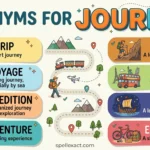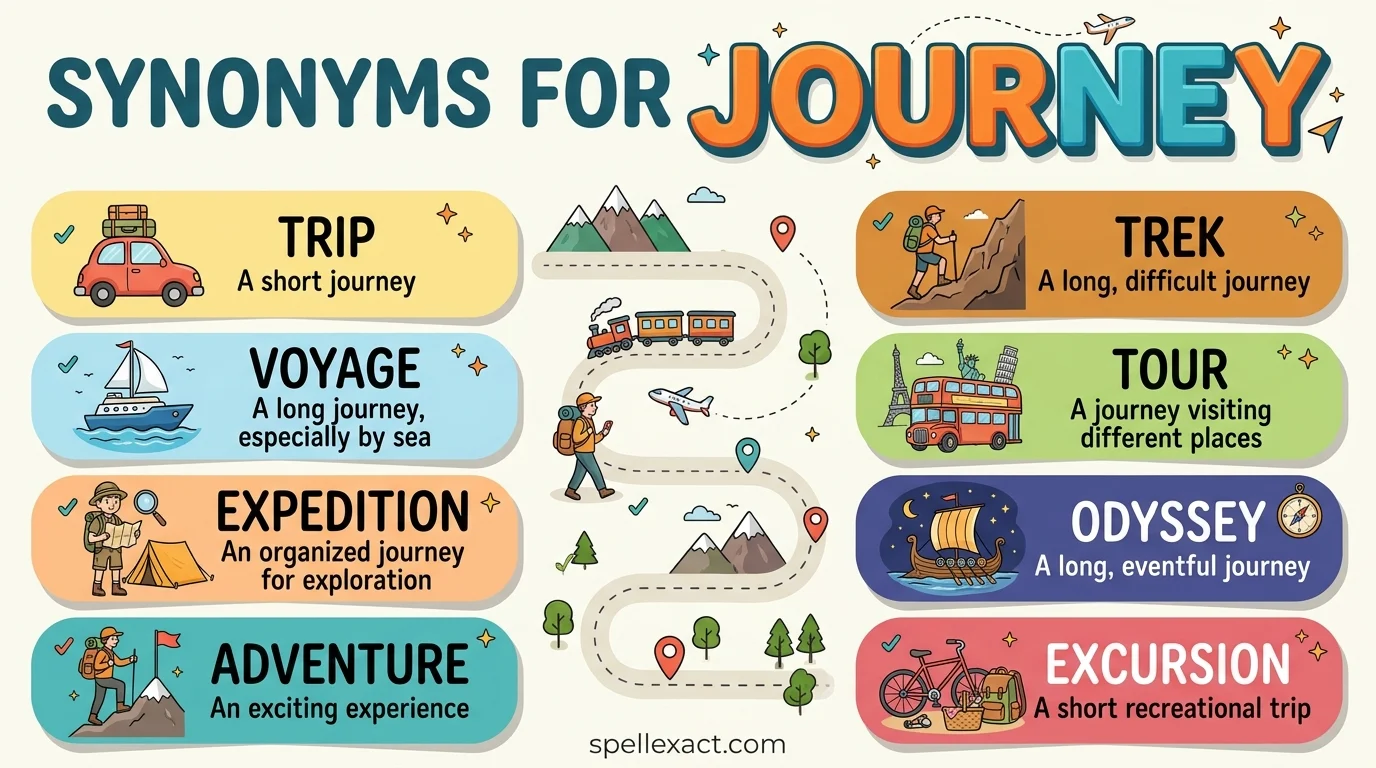
A synonym for journey is a word that describes traveling from one place to another or, in a broader sense, moving through an important experience in life. Common synonyms for journey include trip, expedition, trek, voyage, excursion, tour, adventure, passage, and odyssey. The right word depends on the distance, purpose, type of travel, and meaning you want to express.
For everyday English, trip is usually the simplest alternative to journey. For a difficult journey on foot, use trek. Organized exploration, choose expedition, while voyage is especially suitable for travel by sea or through space. When describing personal growth, path, quest, or odyssey may communicate the intended meaning more effectively.
Quick Answer: What Are the Best Synonyms for Journey?
Here are some of the most useful words for journey and their meanings:
- Trip: Travel to a place for a particular purpose.
- Expedition: An organized journey for exploration or research.
- Trek: A long or difficult journey, usually on foot.
- Excursion: A short journey taken for pleasure or education.
- Flight: A journey by aircraft.
- Voyage: A long journey, especially by sea or through space.
- Tour: A journey involving visits to several places.
- Ride: A journey in a vehicle, on a bicycle, or on an animal.
- Passage: Movement from one place to another.
- Odyssey: A long journey filled with challenges and experiences.
- Adventure: An exciting or unusual experience.
- Jaunt: A short, enjoyable trip.
- Pilgrimage: A journey to a place of religious or spiritual importance.
- Quest: A journey or search undertaken to achieve a goal.
- Outing: A short trip for enjoyment.
- Commute: Regular travel between home and work or school.
- Path: A way or direction followed physically or in life.
For most everyday sentences, trip is a natural substitute for journey. However, words such as route, commute, errand, and progress have more specific meanings and should only be used when they fit the context.
What Does Journey Mean?
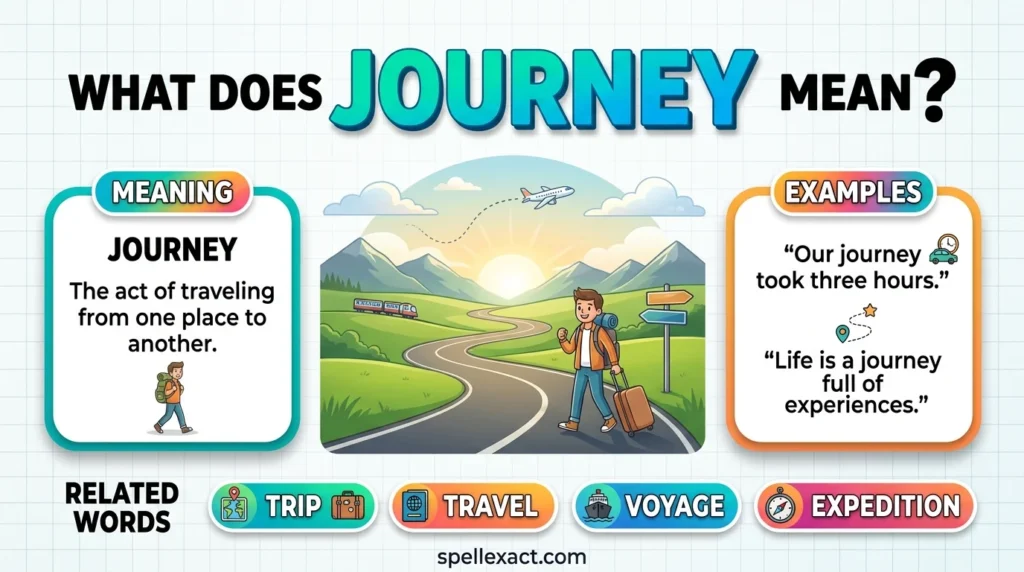
A journey is the act of traveling from one place to another, usually over some distance. It may involve traveling by car, train, airplane, ship, bicycle, or on foot.
The word can also describe a process that takes time and involves learning, change, effort, or personal development. This figurative meaning is common when people discuss education, careers, relationships, recovery, and self-improvement.
Examples of journey in a sentence:
- Physical travel: Our journey across the country took three days.
- Education: Learning English has been an exciting journey.
- Career development: Her journey to becoming a doctor began at university.
- Personal growth: His journey of self-discovery helped him understand his strengths.
A journey often emphasizes the experience of traveling or progressing, not just reaching the final destination.
35 Synonyms for Journey With Meanings and Examples
Below are 35 useful journey synonyms, including everyday alternatives, travel-related terms, formal expressions, and words that describe personal experiences. Each word includes a simple definition, an example, and guidance on when to use it.
1. Trip
Meaning: Travel to a place for a particular reason, usually for a limited period.
Example: We took a short trip to the mountains last weekend.
Best usage: Holidays, business travel, visits, and everyday conversations.
2. Expedition
Meaning: An organized journey undertaken for exploration, research, or a specific purpose.
Example: The scientists planned an expedition to study wildlife in the rainforest.
Best usage: Scientific research, remote exploration, mountain climbing, and organized adventures.
3. Trek
Meaning: A long or difficult journey, usually on foot.
Example: The hikers completed a challenging trek through the mountains.
Best usage: Hiking, difficult terrain, outdoor adventures, and long walks.
4. Excursion
Meaning: A short journey taken for pleasure, education, or exploration.
Example: Our class went on an excursion to the science museum.
Best usage: School outings, sightseeing, day trips, and educational visits.
5. Flight
Meaning: A journey made by aircraft.
Example: Our flight to London lasted several hours.
Best usage: Air travel, airline schedules, and journeys between airports.
6. Voyage
Meaning: A long journey, especially by sea or through space.
Example: The sailors began their voyage across the Atlantic Ocean.
Best usage: Sea travel, space exploration, and formal or literary descriptions of long journeys.
7. Tour
Meaning: A journey involving visits to several places, often for enjoyment or information.
Example: We took a guided tour of the historic city.
Best usage: Sightseeing, holidays, museums, cultural visits, and travel to multiple destinations.
8. Errand
Meaning: A short trip made to complete a task.
Example: I went on an errand to buy groceries.
Best usage: Shopping, collecting items, delivering something, or completing everyday tasks. An errand describes the purpose of a short trip rather than a journey in general.
9. Ride
Meaning: A journey in or on a vehicle, bicycle, or animal.
Example: We enjoyed a scenic ride along the coast.
Best usage: Car journeys, bicycle trips, horseback travel, and amusement rides.
10. Travel
Meaning: The activity of moving from one place to another, often over a distance.
Example: She loves travel because it introduces her to new cultures.
Best usage: General discussions about tourism, transportation, and visiting different places. Travel often describes the activity rather than one specific journey.
11. Cruise
Meaning: A journey by ship, usually for pleasure.
Example: They booked a cruise around the Mediterranean Sea.
Best usage: Holiday travel, passenger ships, and leisure trips by sea.
12. Peregrination
Meaning: A journey from place to place, especially a long or wandering one.
Example: The writer described his peregrinations through several European countries.
Best usage: Literary, formal, or scholarly writing. This is an uncommon word, so journey or travels is usually clearer in everyday English.
13. Passage
Meaning: The act of traveling or moving from one place to another.
Example: The ship provided safe passage across the narrow channel.
Best usage: Sea travel, formal writing, and descriptions of movement between locations.
14. Odyssey
Meaning: A long journey involving many difficulties, discoveries, or changes.
Example: Finding his missing family became an emotional odyssey.
Best usage: Literary writing, challenging experiences, personal growth, and long journeys with many obstacles.
15. Commute
Meaning: Regular travel between home and work or school.
Example: Her daily commute takes about forty minutes.
Best usage: Working life, school travel, and regular transportation. A commute is usually repeated, rather than a one-time holiday.
16. Jaunt
Meaning: A short, pleasant journey.
Example: We took a weekend jaunt to a nearby seaside town.
Best usage: Informal conversations and lighthearted descriptions of short trips.
17. Pilgrimage
Meaning: A journey to a place with religious or spiritual importance.
Example: The family made a pilgrimage to a sacred site.
Best usage: Religious travel, spiritual experiences, and figurative journeys toward meaningful goals.
18. Sail
Meaning: A journey made by traveling in a boat or ship, especially one using sails.
Example: Their sail along the coastline was peaceful and relaxing.
Best usage: Sailing, boating, and nautical writing. In many sentences, voyage or sailing trip sounds more natural.
19. Quest
Meaning: A journey or search undertaken to achieve an important goal.
Example: She began a quest to discover the truth about her family’s history.
Best usage: Stories, personal ambitions, searches for knowledge, and meaningful challenges.
20. Commutation
Meaning: A term associated with regular travel between places, especially in some formal or technical contexts.
Example: The report examined daily commutation between the suburbs and the city.
Best usage: Specialized or historical contexts. In modern everyday English, commute is generally the more natural word for regular travel to work or school.
21. Walk
Meaning: A journey made on foot.
Example: We took a long walk through the park.
Best usage: Short journeys on foot, exercise, and casual outdoor activities.
22. Outing
Meaning: A short trip away from home, usually for enjoyment.
Example: The family planned an outing to the botanical garden.
Best usage: Family activities, school trips, social visits, and recreational travel.
23. Progress
Meaning: Movement toward a goal or improvement over time.
Example: Learning a new language requires patience and steady progress.
Best usage: Personal development, education, careers, and figurative journeys. Progress describes advancement rather than physical travel itself.
24. Hop
Meaning: A short journey, often between nearby places.
Example: It’s only a short hop from our hotel to the beach.
Best usage: Informal descriptions of brief trips, short flights, or movement between nearby locations.
25. Sortie
Meaning: A short journey or mission, especially one made by military forces or aircraft.
Example: The aircraft returned safely after its sortie.
Best usage: Military, aviation, and specialized historical writing. It is not a general replacement for journey.
26. Junket
Meaning: A trip, often organized for pleasure or publicity, sometimes paid for by an organization.
Example: The officials attended a promotional junket abroad.
Best usage: Media, politics, business, and informal discussions of organized trips. The word can suggest that a trip is an unnecessary expense or a perk.
27. Drive
Meaning: A journey made in a motor vehicle, especially a car.
Example: We enjoyed a scenic drive through the countryside.
Best usage: Road trips, car travel, and short or long journeys by road.
28. Hike
Meaning: A long walk, usually in the countryside, hills, or mountains.
Example: We went on a hike through the forest early in the morning.
Best usage: Nature trails, outdoor recreation, and walking in natural areas.
29. Sally
Meaning: A short journey or departure, traditionally associated with a military attack or an attempt to move beyond a protected place.
Example: The soldiers made a sally beyond the fortress walls.
Best usage: Historical or literary writing. In modern everyday English, trip or journey is usually more suitable.
30. Safari
Meaning: A journey, often in Africa, to observe wild animals in their natural surroundings.
Example: We saw elephants and giraffes during our safari.
Best usage: Wildlife observation, guided nature trips, and outdoor tourism.
31. Grand tour
Meaning: An extended trip through several places, traditionally associated with cultural education and sightseeing.
Example: The students planned a grand tour of Europe’s historic cities.
Best usage: Cultural travel, extended holidays, and historical or literary descriptions.
32. Spin
Meaning: An informal, usually short journey, often made in a vehicle.
Example: Let’s take a spin around the countryside this afternoon.
Best usage: Casual conversations about driving or going for a short ride.
33. Walkabout
Meaning: A journey on foot, often involving wandering or traveling through an area.
Example: The travelers went on a walkabout through the remote countryside.
Best usage: Australian English, travel writing, and descriptions of wandering on foot. Its cultural uses can carry specific meanings, so context matters.
34. Slog
Meaning: A long, tiring, and difficult journey or period of effort.
Example: The final slog up the steep hill left everyone exhausted.
Best usage: Difficult walks, exhausting travel, and figurative descriptions of challenging work or progress.
35. Tramp
Meaning: A long walk, often over a considerable distance or through rough country.
Example: They went on a long tramp across the moors.
Best usage: British English and literary descriptions of walking or hiking. In other contexts, the word may have different meanings, so use it carefully.
Other Useful Words Related to Journey
Some of the most useful words related to journey do not appear in the list above because they describe a route, a personal goal, or a particular kind of experience rather than a complete journey.
- Adventure: An exciting or unusual experience that may involve uncertainty or risk. Example: Our journey through the desert became an unforgettable adventure.
- Route: The way taken to reach a destination. Example: We chose a scenic route along the coast.
- Path: A physical way or a direction followed in life. Example: She chose a new path in her career.
- Trekking: The activity of making a long or difficult journey on foot. Example: Trekking through the mountains requires preparation.
- Circuit: A route that returns to its starting point or passes through a planned series of places. Example: The cyclists completed a circuit around the lake.
- Migration: Movement from one region to another, often seasonally or permanently. Example: The birds began their annual migration.
- Transit: The process of traveling through or between places, often using transportation systems. Example: The parcel remained in transit for two days.
- Sojourn: A temporary stay in a place away from home. Example: During his sojourn in Italy, he learned the local language.
These words can enrich your vocabulary, but they should not automatically replace journey in every sentence.
Journey Synonyms Comparison Table
This comparison guide helps you select a word according to its meaning and context.
| Synonym | Main meaning | Tone | Best context |
| Trip | Travel for a purpose | Everyday | Holidays and visits |
| Expedition | Organized exploration | Formal | Research and discovery |
| Trek | Difficult travel on foot | Adventurous | Hiking and mountains |
| Excursion | Short recreational trip | Neutral | School outings and day trips |
| Flight | Travel by aircraft | Neutral | Air travel |
| Voyage | Long-distance travel, especially by sea | Formal or literary | Ships and space travel |
| Tour | Visiting several places | Neutral | Sightseeing |
| Errand | Trip to complete a task | Everyday | Shopping and deliveries |
| Ride | Travel in a vehicle or on an animal | Everyday | Transport and recreation |
| Cruise | Leisure journey by ship | Neutral | Sea holidays |
| Odyssey | Long, challenging journey | Literary | Major life experiences |
| Jaunt | Short, pleasant trip | Informal | Casual outings |
| Pilgrimage | Religious or spiritual journey | Formal | Sacred destinations |
| Quest | Search for a goal | Literary | Personal ambitions |
| Commute | Regular travel to work or school | Everyday | Daily transportation |
| Outing | Short recreational trip | Friendly | Family activities |
| Drive | Journey by car | Everyday | Road travel |
| Hike | Long walk in nature | Neutral | Outdoor recreation |
| Route | Way taken to a destination | Neutral | Navigation |
| Path | Way or direction | Neutral or figurative | Life choices and growth |
How to Choose the Right Synonym for Journey
The best alternative word for journey depends on your intended meaning, the tone of your writing, and the type of experience you want to describe.
1. Choose According to Meaning
For ordinary travel: Choose trip, travel, tour, or outing.
- We took a trip to London.
- They enjoy travel during the holidays.
- The guide organized a tour of the old city.
For long or difficult travel: Choose trek, expedition, voyage, or slog.
- The trek through the mountains was exhausting.
- The research expedition lasted two weeks.
- The sailors began their voyage across the ocean.
Short journeys: Choose jaunt, excursion, hop, or outing.
- We took a weekend jaunt to the coast.
- The school arranged an excursion to the museum.
- It’s just a short hop to the next town.
For personal growth: Choose path, quest, odyssey, or progress.
- Her path to success was not easy.
- His quest for knowledge continued for years.
- Their family story became an emotional odyssey.
2. Choose According to Tone
| Tone | Suitable words |
| Simple and conversational | Trip, ride, walk, outing |
| Formal and descriptive | Expedition, voyage, passage, peregrination |
| Adventurous | Trek, hike, safari, expedition |
| Literary and emotional | Odyssey, quest, pilgrimage |
| Short and casual | Jaunt, hop, spin |
| Professional or technical | Commute, transit, flight, route |
For example, “My trip to Spain was enjoyable” sounds natural in everyday conversation. “My odyssey through life changed me” sounds more literary and emotional.
3. Choose According to Your Purpose
- Reaching a destination: Use trip, voyage, or passage.
- Exploring an unknown place: Use expedition, trek, or safari.
- Visiting several locations: Use tour, grand tour, or circuit.
- Completing a task: Use errand.
- Traveling regularly: Use commute.
- Searching for a goal: Use quest.
- Describing a difficult experience: Use odyssey or slog.
- Describing a direction in life: Use path.
- Traveling by air: Use flight.
- Traveling by car: Use drive.
4. Choose According to Sentence Context
Consider the sentence: “We began our journey early in the morning.”
Different synonyms change the meaning slightly:
- “We began our trip early in the morning.” This is suitable for general travel.
- “We began our expedition early in the morning.” This suggests organized exploration.
- “We began our trek early in the morning.” This suggests a long walk.
- “We began our voyage early in the morning.” This works especially well for a sea journey.
- “We began our drive early in the morning.” This specifies travel by car.
The most effective synonym is the one that preserves your intended meaning.
Common Mistakes When Using Journey Synonyms
1. Treating Every Synonym as an Exact Replacement
Words with related meanings are not always interchangeable. A trip is a particular instance of travel, while a route is the way taken. An expedition usually has a defined purpose, whereas an adventure emphasizes excitement or unusual experiences.
2. Using Voyage for Every Type of Travel
Voyage is especially associated with long sea journeys and can also describe space travel. For a routine drive to the store, trip or drive is usually more natural.
3. Confusing a Journey With a Route
A journey describes the act or experience of traveling. A route describes the way you take.
- Correct: The journey took five hours.
- Correct: We selected a shorter route.
4. Calling Every Walk a Trek
A trek usually suggests a long or difficult journey on foot. A short walk around the neighborhood is better described as a walk or stroll.
5. Using Commute for a Holiday
A commute generally refers to regular travel between home and work or school. A vacation to another country is better described as a trip, tour, or journey.
6. Using Rare Words When Simple Words Are Clearer
Words such as peregrination, sally, and commutation have specialized or uncommon uses. They may suit certain formal or historical contexts, but they can make everyday writing harder to understand.
Choose trip, journey, or travel when a simpler word communicates your meaning accurately.
Frequently Asked Questions
1. What is the best synonym for journey?
Trip is one of the most useful general synonyms for journey. Depending on the context, expedition, trek, voyage, excursion, tour, and adventure may be more precise.
2. What is a simple word for journey?
Trip is a simple, everyday alternative. For example, “Our journey was short” can become “Our trip was short.”
3. What is another word for a long journey?
Voyage, trek, odyssey, and expedition can describe long journeys. Use voyage for sea travel, trek for demanding travel on foot, expedition for organized exploration, and odyssey for a long experience involving challenges.
4. What is a formal synonym for journey?
Expedition, voyage, passage, and peregrination can work in formal or literary writing, depending on the context. Peregrination is uncommon, so it is not usually the clearest choice for general readers.
5. What is a synonym for journey in life?
Path, quest, odyssey, and journey of discovery can describe personal growth and life experiences.
Example: “Her path toward independence taught her patience and confidence.”
6. What is the difference between a journey and a trip?
A journey often emphasizes the experience or process of traveling from one place to another. A trip usually refers to a particular instance of travel, often for a specific purpose. The meanings overlap, and both can be correct in many sentences.
7. What is the difference between a journey and an expedition?
A journey is a general term for traveling from one place to another. An expedition is usually an organized journey with a particular purpose, such as scientific research, exploration, or reaching a remote location.
8. What is a synonym for a journey of discovery?
Expedition is appropriate for physical exploration. Quest is often better for a search for knowledge, truth, or understanding. Odyssey can describe a long process filled with discoveries and challenges.
9. Are journey and adventure the same?
No. A journey involves traveling or progressing through an experience, while an adventure is an exciting or unusual experience that may involve uncertainty or risk. A journey can be an adventure, but not every journey is adventurous.
10. What is the best synonym for a short journey?
Jaunt, excursion, outing, and hop can describe short journeys in different situations. Jaunt suggests a pleasant trip, excursion often involves recreation or education, outing emphasizes enjoyment, and hop suggests a short distance.
Conclusion
There are many useful synonyms for journey, but the best choice depends on what you want to express. Trip is suitable for everyday travel, expedition describes organized exploration, trek emphasizes a difficult journey on foot, and voyage commonly refers to long-distance sea travel. For short recreational trips, excursion, jaunt, and outing are useful alternatives.
When describing personal growth, words such as path, quest, and odyssey can express change, effort, and discovery. Meanwhile, route, commute, errand, and progress have more specific meanings and are not direct substitutes in every situation.
Understanding these differences will help you choose the right word for journey, write more naturally, and communicate your ideas clearly.

Aaron Adam is the Administrator of SpellExact, dedicated to helping readers improve their spelling and writing accuracy. He oversees content quality, ensures reliable language resources, and works to make spelling guidance simple, practical, and accessible for everyone.