When I first encountered holistic, I noticed it often appeared in yoga retreats, meditation studios, spas, healing centers, and health food stores. The meaning relates to the whole, which can make the spelling of wholistic seem like a sensible choice.
The phrase wholistic vs holistic often raises this exact spelling question among English learners and general readers. However, holistic remains the standard spelling in English. Its word history has a Greek origin, and its word formation comes through the Greek language, rather than directly from the English word “whole.” This Greek background helps explain why the spelling does not begin with “wh.”
In common usage, holistic and wholistic can have the same meaning, and some writers use them interchangeably. Still, holistic is more established in modern terminology and language. Wholistic can be found in writing, which explains the continuing argument about its status as a word.
In my experience, examples from health, yoga, meditation, healing, and wellness make the distinction easier to understand: both forms may communicate the same idea, but holistic is generally the more familiar spelling.
Quick Answer
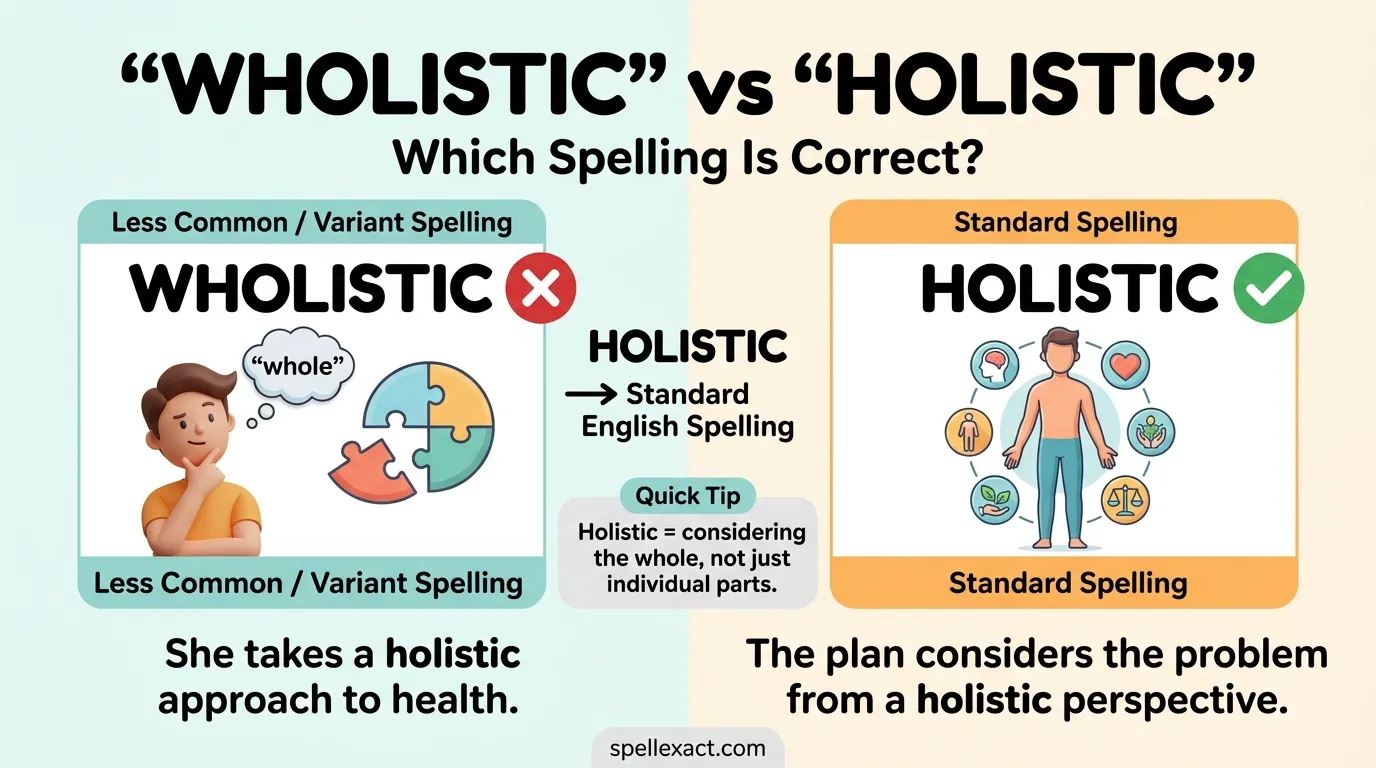
Holistic is the standard and preferred spelling. It means considering a person, system, or situation as a whole rather than focusing only on individual parts. Wholistic is a less common variant that carries essentially the same idea. In most formal and everyday writing, use holistic.
Why Do People Confuse It?
The confusion mainly comes from the meaning of the word. Holistic is related to the idea of a whole, so it can seem logical to spell it as wholistic.
The spelling holistic, however, is the established form. It comes from holism, a concept that emphasizes the importance of looking at a complete system rather than examining its parts separately.
Because whole begins with “wh,” some writers naturally add the “w” when spelling holistic. This produces wholistic, which does appear in some dictionaries and published writing, but it is considerably less common.
For clear, standard writing, holistic is generally the better choice.
First Word: Holistic
Holistic is the standard spelling.
It describes an approach that considers the complete person, system, situation, or problem instead of concentrating on only one part.
For example:
- A holistic approach to health considers physical, emotional, and social well-being.
- A teacher may use a holistic approach to education by considering a student’s academic and personal development.
- A company may take a holistic view of customer experience by considering every stage of a customer’s interaction with the business.
Meaning of Holistic
Holistic means looking at something as a complete whole, with its different parts considered together.
The word is commonly used with terms such as:
- holistic health
- holistic approach
- holistic care
- holistic education
- holistic development
- holistic treatment
- holistic view
- holistic solution
- holistic perspective
Examples of Holistic
We need a holistic approach to solving this problem.
The doctor discussed a holistic approach to health.
The school focuses on the holistic development of its students.
Second Word: Wholistic
Wholistic is a much less common spelling that is sometimes used as a variant of holistic.
It is formed in a way that makes its connection with the word whole more obvious. Some dictionaries and sources recognize its use, but it is far less common than holistic.
For most readers, holistic will look more familiar and standard.
Meaning of Wholistic
Wholistic generally expresses the same basic idea as holistic: considering something in its entirety rather than focusing on isolated parts.
For example:
The program takes a wholistic approach to student development.
The meaning is understandable, but holistic approach would normally be the more conventional choice.
Examples of Wholistic
The organization promotes a wholistic view of wellness.
She believes in a wholistic approach to education.
The program provides wholistic care for families.
Although these examples are understandable, replacing wholistic with holistic would usually make the wording more conventional.
Holistic vs Wholistic: Comparison Table
| Feature | Holistic | Wholistic |
| Standard spelling | Yes | Less common variant |
| Meaning | Considering something as a whole | Generally the same |
| Common in modern English | Very common | Much less common |
| Formal writing | Preferred | Usually avoided |
| Common phrases | Holistic approach, holistic health | Wholistic approach, wholistic health |
| Best choice for most readers | Yes | No |
| Related word | Holism | Whole |
When Should You Use Each?
Use “Holistic” in Most Situations
Choose holistic when you want the conventional spelling for:
- Academic writing
- Business writing
- School assignments
- Websites and articles
- Healthcare discussions
- Professional communication
- General English
For example:
The company needs a holistic strategy for improving customer satisfaction.
When Might “Wholistic” Appear?
You may encounter wholistic in certain organizations, publications, educational materials, or wellness-related contexts.
It can also appear when a writer deliberately emphasizes the word whole.
For example:
The center takes a wholistic approach to personal development.
If you are choosing the spelling yourself, however, holistic is usually the clearer and more widely recognized option.
10+ Examples of Holistic in Sentences
Here are practical examples showing how holistic is commonly used:
- The doctor recommended a holistic approach to improving the patient’s overall well-being.
- The school promotes the holistic development of every student.
- We need a holistic solution rather than a temporary fix.
- The company adopted a holistic approach to employee development.
- She takes a holistic view of health and wellness.
- The therapist considers the patient’s needs from a holistic perspective.
- Good education should support the holistic growth of children.
- The team developed a holistic strategy for addressing the problem.
- A holistic approach to nutrition considers a person’s overall lifestyle.
- The organization provides holistic care for its clients.
- The manager took a holistic look at the company’s performance.
- The program focuses on the holistic development of young people.
Common Mistakes
One of the most common mistakes is assuming that holistic should contain the letters “wh” because it refers to a whole.
For example:
❌ We need a wholistic approach to the problem.
✅ We need a holistic approach to the problem.
Another mistake is assuming that wholistic and holistic are completely different concepts. In most contexts, they communicate essentially the same idea.
You should also avoid switching between the two spellings within the same document. If you are using the conventional form, consistently use holistic.
Common Incorrect or Less-Preferred Forms
- wholistic approach → holistic approach
- wholistic health → holistic health
- wholistic care → holistic care
- wholistic development → holistic development
- wholistic solution → holistic solution
Memory Trick
A simple way to remember the preferred spelling is:
Holistic = whole idea, but no “w.”
Think of holistic as the standard spelling you should normally use when you mean “considering the whole.”
You can remember it like this:
Holistic looks shorter, but it still means the whole thing.
This can help you avoid adding the unnecessary w.
American vs British English
There is no major American-versus-British spelling difference between holistic and wholistic.
Holistic is widely used in both American and British English.
For example:
- American English: a holistic approach
- British English: a holistic approach
The word is used internationally in contexts such as healthcare, education, psychology, business, and personal development.
Wholistic may appear in different varieties of English, but it remains much less common than holistic.
Similar Words
Several words and phrases are closely related to holistic:
Comprehensive
Comprehensive means covering a subject thoroughly or including many relevant parts.
We need a comprehensive review of the project.
Whole
Whole means complete or containing all parts.
We should consider the whole situation.
Integrated
Integrated describes things that are combined so they work together.
The hospital provides integrated healthcare services.
Complete
Complete means having all necessary parts.
We need a complete understanding of the problem.
Systemic
Systemic relates to an entire system rather than a single isolated part.
The organization needs to address the systemic causes of the problem.
These words can overlap with holistic, but they are not always interchangeable.
Final Verdict
Holistic is the standard and preferred spelling for most English writing. It describes an approach that considers a person, problem, system, or situation as a whole.
Wholistic is a much less common variant with essentially the same general meaning. If you are writing an essay, article, professional document, school assignment, or website content, holistic is normally the better choice.
Frequently Asked Questions
Is “wholistic” a correct word?
Wholistic is found in English and is used by some writers as a variant of holistic. However, it is much less common. Holistic is the standard choice for most writing.
Is “holistic” or “wholistic” correct?
Both forms can be found in English, but holistic is the conventional and much more widely used spelling. Use holistic when you want the standard form.
Why is holistic spelled without a W?
Holistic comes from holism, which refers to considering something as a whole. Although its meaning is connected with “whole,” the standard spelling does not include a w.
What does holistic mean?
Holistic means considering something as a complete whole rather than focusing only on separate parts.
Is holistic formal English?
Yes. Holistic is widely used in formal and professional contexts, including education, healthcare, business, psychology, and social sciences.
What is a holistic approach?
A holistic approach considers multiple related aspects of a person, problem, or system instead of examining only one part.
Can I use wholistic in academic writing?
You may encounter wholistic in published material, but holistic is generally the more conventional choice for academic and professional writing.
Is holistic the same as whole?
They are related but not identical. Whole is an adjective or noun referring to completeness, while holistic describes an approach that considers the complete system or situation.
Remember This
Holistic = the standard spelling
Wholistic = a much less common variant
If you are unsure which one to use, choose holistic.
Conclusion
The main difference between holistic and wholistic is not their basic meaning but their usage and spelling preference. Both can refer to considering something as a whole, but holistic is far more common and is the conventional form used in modern English.
For schoolwork, professional communication, websites, and everyday writing, holistic is the safest choice. Remember that although the word relates to the idea of a “whole,” the standard spelling is holistic, without a w.

Caleb Carter is a passionate language enthusiast and content writer specializing in spelling mistakes, grammar, and vocabulary. He creates clear, practical guides that help readers improve their writing skills and communicate confidently every day.