If you have ever paused while writing the word “prefer” and wondered whether it should be spelled “perfer,” you are not alone. This is a surprisingly common spelling mistake, especially because the incorrect version can look and sound natural when written quickly.
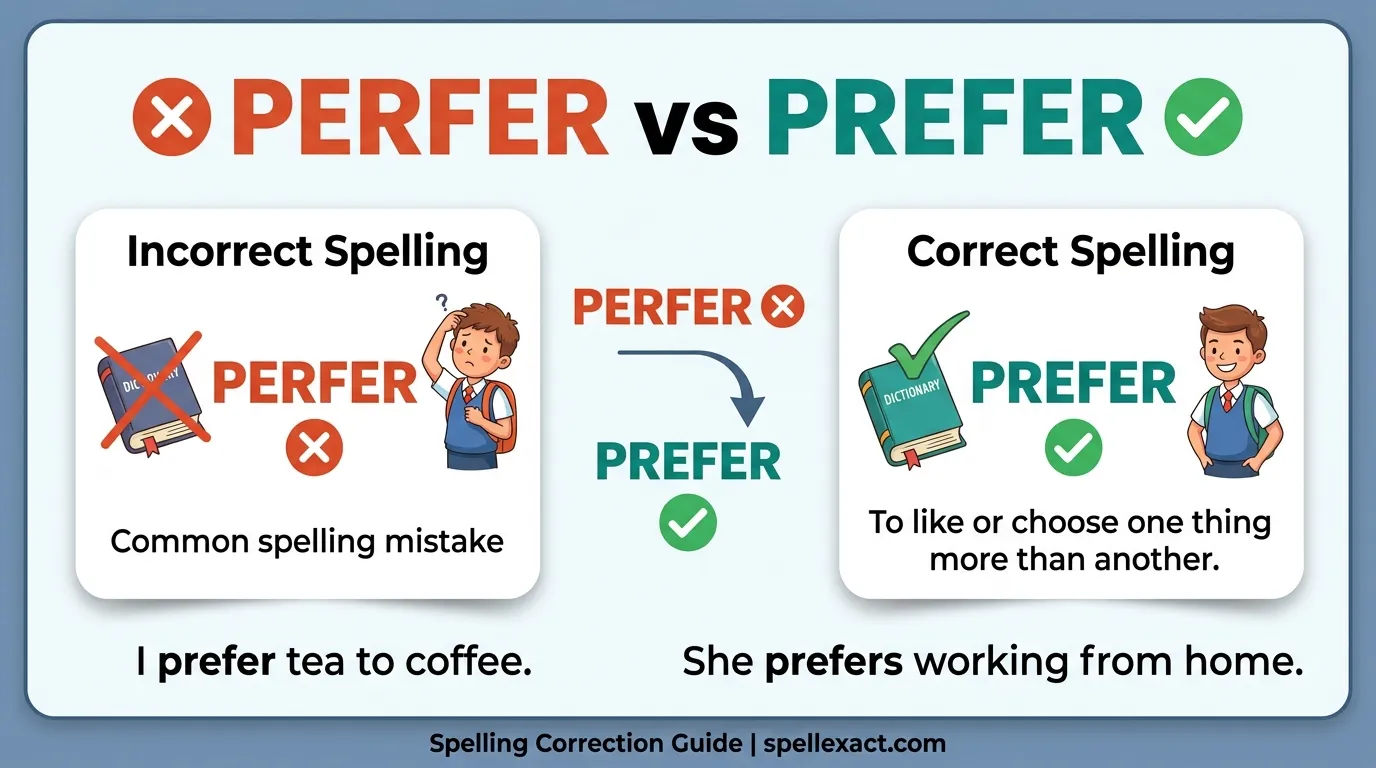
So, perfer vs prefer—which one is correct? The correct spelling is prefer. “Perfer” is a misspelling and should not be used in standard English. In this guide, you will learn the meaning of prefer, see practical examples, understand why “perfer” is incorrect, and discover an easy way to remember the right spelling.
Quick Answer:
Prefer is the correct spelling.
Perfer is incorrect and is commonly written by mistake.
- ✅ Prefer — correct
- ❌ Perfer — incorrect
- Meaning: To like or choose one thing more than another
- Past tense: Preferred
- Noun: Preference
- Adjective: Preferable
Example:
“I prefer tea to coffee.”
If you are writing an email, essay, blog post, resume, school assignment, or professional document, always use prefer.
What Does Prefer Mean?
The verb prefer means to like, choose, or favor one person or thing more than another. It is used when you have a stronger choice or liking for something.
For example:
“I prefer walking to driving.”
This means the speaker likes walking more than driving or would rather walk than drive.
You can use prefer in everyday conversations as well as formal writing. It is a very common English verb and appears frequently in sentences involving choices, opinions, habits, and personal preferences.
More examples of prefer:
- I prefer tea in the morning.
- She prefers working from home.
- We prefer the blue design.
- He prefers summer to winter.
- They prefer to travel by train.
- I would prefer to stay home tonight.
The word can describe a simple personal choice or a more formal preference.
What Does Perfer Mean?
Perfer is not the standard English spelling of the word.
When someone writes “perfer,” they almost always mean prefer. The extra r after the “pe” is a spelling error.
For example:
❌ “I perfer chocolate ice cream.”
The corrected version is:
✅ “I prefer chocolate ice cream.”
Because “perfer” looks close to the correct spelling, it can be easy to overlook during casual writing. However, spelling checkers, teachers, editors, and readers will generally recognize it as an error.
If you frequently make this mistake, there is no need to feel embarrassed. The important thing is to learn the correct spelling and use it consistently.
Prefer vs Perfer: Comparison Table
| Word | Correct? | Meaning | Example |
| Prefer | ✅ Yes | To like or choose something more | I prefer coffee. |
| Perfer | ❌ No | Misspelling of “prefer” | I perfer coffee. ❌ |
The difference is simple: prefer has one “r” after “p” and another “r” at the end: p-r-e-f-e-r.
Why Is “Perfer” a Common Spelling Mistake?
There are several reasons people accidentally write perfer instead of prefer.
One reason is pronunciation. When people say “prefer” quickly, the sounds can blend together, making the spelling less obvious. Another reason is that English contains many words where letters are doubled or repeated, so writers may unconsciously insert an extra r.
Typing quickly can also contribute to the mistake. If you have written “perfer” several times without noticing, your fingers may automatically repeat the same incorrect spelling.
The solution is simple: pay attention to the spelling pattern.
Prefer = P-R-E-F-E-R
There is no second “r” after “p.”
How to Remember the Correct Spelling of Prefer
A useful memory trick is to break the word into parts:
PRE + FER = PREFER
Think of it as:
PRE + FER → PREFER
Not:
PER + FER → PERFER
You can also connect prefer with related words such as:
- Prefer
- Preferred
- Preference
- Preferable
- Preferably
Once you remember the base word prefer, these related forms become easier to recognize.
A simple spelling tip
Remember:
“I prefer the correct spelling.”
The word prefer itself contains “pre” at the beginning. If you start with “per,” you have already gone in the wrong direction.
Examples of Prefer in Everyday Sentences
Understanding the word in context is one of the best ways to remember its spelling.
Personal choices
- I prefer tea without sugar.
- My sister prefers chocolate.
- We prefer quiet restaurants.
- He prefers reading before bed.
Choosing between two things
- I prefer summer to winter.
- She prefers cats to dogs.
- They prefer trains to buses.
- I prefer this option over the other one.
Using “prefer to”
The structure prefer to + verb is very common.
- I prefer to walk to work.
- She prefers to study at night.
- We prefer to eat at home.
- He prefers to work alone.
Using “would prefer”
Would prefer is commonly used when expressing a choice in a particular situation.
- I would prefer tea, please.
- She would prefer to leave early.
- We would prefer a window seat.
- I would prefer to discuss this tomorrow.
Common Mistakes With Prefer
Spelling “prefer” as “perfer” is not the only mistake learners sometimes make. The word can also cause confusion when forming related words.
1. Perfer instead of prefer
❌ I perfer this one.
✅ I prefer this one.
2. Prefered instead of preferred
When prefer becomes a past-tense or participle form, the spelling changes to preferred.
❌ I prefered the first option.
✅ I preferred the first option.
Notice the double r in preferred.
3. Prefering instead of preferring
The -ing form is:
✅ preferring
Not:
❌ prefering
For example:
“She is preferring the new design.”
Although this construction can be grammatically awkward depending on context, the spelling of the form is preferring when the form is required.
4. Confusing preference and prefer
Prefer is a verb:
“I prefer tea.”
Preference is a noun:
“My preference is tea.”
Both are correct, but they serve different grammatical purposes.
Prefer, Preferred, Preference, and Preferable
These related words are worth learning together.
| Word | Part of Speech | Meaning | Example |
| Prefer | Verb | Like or choose more | I prefer tea. |
| Preferred | Verb/adjective | Chosen or liked more | This is my preferred option. |
| Preference | Noun | A choice or liking | Tea is my preference. |
| Preferable | Adjective | More desirable | This option is preferable. |
| Preferably | Adverb | If possible or ideally | Come preferably before noon. |
Learning these forms together can help improve both spelling accuracy and vocabulary.
Is Prefer the Same in American and British English?
Yes. Prefer is spelled the same in both American English and British English.
There is no standard American-versus-British spelling difference such as color/colour or favorite/favourite.
Both varieties use:
- prefer
- preferred
- preferring
- preference
- preferable
- preferably
Therefore, whether you are writing for an American, British, Canadian, Australian, or international audience, prefer is the correct spelling.
Prefer vs Would Rather
Learners sometimes confuse prefer with would rather because both can express a choice.
For example:
“I prefer tea to coffee.”
You can also say:
“I would rather drink tea than coffee.”
Both communicate a preference, but their grammatical structures are different.
Prefer
Prefer + noun + to + noun
I prefer tea to coffee.
Prefer + to + verb
I prefer to walk.
Would rather
Would rather + base verb
I would rather walk.
Using the correct structure makes your English sound more natural and polished.
When Should You Use Prefer?
Use prefer whenever you want to communicate that you like, favor, or choose one thing more than another.
It works well in many situations:
- Personal preferences
- Food and drinks
- Travel choices
- Workplace communication
- Customer service
- Academic writing
- Everyday conversation
- Formal correspondence
For example, you might tell a restaurant:
“I prefer a table near the window.”
Or tell a colleague:
“I prefer to discuss the project tomorrow.”
It is a flexible word that fits both casual and professional English.
Frequently Asked Questions
Is “perfer” a correct English word?
No. Perfer is generally considered a misspelling of prefer. The correct word is prefer.
Which is correct: perfer or prefer?
Prefer is correct. Perfer is incorrect.
How do you spell prefer?
The correct spelling is P-R-E-F-E-R: prefer.
What is the past tense of prefer?
The past tense is preferred, with a double r.
Example:
“She preferred the original plan.”
What is the noun form of prefer?
The noun form is preference.
Example:
“Everyone has a different preference.”
Is “prefer” spelled differently in British English?
No. Prefer has the same spelling in American and British English.
Why do people spell prefer as perfer?
“Perfer” is usually a spelling mistake caused by pronunciation, fast typing, or confusion about the letters in the word.
Is “preferred” spelled with two Rs?
Yes. Preferred contains two consecutive r’s before the “e-d” ending:
preferred
This is different from the base form:
prefer
Final Summary
When comparing perfer vs prefer, there is only one correct standard spelling: prefer. The word means to like, favor, or choose one thing more than another. “Perfer” is an incorrect spelling and should be corrected whenever it appears in your writing. Remember the simple pattern PRE + FER = PREFER to avoid the mistake.
It is also helpful to learn the related forms preferred, preferring, preference, preferable, and preferably. While prefer has only one “r” in its base form, preferred and preferring contain a double “r” because of the spelling rules used when adding their endings. Most importantly, whether you use American or British English, the correct spelling remains prefer.
Actionable Takeaway
Before you write perfer, stop and remember:
✅ PREFER = correct
❌ PERFER = incorrect
A quick spelling check today can help make your emails, assignments, blog posts, and professional writing clearer and more polished.

Liam Noah is a passionate language writer at SpellExact, specializing in spelling mistakes, grammar, word confusion, and American vs. British English. He creates clear, practical content that helps readers write and communicate with confidence.