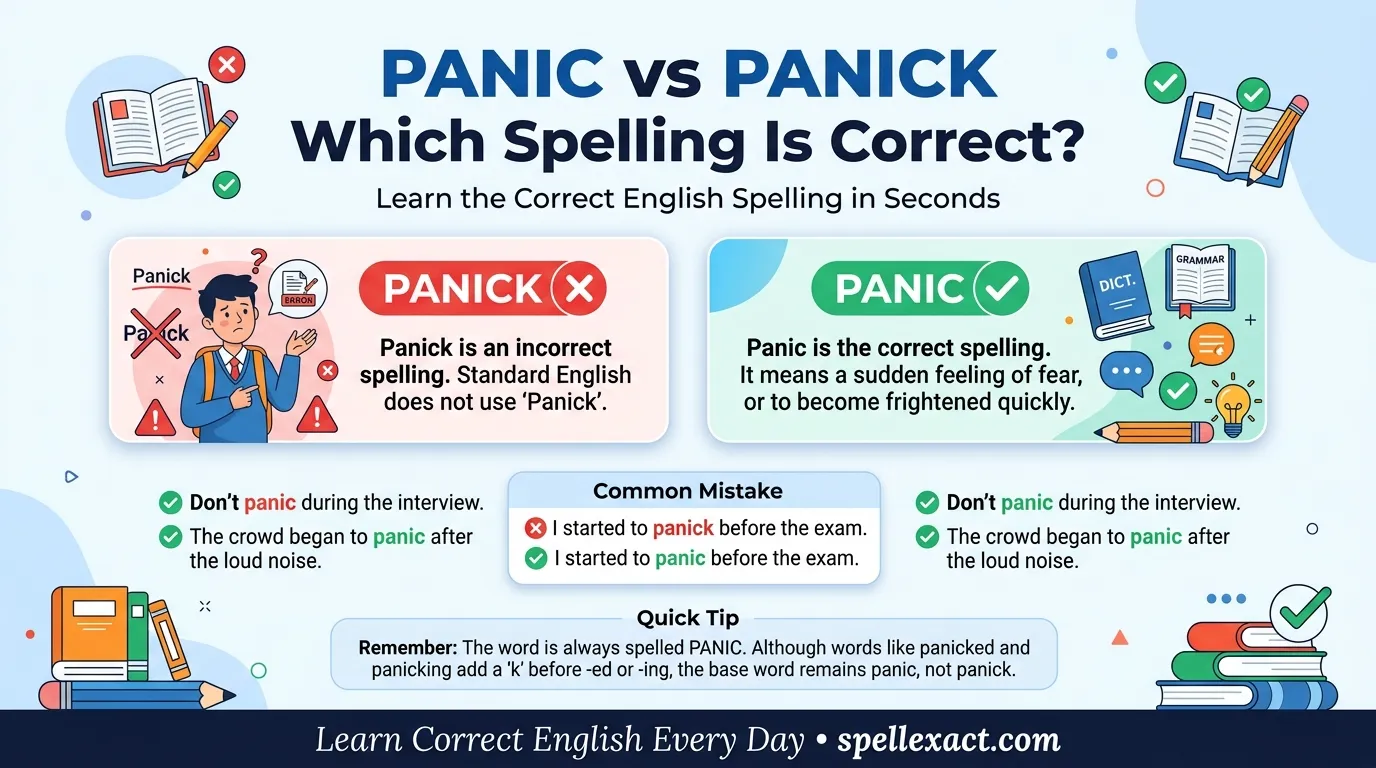
If you’ve searched for panic vs panick, you’re probably wondering which spelling is correct. The short answer is simple: panic is the correct spelling, while panick is a common misspelling. This confusion happens because words like panicked and panicking include an extra k, making many people assume the base word should also end with k.
If you’re a student, writer, teacher, job seeker, or English learner, using the correct spelling improves your writing and helps you communicate more clearly. In this guide, you’ll learn the correct usage, pronunciation, grammar rule, real-life examples, common mistakes, and practical tips to ensure you never confuse panic and panick again.
Quick Answer
Correct Spelling: ✅ Panic
Incorrect Spelling: ❌ Panick
Pronunciation: /ˈpænɪk/ (PAN-ik)
The word panic is the only correct spelling in standard English. The spelling panick does not appear in reputable dictionaries and should never be used as the standalone word. However, the letter k is added in words like panicked, panicking, and panicker to preserve the hard c sound.
Search Intent Answer
| Question | Answer |
| Is panic correct? | ✅ Yes |
| Is panick correct? | ❌ No |
| Is panicked correct? | ✅ Yes |
| Is panicking correct? | ✅ Yes |
| Is panicing correct? | ❌ No |
| Is paniced correct? | ❌ No |
If you remember only one thing from this article, remember this:
Always write “panic” when using the base word.
Panic vs Panick: What’s the Difference?
The difference between panic and panick is simply that one is correct and the other is not.
| Word | Correct? | Meaning |
| Panic | ✅ Yes | A sudden feeling of fear or to become frightened |
| Panick | ❌ No | Incorrect spelling |
Many people mistakenly type panick because they frequently see words like panicked and panicking. In reality, English spelling rules require the extra k only when certain suffixes are added.
What Does “Panic” Mean?
The word panic functions as both a noun and a verb.
Panic as a Noun
As a noun, panic describes a sudden feeling of intense fear, anxiety, or confusion that makes it difficult to think calmly.
Examples:
- Panic spread through the shopping mall after the fire alarm.
- There was no need for panic because everyone was safe.
- Her voice showed signs of panic.
Panic as a Verb
As a verb, panic means to suddenly become frightened or lose control because of fear or uncertainty.
Examples:
- Don’t panic during the interview.
- He began to panic when he couldn’t find his wallet.
- Try not to panic when plans change unexpectedly.
Where Does the Word “Panic” Come From?
The word panic has an interesting history. It comes from the name of Pan, the ancient Greek god of forests and shepherds. According to Greek mythology, Pan was believed to create sudden, unexplained fear in travelers wandering through lonely places. This intense feeling eventually became known as panic.
The word entered the English language centuries ago and has retained its original meaning of sudden fear or overwhelming anxiety. Understanding its origin makes it easier to remember why panic is the correct spelling and why panick has never been part of standard English.
Why Does Google Change “Panick” to “Panic”?
If you’ve searched for panick, you’ve probably noticed that search engines often suggest “Did you mean: panic?”
This happens because:
- Panick is a recognized misspelling.
- Dictionaries list panic as the standard spelling.
- Search engines automatically correct common spelling mistakes to help users find accurate information.
So if Google corrects your search, it’s confirming that panic is the accepted English spelling.
Why Do People Write “Panick”?
This spelling mistake usually happens because people notice these words:
- panicked
- panicking
- panicker
Since each of these contains the letter k, many writers naturally assume the original word should be panick.
However, English spelling follows a pronunciation rule rather than a pattern of simply keeping the same letters in every form.
The base word remains:
panic
When endings like -ed or -ing are added, the extra k keeps the c pronounced as a hard /k/ sound.
Without the k, the pronunciation would change.
Correct:
- panic
- panicked
- panicking
Incorrect:
- panick
- paniced
- panicing
The Grammar Rule Explained
The spelling rule is easier than it looks.
Think of it like this:
panic
↓
panic + ing
↓
panicking
↓
The extra “k” keeps the hard C sound.
The same rule applies when adding -ed.
panic
↓
panic + ed
↓
panicked
Without the k, the pronunciation would sound incorrect.
When Does the Letter “K” Appear?
The k is never part of the original word.
It appears only before certain suffixes.
| Form | Correct |
| panic | ✅ |
| panics | ✅ |
| panicked | ✅ |
| panicking | ✅ |
| panicker | ✅ |
| panick | ❌ |
| paniced | ❌ |
| panicing | ❌ |
This spelling rule applies consistently in modern English.
Real-Life Examples of “Panic”
Seeing the word in different situations helps you remember its correct spelling.
Everyday Conversation
- Don’t panic. We still have plenty of time.
- She started to panic after losing her keys.
- There is no reason to panic.
School and College
- Students often panic before final exams.
- The teacher encouraged everyone not to panic.
- Panic can affect concentration during tests.
Workplace
- The manager reminded the team not to panic.
- Don’t panic when a project becomes challenging.
- Experienced employees stay calm instead of panicking.
Business
- Investors began to panic after the market declined.
- Panic selling can lead to poor financial decisions.
Healthcare
- The doctor explained the symptoms of a panic attack.
- Staying calm helps reduce panic during emergencies.
Travel
- Don’t panic if your flight is delayed.
- She panicked after leaving her passport in the hotel.
Sports
- Good athletes don’t panic under pressure.
- The goalkeeper stayed calm instead of panicking.
Social Media
- Don’t panic because of every rumor you read online.
- People often panic before confirming the facts.
Daily Life
- Parents should avoid panicking in front of children.
- Learning to stay calm reduces unnecessary panic.
Common Misspellings
Many spelling mistakes are closely related to panic.
Avoid these incorrect forms:
- ❌ Panick
- ❌ Paniced
- ❌ Panicing
- ❌ Panik
- ❌ Pannic
Always write:
- ✅ Panic
- ✅ Panicked
- ✅ Panicking
Common Mistakes to Avoid
Here are the mistakes writers make most often.
❌ I started to panick.
✅ I started to panic.
❌ She was panicing before the interview.
✅ She was panicking before the interview.
❌ He paniced after hearing the news.
✅ He panicked after hearing the news.
❌ Everyone was in panick.
✅ Everyone was in panic.
These examples show that the standalone word is always panic, while the k appears only in specific derived forms.
Similar Words That Follow the Same Spelling Rule
The spelling pattern used in panic is not unique. Many English words ending in -ic add the letter k before suffixes such as -ed, -ing, or -er to keep the hard c sound.
| Base Word | Past Tense | -ing Form |
| panic | panicked | panicking |
| picnic | picnicked | picnicking |
| frolic | frolicked | frolicking |
| mimic | mimicked | mimicking |
| traffic | trafficked | trafficking |
Learning this pattern helps you avoid spelling mistakes in many commonly used English words, not just panic.
Similar Spelling Confusions
English has many words that confuse writers because their spelling changes slightly when suffixes are added. Understanding these patterns improves your grammar and writing skills.
Examples include:
- Panic vs. Panick
- Picnic vs. Picnick
- Mimic vs. Mimick
- Frolic vs. Frolick
- Traffic vs. Traffick
In each case, the base word does not end with k. The extra k appears only before certain suffixes to preserve pronunciation.
American vs. British English
Many spelling differences exist between American and British English, such as color/colour or center/centre. However, panic is not one of them.
Both American and British English use exactly the same spelling.
| English Variety | Correct Spelling |
| American English | panic |
| British English | panic |
| Canadian English | panic |
| Australian English | panic |
The same rule applies worldwide:
- ✅ panic
- ✅ panicked
- ✅ panicking
- ❌ panick
There is no regional variation for this word.
Expert Writing Tip
Professional editors and proofreaders recommend checking unfamiliar words in a trusted dictionary rather than relying solely on autocorrect. While spell-check tools often catch obvious errors, understanding the spelling rule behind panic helps you avoid repeating the same mistake in future writing.
A good habit is to remember the base word first. Once you know the correct base spelling, adding the appropriate suffix becomes much easier.
Key Takeaways
Before you leave, remember these important points:
- ✅ Panic is the correct spelling.
- ❌ Panick is always incorrect.
- ✅ Panicked and panicking are correct derived forms.
- ❌ Paniced and panicing are incorrect spellings.
- The extra k is added only before certain suffixes.
- This rule applies in both American and British English.
- Learning the -ic spelling pattern will help you spell similar words correctly.
Quick Practice Quiz
Test your understanding with these simple questions.
1. Which spelling is correct?
- ✅ Panic
- ❌ Panick
2. Which sentence is correct?
- ✅ She panicked after missing the train.
- ❌ She paniced after missing the train.
3. Which spelling is correct?
- ✅ Panicking
- ❌ Panicing
4. Which word is accepted in standard English?
- ✅ Panic
- ❌ Panick
If you answered all four correctly, you’ve mastered one of the most common English spelling confusions.
Frequently Asked Questions (FAQs)
1. Is panic or panick correct?
Panic is the correct spelling. Panick is a common misspelling and is not accepted in standard English dictionaries.
2. Why does panicked have a k?
The k is added before -ed to keep the c pronounced as a hard /k/ sound. This follows a standard English spelling rule for many words ending in -ic.
3. Is panicking spelled with one k?
Yes. The correct spelling is panicking with one k. The form panicing is incorrect.
4. Is panic a noun or a verb?
It can be both. As a noun, it refers to sudden fear or anxiety. As a verb, it means to become frightened or lose composure because of fear.
5. Is panick used in British English?
No. British English also uses panic. There is no regional spelling difference between British and American English for this word.
6. Why do so many people misspell panic?
Many people assume the base word ends with k because they frequently see panicked and panicking. However, the extra k is added only when specific suffixes are attached.
7. How can I remember the correct spelling?
A simple memory trick is:
“Panic stands alone. K joins only before -ed, -ing, or -er.”
This makes it easy to remember when the extra letter is needed.
8. What is the correct spelling of panic attack?
The correct phrase is panic attack. Writing panick attack is always incorrect.
Final Thoughts
If you’ve ever hesitated between panic and panick, you now know the correct answer with confidence. Panic is the only accepted spelling of the base word in modern English, while panick is simply a spelling mistake. The extra k appears only in forms such as panicked, panicking, and panicker, where it preserves the hard c sound. Understanding this simple rule eliminates confusion and helps you write more accurately.
Small spelling mistakes can affect the clarity and professionalism of your writing, whether you’re completing school assignments, sending emails, publishing blog posts, or creating business content. By learning the grammar rule, practicing with real-life examples, and remembering the common -ic spelling pattern, you’ll avoid this mistake and strengthen your overall English writing skills.
Actionable Takeaway
Whenever you’re unsure, use this quick checklist:
- Write panic when using the standalone word.
- Add k only in panicked, panicking, and panicker.
- Never write panick, paniced, or panicing.
- Proofread your work before publishing or submitting it.
- When in doubt, verify the spelling in a trusted dictionary.
Following these simple habits will help you write confidently, avoid common spelling mistakes, and improve your grammar and communication skills.

Andrew Anthony is a language enthusiast and content writer specializing in spelling mistakes, grammar, and English usage. He creates clear, practical, and well-researched guides that help readers improve their writing skills with confidence.