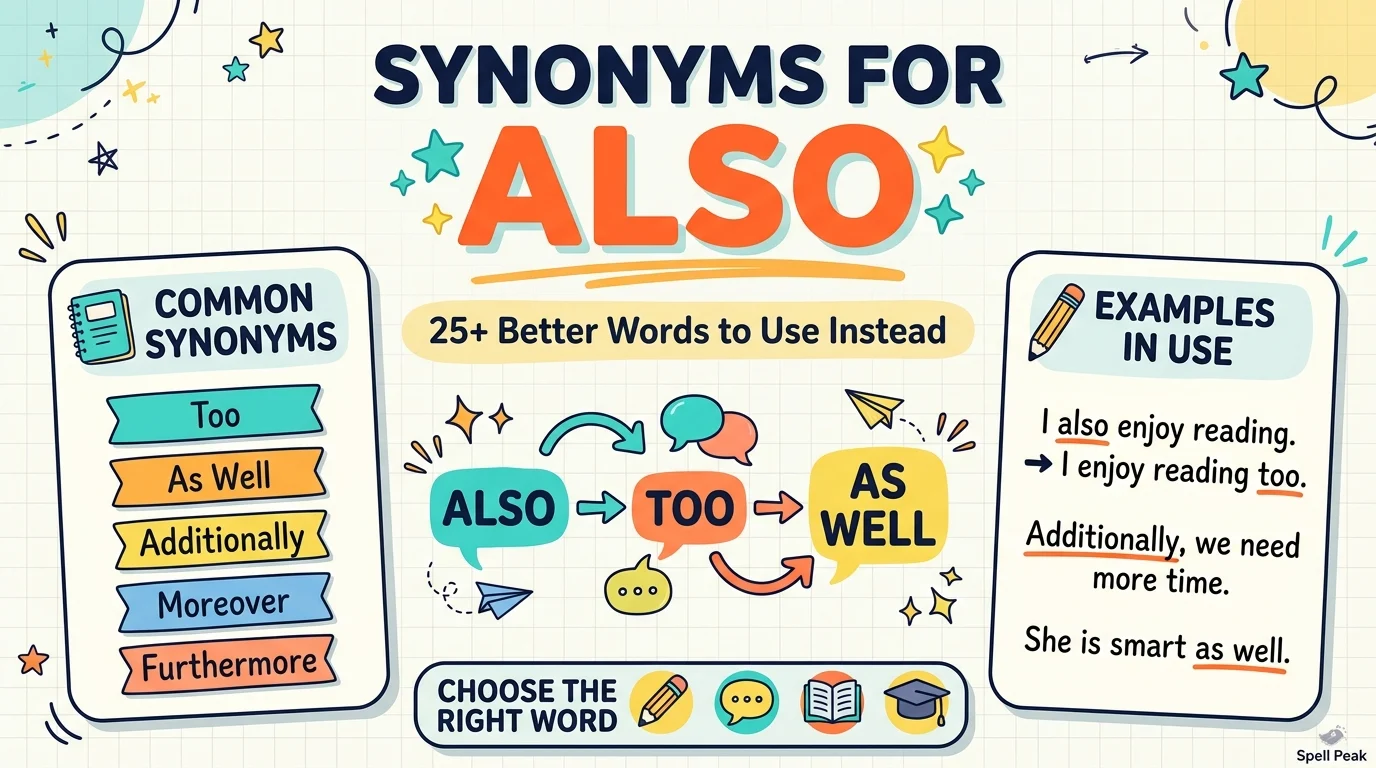
Using synonyms for also can make your writing smoother and more professional when creating essays, articles, or emails, helping you connect ideas naturally. If you need another word for also, this guide introduces easy alternatives that improve sentence flow and reduce repetition. Also is an adverb used to add information or show that something applies in addition to what was just mentioned. From my experience with English writing, choosing the right alternative makes everyday communication clearer and helps each sentence sound more natural.
The word also can appear at the beginning, middle, or end of a sentence, depending on the intended meaning and style. Understanding its definitions and following practical usage tips can help you select the right expression for real-world situations. For example, “She also teaches English” can become “She teaches English as well.” Similarly, “Also, we need more time” can become “Additionally, we need more time.” These alternatives help you present ideas clearly, avoid repeating the same expression, and keep your writing natural.
Quick Answer: What Are the Best Synonyms for Also?
The best direct alternatives also include too, as well, additionally, and in addition. Depending on the sentence, furthermore and moreover can also work when you want to introduce a related supporting point.
Here are the most useful choices:
- Formal writing: Additionally, furthermore, moreover, in addition
- Everyday English: Too, as well
- Professional emails: Additionally, in addition, as well
- Persuasive writing: Moreover, furthermore, what is more
- Comparisons: Similarly, likewise
- Connecting related items: As well as, along with
For most situations, also is already a clear and correct choice. Replace it only when another expression better suits your meaning or sentence structure.
What Does Also Mean?
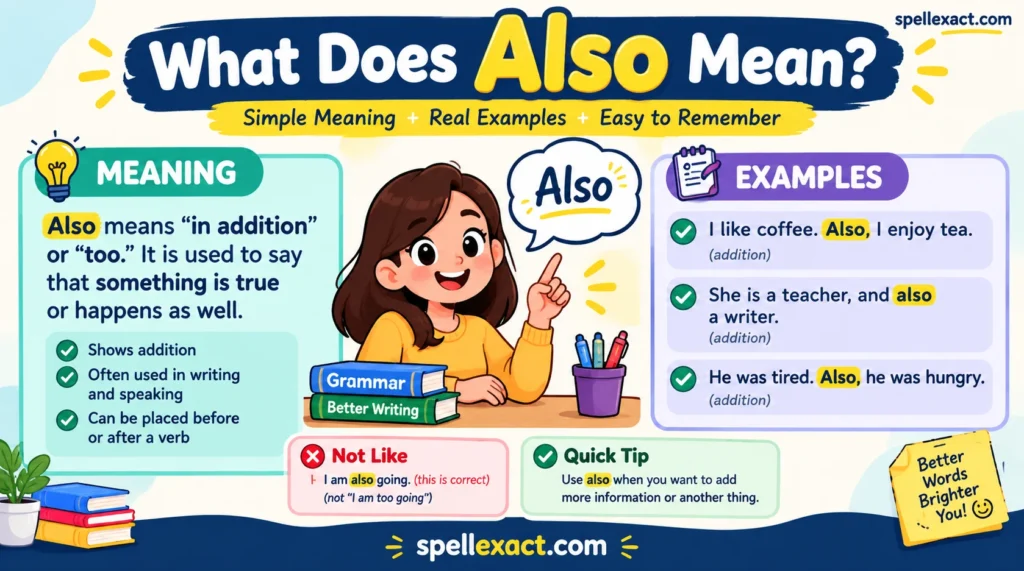
Also is an adverb that means in addition, too, or as well. It indicates that another fact, action, quality, or person is included.
Examples of Also in a Sentence
- She also speaks French.
- I enjoy reading and also like writing.
- The course is affordable and also offers flexible schedules.
- He is a teacher. He is also a talented writer.
In each example, also adds information to the existing statement.
How to Use Also Correctly
The position of also depends on the sentence.
Before the main verb:
She also works on weekends.
After the verb “be”:
He is also a skilled photographer.
After an auxiliary verb:
They have also completed the assignment.
At the beginning of a sentence:
Also, remember to check your spelling.
The final example is grammatically possible, although beginning with also can sound less natural when the connection between the sentences is not clear.
30 Synonyms for Also With Meanings and Examples
Not all 30 expressions below are interchangeable with also. To help you choose accurately, they are divided into direct alternatives, transitions, expressions of similarity, and context-dependent phrases.
Group 1: Direct Synonyms for Also
These are the most useful options when your goal is simply to add information.
1. Too
Meaning: Also or in addition.
Example: I want to learn Spanish, too.
Best usage: Everyday conversation, informal writing, and friendly messages.
Usage tip: Too commonly appears at the end of a clause or sentence. It can appear elsewhere when the writer wants to emphasize a particular word.
2. As Well
Meaning: In addition; also.
Example: She will attend the workshop as well.
Best usage: Everyday English, emails, and general writing.
Usage tip: It often appears at the end of a clause. Compare “She also teaches French” with “She teaches French as well.”
3. Additionally
Meaning: Adding another fact or piece of information.
Example: Additionally, students receive free access to the online library.
Best usage: Formal essays, reports, presentations, and professional communication.
Usage tip: Use it to introduce an extra point that relates to the existing discussion.
4. In Addition
Meaning: Including something extra.
Example: In addition, the company provides free customer support.
Best usage: Academic writing, business documents, reports, and explanatory articles.
Usage tip: It often introduces a separate sentence containing additional information.
5. Furthermore
Meaning: In addition to what has already been said, often to provide further support.
Example: The software is easy to use. Furthermore, it protects sensitive information.
Best usage: Academic essays, research papers, formal reports, and reasoned arguments.
Usage tip: It is especially useful when the next point strengthens the previous one.
6. Moreover
Meaning: Introducing an additional point that reinforces an earlier statement.
Example: The school has experienced teachers. Moreover, it offers modern learning facilities.
Best usage: Formal writing, persuasive arguments, and professional reports.
Usage tip: Use it when the additional information adds weight to your argument, rather than simply listing an unrelated fact.
7. Plus
Meaning: In addition to something else.
Example: The apartment is spacious, plus it is close to public transport.
Best usage: Informal writing, conversations, reviews, and approachable content.
Usage tip: Plus is more conversational than additionally. In formal writing, consider a more neutral alternative.
8. Besides
Meaning: In addition to something; also used to introduce another reason.
Example: Besides English, he studies mathematics and science.
Best usage: Conversations, explanations, and informal arguments.
Usage tip: Besides can also mean “apart from,” so make sure your sentence communicates the intended meaning.
9. What Is More
Meaning: Introducing another point that adds strength or importance to the previous statement.
Example: The book is affordable. What is more, it includes practical exercises.
Best usage: Reviews, persuasive articles, presentations, and general writing.
Usage tip: This phrase is similar to moreover, but it can sound more conversational.
10. On Top of That
Meaning: In addition to everything already mentioned.
Example: The bus was late, and on top of that, it started raining.
Best usage: Informal conversations, personal stories, and blog posts.
Usage tip: It often introduces an additional problem, inconvenience, or unexpected benefit.
Group 2: Synonyms and Transitions for Specific Contexts
These expressions can communicate addition, but their meanings or grammatical roles are more specific.
11. As Well As
Meaning: In addition to; together with.
Example: She teaches grammar as well as vocabulary.
Best usage: Connecting related subjects, activities, qualities, or items within a sentence.
Usage tip: As well as is not a universal replacement for also. Compare:
- She also teaches French.
- She teaches French as well as Spanish.
The first adds another action or fact. The second connects two subjects she teaches.
12. Along With
Meaning: Together with or accompanied by something.
Example: The teacher provided worksheets along with a reading list.
Best usage: Describing accompanying people, items, services, or activities.
Usage tip: It usually connects nouns or noun phrases rather than functioning as a general sentence transition.
13. Together With
Meaning: In company with or in combination with something.
Example: The manager, together with her team, prepared the annual report.
Best usage: Professional writing and descriptions of joint activities.
Usage tip: The phrase emphasizes association or participation, not simply an additional fact.
14. Coupled With
Meaning: Combined with another factor, often to produce an effect.
Example: Regular practice, coupled with helpful feedback, can improve writing.
Best usage: Academic explanations, analytical writing, and professional reports.
Usage tip: Use it when two factors work together or contribute to a result.
15. Combined With
Meaning: Joined or used together with something else.
Example: Clear instructions, combined with practical examples, make lessons easier to understand.
Best usage: Educational writing, reports, and explanations of methods.
Usage tip: It emphasizes the combined effect of two elements rather than simply adding information.
16. Not Only … But Also
Meaning: A grammatical structure that emphasizes two connected facts, actions, or qualities.
Example: She is not only hardworking but also highly creative.
Best usage: Academic writing, persuasive statements, speeches, and descriptions.
Usage tip: Keep the two connected elements grammatically parallel. For example, “She not only writes articles but also edits videos.”
17. Not to Mention
Meaning: Introducing an additional detail worth considering.
Example: The hotel is comfortable, not to mention conveniently located.
Best usage: Reviews, descriptions, and conversational writing.
Usage tip: It often highlights an extra advantage or detail that makes the subject more appealing.
18. Over and Above
Meaning: In addition to something already included or expected.
Example: The employee received a bonus over and above her regular salary.
Best usage: Discussions of extra benefits, payments, responsibilities, and amounts.
Usage tip: This is a context-specific expression, not a general substitute for also.
19. Beyond That
Meaning: In addition to what has already been discussed.
Example: The course teaches grammar. Beyond that, it helps students develop confidence.
Best usage: Explanatory writing, presentations, and discussions that extend an earlier point.
Usage tip: It often suggests moving beyond the original topic or benefit.
20. Further
Meaning: Additional or more, depending on the sentence.
Example: Please contact the office for further information.
Best usage: Formal instructions and expressions such as further details, further research, and further assistance.
Usage tip: Further usually means “more” or “additional.” It is not normally a direct replacement for also.
21. Another
Meaning: One more or an additional person or thing.
Example: We need another example to understand the rule.
Best usage: Introducing an extra item, option, reason, or example.
Usage tip: Another is a determiner or pronoun, depending on its use. It normally needs a noun when used as a determiner, so it cannot replace also directly.
22. Additional
Meaning: Extra or added to what already exists.
Example: The teacher provided additional practice questions.
Best usage: Educational materials, instructions, reports, and product descriptions.
Usage tip: Additional is an adjective. Use also to add an action or fact, and additional to describe something extra.
23. Further to That
Meaning: In addition to the matter already mentioned.
Example: Further to that, we should review the updated guidelines.
Best usage: Some formal discussions and professional correspondence.
Usage tip: This phrase can sound stiff or unnatural in general writing. In most cases, in addition or furthermore is clearer.
Group 3: Expressions That Show Similarity
These expressions are useful when two ideas are alike. They are not exact synonyms for also in every sentence.
24. Likewise
Meaning: In a similar way or under similar circumstances.
Example: The first student completed the assignment. Likewise, the second student submitted it on time.
Best usage: Comparisons, formal discussions, and situations involving similar actions.
Usage tip: Use it when the second situation resembles the first, not merely when you want to add a new fact.
25. Similarly
Meaning: In a way that resembles something else.
Example: Reading improves vocabulary. Similarly, regular writing strengthens language skills.
Best usage: Academic writing, comparisons, and educational explanations.
Usage tip: It works best when the relationship between two ideas involves similarity.
26. Equally
Meaning: To the same degree or with the same importance.
Example: Grammar is important, and pronunciation is equally important.
Best usage: Comparisons, balanced arguments, and discussions of equal importance.
Usage tip: Equally expresses degree or importance. It does not simply mean “another thing.”
27. In the Same Way
Meaning: Using a similar method or following a comparable pattern.
Example: Children learn new words through reading. In the same way, adults can expand their vocabulary through regular practice.
Best usage: Educational articles, explanations, and comparisons.
Usage tip: Use this expression when you want to show how one process resembles another.
28. By the Same Token
Meaning: For a similar reason or according to the same reasoning.
Example: A clear introduction helps readers understand an article. By the same token, a clear conclusion helps them remember its main message.
Best usage: Analytical writing, reasoned arguments, and formal discussions.
Usage tip: This phrase introduces a parallel argument or conclusion rather than a simple addition.
Group 4: General Expressions That Can Add Information
29. And
Meaning: A conjunction that connects words, phrases, or related ideas.
Example: She writes articles and creates educational videos.
Best usage: Everyday English, natural sentence construction, and lists of related actions.
Usage tip: And can communicate addition, but it is not an adverb and cannot replace also in every grammatical position.
30. Not to Forget
Meaning: An expression used to draw attention to another detail that deserves consideration.
Example: The city has excellent museums, not to forget its beautiful parks.
Best usage: Informal descriptions and conversational lists.
Usage tip: This expression can sound awkward in some sentences. A more natural version might be: “The city has excellent museums, and its beautiful parks are worth visiting, too.”
Comparison Table: Also vs. Too vs. As Well vs. Moreover
Understanding the differences between similar words helps you choose the right alternative without changing your intended meaning.
| Word or phrase | Main function | Typical tone | Example |
| Also | Adds information | Neutral | She also teaches English. |
| Too | Adds information | Neutral/informal | She teaches English, too. |
| As well | Adds information | Neutral | She teaches English as well. |
| Additionally | Introduces another fact | Formal | Additionally, she teaches French. |
| In addition | Adds a related point | Neutral/formal | In addition, she offers online classes. |
| Furthermore | Strengthens a related point | Formal | Furthermore, she has teaching experience. |
| Moreover | Reinforces an argument | Formal | Moreover, she develops learning materials. |
| Besides | Adds a point or reason | Conversational | Besides English, she teaches French. |
| Likewise | Shows a similar situation | Neutral/formal | Likewise, her colleague teaches French. |
| Similarly | Establishes a comparison | Neutral/formal | Similarly, both courses include exercises. |
| Plus | Adds another point | Informal | Plus, the lessons are affordable. |
| As well as | Connects related elements | Neutral | She teaches English as well as French. |
Which Synonyms Can Replace Also Directly?
Consider these examples:
Original: She also enjoys reading.
- She enjoys reading, too. — Direct alternative.
- She enjoys reading as well. — Direct alternative.
- Additionally, she enjoys reading. — Suitable, particularly when adding a separate point.
- Moreover, she enjoys reading. — Possible, but usually requires a context in which the information reinforces an argument.
- She enjoys reading as well as writing. — Different meaning because it introduces another activity.
This is the most important distinction: an expression can be related to also without being an interchangeable synonym.
How to Choose the Right Synonym for Also
The best choice depends on your tone, meaning, and purpose.
1. For Academic Writing and Essays
Use additionally, furthermore, moreover, or in addition when they accurately express the relationship between your ideas.
Example:
Original: Regular reading improves vocabulary. It also develops comprehension skills.
Revised: Regular reading improves vocabulary. Furthermore, it develops comprehension skills.
The second version sounds more formal, although the original is also correct.
For IELTS essays and other academic assignments, focus on logical connections rather than inserting formal transition words into every paragraph.
2. For Professional Emails
Professional alternatives to also include additionally, in addition, and as well.
Examples:
- Additionally, please review the attached document.
- In addition, we need your approval before Friday.
- We can provide technical support as well.
Choose concise language that helps the recipient understand the message quickly.
3. For Everyday Conversations
Use too, as well, or plus when speaking casually.
Examples:
- I want to join, too.
- Can you send me the notes as well?
- Plus, we have enough time.
These expressions generally sound more natural in everyday English than furthermore or moreover.
4. For Persuasive Writing
Use moreover, furthermore, or what is more when the additional point supports your argument.
Example:
The service is affordable. Moreover, it offers flexible payment options.
The second point strengthens the positive description of the service.
5. For Comparing Similar Ideas
Choose similarly, likewise, or in the same way when the ideas share a meaningful similarity.
Example:
The first method improves reading speed. Similarly, the second method helps readers process information more efficiently.
Avoid using these expressions merely to introduce unrelated information.
6. For Connecting Related Items
Use along with, as well as, or together with when connecting people, things, or activities.
Example:
The course includes grammar lessons along with practical writing exercises.
This structure works naturally because the phrase connects related components of the course.
Common Mistakes When Using Synonyms for Also
Mistake 1: Treating Every Alternative as Interchangeable
Incorrect: She is similarly a doctor and a teacher.
Better: She is both a doctor and a teacher.
Or: She is a doctor and also a teacher.
Similarly indicates a comparison, not simply the presence of another role.
Mistake 2: Placing Too in an Awkward Position
Natural: I like this book, too.
Also correct, with emphasis: I, too, like this book.
The position of too can change which part of the sentence receives emphasis.
Mistake 3: Confusing As Well With As Well As
Incorrect: She as well as studies English.
Correct: She studies English as well.
Also correct: She studies English as well as French.
The first correct sentence adds information. The second connects two subjects.
Mistake 4: Repeating Formal Transitions
Repetitive: Furthermore, the course is affordable. Furthermore, it is flexible. Furthermore, it is convenient.
Better: The course is affordable. It is also flexible and convenient.
Vary your sentence structure instead of replacing every occurrence of also with a formal transition.
Mistake 5: Confusing Also With Additional
Incorrect: She additional works on weekends.
Correct: She also works on weekends.
Another correct sentence: She has additional work on weekends.
Also is an adverb, whereas additional is an adjective.
Mistake 6: Using Moreover Without a Clear Connection
Weak: The office closes at five. Moreover, the sky is cloudy.
Better: The office closes at five. Additionally, visitors must leave the building before closing time.
The improved version introduces information relevant to the original point.
Mistake 7: Adding Unnecessary Synonyms
If also already communicates your meaning clearly, there is no need to replace it.
For example, “She also speaks English” is perfectly natural. Changing it to “Furthermore, she speaks English” may sound unnecessarily formal unless the surrounding context supports that tone.
Good writing prioritizes accuracy, clarity, and natural expression over complicated vocabulary.
Frequently Asked Questions
1. What is another word for also?
Common alternatives include too, as well, additionally, and in addition. Furthermore and moreover can also work when introducing related supporting information.
2. What are five common synonyms for also?
Five common alternatives are too, as well, additionally, in addition, and furthermore. The first two are especially natural in everyday English, while the others are useful in more formal contexts.
3. What is a formal word for also?
Additionally, furthermore, moreover, and in addition are useful formal alternatives. Choose additionally for a neutral extra fact and furthermore or moreover when the next point supports an argument.
4. What is an informal synonym for also?
Too, as well, and plus are useful informal alternatives. For example, “I’m learning English, too” sounds natural in everyday conversation.
5. Can I use furthermore instead of also?
Sometimes. Furthermore is appropriate when introducing an additional point that supports the previous statement. However, also is more flexible and generally works better for simple additions within a sentence.
6. What is the difference between also and too?
Both express addition. Also often appears before the main verb, while too commonly appears at the end of a sentence.
- She also plays tennis.
- She plays tennis, too.
Both sentences are correct.
7. What is the difference between also and in addition?
Both communicate that something extra is included. Also often appears within a sentence, while in addition frequently introduces a separate sentence or point.
Example:
The course teaches grammar. In addition, it provides writing practice.
8. How can I avoid repeating also in an essay?
Choose an alternative according to the relationship between your ideas. Use additionally for extra facts, furthermore for supporting points, similarly for comparisons, and as well as to connect related elements. You can also combine related sentences or remove unnecessary transitions.
Conclusion
Learning synonyms for also helps you improve your vocabulary, write more naturally, and communicate ideas with greater precision. Although too, as well, additionally, in addition, furthermore, and moreover can express addition, each works best in particular situations.
For academic writing, choose formal alternatives when they strengthen the connection between ideas. For professional emails, prioritize clarity and courtesy. For everyday conversations, too and as well are usually natural choices. When comparing ideas, use similarly or likewise, and when connecting related items, consider as well as or along with.
Remember that not every related expression is a direct synonym. Pay attention to meaning, grammatical function, and sentence placement before choosing a replacement.
Ultimately, the best alternative to also is the word or phrase that communicates your intended meaning clearly and naturally.

Aaron Adam is the Administrator of SpellExact, dedicated to helping readers improve their spelling and writing accuracy. He oversees content quality, ensures reliable language resources, and works to make spelling guidance simple, practical, and accessible for everyone.