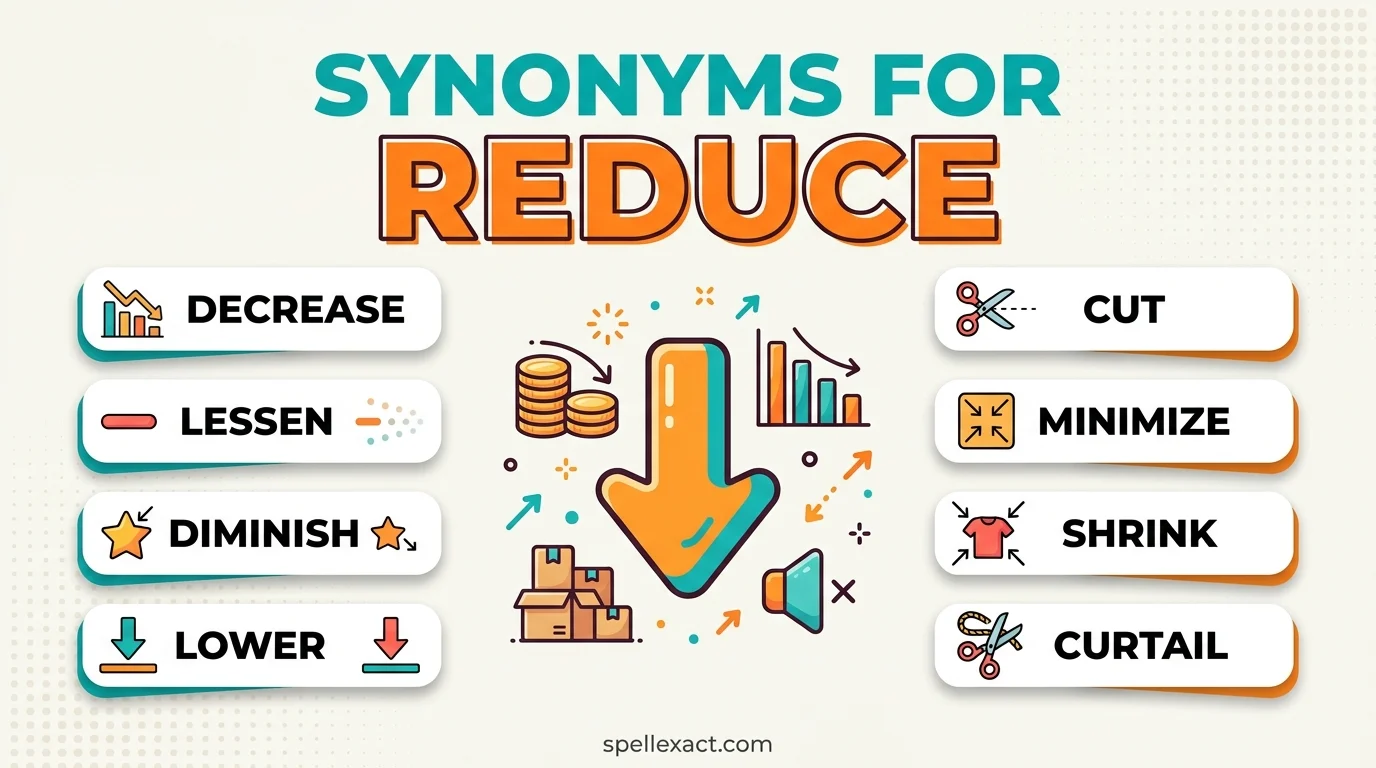
A synonym for the word reduce helps explain how something becomes smaller, lower, weaker, or less important in different situations. Common alternatives include reduce, reduction, decrease, diminish, lessen, cut, decline, drop, and shrink. For example, you can lessen in size a large file, lower a price, decrease value through depreciation, or bring down costs.
The right choice depends on its relevance to the sentence. From my experience with English vocabulary, choosing a precise synonym improves writing, makes it clearer, and helps readers understand the intended meaning.
When choosing among synonyms, consider whether you are describing a position, removing someone from a job, or reducing an amount. Words such as demote, degrade, downgrade, disrate, humiliate, debase, demean, abase, and humble can describe lowering someone’s status or dignity.
Similarly, dismiss, bust, can, sack, break, downsize, lay off, fire, cashier, remove, and terminate may refer to ending employment or eliminating something, depending on the context. Phrases such as lower in rank, downgrade in status, dismiss from employment, and weaken suit a different situation. Selecting words carefully matters because using them incorrectly can change meaning.
Quick Answer: What Is a Synonym for Reduce?
A synonym for reduce is a word that expresses a similar idea, such as making something smaller, lowering an amount, or decreasing the intensity of something.
The most useful alternatives include:
- Decrease: To make an amount or number smaller.
- Lessen: To make something less severe or intense.
- Lower: To bring something down to a lower level.
- Diminish: To make something weaker or less important.
- Cut: To reduce an amount, cost, or quantity.
- Minimize: To make something as small as possible.
- Limit: To set a boundary on an amount or activity.
- Trim: To remove excess or reduce something slightly.
- Mitigate: To make a harmful effect less severe.
- Scale back: To reduce the size or extent of an activity.
Best general synonym: Decrease works in many situations involving amounts, numbers, and levels. For prices, use lower; for stress, use lessen; and for harmful effects, use mitigate.
What Does Reduce Mean?
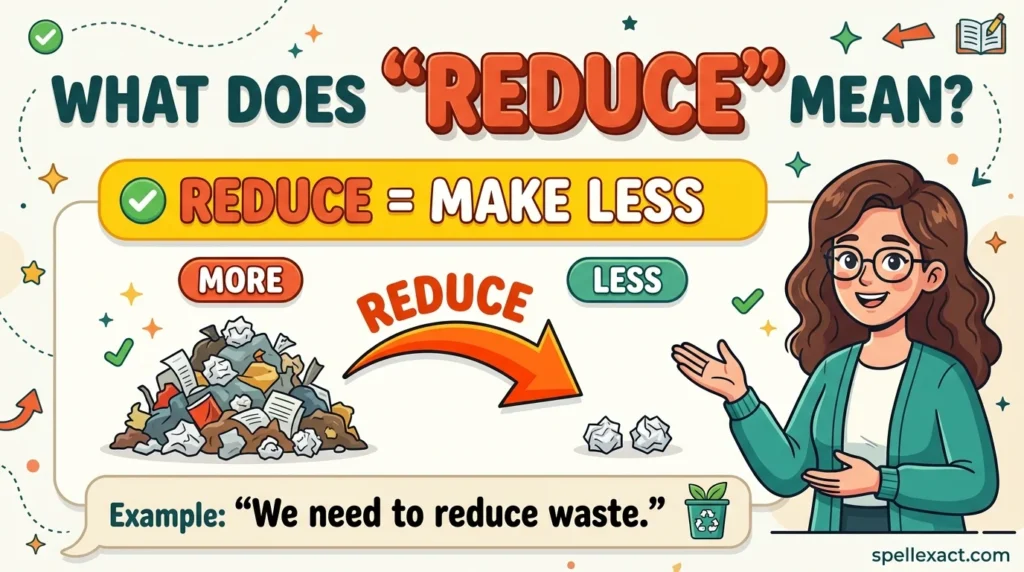
The word reduce is a verb meaning to make something smaller, lower, fewer, weaker, or less intense.
It can describe a change in quantity, cost, size, pressure, risk, or importance.
Simple Definition of Reduce
To reduce something means to make less of it or bring it down to a lower level.
Examples:
- We need to reduce our monthly expenses.
- Regular exercise may help reduce stress.
- The company plans to reduce its energy consumption.
- The teacher reduced the number of questions on the test.
- The city introduced measures to reduce air pollution.
In each example, something becomes smaller, lower, or less than it was before.
Reduce vs. Decrease vs. Lessen
These three words are often interchangeable, but they emphasize different things.
- Reduce: A broad term for making something smaller or less.
- Decrease: A change in an amount, number, or level.
- Lessen: A reduction in intensity, severity, or difficulty.
Compare these examples:
- The company reduced its expenses.
- The number of complaints decreased.
- The new procedure lessened the pressure on employees.
All three sentences describe a reduction, but each word fits its particular context.
30 Synonyms for Reduce With Meanings and Examples
The following list includes common direct synonyms as well as context-specific alternatives. This distinction matters because some words can replace reduce in many sentences, while others work only when the surrounding meaning supports them.
Group 1: Common Direct Synonyms
These words are useful in everyday conversation, school assignments, and general writing.
1. Decrease
Meaning: To make something smaller in amount, number, or degree, or to become smaller.
Example: The school hopes to decrease the number of student absences this year.
Best usage: Numbers, quantities, expenses, temperatures, and statistics.
Common combinations: Decrease spending, decrease the risk, decrease the temperature.
Usage tip: Both “The company decreased its prices” and “Prices decreased” are correct.
2. Lessen
Meaning: To make something less severe, intense, difficult, or painful.
Example: Taking regular breaks can lessen the stress of a busy workday.
Best usage: Stress, pressure, pain, anxiety, and negative effects.
Usage tip: Choose lessen when the main idea is making an unpleasant experience less intense.
3. Lower
Meaning: To bring something down to a lower amount, level, or position.
Example: The store decided to lower its prices before the holiday season.
Best usage: Prices, fees, temperatures, interest rates, and expectations.
Common combinations: Lower costs, lower your voice, lower the temperature.
Usage tip: Lower is one of the most natural alternatives when describing prices or measurable levels.
4. Diminish
Meaning: To make something smaller, weaker, or less important.
Example: Repeated setbacks did not diminish her confidence.
Best usage: Influence, importance, confidence, reputation, and impact.
Usage tip: Diminish often sounds more formal than decrease and works particularly well when discussing abstract ideas.
5. Cut
Meaning: To reduce an amount, expense, quantity, or activity.
Example: We need to cut unnecessary expenses to stay within our budget.
Best usage: Spending, costs, working hours, waste, and production.
Usage tip: Cut is direct and common in everyday English. It can suggest a deliberate or substantial reduction.
6. Minimize
Meaning: To make something as small or slight as possible.
Example: Regular equipment checks can minimize the risk of unexpected failures.
Best usage: Risk, errors, damage, waste, and negative effects.
Usage tip: Use minimize when the goal is to keep something as low as reasonably possible, not simply to make it smaller by any amount.
7. Trim
Meaning: To remove excess or reduce something slightly.
Example: The editor trimmed unnecessary sentences from the introduction.
Best usage: Budgets, expenses, word counts, schedules, and excess material.
Usage tip: Trim often suggests a careful reduction that removes what is unnecessary.
8. Curtail
Meaning: To reduce or restrict something, often by cutting back an activity.
Example: The organization had to curtail its travel expenses during the financial crisis.
Best usage: Spending, operations, activities, services, and freedoms.
Usage tip: This is a relatively formal alternative that often implies a restriction or cutback.
9. Scale Back
Meaning: To reduce the amount, size, or extent of an activity.
Example: The company decided to scale back its advertising campaign.
Best usage: Projects, business operations, marketing, production, and plans.
Usage tip: Scale back is especially natural when discussing doing less of something that is already underway.
10. Scale Down
Meaning: To make something smaller in size, scope, or complexity.
Example: The organizers scaled down the event after registration numbers fell.
Best usage: Events, projects, operations, designs, and production.
Usage tip: Scale down emphasizes making something smaller overall, while scale back often emphasizes reducing activity or effort. The two expressions can overlap.
Group 2: Synonyms for Reducing Intensity, Harm, or Pressure
These alternatives are particularly useful when discussing problems, emotions, physical discomfort, or unwanted effects.
11. Mitigate
Meaning: To make something harmful or serious less severe.
Example: Planting trees can help mitigate the effects of extreme heat in cities.
Best usage: Risks, damage, consequences, environmental problems, and harmful effects.
Usage tip: Mitigation reduces the severity or consequences of a problem. It does not necessarily eliminate the problem.
12. Alleviate
Meaning: To make pain, suffering, worry, or difficulty easier to bear.
Example: The support program aims to alleviate financial pressure on families.
Best usage: Pain, suffering, hardship, anxiety, and financial pressure.
Usage tip: Alleviate is a good choice when the focus is making an unpleasant experience easier to endure.
13. Relieve
Meaning: To reduce discomfort, pain, worry, or pressure.
Example: A short walk helped relieve her tension after a long meeting.
Best usage: Stress, pain, symptoms, worry, and discomfort.
Usage tip: Relieve is common in everyday English and health-related contexts.
14. Moderate
Meaning: To make something less extreme or intense.
Example: The manager moderated the team’s workload during the busiest weeks.
Best usage: Behavior, intensity, tone, speed, and consumption.
Usage tip: Moderate suggests bringing something toward a more balanced or less extreme level.
15. Curb
Meaning: To control or reduce something undesirable.
Example: The city introduced new measures to curb speeding in residential areas.
Best usage: Crime, pollution, inflation, excessive spending, and unwanted behavior.
Usage tip: Curb is particularly common in news reports, government policies, and professional writing.
16. Suppress
Meaning: To restrain, control, or prevent the expression or development of something.
Example: The treatment is designed to suppress the symptoms of the condition.
Best usage: Symptoms, emotions, reactions, outbreaks, and unwanted activity.
Usage tip: Suppress can imply forceful control or preventing something from being expressed. It is not a neutral replacement for reduce in every situation.
17. Abate
Meaning: To become less intense, severe, or widespread.
Example: The storm began to abate after several hours.
Best usage: Storms, anger, tension, pain, and noise.
Usage tip: Abate commonly describes something becoming less intense. It is often used without a direct object.
18. Subside
Meaning: To become less strong, intense, or noticeable.
Example: The swelling began to subside after a few days.
Best usage: Swelling, pain, noise, excitement, and disturbances.
Usage tip: Use subside when something gradually settles or diminishes on its own.
19. Restrict
Meaning: To limit the amount, range, availability, or freedom of something.
Example: The school decided to restrict phone use during lessons.
Best usage: Access, movement, permissions, quantities, and activities.
Usage tip: Restrict means to place limits on something. It does not necessarily mean that its actual amount has already decreased.
Group 3: Synonyms for Gradual or Measurable Reduction
These words are useful when describing trends, changing quantities, or something becoming weaker over time.
20. Drop
Meaning: To become lower in amount, level, or value, or to make something lower.
Example: The temperature is expected to drop overnight.
Best usage: Prices, temperatures, sales, rates, and numbers.
Usage tip: Drop is straightforward and works well in both spoken English and general writing.
21. Decline
Meaning: To become lower, weaker, or smaller, often over time.
Example: Customer demand began to decline toward the end of the year.
Best usage: Sales, demand, performance, quality, and population figures.
Usage tip: Decline can also mean to politely refuse an offer, so the sentence determines its meaning.
22. Dwindle
Meaning: To gradually become smaller, fewer, or less.
Example: Our food supplies began to dwindle during the extended trip.
Best usage: Resources, savings, supplies, opportunities, and numbers.
Usage tip: Dwindle normally describes a gradual change rather than a deliberate action performed by someone.
23. Erode
Meaning: To gradually weaken, damage, or wear something away.
Example: Poor communication can erode trust between coworkers.
Best usage: Trust, confidence, support, authority, and physical surfaces.
Usage tip: Erode suggests gradual weakening or loss, not an ordinary reduction in every type of quantity.
24. Downsize
Meaning: To make an organization, operation, or object smaller.
Example: The company decided to downsize its office space to save money.
Best usage: Businesses, workforces, offices, homes, and equipment.
Usage tip: In employment contexts, downsize often implies reducing the number of employees. Use it carefully when discussing job cuts.
Group 4: Context-Specific Alternatives
These words can express particular types of reduction, but they are not universal replacements for reduce.
25. Limit
Meaning: To set a maximum or control the amount, number, or extent of something.
Example: The library limits each visitor to five borrowed books.
Best usage: Screen time, spending, access, quantities, and activities.
Usage tip: A limit establishes a boundary. For example, limiting spending to $100 does not necessarily mean someone has already reduced their spending to $100.
26. Prune
Meaning: To remove unnecessary or unwanted parts.
Example: The editor pruned repetitive paragraphs from the article.
Best usage: Writing, budgets, lists, organizations, and processes.
Usage tip: The word originally refers to cutting unwanted branches from plants. In writing, it describes removing material that is unnecessary.
27. Pare Down
Meaning: To make something smaller by removing unnecessary parts.
Example: She pared down her presentation to focus on the three most important ideas.
Best usage: Documents, presentations, wardrobes, budgets, and plans.
Usage tip: This expression emphasizes simplifying something by removing excess rather than merely lowering a number.
28. Slash
Meaning: To reduce something sharply or dramatically.
Example: The retailer slashed prices during its clearance sale.
Best usage: Prices, budgets, costs, and spending.
Usage tip: Slash is stronger than cut and usually suggests a substantial reduction. Avoid it when describing a very small change.
29. Compress
Meaning: To make something smaller, shorter, or more compact.
Example: The writer compressed the report into a one-page summary.
Best usage: Text, files, data, schedules, and physical materials.
Usage tip: Compressing information often means presenting it in a shorter form. It does not necessarily mean removing its essential meaning.
30. Thin Out
Meaning: To reduce the number or density of things in an area or group.
Example: The gardener thinned out the seedlings to give the remaining plants more room to grow.
Best usage: Plants, crowds, traffic, and closely packed objects.
Usage tip: This expression is most natural when discussing physical groups or things that are too densely packed.
Comparison Table: Which Synonym for Reduce Should You Use?
Use this table to identify the best word based on the type of reduction you want to describe.
| Synonym | Main purpose | Example phrase | Tone |
| Decrease | Reduce an amount or number | Decrease expenses | Neutral |
| Lessen | Reduce intensity | Lessen stress | Neutral |
| Lower | Bring a level down | Lower prices | Neutral |
| Diminish | Weaken importance or influence | Diminish confidence | Formal |
| Cut | Reduce costs or quantities | Cut spending | Direct |
| Minimize | Make as small as possible | Minimize risk | Professional |
| Trim | Remove excess | Trim the budget | Neutral |
| Curtail | Cut back or restrict | Curtail activities | Formal |
| Scale back | Reduce activity | Scale back production | Professional |
| Scale down | Reduce overall size | Scale down an event | Professional |
| Mitigate | Reduce harmful effects | Mitigate damage | Formal |
| Alleviate | Make suffering easier to bear | Alleviate hardship | Formal |
| Relieve | Reduce discomfort | Relieve pain | Neutral |
| Moderate | Make less extreme | Moderate behavior | Neutral |
| Curb | Control something undesirable | Curb inflation | Formal |
| Suppress | Restrain or prevent expression | Suppress symptoms | Strong |
| Abate | Become less intense | Storms abate | Formal |
| Subside | Gradually settle | Swelling subsides | Neutral |
| Restrict | Set limits | Restrict access | Neutral |
| Drop | Become or make lower | Temperatures drop | Neutral |
| Decline | Become lower or weaker | Demand declines | Formal |
| Dwindle | Gradually become fewer | Supplies dwindle | Neutral |
| Erode | Gradually weaken | Erode trust | Formal |
| Downsize | Make an organization or operation smaller | Downsize the workforce | Professional |
| Limit | Set a boundary | Limit spending | Neutral |
| Prune | Remove unnecessary parts | Prune the report | Neutral |
| Pare down | Simplify by removing excess | Pare down a presentation | Neutral |
| Slash | Reduce dramatically | Slash prices | Strong |
| Compress | Make compact or shorter | Compress a report | Technical |
| Thin out | Reduce density | Thin out seedlings | Informal |
How to Choose the Right Synonym for Reduce
Choosing an appropriate synonym depends on the meaning, tone, audience, and sentence structure.
1. Choose According to Tone
For everyday English
Use decrease, lower, cut, drop, or lessen.
Example: “I want to cut my monthly expenses.”
These words are simple and natural in everyday conversation.
For academic writing
Use decrease, diminish, mitigate, alleviate, or curtail when the meaning fits.
Example: “The intervention helped mitigate the negative effects of the policy.”
Academic writing benefits from precise vocabulary, not simply longer or more complicated words.
For business communication
Use minimize, trim, scale back, scale down, or downsize.
Example: “The company plans to scale back unnecessary operational expenses.”
Choose downsize only when making an organization or operation smaller is what you actually mean.
For strong or persuasive language
Use slash or cut when the reduction is substantial and the context supports that emphasis.
Example: “The retailer slashed prices on selected products.”
2. Choose According to Meaning
To reduce an amount: Use decrease, lower, or cut.
Example: “The shop lowered its delivery charges.”
To reduce pain or discomfort: Use alleviate, relieve, or lessen.
Example: “The treatment helped relieve the patient’s discomfort.”
To reduce risk or harm: Use minimize or mitigate.
Example: “Regular maintenance can minimize the risk of equipment failure.”
To reduce an activity: Use curtail, scale back, or scale down.
Example: “The team scaled back the project to meet its deadline.”
To describe something gradually becoming smaller: Use dwindle, decline, or subside, depending on the subject.
Example: “The available supplies began to dwindle.”
To reduce something by removing unnecessary parts: Use trim, prune, or pare down.
Example: “The editor pared down the introduction to improve clarity.”
3. Choose According to Intent
Ask yourself what you want the reader to understand.
- A small reduction: Choose trim or slightly decrease.
- A major reduction: Choose slash or sharply cut.
- The smallest practical amount: Choose minimize.
- Less intense pain or pressure: Choose lessen or relieve.
- A rule that sets a maximum: Choose limit.
- A gradual loss: Choose dwindle or erode, depending on the context.
- Less severe consequences: Choose mitigate.
- A smaller project or operation: Choose scale down.
This approach helps you select a word that communicates your intended meaning accurately.
Synonyms for Reduce in Different Situations
Some expressions sound more natural with particular nouns. Learning these common combinations helps students, ESL learners, and writers improve their vocabulary.
| Original phrase | Natural alternative | Example |
| Reduce costs | Cut costs / trim costs | We trimmed costs without lowering service quality. |
| Reduce risk | Minimize risk / mitigate risk | The new checks help minimize risk. |
| Reduce pain | Relieve pain / alleviate pain | The treatment helped relieve pain. |
| Reduce stress | Lessen stress / relieve stress | A clear schedule can lessen stress. |
| Reduce prices | Lower prices / slash prices | The store lowered its prices. |
| Reduce pollution | Curb pollution | The city introduced measures to curb pollution. |
| Reduce spending | Cut spending / scale back spending | The family cut unnecessary spending. |
| Reduce the number | Decrease the number | The school decreased the number of tests. |
| Reduce the impact | Lessen the impact / mitigate the impact | Planning can mitigate the impact of delays. |
| Reduce a document’s length | Condense / pare down | She pared down the report to two pages. |
| Reduce the workforce | Downsize the workforce | The company downsized its workforce. |
| Reduce intensity | Moderate the intensity | The coach moderated the intensity of the training. |
What Is Another Word for Reduce in Academic Writing?
If you need words to use instead of reduce in an essay, consider decrease, diminish, mitigate, minimize, and curtail.
For example:
Original: “The new policy may reduce environmental damage.”
Alternative: “The new policy may mitigate environmental damage.”
The second sentence is appropriate when the policy makes the damage less severe rather than eliminating it.
For numerical results, decrease may be more precise:
Original: “The intervention reduced the number of errors.”
Alternative: “The intervention decreased the number of errors.”
Both are natural and accurate.
What Is Another Word for Reduce in Business Writing?
Common alternatives include cut, lower, trim, minimize, and scale back.
Examples:
- The company plans to cut operating costs.
- Management hopes to lower production expenses.
- The finance team will trim the annual budget.
- New procedures may minimize errors.
- The organization will scale back its expansion plans.
Choose a word that accurately describes the action rather than using a formal alternative simply to sound professional.
What Is a Simple Word for Reduce?
For everyday conversations, the simplest alternatives are lower, cut, and decrease.
Examples:
- I want to cut my expenses.
- Try to lower your screen time.
- We need to decrease the amount of waste.
- The temperature may drop tonight.
These alternatives are straightforward and suitable for beginner English learners.
What Are the Opposites of Reduce?
The antonyms of reduce are words that express an increase, expansion, or movement toward a higher level. The best opposite depends on the sentence.
| Antonym | Meaning | Example |
| Increase | Become or make greater | We need to increase production. |
| Raise | Bring something to a higher level | The company raised its prices. |
| Expand | Make something larger or broader | The business plans to expand its services. |
| Enlarge | Make something bigger | They enlarged the image. |
| Grow | Become larger or develop | The company’s customer base continues to grow. |
| Boost | Increase or improve something | The campaign helped boost sales. |
For example, “reduce spending” can be contrasted with “increase spending,” while “reduce the size” can be contrasted with “enlarge.”
Common Mistakes When Using Synonyms for Reduce
Understanding a word’s definition is only part of learning how to use it correctly. These common mistakes show why some alternatives cannot replace reduce in every sentence.
1. Using Minimize for Every Specific Reduction
Less natural: “We minimized the price by five dollars.”
Better: “We reduced the price by five dollars.”
Why? Minimize usually means trying to make something as small as possible. Reduce or lower is more suitable when describing a specific change.
2. Using Alleviate for Prices
Incorrect or awkward: “The company alleviated its product prices.”
Better: “The company lowered its product prices.”
Why? Alleviate usually refers to making pain, suffering, hardship, or difficulty easier to bear.
3. Confusing Limit With Reduce
“The school limited the number of students in each class” means the school set a maximum.
It does not necessarily mean that the number of students actually decreased.
If the number has already become smaller, write: “The school reduced the number of students in each class.”
4. Using Dwindle for a Deliberate Action
Incorrect: “The manager dwindled the company’s expenses.”
Better: “The manager reduced the company’s expenses.”
Why? Dwindle normally describes something gradually becoming smaller or fewer. It is not usually used as a direct action verb with an object.
5. Confusing Decline With Refuse
The word decline has two common meanings.
- “Sales declined last month.” This means sales decreased.
- “She declined the invitation.” This means she politely refused it.
The surrounding sentence determines the intended meaning.
6. Using Slash for a Small Reduction
Potentially misleading: “The company slashed its budget by one percent.”
More neutral: “The company trimmed its budget by one percent.”
Why? Slash generally suggests a dramatic reduction. Trim is more appropriate for a small cut.
7. Ignoring Grammar and Sentence Structure
Different synonyms follow different grammatical patterns.
- Correct: “Prices decreased.”
- Correct: “The company decreased its prices.”
- Correct: “The swelling subsided.”
- Correct: “The treatment helped alleviate the pain.”
- Correct: “The team scaled back its activities.”
Learning a word’s grammatical pattern is just as important as learning its meaning.
Frequently Asked Questions
1. What is the best synonym for reduce?
Decrease is one of the best general synonyms for reduce. However, the right choice depends on the context. Use lower for prices, lessen for stress, mitigate for harmful effects, and minimize when you want to make something as small as possible.
2. What are 10 common synonyms for reduce?
Ten common alternatives are decrease, lessen, lower, diminish, cut, minimize, trim, limit, curtail, and scale back. These words express different types of reduction, so select one that fits the sentence.
3. What is a formal word for reduce?
Diminish, curtail, mitigate, and alleviate can work in formal writing, depending on the meaning. For example, “The policy aims to mitigate the harmful effects of pollution” is suitable for many academic and professional contexts.
4. What is a simple word for reduce?
Lower, cut, and decrease are simple, widely understood alternatives.
For example, “We need to reduce our spending” can become “We need to cut our spending.”
5. What is the difference between reduce, decrease, and lessen?
Reduce is a broad term for making something smaller or less. Decrease commonly describes a lower amount, number, or level. Lessen emphasizes making something less severe, intense, or difficult.
Examples:
- Reduce waste.
- Decrease the temperature.
- Lessen the pain.
6. What is a synonym for reduce costs?
Common alternatives include cut costs, lower costs, trim expenses, and scale back spending.
Example: “The business introduced new procedures to cut costs without affecting product quality.”
7. What is a synonym for reduce the risk?
Minimize the risk, mitigate the risk, and lower the risk are all appropriate expressions.
Minimize emphasizes making a risk as small as possible, while mitigate often emphasizes reducing the severity or consequences of a potential problem.
8. Can reduce and decrease be used interchangeably?
Yes, in many situations. For example, “The company reduced its expenses” and “The company decreased its expenses” are both correct.
However, reduce often emphasizes an action taken to make something smaller, while decrease can describe either an intentional action or a change that occurs naturally.
Conclusion
Learning synonyms for reduce can help you express ideas more clearly, improve your vocabulary, and avoid repeating the same word in every sentence. Common alternatives include decrease, lower, lessen, diminish, and cut, while more specific choices include mitigate, alleviate, curtail, pare down, and dwindle.
Use decrease for amounts and numbers, lower for prices and levels, lessen for intensity, minimize for risks and errors, and mitigate for harmful effects. Choose trim when removing excess, scale down when making something smaller, and dwindle when describing a gradual decrease.
The most important lesson is that synonyms are not always interchangeable. Consider the meaning, grammatical structure, tone, and context before choosing a replacement.
With regular practice, you can use these 30 alternatives more confidently in school essays, professional documents, everyday conversations, and creative writing.

Liam Noah is a passionate language writer at SpellExact, specializing in spelling mistakes, grammar, word confusion, and American vs. British English. He creates clear, practical content that helps readers write and communicate with confidence.