Have you ever typed “costumer” when you meant someone who buys a product or service? You’re not alone. Costumer vs customer is a common spelling confusion because the two words look almost identical, but they have completely different meanings.
If you’re writing an email, website copy, school assignment, business message, or social media post, using the right word matters. In this guide, you’ll learn the difference between costumer and customer, see clear examples, discover common mistakes, and get a simple trick that makes the correct spelling easy to remember.
Quick Answer:
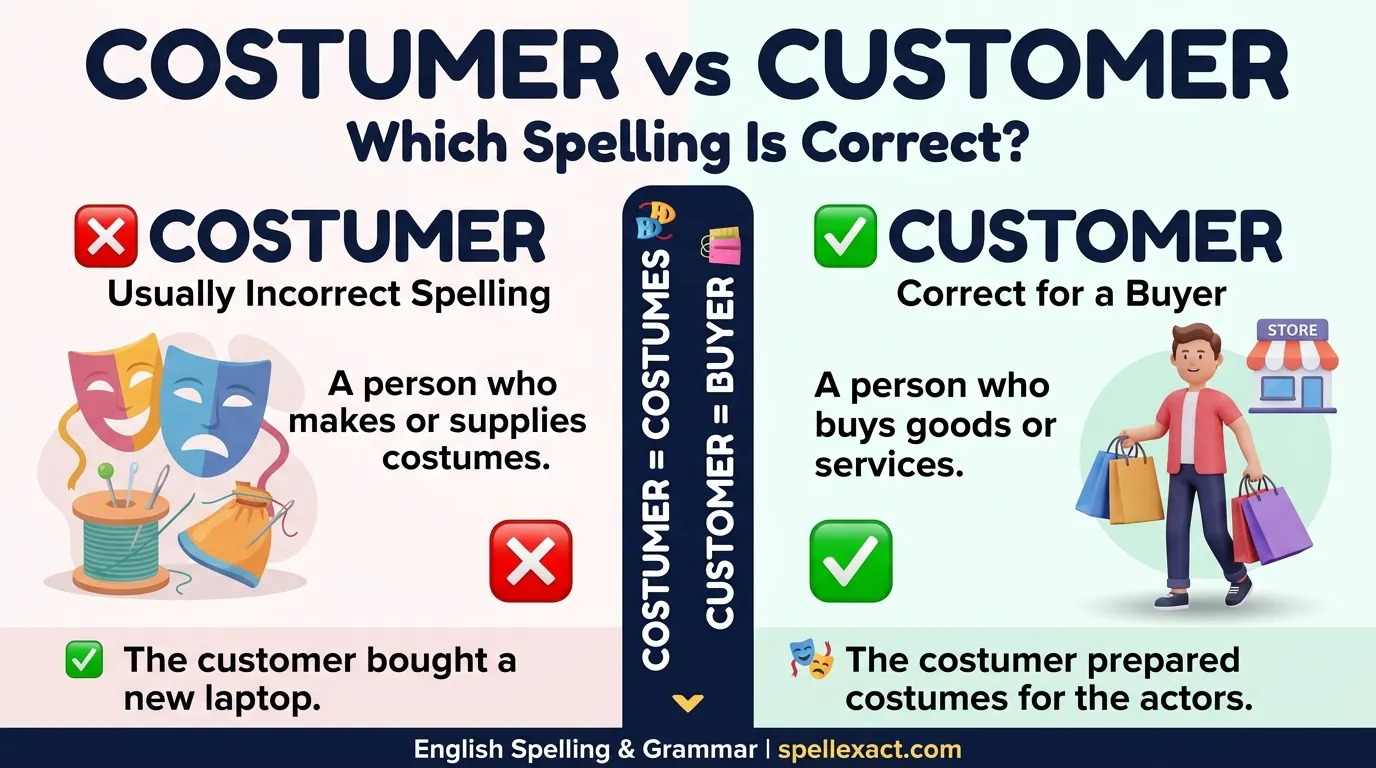
Customer is the correct word when you mean a person who buys goods or services from a business or seller.
Costumer is also a real English word, but it means a person who makes, supplies, or wears costumes, especially for theater, film, television, or other performances.
- Customer = someone who buys something
- Costumer = someone involved with costumes
Example:
The customer ordered a new laptop online.
The film’s costumer prepared the actors’ historical clothing.
So, if you are talking about shoppers, buyers, clients, or people purchasing something, customer is the spelling you need.
Customer: Meaning and Definition
The noun customer refers to a person or organization that purchases a product or service from a business.
It is commonly used in retail, restaurants, online shopping, banking, customer service, and business communication.
Examples of Customer
- The customer asked for a refund.
- Every customer deserves good service.
- The store has hundreds of regular customers.
- A new customer signed up for the service.
- The restaurant welcomed its first customer of the morning.
- Our company values every customer.
The word customer can describe someone making a one-time purchase or someone who regularly buys from the same business.
Customer in Business
In business English, you will frequently see phrases such as:
- customer service
- customer support
- customer experience
- customer satisfaction
- customer feedback
- customer loyalty
- customer account
- customer needs
- customer reviews
- potential customer
For example:
Good customer service can encourage people to return to a business.
This is why customer is much more common than costumer in everyday business and commercial writing.
Costumer: Meaning and Definition
Costumer is a legitimate English word, but it has a very different meaning.
A costumer is a person who works with costumes. Depending on the context, this can mean someone who designs, makes, supplies, selects, or manages clothing used for performances, productions, or special events.
The word is related to costume, not customer.
Examples of Costumer
- The costumer prepared the actors’ outfits for the play.
- The movie hired an experienced costumer for its historical costumes.
- The theater’s costumer repaired several damaged costumes.
- The production team worked closely with the costumer.
- The costumer selected clothing that matched the period shown in the film.
Although costumer is grammatically correct, it is relatively specialized. You are most likely to encounter it in discussions about theater, film, television, fashion, costume design, or stage productions.
Costumer vs Customer: The Main Difference
The easiest way to understand the difference is to focus on what each person does.
| Word | Meaning | Common Context | Example |
| Customer | A person who buys something | Shopping, business, services | The customer bought a new phone. |
| Costumer | A person who works with costumes | Theater, film, television | The costumer prepared the actors’ clothing. |
The spelling difference is only one letter, but the meanings are completely different.
Customer contains “custom”, which can help you associate it with people who purchase products or services.
Costumer comes from “costume”, so think about clothing, characters, performances, and costumes.
Customer vs Costumer: Easy Memory Trick
Here is a simple way to remember the correct spelling.
Think:
Costume → Costumer
If the sentence is about costumes, clothing for a performance, or someone working with theatrical outfits, costumer may be correct.
For shopping and business:
Buy → Customer
If someone buys a product, orders food, pays for a service, or shops at a store, that person is a customer.
A Quick Test
Ask yourself:
“Is this person buying something?”
If yes → customer
“Is this person working with costumes?”
If yes → costumer
This quick test can prevent one of the most common spelling errors between these two words.
Common Mistake: Using Costumer for Customer
The most frequent mistake occurs when someone writes costumer instead of customer.
For example:
❌ The costumer complained about the poor service.
Unless the person is specifically involved with costumes, this is incorrect.
✅ The customer complained about the poor service.
Another example:
❌ We want to provide excellent costumer service.
✅ We want to provide excellent customer service.
The phrase customer service is extremely common, while costumer service is generally a spelling mistake when the intended meaning is service provided to buyers.
Common Mistake: Thinking Costumer Is Always Wrong
There is an important point here: costumer is not simply a misspelling of customer.
It is a real word with its own definition.
For example:
The costumer designed costumes for the theater production.
That sentence is perfectly valid.
So, rather than remembering “costumer is wrong,” remember this:
Customer and costumer are both words, but they describe different things.
This distinction is especially useful for writers, editors, students, and anyone working with English vocabulary.
Customer or Costumer in Different Sentences
Seeing the words in context makes the difference much easier to understand.
Shopping
The customer paid for the groceries.
Here, customer is correct because the person is buying something.
Restaurant
The customer asked the waiter for a menu.
Again, customer is correct because the person is receiving a commercial service.
Online Business
Our website makes it easy for every customer to track an order.
The person purchasing from the website is a customer.
Theater
The costumer helped create clothing for the actors.
Here, costumer is correct because the sentence concerns costumes.
Film Production
The costumer researched clothing styles from the 1920s.
The person is working with costumes, so costumer fits the context.
American vs British English
There is no major American-versus-British spelling difference between customer and costumer.
Both varieties of English use customer for a person who purchases goods or services.
Likewise, costumer can be used for someone associated with costumes.
For example, these are correct in both American and British English:
The customer placed an order online.
The costumer prepared the costumes for the production.
However, terminology surrounding costume-related jobs can vary depending on the industry and region. Words such as costume designer, wardrobe supervisor, wardrobe assistant, or costume maker may be preferred in particular professional settings.
For everyday writing about buyers and shoppers, customer remains the standard choice.
Customer: Related Words and Phrases
Understanding related vocabulary can make your writing more precise.
Common words associated with customer include:
- buyer
- shopper
- client
- consumer
- purchaser
- patron
- account holder
- user
These words are related but are not always interchangeable.
For example, a customer usually purchases a product or service, while a consumer emphasizes the person who uses or consumes a product or service.
Similarly, client is often used for professional services, such as lawyers, consultants, designers, or accountants.
Costumer: Related Words and Phrases
Words associated with costumer include:
- costume
- costume designer
- costume maker
- wardrobe
- theatrical clothing
- stage costume
- film costume
- period clothing
- costume department
If your sentence contains these ideas, costumer may be the word you need.
Why This Spelling Mistake Happens
The confusion between costumer and customer is understandable because they look and sound very similar.
The extra “o” in costumer makes it visually close to the word costume, while customer has the familiar “custom” pattern.
When typing quickly, people may accidentally add the extra vowel and produce costumer.
Autocorrect and spell-check tools may not always catch the problem because costumer is a legitimate English word. A spell checker can recognize it as correctly spelled even when it is wrong for the context.
That is why understanding the meaning is more useful than relying only on automated spelling correction.
Frequently Asked Questions
Is customer or costumer correct?
Both are correct words, but they have different meanings. Customer means a person who buys goods or services. Costumer refers to someone who works with costumes.
Is “costumer service” correct?
Usually, no. If you mean assistance provided to people who buy products or services, the correct phrase is customer service.
Is costumer a misspelling of customer?
Not necessarily. Costumer is a legitimate word related to costumes. However, it is often an incorrect spelling when someone intends to write customer.
What is the plural of customer?
The plural is customers.
Example:
The store welcomed many new customers.
What is the plural of costumer?
The plural is costumers.
Example:
Several costumers worked on the theater production.
Can customer and client mean the same thing?
Sometimes, yes. Both can refer to people who obtain products or services. However, client is particularly common for professional or ongoing services, while customer is widely used in retail and commercial contexts.
How can I remember the spelling of customer?
Think of customer as the word for someone who buys something. For costumer, think of costume. If costumes are involved, the spelling with “costume” may be appropriate.
Why does spell-check not always correct costumer?
Because costumer is a real English word. A spell checker may recognize the spelling as valid without understanding that the word is wrong for your particular sentence.
Final Summary
The difference between costumer vs customer becomes simple once you focus on meaning. A customer is someone who buys goods or services, while a costumer is someone who works with costumes. Although the two words look almost identical, they belong to different contexts.
When writing about shopping, sales, businesses, restaurants, online orders, or customer support, choose customer. When discussing theater, film, stage clothing, or costume production, costumer may be appropriate. Always consider the context instead of relying only on how a word looks or sounds.
Actionable Takeaway
Remember this simple rule:
Customer = buyer
Costumer = costume professional
If you’re talking about someone purchasing a product or service, write customer—not costumer.

Caleb Carter is a passionate language enthusiast and content writer specializing in spelling mistakes, grammar, and vocabulary. He creates clear, practical guides that help readers improve their writing skills and communicate confidently every day.