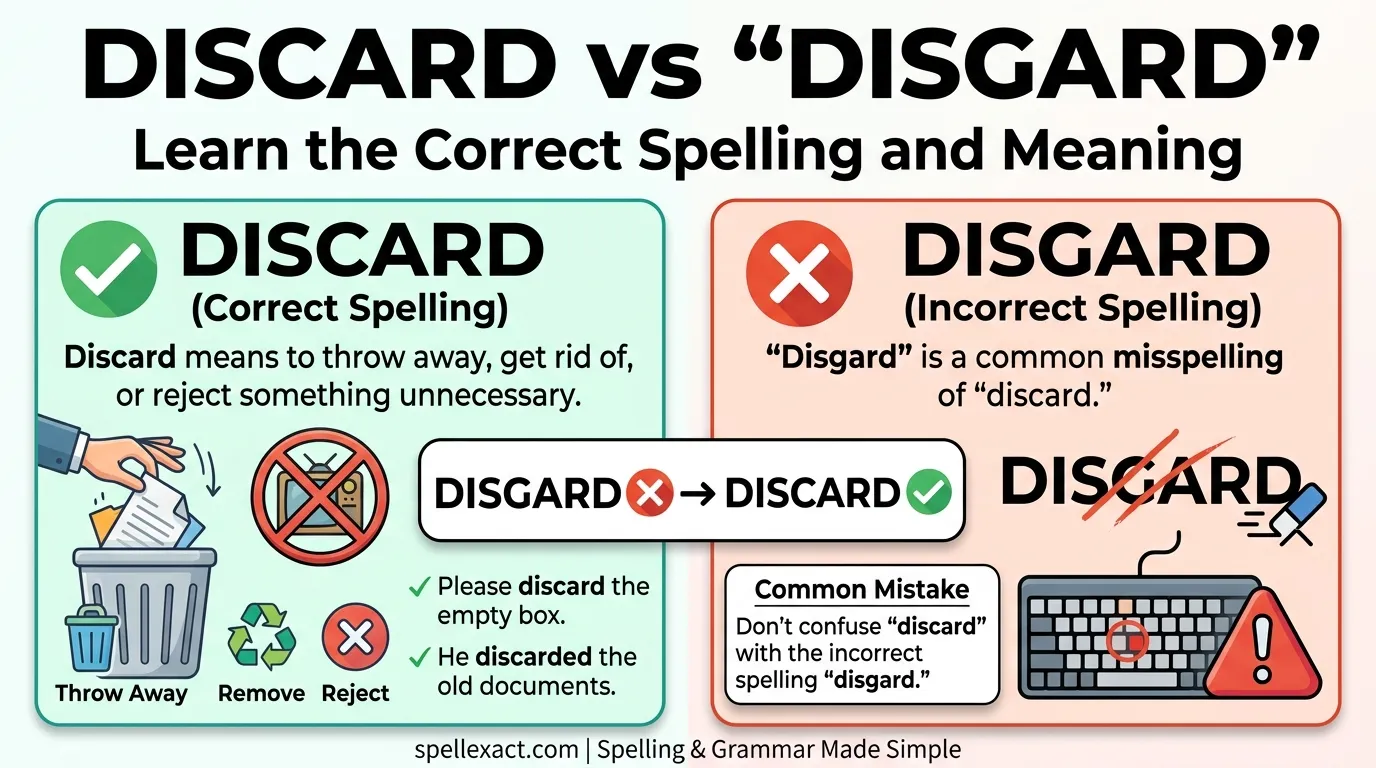
If you are wondering whether to write discard or disgard, the answer is simple: discard is the correct spelling, while disgard is a misspelling in standard English. The confusion is understandable because the hard /k/ sound in discard can sometimes make people think the word should contain a g.
Learning the difference between discard vs disgard can help you avoid a common spelling mistake in emails, schoolwork, professional writing, and everyday communication. This guide explains the correct spelling, meaning, pronunciation, examples, common errors, and useful tips to help you remember the word confidently.
Quick Answer:
Discard is the correct English word.
Disgard is an incorrect spelling and should generally be avoided.
- Correct: Please discard the empty box.
- Incorrect: Please disgard the empty box.
The verb discard means to throw something away, get rid of something, reject something, or decide not to use something.
Discard Meaning
The word discard can function as both a verb and a noun, although it is most commonly used as a verb.
Discard as a verb
As a verb, discard means:
- To throw away something that is no longer wanted
- To get rid of something unnecessary
- To reject an idea, plan, or belief
- To remove something from consideration
- To stop using something
For example:
- Please discard any expired food.
- The company decided to discard the old files.
- Scientists had to discard inaccurate data.
- She discarded her original plan and started again.
In simple terms, if you discard something, you choose not to keep or use it anymore.
Discard as a noun
As a noun, discard refers to something that has been thrown away or rejected.
For example:
- The factory reduced the amount of discard it produced.
- The card player placed a discard on the table.
However, the noun form is less common in everyday conversation than the verb.
Why Is “Disgard” Incorrect?
The spelling disgard is incorrect because the English word is formed with discard, not disgard. The final part of the word is card, which uses the letter c.
The spelling can be broken down like this:
dis + card = discard
The word originally developed with the sense of setting aside or getting rid of something. Although pronunciation may lead some writers to hear a sound similar to g, the correct spelling remains discard.
English spelling can be confusing because letters do not always match pronunciation perfectly. This is one reason misspellings such as disgard, discarred, or disscard occasionally appear.
The safest rule is easy to remember:
If you mean “throw away” or “get rid of,” spell it discard.
Discard vs Disgard: Comparison Table
| Feature | Discard | Disgard |
| Correct spelling? | Yes | No |
| Standard English word? | Yes | No |
| Meaning | To throw away, reject, or stop using | No standard meaning |
| Used in dictionaries? | Yes | Generally not as a standard English word |
| Example | Discard the old receipt. | Disgard the old receipt. ❌ |
| Suitable for formal writing? | Yes | No |
The comparison is straightforward: discard is correct, and disgard is a spelling mistake.
How to Use “Discard” in a Sentence
One of the best ways to remember the correct spelling is to see the word in natural sentences.
Everyday examples
- Please discard your rubbish in the correct bin.
- You can discard the packaging after opening the product.
- I accidentally discarded an important receipt.
- Do not discard the instructions until you finish assembling the item.
- She decided to discard her old clothes.
Professional examples
- Employees should discard confidential documents securely.
- The team chose to discard the outdated proposal.
- Please discard duplicate records from the database.
- The researchers had to discard unreliable results.
Academic examples
- Students should discard sources that are not credible.
- The experiment required the researchers to discard contaminated samples.
- The author discarded several paragraphs during the editing process.
These examples show that discard is useful far beyond simply throwing something into a bin. You can discard physical objects, ideas, evidence, plans, assumptions, documents, and information.
Common Phrases and Word Forms
Understanding related forms can make the correct spelling easier to remember.
Discarded
Discarded is the past tense and past participle of discard.
- The old furniture was discarded.
- She discarded her first draft.
Discarding
Discarding is the present participle.
- He is discarding unnecessary files.
- Discarding old assumptions can lead to better ideas.
Discards
Discards can be the third-person singular verb form or a plural noun.
- She discards anything she no longer needs.
- The pile contained several discards.
Notice that every form keeps the spelling discard. There is no standard form such as disgard, disgarded, or disgarding.
Common Mistakes When Spelling Discard
Several spelling errors can occur because people may write the word according to how they think it sounds.
1. Writing “disgard”
This is the most common error in the discard vs disgard comparison.
- Incorrect: We should disgard the old equipment.
- Correct: We should discard the old equipment.
2. Writing “disscard”
Some writers incorrectly add an extra s.
- Incorrect: Disscard the damaged item.
- Correct: Discard the damaged item.
3. Writing “discarred”
The word discarded has one r before ded.
- Incorrect: She discarred the document.
- Correct: She discarded the document.
4. Confusing discard with disregard
This is a particularly important mistake because discard and disregard are both real words but have different meanings.
- Discard = throw away or get rid of
- Disregard = ignore or pay no attention to
For example:
- Please discard the broken bottle.
- Please disregard my previous message.
Although the words may look similar, they cannot always be used interchangeably.
Discard vs Disregard: What Is the Difference?
Because disgard may result from confusion with disregard, it is helpful to understand the difference.
Discard
Discard means to remove, throw away, reject, or stop using something.
- Discard the empty container.
- The editor discarded several unnecessary paragraphs.
Disregard
Disregard means to ignore something or fail to consider it.
- Disregard the previous email.
- The driver disregarded the warning sign.
A simple memory trick is this:
Discard = remove it.
Disregard = ignore it.
This distinction can prevent both spelling and vocabulary mistakes.
American English vs British English
There is no spelling difference between American and British English for this word.
Both varieties use:
Discard
The same spelling is standard in:
- American English
- British English
- Canadian English
- Australian English
- Other major varieties of English
For example:
American English: Please discard the empty container.
British English: Please discard the empty container.
Unlike words such as color/colour or organize/organise, discard does not have a separate British spelling.
Therefore, disgard is not a British English alternative. It is simply a misspelling of discard.
Easy Ways to Remember the Correct Spelling
If you frequently forget whether the word is discard or disgard, these memory tips may help.
Remember the word “card”
The word discard contains card:
dis + card = discard
Think:
“I discard an unwanted card.”
This is especially useful because the spelling contains the familiar word card.
Connect it with card games
In many card games, players discard a card. That phrase naturally reinforces the spelling:
discard = dis + card
If you can remember discard a card, you can remember that the word uses c, not g.
Focus on meaning first
Ask yourself what you want to say.
If you mean:
- throw away
- get rid of
- reject
- remove
- stop using
Then the word you need is discard.
Synonyms for Discard
Depending on the context, several words can have a similar meaning to discard.
Common synonyms include:
- Throw away
- Dispose of
- Get rid of
- Reject
- Abandon
- Remove
- Eliminate
- Ditch
- Cast aside
- Set aside
However, these words are not always interchangeable.
For example, discard is usually more natural when talking about something being intentionally removed from use:
- Discard the damaged file.
Reject may be better when refusing an idea or proposal:
- The committee rejected the proposal.
Dispose of is often useful in formal or practical contexts:
- Dispose of hazardous waste safely.
Choosing the best synonym depends on the sentence and level of formality.
When Should You Use “Discard”?
Use discard when something is being deliberately removed from possession, use, consideration, or selection.
You might discard:
- Old clothes
- Rubbish or waste
- Unnecessary documents
- Expired products
- Incorrect information
- Weak ideas
- Outdated plans
- Damaged materials
- Unreliable evidence
For example:
After reviewing the information, the team decided to discard the inaccurate data.
This sentence shows that discard can refer to something physical or something abstract.
Is “Disgard” Ever Correct?
In standard modern English, disgard is not the correct spelling when you mean “throw away” or “get rid of.”
If you see disgard in a document, article, email, or school assignment, it should usually be corrected to discard.
However, unusual spellings can occasionally appear as:
- Typographical errors
- Usernames
- Brand names
- Fictional names
- Nonstandard historical or specialized references
Those exceptional uses do not make disgard an alternative spelling of discard in normal English writing.
Frequently Asked Questions
1. Is it discard or disgard?
The correct spelling is discard. Disgard is a misspelling in standard English.
2. What does discard mean?
Discard means to throw something away, get rid of it, reject it, or stop using it.
3. Why do people spell discard as disgard?
The mistake may happen because the pronunciation can cause some writers to associate the sound with the letter g. Confusion with the word disregard may also contribute.
4. Is disgard a British spelling?
No. Both American and British English use discard. Disgard is not a standard British English variant.
5. How do you spell discarded?
The correct past tense is discarded.
- Correct: discarded
- Incorrect: disgarded
- Incorrect: discarred
6. What is the difference between discard and disregard?
Discard means to get rid of something, while disregard means to ignore something.
7. Can I discard an idea?
Yes. You can discard an idea, theory, plan, assumption, or suggestion when you decide not to use or consider it further.
8. What is an easy way to remember how to spell discard?
Remember the phrase “discard a card.” The word contains card, so it is spelled discard, not disgard.
Final Summary:
The correct spelling is discard, while disgard is a common spelling mistake. Discard means to throw away, get rid of, reject, remove, or stop using something. The word can apply to physical objects, such as rubbish and packaging, as well as abstract things, such as ideas, plans, and unreliable information.
There is also no difference between American and British English: both use discard. To remember the spelling, think of the phrase “discard a card.” Whenever you are unsure, remember that if you mean throw away or get rid of, the correct word is always discard.
Actionable Takeaway
Before publishing or sending your writing, use this quick check: if you have written disgard, change it to discard. Also check whether you actually mean discard (get rid of) or disregard (ignore), because these two correct English words have different meanings.

Andrew Anthony is a language enthusiast and content writer specializing in spelling mistakes, grammar, and English usage. He creates clear, practical, and well-researched guides that help readers improve their writing skills with confidence.