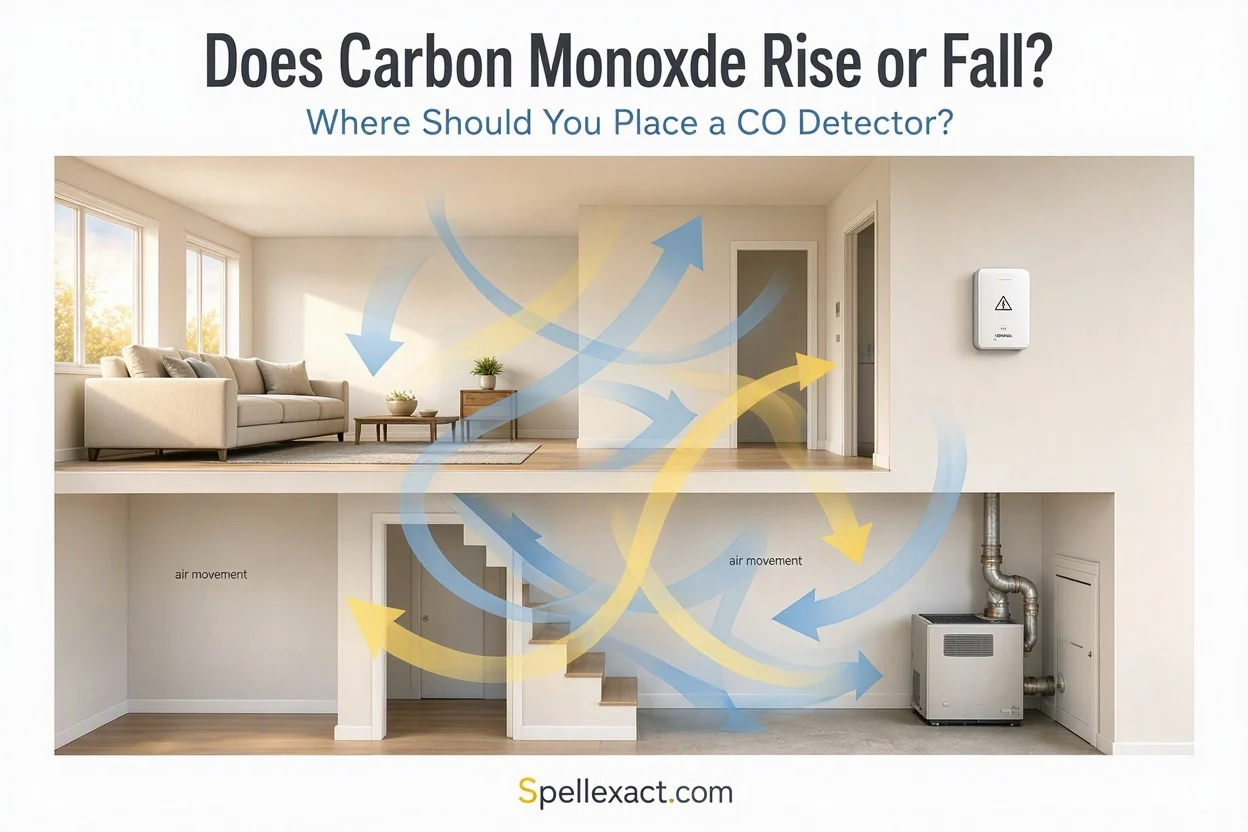
Carbon monoxide is a gas you cannot see, smell, or taste, so many people wonder where it goes in a room. Does carbon monoxide rise or fall? The short answer is that it does neither in a strong way. It is almost the same weight as air, so it mixes through the whole room instead of floating to the ceiling or sinking to the floor.
This matters because many people believe CO always collects near the ceiling or near the floor, and that belief can lead to poor safety choices. In this guide, you will learn how carbon monoxide behaves, why heat can make it move upward at first, and where to place a detector. The explanations use simple English, so students and ESL learners can follow easily.
Quick Answer
Carbon monoxide (CO) does not reliably rise or fall. Its weight is very close to the weight of air, so it spreads evenly through a room. Warm CO from a fire or heater may rise at first, but it then mixes with the air. Always follow your detector’s placement instructions.
Why Do People Confuse This?
People often repeat simple rules such as “gas rises” or “gas sinks.” These rules are not always true. Here are the main reasons for the confusion:
- Old advice: Some people say CO is lighter than air, so detectors must go on the ceiling. Others say the opposite.
- Smoke behavior: Smoke from a fire rises because it is hot. People wrongly think CO always acts the same way.
- Other gases: Propane sinks, and natural gas rises. People assume CO must follow one of these patterns.
- Different detector locations: Some detectors plug into a wall near the floor, and others sit high on a wall or ceiling. This makes people think one location must be wrong.
Does Carbon Monoxide Rise?
Carbon monoxide is very slightly lighter than air. Its molecular weight is about 28, while the average weight of air is about 29. That means CO is roughly 3 percent lighter. This tiny difference is not enough to make it float upward by itself.
However, CO often comes from something hot, such as a gas furnace, a car engine, a fireplace, or a fire. Hot gases rise because heat makes them expand and become lighter. So fresh, warm CO may move upward first. As it cools, it mixes with the air in the room.
Does Carbon Monoxide Fall or Sink?
Carbon monoxide does not sink in normal conditions. It is not heavier than air, so it does not pool on the floor the way some other gases do.
CO can still seem to be low in a room. This happens when a source is near the floor, such as a space heater or a generator. The gas starts low and then spreads outward. Moving air from fans, open windows, and heating systems also pushes CO around the room.
Comparison Table: Rise vs. Fall vs. Mix
| Question | Carbon monoxide (CO) | Propane | Natural gas (methane) |
| Weight compared with air | Almost the same (about 3% lighter) | Heavier | Lighter |
| Usual movement | Mixes evenly through the air | Sinks to low areas | Rises to high areas |
| Effect of heat | Warm CO may rise first | Warm gas may rise briefly | Rises faster when warm |
| Where it can collect | Anywhere in an enclosed space | Basements, floors | Ceilings, upper areas |
When Does CO Seem to Rise, and When Does It Seem to Fall?
CO may seem to rise when:
- It comes from a hot source, such as a fire or a furnace.
- Warm air currents carry it toward the ceiling.
- It travels up a stairwell or vent.
CO may seem to sink or stay low when:
- It leaks from a low source, such as a portable heater or a generator near the floor.
- Cool air near the floor carries it along.
- A room has little air movement, and the gas has not mixed yet.
In most homes, CO spreads through the whole space within a short time. That is why a detector placed anywhere in the right area can still sense it.
10+ Real-Life Examples
- A gas furnace in a basement releases warm CO, which rises with the heated air into upper rooms.
- A car engine runs in a closed garage, and CO spreads through the garage and into rooms next to it.
- A portable generator runs near a window, and CO can drift inside and mix with the air.
- A blocked chimney pushes combustion gases back into the living room.
- A charcoal grill used indoors fills a small room with CO within minutes.
- A gas stove used for heating a kitchen releases CO that spreads to nearby rooms.
- A water heater with poor ventilation sends CO into a closet and then into the hallway.
- A fireplace burns wood in a house with weak airflow, and CO builds up slowly.
- A camping stove inside a closed tent creates dangerous CO levels very quickly.
- A damaged heating system in an apartment sends CO through shared vents.
- A fire in a building produces hot smoke and CO that rise through stairwells.
Common Mistakes
- Believing CO always rises: This can lead people to ignore low-level sources or place detectors in the wrong spot.
- Believing CO always sinks: This idea is also wrong and can lead to poor placement.
- Ignoring the instructions: Detector makers test their products and give exact placement rules. Follow them.
- Placing a detector right next to a stove or vent: Normal fumes near these spots can cause false alarms or block good readings.
- Installing only one detector: CO can spread between rooms, so one alarm may not protect the whole home.
- Using the smell test: CO has no smell. Never wait to smell it.
Memory Trick
Think of CO as a crowd, not a balloon. A balloon floats up, and a stone sinks down. A crowd spreads out and fills the space. Carbon monoxide fills the space.
American English vs. British English
The science is the same everywhere, but some words differ:
- Americans usually say “carbon monoxide detector.” British speakers often say “CO alarm” or “carbon monoxide alarm.”
- Americans say “furnace” for a home heating system, while British speakers often say “boiler” or “central heating.”
- “Gas” in American English can mean gasoline for a car. In British English, “petrol” means car fuel, and “gas” usually means the kind used for cooking and heating.
Similar Words and Related Terms
- Rise: to go up. “Warm air rises.”
- Fall: to go down. “Cool air falls.”
- Sink: to move downward, especially in a heavier substance.
- Lighter than air: a gas that tends to float upward, such as helium.
- Heavier than air: a gas that tends to settle low, such as propane or carbon dioxide.
- Dissipate or disperse: to spread out and become thinner.
- Carbon dioxide (CO2): a different gas from carbon monoxide (CO). CO2 is heavier than air.
Final Verdict
Carbon monoxide does not have a strong habit of rising or falling. It is almost the same weight as air, so it spreads through space. Heat can push it upward at first, and a low source can make it seem to stay low. For safety, do not depend on height. Depend on working detectors and good ventilation. For more on symptoms and prevention, read the CDC guidance on carbon monoxide poisoning.
FAQs:
Is carbon monoxide lighter or heavier than air?
It is slightly lighter, by about 3 percent. The difference is too small to make it float or sink in a room.
Where should I place a carbon monoxide detector?
Follow the instructions from the detector’s maker, because designs differ. In general, put one on every level of your home and near sleeping areas. Keep detectors away from fuel-burning appliances, and avoid blocked spots such as behind furniture.
Should a CO detector go high or low on the wall?
It depends on the product. Many are tested to work well at different heights, so the manufacturer’s guide is the best rule. Some combined smoke and CO alarms are made for the ceiling.
Does carbon monoxide rise with heat?
Yes, hot CO from a fire or heater can rise first. It then cools and mixes with the air in the room.
Can carbon monoxide collect in a basement?
Yes. It can build up in any enclosed place with poor airflow, including basements, garages, and small rooms. The cause is usually a nearby source such as a furnace, a water heater, or a running engine.
How is carbon monoxide different from carbon dioxide?
Carbon monoxide (CO) is a poisonous gas made by incomplete burning. Carbon dioxide (CO2) is the gas we breathe out, and it is heavier than air. They are different gases with different risks.
What should I do if my CO alarm goes off?
Move to fresh air right away, and bring everyone and every pet with you. Call your local emergency number from outside. Do not go back inside until emergency workers say it is safe. Seek medical help if anyone has headache, dizziness, nausea, or confusion.
Remember This
- CO is almost the same weight as air and spreads evenly.
- Warm CO may rise first, and low sources may seem to keep it low.
- Detectors should go where the manufacturer says, on every level of the home.
- CO has no color, smell, or taste, so only a working alarm can warn you.
- If the alarm sounds, get outside first and call for help.
Conclusion:
Many people look for a simple answer to “does carbon monoxide rise or fall,” but the real answer is more useful. CO is nearly as heavy as air, so it mixes through a room. Heat from a fire or heater can lift it for a short time, and a low source can keep it near the floor for a while. In the end, it spreads.
Because height is not a reliable guide, your best protection is a working detector, regular battery checks, and well-maintained heating equipment. Learn the warning signs, keep your appliances ventilated, and act quickly when an alarm sounds. These steps matter far more than guessing where the gas will travel.

Maria Megan is a language enthusiast and content writer specializing in spelling, grammar, and English usage. She creates clear, practical articles that help readers identify common spelling mistakes, improve writing accuracy, and communicate with greater confidence.