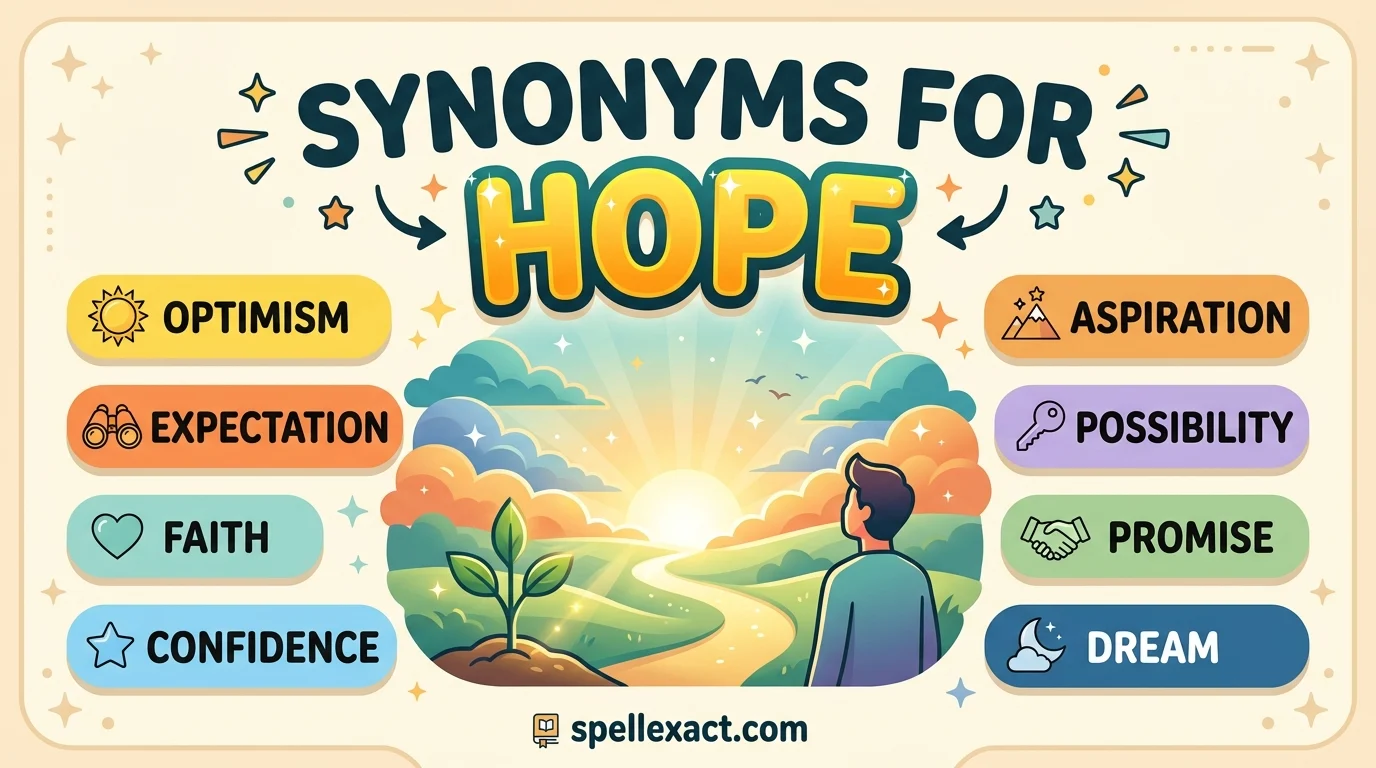
These synonyms for hope help express belief in a better future, confidence during hard times, and the wish for positive change in life and work. Hope often comes from belief, faith, confidence, and optimism, helping people pursue an achievement, follow an ambition, or work toward an aspiration and goal. A strong desire, positive expectation, and joyful anticipation can inspire a wish, a promise, or a hopeful prospect, even when there is concern about the outcome.
Hopefulness, buoyancy, endurance, and sanguineness describe a positive attitude during difficult situations, while reliance, dependence, and trust reflect the support people seek when facing uncertainty. Hope may bring a sense of security and motivate people to seek gain, fortune, or a reward for their efforts.
Words such as expectancy, assumption, and fancy express what someone imagines may happen, while a daydream or reverie offers a pleasant escape and rosiness reflects a positive view of the future. Choosing the right synonym depends on whether you want to highlight success, happiness, patience, or a positive outlook.
Figurative expressions add more meaning: the bright side encourages people to focus on the good, and the light at the end of the tunnel suggests that a difficult period may soon end. The Promised Land represents a hoped-for place of happiness and success, while utopia describes an ideal world.
In contrast, castles in air, a fool’s paradise, and a pipe dream refer to unrealistic hopes. Emily Dickinson’s famous phrase thing with feathers presents hope as something that continues to live within us. However, greedy glutton is not a standard synonym for hope; it relates more closely to excessive desire and should only be used when the context supports that meaning.
Quick Answer: What Are the Best Synonyms for Hope?
The best synonyms of hope include optimism, hopefulness, confidence, faith, expectation, anticipation, aspiration, belief, wish, and possibility.
Here are some of the most useful alternatives:
- Hopefulness: A feeling that good things may happen.
- Optimism: A generally positive attitude toward the future.
- Faith: Strong belief or trust.
- Confidence: Belief that someone or something will succeed.
- Expectation: A belief that something is likely to happen.
- Aspiration: A meaningful goal someone wants to achieve.
- Wish: Something a person wants to happen.
- Possibility: A chance that something may happen.
- Prospect: A potential future opportunity or outcome.
- Anticipation: The feeling of looking forward to something.
If you need another word for hope, start by identifying your intended meaning. For example, use optimism for a positive outlook, faith for strong trust, and aspiration for an important life goal.
What Does Hope Mean?
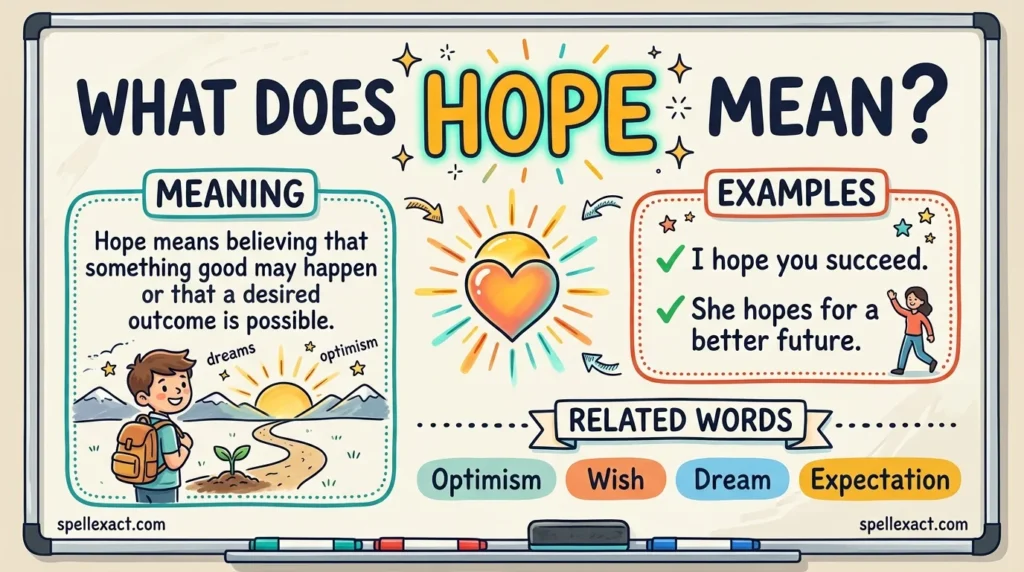
Hope means wanting a positive outcome and believing that it may happen. It can describe a feeling about the future or the act of wishing for a particular result.
Hope as a noun: She has hope that she will pass her examination.
Hope as a verb: I hope you enjoy your new job.
The hope meaning can change slightly depending on the context. Someone might hope for better weather, a successful career, improved health, or a peaceful future.
Understanding the hope definition helps you choose words that express the same idea more precisely. Some alternatives describe a feeling, while others focus on a goal, belief, or possible outcome.
30 Synonyms for Hope With Meanings and Examples
Not every word associated with hope is a direct synonym. The first group contains close alternatives, while the second includes words that work in particular situations. This distinction helps you use each word naturally.
Closest Synonyms for Hope
1. Hopefulness
Meaning: The feeling that something good may happen.
Example: Her hopefulness helped her remain positive during a difficult year.
Best use: Use hopefulness when describing a hopeful state of mind. It is one of the closest alternatives to hope when discussing feelings.
2. Optimism
Meaning: A positive attitude that expects good things or believes situations can improve.
Example: His optimism encouraged the team to keep working toward success.
Best use: Use optimism to describe someone’s general attitude toward life, challenges, or the future.
3. Expectation
Meaning: A belief that something will probably happen.
Example: We have an expectation that the project will be completed on time.
Best use: Use expectation when discussing a likely result. It can suggest more certainty than hope.
4. Anticipation
Meaning: The feeling of looking forward to something that may happen.
Example: The children waited in anticipation for the school trip.
Best use: Use anticipation when a future event creates excitement, interest, or expectation.
5. Confidence
Meaning: A belief that someone or something will succeed.
Example: She approached the examination with confidence.
Best use: Use confidence when hope is supported by preparation, experience, or belief in someone’s abilities.
6. Faith
Meaning: Strong belief or trust in someone, something, or an outcome.
Example: He kept his faith in his ability to overcome the challenge.
Best use: Use faith when expressing deep trust, personal conviction, or spiritual belief.
7. Belief
Meaning: The feeling that something is true or possible.
Example: Her belief that life could improve helped her remain determined.
Best use: Use belief when hope comes from a conviction or idea about what may happen.
8. Trust
Meaning: Confidence that someone or something is reliable.
Example: I trust my team to find a solution to the problem.
Best use: Use trust when hope depends on another person’s reliability or your confidence in a process.
9. Assurance
Meaning: A feeling of certainty or confidence, sometimes supported by a promise or guarantee.
Example: The manager gave us assurance that our concerns would be addressed.
Best use: Use assurance when someone provides reasons to feel confident. It is related to hope but usually implies greater certainty.
10. Expectancy
Meaning: The state of expecting something to happen.
Example: She watched the results page with a sense of expectancy.
Best use: Use expectancy in formal or literary writing. In everyday English, expectation is usually more natural.
11. Outlook
Meaning: A person’s general attitude toward the future.
Example: The new opportunity gave him a more positive outlook on life.
Best use: Use outlook when discussing a person’s general perspective rather than a specific desired outcome.
12. Promise
Meaning: A sign that something good may happen in the future.
Example: The early signs of recovery offered a promise of better days.
Best use: Use promise in expressions such as a promise of success or a promising future. It suggests potential rather than certainty.
13. Prospect
Meaning: The possibility of a future opportunity or outcome.
Example: The prospect of a better job gave her hope for the future.
Best use: Use prospect in professional, academic, and formal writing about future opportunities.
14. Possibility
Meaning: A chance that something may happen.
Example: There is still a possibility that we can finish the work today.
Best use: Use possibility when emphasizing that a positive outcome remains achievable.
15. Likelihood
Meaning: The chance that something will happen.
Example: The improved results increased the likelihood of success.
Best use: Use likelihood when discussing how probable an outcome is. It is more factual and less emotional than hope.
Synonyms Related to Goals and Desires
16. Wish
Meaning: A desire for something to happen or become true.
Example: My wish is to see every child receive a good education.
Best use: Use wish for personal desires or preferred outcomes, especially when the result is uncertain.
17. Desire
Meaning: A strong feeling of wanting something.
Example: Her desire to learn English motivated her to practise every day.
Best use: Use desire when emphasizing what someone wants rather than whether they believe it will happen.
18. Aspiration
Meaning: A strong desire to achieve something important.
Example: Becoming a successful writer is her greatest aspiration.
Best use: Use aspiration for meaningful long-term goals, particularly in education, career development, and personal growth.
19. Ambition
Meaning: A strong desire to achieve success or reach a goal.
Example: His ambition to start a business encouraged him to develop new skills.
Best use: Use ambition when hope involves achievement, effort, and determination.
20. Dream
Meaning: A cherished wish or an imagined future someone wants to achieve.
Example: Her dream of becoming a doctor kept her focused on her studies.
Best use: Use dream for personal goals, inspiring ideas, and important wishes.
21. Longing
Meaning: A strong emotional desire for something or someone.
Example: He felt a longing for the day his family could live together again.
Best use: Use longing when the desired outcome is deeply personal or currently out of reach.
22. Yearning
Meaning: An intense desire for something meaningful.
Example: She had a yearning for a more peaceful life.
Best use: Use yearning in emotional or literary writing. It often communicates a deeper feeling than ordinary desire.
23. Eagerness
Meaning: Strong interest or enthusiasm about doing something.
Example: The students showed eagerness to begin their new course.
Best use: Use eagerness when someone is keen to act or experience something. It is related to anticipation, rather than a direct synonym for hope.
24. Aspiration for a Better Future
Meaning: A strong desire to create or achieve a better future.
Example: Education gave the family an aspiration for a better future.
Best use: This phrase can be useful in motivational writing, but aspiration or hope for a better future is usually more natural in everyday sentences.
Synonyms and Expressions for Specific Situations
25. Faith in the Future
Meaning: A strong belief that the future can bring positive changes.
Example: She maintained her faith in the future despite the setbacks.
Best use: Use this expression in reflective, emotional, or inspirational writing. It describes a form of hope rather than a single-word synonym.
26. Positive Outlook
Meaning: A way of viewing life or future events with confidence and positivity.
Example: His positive outlook helped him manage the uncertainty.
Best use: Use positive outlook when describing someone’s general mindset.
27. Looking Forward To
Meaning: Feeling pleased or excited about something expected to happen.
Example: I am looking forward to meeting my new classmates.
Best use: Use this expression when talking about a specific future event you anticipate with pleasure. It is particularly natural when replacing hope in certain sentences.
28. Wish For
Meaning: To want something to happen or be true.
Example: We wish for peace and happiness for everyone.
Best use: Use wish for when expressing a desired outcome. The phrase does not necessarily mean you expect the outcome to happen.
29. Aspire To
Meaning: To work toward or strongly desire an important goal.
Example: She aspires to become a skilled English teacher.
Best use: Use aspire to when discussing ambitions and long-term achievements. It is a useful verb phrase for formal writing.
30. Hope Against Hope
Meaning: To continue hoping even when success seems unlikely.
Example: The family hoped against hope that the missing documents would be found.
Best use: Use this established expression when someone continues to hope despite very difficult circumstances. It is an idiom, not a direct synonym.
Comparison Table: Which Synonym for Hope Should You Choose?
The best alternative depends on your intended meaning. Use this comparison guide to find the most suitable word for your sentence.
| Word | Main meaning | Best context |
| Hopefulness | Feeling that things may improve | Emotional situations |
| Optimism | Positive attitude toward the future | General outlook |
| Faith | Strong trust or belief | Personal or spiritual writing |
| Confidence | Belief in success | Work, school, and goals |
| Expectation | Belief that something will happen | Likely outcomes |
| Anticipation | Looking forward to an event | Upcoming experiences |
| Aspiration | Important personal goal | Education and careers |
| Wish | Something you want to happen | Personal desires |
| Prospect | Future opportunity or outcome | Formal writing |
| Possibility | A chance of something happening | Uncertain outcomes |
| Longing | Deep emotional desire | Personal or literary writing |
| Looking forward to | Eagerly awaiting something | Everyday conversation |
Hope vs. Optimism
Usually Hope focuses on a desired outcome, while optimism describes a generally positive attitude toward the future.
- Hope: I hope I pass my examination.
- Optimism: I remain optimistic about my future.
Hope vs. Faith
Hope involves wanting a positive outcome and believing it may happen. Faith involves strong trust or belief.
- Hope: I hope the situation improves.
- Faith: I have faith in my abilities.
Hope vs. Wish
Hope usually suggests that an outcome is possible. A wish can express a desire even when the result seems unlikely.
- Hope: I hope I can visit you next month.
- Wish: I wish I could travel around the world.
Hope vs. Aspiration
Hope focuses on a positive outcome, while aspiration describes an important goal someone wants to achieve.
- Hope: I hope I get accepted into university.
- Aspiration: My aspiration is to become a doctor.
Synonyms for Hope as a Verb
The word hope is not limited to its use as a noun. In sentences such as “I hope you feel better” or “We hope to see you soon,” you may need a different verb or expression.
Here are useful alternatives, depending on the meaning:
| Expression | Example | Important difference |
| Wish | I wish you success. | Expresses a desire or goodwill |
| Expect | I expect to hear from you soon. | Suggests a belief that something will happen |
| Anticipate | We anticipate a positive response. | Suggests an expectation about the future |
| Trust | I trust that everything will work out. | Emphasizes confidence or belief |
| Believe | I believe things can improve. | Emphasizes a conviction |
| Look forward to | I look forward to seeing you. | Expresses positive anticipation |
| Aspire to | She aspires to become a writer. | Describes a goal or ambition |
| Pray for | They prayed for a peaceful outcome. | Expresses a wish through prayer |
These expressions cannot replace hope in every sentence. For example, “I expect you feel better” is not a natural replacement for “I hope you feel better.” Instead, say, “I hope you feel better soon” or “I trust you are feeling better.”
How to Choose the Right Synonym for Hope
Selecting the right word becomes easier when you consider the tone, meaning, and purpose of your sentence.
1. Choose by Tone
Positive and encouraging: Use optimism, hopefulness, or confidence.
Example: Her optimism helped everyone remain motivated.
Emotional and personal: Use faith, longing, or yearning.
Example: His faith in the future gave him comfort.
Formal and professional: Use prospect, expectation, or possibility.
Example: The new training programme offers promising prospects for career growth.
Inspirational: Use dream, aspiration, ambition, or positive outlook.
Example: Her ambition encouraged her to continue learning.
2. Choose by Meaning
If you want to describe a positive attitude, use optimism.
If you want to express strong trust, use faith.
Weather you want to describe belief in success, use confidence.
If you want to describe a future goal, use aspiration or ambition.
If you want to discuss a chance of success, use possibility or prospect.
Weather you want to describe an intense emotional desire, use longing or yearning.
If you want to express excitement about a future event, use anticipation or looking forward to.
3. Choose by Intent
For school assignments: Use expectation, possibility, belief, or aspiration when appropriate.
For everyday conversations: Use hope, wish, confidence, or look forward to.
Motivational writing: Use optimism, ambition, hopefulness, and aspiration.
For creative writing: Use longing, yearning, dream, or hope against hope.
For professional writing: Use prospect, expectation, confidence, or likelihood when discussing future outcomes.
A simple, accurate word is usually better than an unfamiliar word that changes your meaning.
Common Mistakes When Using Synonyms for Hope
1. Assuming Optimism and Hope Mean Exactly the Same Thing
Optimism usually describes a general positive attitude, while hope can focus on one particular outcome.
- I hope the weather improves tomorrow.
- She maintains an optimistic attitude despite the challenges.
2. Confusing Hope With Expectation
Hope does not always mean that something is likely to happen. Expectation often suggests a stronger belief in a particular outcome.
- I hope the package arrives today.
- I expect the package to arrive today because it is scheduled for delivery.
3. Treating Wish and Hope as Identical
A wish can express a desire even when the outcome is unlikely. Hope usually suggests that the outcome remains possible.
Correct examples:
- I hope I can attend the event.
- I wish I could attend the event, but I will be out of town.
4. Using Aspiration for Every Type of Hope
Aspiration refers to a goal or ambition, not every positive feeling about the future.
Less natural: I have an aspiration that it will rain tomorrow.
More natural: I hope it rains tomorrow.
Use aspiration for meaningful goals, such as becoming a teacher or building a successful career.
5. Replacing Hope With a Related but Different Word
Words such as longing, confidence, and possibility express related ideas, but they are not always interchangeable with hope.
For example, confidence means belief in success, while longing means a strong desire. Choose the word that best matches your sentence.
6. Forcing Too Many Synonyms Into One Paragraph
Using many alternatives in a short passage can make writing sound unnatural.
Repetitive: She had hope for success and hope for a better future.
Improved: She remained hopeful about her success and looked forward to a better future.
Use synonyms to improve clarity, not simply to avoid repeating a word.
Frequently Asked Questions
1. What Is the Best Synonym for Hope?
Hopefulness is one of the closest alternatives when describing a hopeful feeling. Optimism is suitable for a positive outlook, while faith, confidence, aspiration, and possibility express different aspects of hope.
2. What Are Five Synonyms for Hope?
Five useful synonyms for hope are hopefulness, optimism, faith, confidence, and expectation. Each has a slightly different meaning, so the best choice depends on the sentence.
3. What Is Another Word for Hope in a Positive Sense?
Optimism, hopefulness, confidence, and positive outlook can express a positive attitude toward the future.
Example: “Her hopefulness helped her remain positive during difficult times.”
4. What Is a Stronger Word for Hope?
There is no single stronger word for every context. Faith can suggest deep trust, conviction suggests a firmly held belief, and aspiration communicates a strong desire to achieve a goal.
5. What Are Some Formal Synonyms for Hope?
Prospect, expectation, possibility, and likelihood are useful in formal writing when they fit the intended meaning.
Example: “The programme offers promising prospects for professional growth.”
6. What Is the Difference Between Hope and Faith?
Hope is a desire for a positive outcome combined with a sense that it may happen. Faith is strong belief or trust in someone, something, or an idea.
A person can hope for success while having faith in their abilities.
7. What Is the Difference Between Hope and Aspiration?
Hope focuses on a desired outcome, while aspiration focuses on an important goal someone wants to achieve.
For example, a student may hope to pass an examination and aspire to become a doctor.
8. How Can I Use Synonyms for Hope in an Essay?
Choose a synonym based on your intended meaning. Use optimism to discuss a positive attitude, aspiration for a future goal, prospect for an opportunity, and confidence for belief in success. Keep your sentences natural and avoid replacing hope with words that have different meanings.
Conclusion
Learning synonyms for hope can improve your English vocabulary and help you express feelings, beliefs, goals, and expectations more accurately. Words such as hopefulness, optimism, faith, confidence, aspiration, and possibility are useful alternatives, but each communicates a different idea.
For everyday English, hope and optimism are often suitable choices. Personal ambitions, aspiration and ambition may be more precise. For strong trust, faith may fit better, while prospect is useful when discussing future opportunities.
The best synonym is the one that fits your meaning and sounds natural in context. By understanding these differences and practising the examples, you can make your English clearer, more confident, and more expressive.

Andrew Anthony is a language enthusiast and content writer specializing in spelling mistakes, grammar, and English usage. He creates clear, practical, and well-researched guides that help readers improve their writing skills with confidence.