Synonyms for respecting help you express admiration, care, and consideration in everyday language and communication. Respecting someone means valuing their feelings, rights, and wishes while treating them with dignity and courtesy.
Other words for respect include esteem, admiration, honor, honour, appreciation, recognition, and acknowledgment. These related terms make speech and writing more interesting and help you express a high opinion of someone without repeating the same expressions.
The best synonyms for respecting, respect synonyms, words similar to respecting, and alternative words depend on the context and usage. For example, valuing a colleague shows consideration for their ideas, while esteem expresses a high level of respect. Showing respect through kind actions, thoughtful words, and positive attitudes reflects dignity, courtesy, politeness, deference, and reverence.
These different words also describe good behavior, conduct, relationships, and social interaction. In formal language, esteem and deference may fit best, while value and appreciation often sound natural in informal language. Choosing suitable alternative expressions creates respectful language and shows the semantic relationships between similar terms.
Simple examples make each word easier to understand and use correctly. You might say, “I value my teacher’s advice,” “We honor people who help our community,” or “She treats everyone with dignity.”
These sentences show a positive attitude and regard for others without forcing vocabulary into unnatural phrases. Understanding contextual vocabulary helps you describe admiration, esteem, and respect clearly. The right word choice makes an article more meaningful and helps readers understand the intended expression in each situation.
Quick Answer: What Are the Best Synonyms for Respecting?
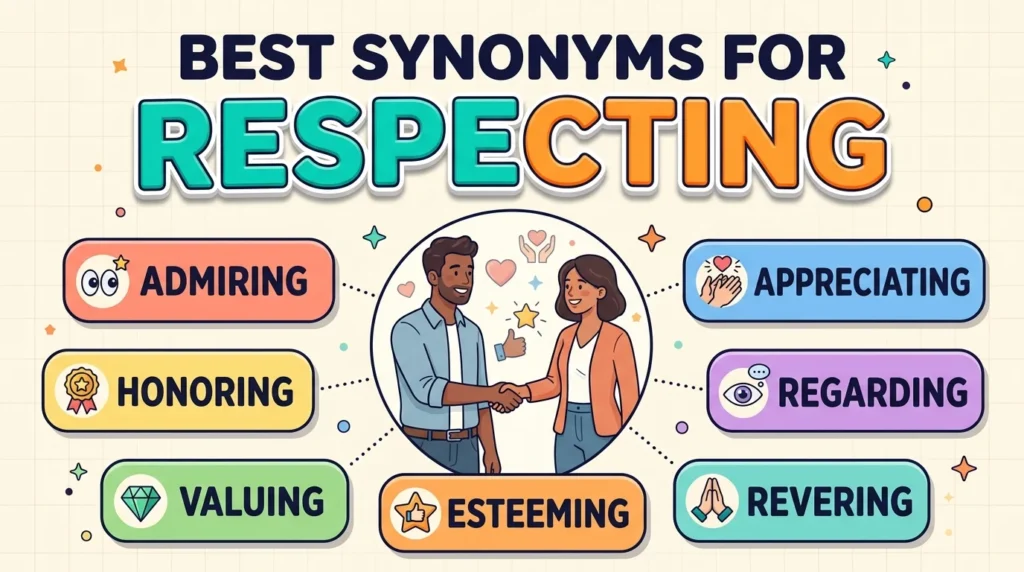
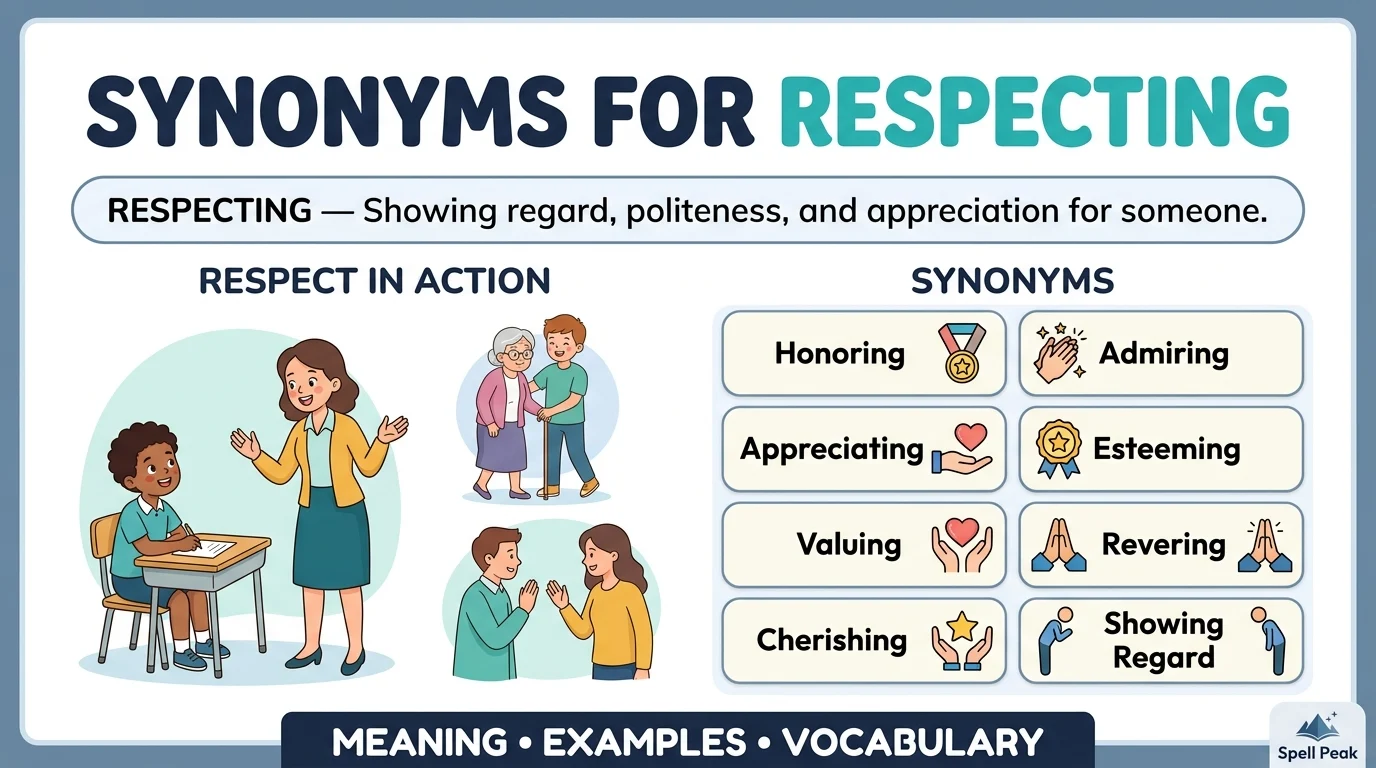
Here are some of the most useful words similar to respecting:
- Honoring — showing respect for a person, tradition, or achievement.
- Valuing — recognizing the importance of someone or something.
- Admiring — respecting someone for their positive qualities or achievements.
- Appreciating — recognizing someone’s worth, effort, or contribution.
- Esteeming — regarding someone highly.
- Acknowledging — recognizing someone’s contribution, rights, or qualities.
- Recognizing — identifying or accepting someone’s merit.
- Considering — taking someone’s feelings or opinions into account.
- Observing — following a rule, custom, or tradition.
- Upholding — supporting a principle, right, or standard.
Other alternatives include cherishing, treasuring, revering, and showing regard for.
The best choice depends on your intended meaning. If you want to express admiration, choose admiring. If you mean following rules, use observing or adhering to. Weather you want to show consideration for another person’s feelings, being mindful of may be more appropriate.
What Does Respecting Mean?
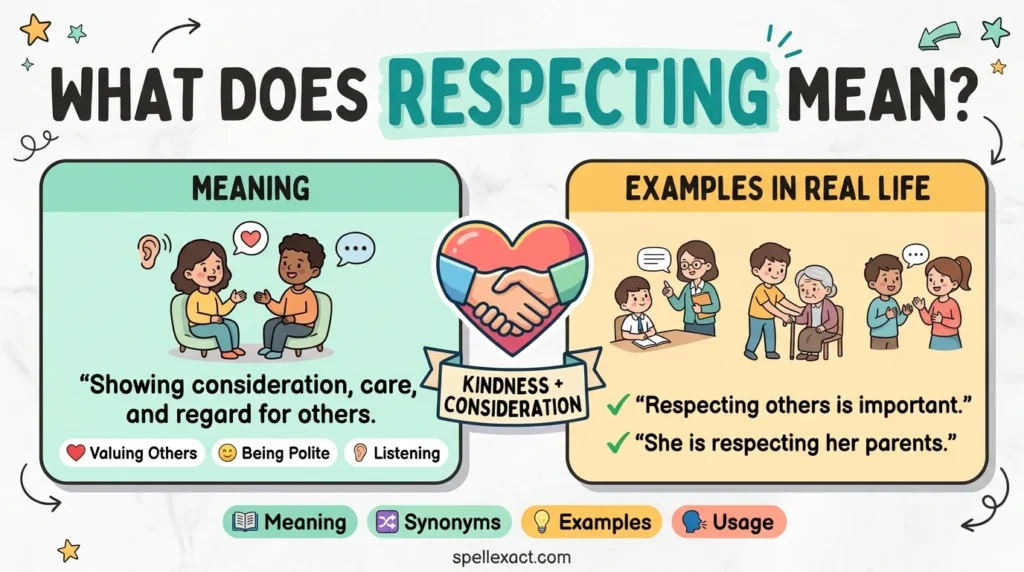
Respecting is the present participle of the verb respect. It generally means treating someone or something with consideration, recognizing their value, or accepting their rights, feelings, opinions, and boundaries.
For example:
- She is respecting her parents’ wishes.
- The students respect their teacher’s experience.
- We should respect everyone’s personal boundaries.
- The company respects the rights of its employees.
- They respect different cultural traditions.
These examples show how respecting meaning changes slightly according to context. It can describe an attitude of admiration, thoughtful behavior, recognition of rights, or following rules.
Does Respecting Also Mean Regarding?
Yes. In formal English, respecting can also mean concerning, regarding, or about a particular subject. This is a different use from showing admiration or consideration. <Cite refs={[“turn968839search1″,”turn968839search4″,”turn968839search9”]}/>
For example:
- Formal: The document contains several provisions respecting employee safety.
- More conversational: The document contains several provisions concerning employee safety.
In this context, useful synonyms of respecting include:
- Regarding
- Concerning
- About
- Relating to
- With regard to
- With reference to
- In connection with
These expressions are especially useful in formal documents, reports, and professional communication.
Different Ways to Show Respect
Respect can be expressed in several ways, depending on the situation and the people involved.
Treating People with Respect: This means treating others fairly and recognizing their dignity.
Valuing Different Opinions: Listening to different viewpoints and considering them seriously demonstrates respect for others’ perspectives.
Following Rules and Regulations: Respect for rules involves obeying instructions, laws, and established procedures.
Honoring Personal Boundaries: Recognizing another person’s privacy, choices, and personal limits helps build trust.
Recognizing Achievements: Acknowledging someone’s abilities, hard work, and accomplishments is another meaningful way to show respect.
Understanding these differences helps you choose the right word instead of using the same expression in every sentence.
30 Synonyms for Respecting With Meanings and Examples
The following list includes direct synonyms, closely related verbs, and context-specific expressions. Some can replace respecting directly, while others are appropriate only in certain situations.
1. Honoring
Simple meaning: Showing respect for someone or something.
Example: The school is honoring a teacher who dedicated 30 years to education.
Best usage: Use honoring when recognizing achievements, celebrating traditions, remembering important people, or respecting someone’s wishes.
2. Valuing
Simple meaning: Recognizing that someone or something is important.
Example: A good manager values every employee’s contribution.
Best usage: Use valuing when discussing relationships, opinions, skills, personal qualities, or professional contributions.
3. Admiring
Simple meaning: Feeling respect because someone has impressive qualities or abilities.
Example: I admire her courage and determination.
Best usage: Use admiring when expressing appreciation for talent, honesty, kindness, dedication, or achievement.
4. Appreciating
Simple meaning: Recognizing someone’s worth, effort, or contribution.
Example: We appreciate the time our teachers spend helping students.
Best usage: Use appreciating when expressing gratitude or recognizing someone’s effort, kindness, support, or valuable qualities.
5. Esteeming
Simple meaning: Regarding someone as worthy of high respect.
Example: Her colleagues hold her in high esteem because of her integrity.
Best usage: Use esteeming in formal or literary contexts. The phrase hold someone in high esteem is often more natural than using esteeming in everyday conversation.
6. Acknowledging
Simple meaning: Recognizing or openly admitting someone’s contribution, rights, or qualities.
Example: The director acknowledged the team’s hard work.
Best usage: Use acknowledging when recognizing achievements, giving credit, or accepting the importance of someone’s concerns.
7. Revering
Simple meaning: Showing profound respect, often mixed with awe.
Example: Many followers revere the spiritual leader for his wisdom.
Best usage: Use revering for spiritual figures, influential leaders, sacred traditions, or people who inspire deep respect.
8. Recognizing
Simple meaning: Identifying or accepting someone’s worth, abilities, or achievements.
Example: The school recognized students who demonstrated exceptional kindness.
Best usage: Use recognizing when acknowledging merit, giving public credit, or appreciating someone’s contribution.
9. Considering
Simple meaning: Thinking about someone’s feelings, needs, or opinions before acting.
Example: She considered her teammates’ suggestions before making a decision.
Best usage: Use considering when discussing fairness, thoughtful decisions, respectful communication, and different viewpoints.
10. Observing
Simple meaning: Following a rule, custom, tradition, or agreement.
Example: The company observes strict safety procedures.
Best usage: Use observing when respect involves following established rules, cultural customs, religious practices, or formal traditions.
11. Treasuring
Simple meaning: Treating someone or something as especially valuable.
Example: She treasures the advice her grandmother gave her.
Best usage: Use treasuring when respect is connected with meaningful memories, important relationships, or personal values.
12. Cherishing
Simple meaning: Holding someone or something dear and treating it as precious.
Example: We cherish the traditions passed down through our family.
Best usage: Use cherishing for loved ones, memories, friendships, and cultural traditions. It expresses affection as well as appreciation.
13. Upholding
Simple meaning: Supporting and maintaining a principle, law, right, or standard.
Example: The organization upholds its commitment to fairness.
Best usage: Use upholding when discussing human rights, ethical standards, promises, laws, or important principles.
14. Following
Simple meaning: Acting according to instructions, rules, or guidance.
Example: The students are following the school’s code of conduct.
Best usage: Use following when respect involves complying with instructions or established expectations. It describes an action rather than necessarily expressing admiration.
15. Obeying
Simple meaning: Doing what a rule or person with authority requires.
Example: All participants must obey the safety instructions.
Best usage: Use obeying when the emphasis is on instructions, laws, orders, or authority. It is not a general substitute for respecting someone’s feelings or opinions.
16. Heeding
Simple meaning: Paying attention to advice, warnings, or instructions and taking them seriously.
Example: The hikers heeded the guide’s warning about the approaching storm.
Best usage: Use heeding when someone responds seriously to advice, warnings, or important guidance.
17. Adhering to
Simple meaning: Following a principle, rule, or agreement consistently.
Example: The organization adheres to its ethical standards.
Best usage: Use adhering to in professional, academic, or formal writing about policies, commitments, and principles.
18. Complying with
Simple meaning: Acting according to a rule, request, or requirement.
Example: The business complies with workplace safety regulations.
Best usage: Use complying with in legal, administrative, workplace, and official contexts. It describes meeting a requirement, not necessarily feeling personal respect.
19. Deferring to
Simple meaning: Accepting another person’s judgment because of their expertise, position, or authority.
Example: The team deferred to the doctor’s professional judgment.
Best usage: Use deferring to when allowing another person’s knowledge or authority to guide a decision.
20. Giving deference to
Simple meaning: Showing special consideration for someone’s experience, position, or judgment.
Example: The junior researchers gave deference to the senior scientist’s expertise.
Best usage: Use this expression in formal, academic, professional, or legal discussions. It can suggest yielding to another person’s judgment or status.
21. Showing regard for
Simple meaning: Demonstrating consideration or respect for someone or something.
Example: The organization shows regard for the needs of its local community.
Best usage: Use this expression in professional writing about people’s rights, feelings, needs, and circumstances.
22. Being mindful of
Simple meaning: Remembering and considering something carefully.
Example: Please be mindful of other people’s privacy when sharing photographs.
Best usage: Use being mindful of when discussing boundaries, privacy, feelings, cultural differences, or the possible effects of your actions.
23. Taking into account
Simple meaning: Considering something before making a decision.
Example: The manager took employees’ concerns into account.
Best usage: Use this expression when respect involves listening carefully, considering relevant needs, or making fair decisions.
24. Giving credit to
Simple meaning: Recognizing someone’s contribution or achievement.
Example: The author gave credit to the researchers who helped develop the study.
Best usage: Use giving credit to in academic assignments, business projects, creative collaborations, and discussions about teamwork.
25. Paying tribute to
Simple meaning: Expressing admiration, gratitude, or respect for someone’s contribution.
Example: The community paid tribute to the volunteers who helped rebuild the town.
Best usage: Use paying tribute to in memorials, ceremonies, public speeches, and celebrations of achievement.
26. Accommodating
Simple meaning: Adjusting your actions or arrangements to meet someone’s needs.
Example: The school accommodates students with different learning needs.
Best usage: Use accommodating when respect involves flexibility, accessibility, or reasonable adjustments. It describes considerate action, not necessarily admiration.
27. Accepting
Simple meaning: Recognizing or allowing something without necessarily trying to change it.
Example: They accept that their colleagues may have different opinions.
Best usage: Use accepting when discussing differences, personal choices, and alternative viewpoints. Acceptance does not always mean agreement.
28. Venerating
Simple meaning: Showing profound respect for someone or something considered sacred or especially important.
Example: The community venerates its ancestors through traditional ceremonies.
Best usage: Use venerating for sacred figures, revered ancestors, historical leaders, and deeply respected traditions. It is much stronger and more formal than ordinary respect.
29. Regarding
Simple meaning: Concerning or referring to a particular subject; in another context, regarding someone highly can mean thinking well of them.
Example: The report contains information regarding employee safety.
Best usage: Use regarding when introducing a topic in formal or professional writing. When expressing admiration, use a construction such as regarding someone highly rather than treating regarding alone as a direct synonym for respecting.
30. Concerning
Simple meaning: Relating to or being about a particular subject.
Example: The committee discussed several questions concerning workplace safety.
Best usage: Use concerning when respecting means regarding or about. It is not a direct replacement when you mean showing admiration or consideration.
Comparison Table: Which Synonym Should You Use?
Use this respecting synonyms table to choose a word based on its meaning, tone, and typical context.
| Word or expression | Main meaning | Best context | Formality |
| Honoring | Showing respect or recognition | People, traditions, achievements | Neutral |
| Valuing | Recognizing importance | Opinions, relationships, skills | Neutral |
| Admiring | Appreciating positive qualities | Talent, character, achievements | Neutral |
| Appreciating | Recognizing worth or effort | Gratitude and contributions | Neutral |
| Esteeming | Holding in high regard | Formal recognition | Formal |
| Acknowledging | Recognizing a contribution or fact | Achievements and rights | Neutral |
| Revering | Showing profound respect | Spiritual or influential figures | Formal |
| Considering | Taking needs or views into account | Decisions and relationships | Neutral |
| Observing | Following rules or customs | Policies and traditions | Neutral/Formal |
| Upholding | Maintaining a principle or right | Ethics, law, and standards | Formal |
| Heeding | Taking advice or warnings seriously | Guidance and instructions | Neutral |
| Adhering to | Following a principle or standard | Policies and commitments | Formal |
| Complying with | Meeting a requirement | Workplace and legal settings | Formal |
| Deferring to | Accepting another’s judgment | Expertise and authority | Formal |
| Being mindful of | Considering possible effects | Privacy and boundaries | Neutral |
| Showing regard for | Demonstrating consideration | Professional communication | Formal |
| Paying tribute to | Expressing public respect | Ceremonies and memorials | Neutral/Formal |
| Regarding | Concerning a subject | Reports and correspondence | Formal |
| Concerning | Relating to a subject | Documents and discussions | Neutral/Formal |
The main distinction is that some words describe feelings, while others describe actions. Admiring expresses a feeling, honoring communicates recognition, complying with describes following a requirement, and regarding introduces a subject.
How to Choose the Right Synonym for Respecting
Choosing the right word depends on the meaning you want to express, the tone of your writing, and the grammatical structure of your sentence.
1. Choose According to Tone
For everyday conversations
Use familiar expressions such as valuing, appreciating, admiring, considering, and being mindful of.
Example: Instead of saying, “I am respecting your opinion,” you could say, “I value your opinion.”
For formal or academic writing
Consider esteeming, acknowledging, upholding, adhering to, and giving deference to.
Example: “The institution upholds its commitment to fairness.”
For emotional or personal writing
Choose cherishing, treasuring, honoring, or admiring.
Example: “We cherish the memories we created together.”
For official documents
Use regarding, concerning, with regard to, or with reference to when you mean that a statement relates to a particular subject.
Example: “Please contact the office regarding your application.”
2. Choose According to Meaning
Different alternative words for respecting suit different situations.
- Respect for achievements: Admiring, recognizing, or honoring.
- Respect for opinions: Valuing, considering, or taking into account.
- Respect for rules and regulations: Observing, complying with, or adhering to.
- Respect for principles: Upholding or adhering to.
- Respect for personal boundaries: Being mindful of or showing regard for.
- Respect for traditions: Honoring, cherishing, or observing.
- Respect for expertise: Deferring to or giving deference to.
- Respect for human dignity: Recognizing someone’s dignity or treating someone with consideration.
- Respecting as in concerning a subject: Regarding, concerning, or with reference to.
3. Choose According to Your Intent
If you want to communicate a particular message, choose the word that expresses it most accurately.
To express admiration: “I admire her determination.”
To express gratitude: “We appreciate your continued support.”
When recognize a contribution: “The company acknowledged the team’s achievements.”
To follow a rule: “All participants must comply with the safety requirements.”
When consider another person’s feelings: “Please be mindful of other people’s privacy.”
To communicate deep reverence: “The community venerates its sacred traditions.”
When introduce a subject: “The report contains new information concerning employee safety.”
These examples demonstrate how different words that show respect can serve distinct purposes.
4. Pay Attention to Grammar
Synonyms do not always fit the same grammatical pattern.
- Respecting her decision → honoring her decision
- Respecting the rules → observing the rules
- Respecting someone’s privacy → being mindful of someone’s privacy
- Respecting a colleague’s expertise → deferring to a colleague’s expertise
- Respecting the team’s contribution → acknowledging the team’s contribution
- Information respecting the policy → information regarding the policy
Notice the prepositions in these expressions:
- Adhere to a principle.
- Comply with a rule.
- Defer to an expert.
- Show regard for someone’s feelings.
- Pay tribute to a person.
- Give credit to a contributor.
Learning these patterns will help you use respecting synonyms naturally in both spoken and written English.
Common Mistakes When Using Synonyms for Respecting
Even when two words have related meanings, replacing one with the other can change the sentence.
1. Confusing Respect With Admiration
Respect can mean treating someone fairly even when you disagree with them. Admiration usually involves appreciating their positive qualities or achievements.
Less precise: “I admire everyone’s right to privacy.”
More natural: “I respect everyone’s right to privacy.”
Use admiring for impressive qualities and respecting for rights, boundaries, and fair treatment.
2. Confusing Respect With Obedience
Words such as obeying, complying with, and adhering to describe following rules or requirements. They do not necessarily communicate affection or admiration.
Unnatural: “I am complying with my grandmother.”
More natural: “I respect my grandmother.”
If you mean following her instructions, say, “I am following my grandmother’s instructions.”
3. Confusing Appreciation With Acknowledgment
Appreciating often communicates gratitude or recognition of worth. Acknowledging means recognizing or admitting something.
Appreciation: “We appreciate your help.”
Acknowledgment: “We acknowledge your contribution to the project.”
Both can express respect, but they emphasize different ideas.
4. Using Overly Formal Words in Casual Conversations
Words such as venerating and giving deference to may sound unnatural in ordinary conversation.
Instead of saying, “I venerate my colleague’s opinion,” say, “I value my colleague’s opinion.”
Choose formal expressions when the situation calls for them.
5. Using the Wrong Preposition
Some expressions require specific prepositions. For example, say adhere to a principle, not adhere with a principle. Say comply with a rule, not comply to a rule.
Similarly, use defer to an expert and show regard for someone’s feelings.
These small grammatical details make your writing clearer and more natural.
6. Assuming Respect Always Means Agreement
Respecting another person does not require agreeing with everything they say.
Example: “I respect your perspective, but I have a different interpretation of the evidence.”
This sentence shows consideration without suggesting that both people share the same opinion.
Frequently Asked Questions
1. What is the closest synonym for respecting?
The closest synonym depends on the sentence. Honoring, valuing, appreciating, and esteeming are useful alternatives when you mean recognizing someone’s worth. For rights and personal boundaries, showing consideration for may be more precise.
2. What are five common synonyms for respecting?
Five useful synonyms are honoring, valuing, admiring, appreciating, and acknowledging. Each expresses a different aspect of respect, such as recognition, importance, positive qualities, gratitude, or awareness.
3. What is another word for respecting someone?
You can use honoring, valuing, admiring, or appreciating, depending on the situation. For example, “I respect my teacher” could become “I admire my teacher’s dedication” when you want to emphasize a particular quality.
4. What is a formal word for respecting?
Esteeming is a formal alternative meaning to regard someone highly. Other formal expressions include revering, giving deference to, and showing regard for. Choose the word that fits your intended meaning.
5. What is another way to say respecting someone’s opinion?
You can say valuing someone’s opinion, considering someone’s viewpoint, or taking someone’s perspective into account.
Example: “The manager values the opinions of all team members.”
These expressions emphasize listening and considering different viewpoints.
6. What are synonyms for respecting rules?
Common alternatives include observing, following, complying with, and adhering to.
For example:
- The students observe the school rules.
- The company complies with safety regulations.
- The organization adheres to its ethical standards.
The best choice depends on whether you mean following a custom, meeting a requirement, or maintaining a principle.
7. What is the difference between respecting and honoring?
Respecting is a broad term that can mean treating someone fairly, recognizing their rights, or valuing their qualities. Honoring often emphasizes openly showing respect or giving recognition.
For example, you can respect a colleague’s privacy or honor a national hero at a public ceremony.
8. What are synonyms for respecting in formal writing?
Formal alternatives include esteeming, upholding, adhering to, giving deference to, and showing regard for. If respecting means introducing a subject rather than showing admiration, use regarding, concerning, or with reference to.
Example: “The report contains additional information regarding the proposed policy.”
Conclusion
Learning synonyms for respecting helps you express admiration, consideration, recognition, and appreciation more accurately. Words such as honoring, valuing, appreciating, and acknowledging are useful in everyday situations, while observing, complying with, and adhering to are more appropriate when discussing rules or standards.
Remember that respecting can also mean regarding or concerning in formal English. By understanding the difference between these meanings and choosing words that fit your sentence, you can build a stronger vocabulary, improve your writing, and communicate more naturally.

Aaron Adam is the Administrator of SpellExact, dedicated to helping readers improve their spelling and writing accuracy. He oversees content quality, ensures reliable language resources, and works to make spelling guidance simple, practical, and accessible for everyone.