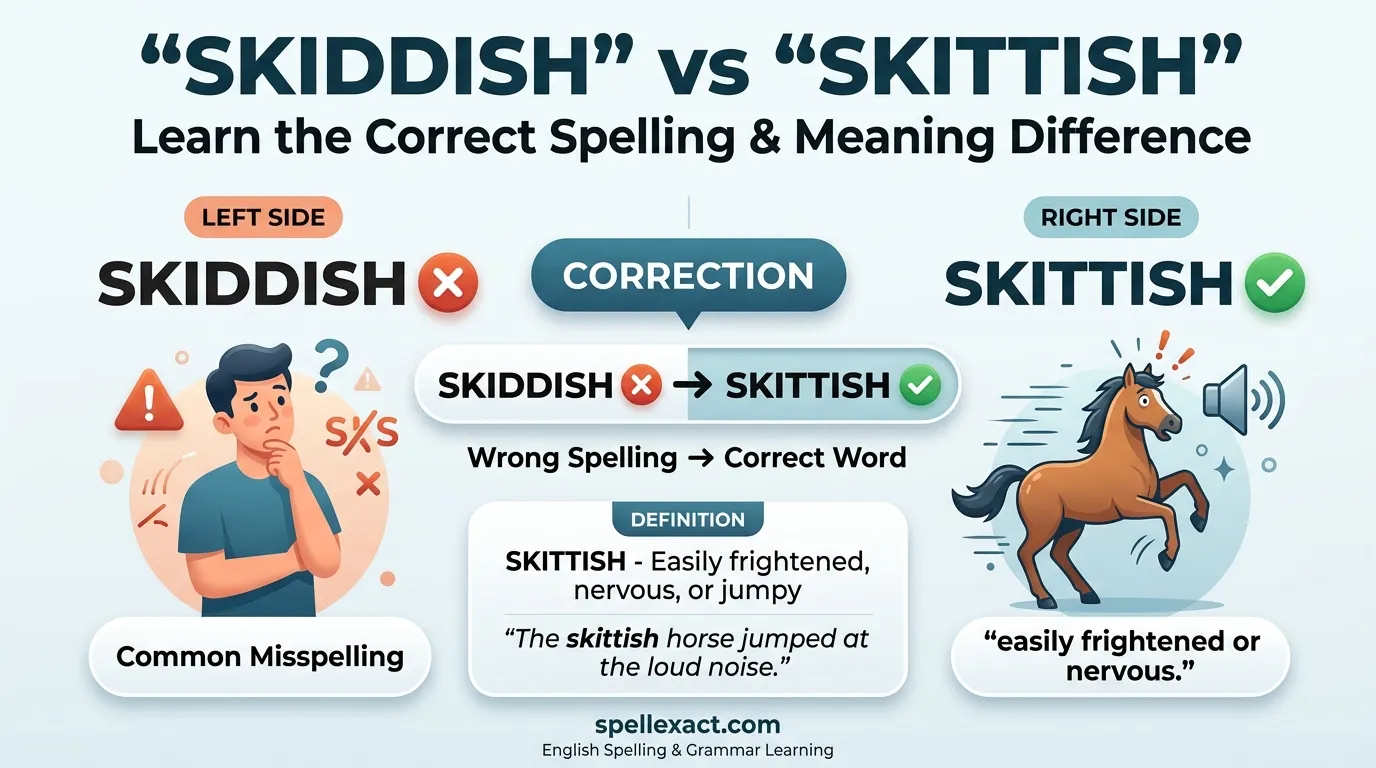
If you are wondering whether “skiddish” or “skittish” is the correct spelling, the short answer is simple: skittish is the standard and correct English word. Skiddish is generally considered a misspelling or nonstandard variation.
The confusion is understandable. The words look and sound similar, especially when spoken quickly. However, if you are writing about someone or something that is nervous, easily frightened, jumpy, or easily startled, skittish is the spelling you should use.
This guide explains the difference between skiddish vs skittish, their meanings, examples, common mistakes, and tips for remembering the correct word.
Quick Answer
Skittish is the correct standard English spelling.
- Skittish = nervous, easily frightened, jumpy, or easily startled.
- Skiddish = usually a misspelling or nonstandard form of skittish.
Correct: The skittish horse moved away when it heard the loud noise.
Incorrect in standard writing: The skiddish horse moved away when it heard the loud noise.
If you mean easily frightened or nervous, choose skittish.
Skittish Meaning
The adjective skittish describes a person or animal that is easily frightened, nervous, restless, or quick to react to something unexpected.
The word is commonly used for animals, particularly horses, but it can also describe people, groups, markets, investors, or situations.
Common meanings of skittish
1. Easily frightened
The skittish cat ran under the bed when the door slammed.
Here, the cat is easily startled by a sudden sound.
2. Nervous or jumpy
She became skittish whenever strangers approached her.
In this example, skittish suggests nervousness and a tendency to react quickly.
3. Hesitant or cautious
The word can also describe someone who is reluctant or unwilling to take a risk.
Investors became skittish after the unexpected economic news.
Here, investors are not literally frightened. Instead, they are nervous and uncertain about making financial decisions.
Is “Skiddish” a Word?
In standard modern English, skiddish is not the accepted spelling for skittish. If you encounter skiddish, it is usually a spelling mistake caused by confusion over pronunciation.
English spelling can create this type of mistake because words do not always look exactly like they sound. Someone may hear the ending of skittish and incorrectly write -dish instead of -ttish.
For formal writing, schoolwork, professional communication, published content, and everyday standard English, use skittish.
Skiddish vs Skittish: Side-by-Side Comparison
| Feature | Skiddish | Skittish |
| Standard English spelling | No | Yes |
| Accepted in formal writing | No | Yes |
| Meaning | Usually intended to mean skittish | Easily frightened, nervous, or jumpy |
| Common usage | Misspelling or nonstandard variation | Standard adjective |
| Example | The horse was skiddish. ❌ | The horse was skittish. ✅ |
The key takeaway is straightforward: when choosing between skiddish vs skittish, use skittish.
How to Use Skittish in a Sentence
Understanding a word through realistic examples is often the easiest way to remember it.
Examples involving animals
- The skittish horse backed away from the unfamiliar sound.
- We spoke quietly because the rescue dog was still skittish.
- The deer was skittish and disappeared into the trees.
- My cat becomes skittish during thunderstorms.
Animals may be described as skittish when they react strongly or quickly to unfamiliar people, noises, movements, or environments.
Examples involving people
- He seemed skittish during the interview because he was extremely nervous.
- The child became skittish after hearing a strange noise outside.
- She was initially skittish around new people but became more comfortable over time.
When used for people, skittish often suggests nervousness, uneasiness, or a tendency to be easily startled.
Examples involving situations and decisions
- Consumers became skittish about spending money during uncertain times.
- The market turned skittish after the announcement.
- Some buyers were skittish about making such a large investment.
In these contexts, skittish has a more figurative meaning. It describes uncertainty, caution, or nervous behavior rather than literal fear.
Why Do People Write “Skiddish”?
The most likely reason is phonetic confusion. People often spell words according to how they believe they sound, particularly when they have heard the word but rarely seen it in writing.
Several factors can contribute to the skiddish vs skittish confusion:
- The words sound somewhat similar when spoken quickly.
- English contains many irregular spelling patterns.
- The ending -ish is common in English adjectives.
- People may unconsciously associate the word with other words ending in -dish.
This is a common type of spelling error. Similar mistakes happen when writers replace double consonants, confuse vowel sounds, or choose a familiar-looking letter pattern.
The best solution is to remember that the correct word is skittish, with two Ts.
A Simple Trick to Remember the Correct Spelling
A useful memory trick is:
A skittish person may be startled twice—so remember the two Ts.
S K I T T I S H
The double T is the most important part of the spelling. If you remember that skittish contains TT, you can avoid accidentally writing skiddish.
Another simple association is:
Skittish = jittery and jumpy.
Although these words are not spelled alike, connecting skittish with other words describing nervous behavior can help reinforce its meaning.
Skittish Synonyms and Related Words
Depending on the context, several words can have meanings similar to skittish.
Synonyms for skittish
- Jumpy
- Nervous
- Easily frightened
- Timid
- Fearful
- Apprehensive
- Uneasy
- Restless
- Flighty
- Startled
However, these words are not always perfect substitutes.
For example, timid usually describes a generally shy or fearful personality, while skittish often emphasizes a quick reaction to fear or uncertainty.
Similarly, jumpy strongly suggests being easily startled, making it one of the closest alternatives in many situations.
Example comparison
The dog was timid around strangers.
This suggests the dog is generally shy or fearful.
The dog was skittish around strangers.
This suggests the dog was nervous and likely to react quickly, move away, or become startled.
The distinction may be subtle, but choosing the right word can make your writing more precise.
Common Mistakes With Skittish
Mistake 1: Writing “skiddish”
Incorrect: The skiddish horse refused to enter the barn.
Correct: The skittish horse refused to enter the barn.
Remember that standard English uses skittish.
Mistake 2: Confusing skittish with childish behavior
A skittish person is not necessarily immature or childish. The word describes nervousness, fearfulness, or a tendency to be easily startled.
For example:
He was skittish about investing his savings.
This does not mean he behaved like a child. It means he felt nervous or cautious about the decision.
Mistake 3: Using skittish when “careful” is more accurate
Someone who carefully studies a decision is not automatically skittish.
Compare:
She was careful before signing the contract.
This suggests thoughtful attention.
She was skittish about signing the contract.
This suggests nervousness or hesitation.
The emotional tone of the two words is different.
Mistake 4: Forgetting the double T
The correct spelling is:
S-K-I-T-T-I-S-H
Not:
- Skitish ❌
- Skiddish ❌
- Skitishh ❌
The standard spelling contains two Ts.
Skittish in American vs British English
There is no meaningful spelling difference between American and British English for this word.
Both varieties use:
American English: skittish
British English: skittish
The meaning is also essentially the same in both forms of English. Whether you are writing for readers in the United States, the United Kingdom, Canada, Australia, or other English-speaking regions, skittish remains the standard spelling.
This makes the word easier to use internationally because you do not need to choose between competing American and British spellings.
Can Skittish Describe Financial Markets?
Yes. Skittish is often used figuratively in business, finance, and economic reporting.
For example:
Investors grew skittish after the company reported weaker results.
The market remained skittish as uncertainty continued.
In these examples, skittish means nervous, uncertain, or easily influenced by worrying developments.
This figurative use is especially common when describing:
- Investors
- Consumers
- Financial markets
- Businesses
- Buyers
- Voters
- Travelers
The word communicates a sense that people may react quickly or cautiously because they feel uncertain.
How to Choose Between Skiddish and Skittish
When proofreading your writing, ask yourself one simple question:
Am I describing someone or something that is nervous, easily frightened, jumpy, or hesitant?
If the answer is yes, the correct standard word is almost certainly skittish.
Use this quick formula:
Nervous + easily startled = skittish
Examples:
- A nervous horse = skittish horse
- An easily startled cat = skittish cat
- Nervous investors = skittish investors
- A jumpy person = skittish person
If you typed skiddish, replace it with skittish in standard writing.
FAQs
1. Is skiddish a correct word?
No. Skiddish is generally treated as a misspelling or nonstandard form when the intended word is skittish. Standard English uses skittish.
2. What does skittish mean?
Skittish means easily frightened, nervous, jumpy, or easily startled. It can also describe someone who is hesitant or nervous about making a decision.
3. How do you spell skittish correctly?
The correct spelling is:
S-K-I-T-T-I-S-H
The word contains two Ts.
4. Is skittish an adjective?
Yes. Skittish is an adjective because it describes a noun, such as a person, animal, group, or market.
Example:
The skittish horse moved away.
5. What is the difference between skittish and nervous?
Nervous is a broad word for feeling worried or anxious. Skittish more specifically suggests being easily startled, fearful, jumpy, or quick to react to something unsettling.
6. Can you call a person skittish?
Yes. You can describe a person as skittish if they seem nervous, easily frightened, jumpy, or hesitant.
Example:
She was skittish about walking home alone at night.
7. Can skittish describe a horse?
Yes. This is one of the most common uses of the word. A skittish horse is easily startled or nervous, often reacting quickly to unexpected sights or sounds.
8. Is there a British spelling of skittish?
No. Both American and British English use skittish. There is no separate British spelling.
Summary:
The difference between skiddish vs skittish is clear once you know the standard spelling. Skittish is the correct English word for describing someone or something that is nervous, easily frightened, jumpy, or easily startled. It can describe animals such as horses and cats, people who react nervously, or groups such as investors who feel uncertain about a decision.
Skiddish, on the other hand, is generally a misspelling or nonstandard variation of skittish. The easiest way to avoid the mistake is to remember the double T in skittish. Whether you are writing an email, school assignment, article, business report, or social media post, use skittish when you mean nervous, jumpy, hesitant, or easily frightened.
Actionable Takeaway
Before publishing or sending your writing, check for skiddish and replace it with skittish when referring to nervous or easily startled behavior. Remember: a skittish word has two Ts just like someone who might take two quick steps back when startled.

Caleb Carter is a passionate language enthusiast and content writer specializing in spelling mistakes, grammar, and vocabulary. He creates clear, practical guides that help readers improve their writing skills and communicate confidently every day.