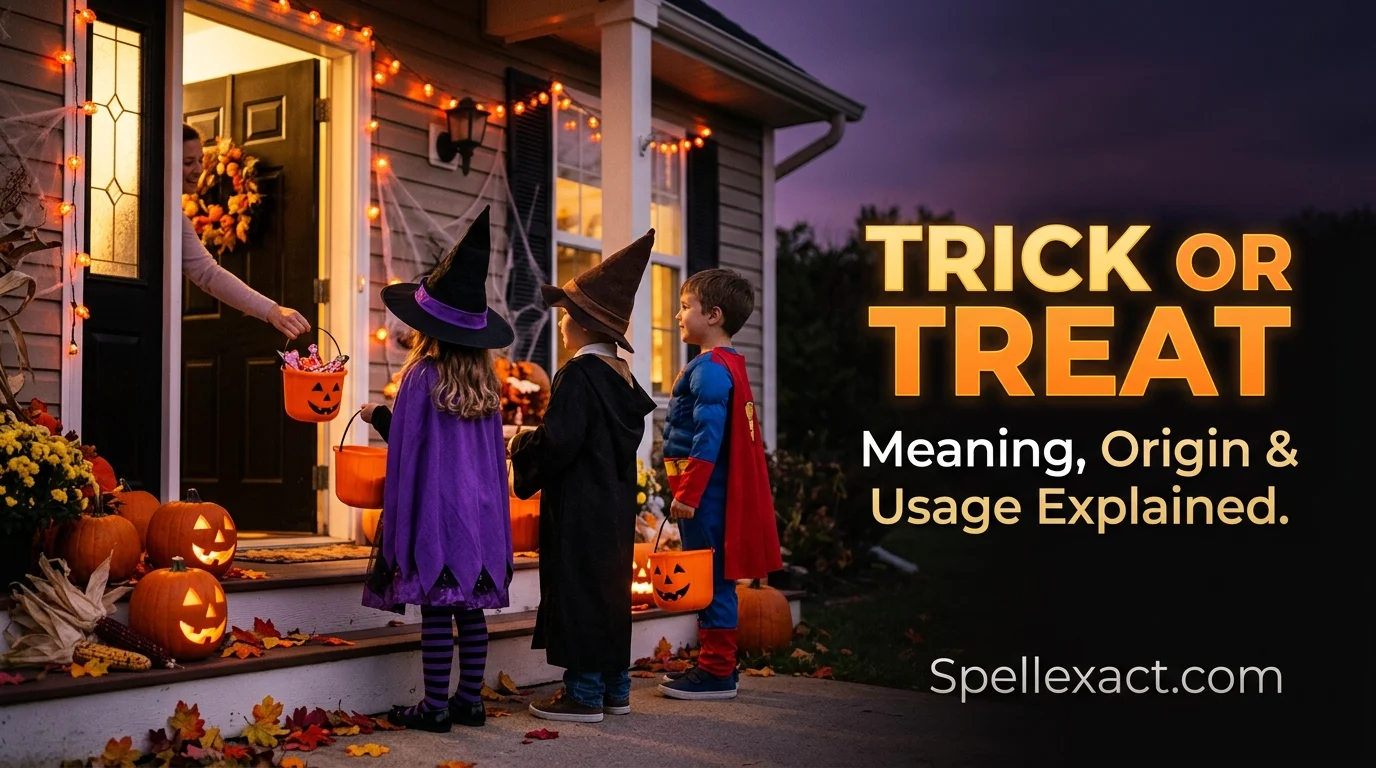
Trick or treat is a Halloween phrase that children say when they knock on doors in costume and ask for candy. It means, “Give us a treat, or we may play a trick on you.” Every October 31, kids in the United States, Canada, and many other countries walk from house to house with bags and buckets, shouting these three words.
Many English learners find this phrase confusing. What is the trick? What is the treat? Do you write it with hyphens? Is it a noun, a verb, or just something you shout? This guide answers these questions in simple English. You will learn what each word means, how to use the phrase in sentences, how the spelling changes, and how to avoid common mistakes.
Quick Answer
Trick or treat is a Halloween phrase said by children, usually dressed in costumes, when they visit homes on October 31. It means “give me a treat, or I may play a trick.” As a verb, it describes the activity of going door to door for candy: “We went trick-or-treating last night.”
Why Do People Confuse “Trick or Treat”?
The phrase causes confusion for a few simple reasons:
- It has several jobs. It is something you say, something you do, and a name for the whole custom.
- The spelling changes. You may see “trick or treat,” “trick-or-treat,” “trick-or-treating,” and “trick-or-treater.”
- The “trick” is not serious. Learners often wonder whether the phrase is a real threat. Today, it is just a playful tradition.
- It is not the same everywhere. Some countries have older customs with different names and different rules.
What Does “Trick” Mean?
A trick is something done to fool, surprise, or play a joke on someone. As a noun, it can mean a prank, a clever skill, or a way of cheating. As a verb, it means to fool someone.
In the Halloween phrase, “trick” means a harmless prank. The idea is playful: if you do not give a treat, the child might do something silly in return. In real life, most children simply say the phrase, smile, and wait for candy.
Other common uses of the word:
- “The magician showed us a card trick.”
- “He tricked me into believing it was a gift.”
What Does “Treat” Mean?
A treat is something special that gives pleasure, such as candy, a snack, or a nice surprise. As a verb, it can also mean to behave toward someone in a certain way (“She treats everyone kindly”) or to pay for something enjoyable (“I’ll treat you to lunch”).
On Halloween, “treat” means the candy or small gifts that people give to children. Common treats include chocolate bars, lollipops, gummy sweets, and small toys.
Trick vs. Treat: Comparison Table
| Feature | Trick | Treat |
| Basic meaning | A prank or joke | Candy or a small gift |
| Main word type | Noun or verb | Noun or verb |
| Halloween idea | The playful “or else” | The reward people hope for |
| Feeling | Mischievous | Happy and generous |
| Everyday example | “That was a clever trick.” | “Ice cream is my favorite treat.” |
| In the phrase | Second choice if no candy is given | First choice everyone prefers |
When Should You Use Each Form?
Use the right form for the right job:
- “Trick or treat!” is what children say at the door. Use it as an exclamation.
- “Trick-or-treat” can work as a verb or adjective: “We trick-or-treat every year.” “It was a trick-or-treat night.”
- “Trick-or-treating” names the activity: “Trick-or-treating starts at six.”
- “Trick-or-treater” names the person: “A tiny trick-or-treater dressed as a bee.”
Dictionaries usually write the verb, adjective, and noun forms with hyphens. The spoken phrase is often written without them.
10+ Examples of “Trick or Treat” in Sentences
- The children shouted, “Trick or treat!” when the door opened.
- We went trick-or-treating around our neighborhood.
- My sister is going trick-or-treating as a pirate.
- The first trick-or-treater arrived at 5:30.
- Please leave a bowl of candy outside for trick-or-treaters.
- Are you taking your little brother trick-or-treating this year?
- Our street is very popular for trick-or-treating.
- He said “trick or treat” and held out his orange bucket.
- The trick-or-treat bags were full of chocolate and lollipops.
- Some towns hold trick-or-treat events in shopping centers.
- Last year, we ran out of candy before eight o’clock.
- She chose a treat, not a trick, so everyone laughed.
Common Mistakes to Avoid
- Saying “trick and treat.” The phrase always uses “or,” because it is a choice.
- Using it with an object. You cannot “trick-or-treat someone.” Say, “The children trick-or-treated at our house.”
- Adding extra letters. Say “trick or treat,” not “tricks or treats.” The singular form is the standard phrase.
- Forgetting hyphens in formal writing. Write “trick-or-treating,” not “trick or treating,” when it acts as a verb or noun.
- Using it all year. The phrase belongs to Halloween, so it sounds odd in other seasons.
An Easy Memory Trick
Think: “Treat me well, or trouble tells.”
Both Treat and Trick start with T, but only one makes people happy. If you remember that “treat” is the tasty one and “trick” is the trouble, you will never mix up their meanings. The word “or” reminds you that the choice is yours.
American English vs. British English
The spelling of “trick or treat” is the same in both varieties. The differences are mostly in the surrounding words and traditions:
- Candy vs. sweets. Americans say “candy,” while British speakers say “sweets.”
- Costume vs. fancy dress. “Costume” is common in American English, and “fancy dress” is common in British English.
- Tradition. In the United States and Canada, trick-or-treating is a major Halloween event. In Britain and Ireland, older customs such as souling and guising came first, and trick-or-treating has become more common in recent decades.
Similar Words and Related Terms
- Guising: An older Scottish and Irish custom where children wear disguises and perform a song, joke, or poem for treats.
- Souling: A medieval custom where people asked for “soul cakes” in return for prayers.
- Prank: A playful trick, often a harmless joke.
- Costume: Special clothes worn to look like a character or creature.
- Jack-o’-lantern: A carved pumpkin with a candle inside.
- Goodies: An informal word for treats.
Final Verdict
Trick or treat is both a phrase and a custom. “Trick” means a playful prank, and “treat” means candy or a small reward. Use “trick or treat” for the words children say, and use the hyphenated forms “trick-or-treat,” “trick-or-treating,” and “trick-or-treater” for the verb, noun, and person. Spelling stays the same in American and British English, but the surrounding vocabulary can differ.
FAQs:
What does “trick or treat” mean?
It means “give me a treat, or I may play a trick on you.” Children say it on Halloween when they ask neighbors for candy.
Is it “trick or treat” or “trick-or-treat”?
Both are used. Write “trick or treat” for the spoken phrase and “trick-or-treat” or “trick-or-treating” when it works as a verb, adjective, or noun.
When do people go trick-or-treating?
Usually on October 31, which is Halloween. Some towns choose a nearby evening or hold special events, so local dates and times can vary.
Where does trick or treat come from?
The custom grew from older traditions such as souling and guising in Britain and Ireland. The phrase “trick or treat” was first recorded in Canada in the early 1900s and became widespread across North America in the 1920s and 1930s. You can read more about its history in this detailed guide to trick-or-treating.
Do children really play tricks?
Very rarely today. The “trick” is part of the playful tradition, and most children just say the phrase and receive candy.
Is trick or treat only an American custom?
No. It is strongly linked with the United States and Canada, but it is now common in the United Kingdom, Ireland, Australia, and many other countries.
What is a trick-or-treater?
A trick-or-treater is a person, usually a child, who goes from door to door at Halloween asking for treats.
What do you say when someone gives you candy?
Say “Thank you!” It is polite, and some children add “Happy Halloween!”
Remember This
- Trick or treat means “give me a treat, or I might play a trick.”
- A trick is a prank. A treat is candy or a small gift.
- Use hyphens for the verb, noun, and adjective forms: trick-or-treating, trick-or-treater.
- You trick-or-treat at a house, never someone.
- Americans say “candy,” and British speakers say “sweets.”
Conclusion:
Trick or treat may look like a simple phrase, but it carries a lot of meaning. It names a Halloween choice, a fun activity, and a tradition with deep roots in older customs. Once you understand “trick” and “treat” separately, the whole phrase becomes easy to use.
Next time you hear children shouting it at your door, you will know exactly what they mean and how to write about it. Keep the examples and memory trick in mind, and you can use every form of the phrase with confidence in conversation, school writing, or everyday messages.

Maria Megan is a language enthusiast and content writer specializing in spelling, grammar, and English usage. She creates clear, practical articles that help readers identify common spelling mistakes, improve writing accuracy, and communicate with greater confidence.