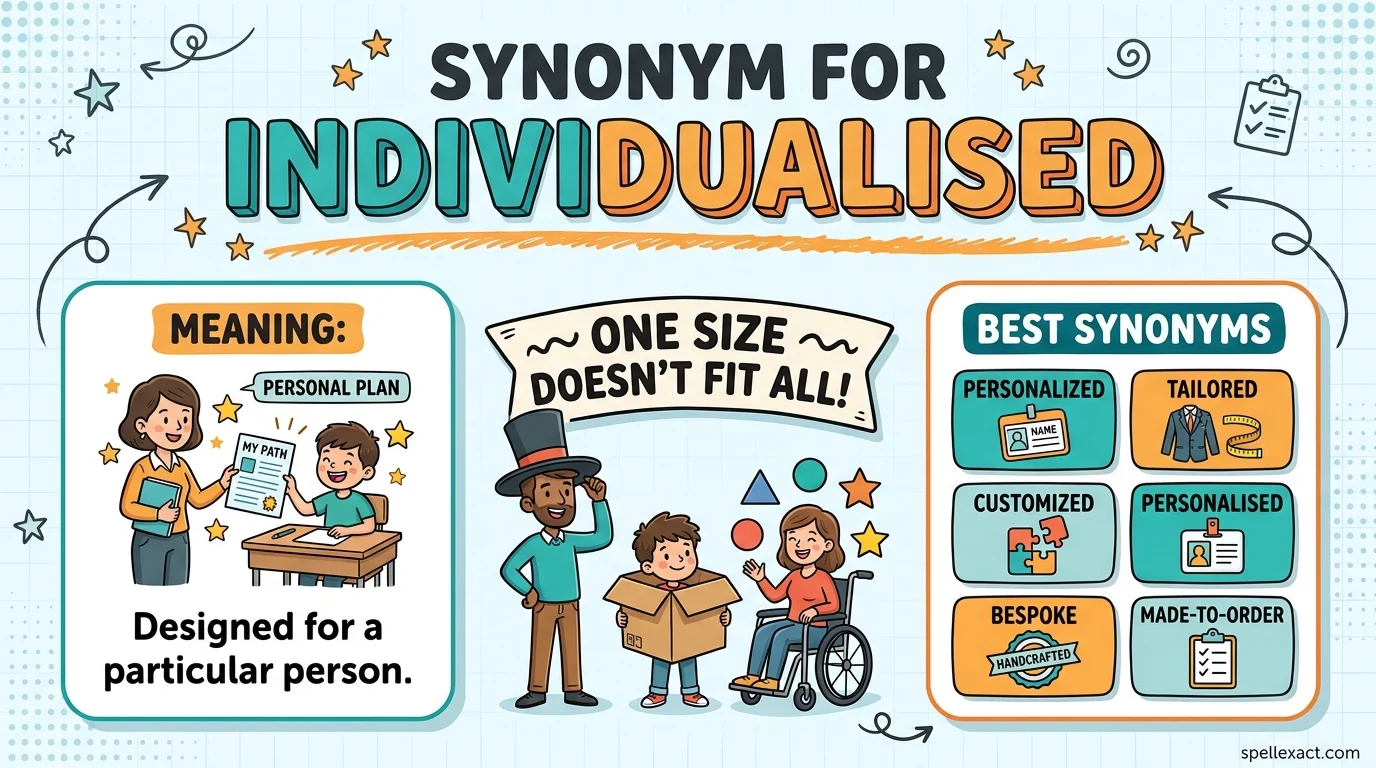
A synonym for individualised depends on the meaning you want to express and the context in which you use it. Common alternatives include personalized, customized, tailored, bespoke, unique, specific, and person-centered. These words describe something designed, adapted, or created to meet the needs of a particular person. For example, a personalized approach considers someone’s preferences, while a tailored approach adjusts a plan to meet their specific requirements.
The best choice depends on the situation, the individual, and their needs. In everyday writing, personalized and customized are widely used because they are easy to understand. Bespoke often describes a special product or service, while person-centered focuses on a person’s needs and choices. These alternatives help writers explain personal needs and individual preferences clearly without repeating the same words.
Writers can also use phrases such as customized solution, tailored approach, bespoke design, unique solution, and person-centered approach to make their meaning clearer. For example, a teacher may create an individualized learning plan for each student, while a business may offer a customized solution for a customer. From a writing perspective, selecting the right alternative makes sentences more natural, precise, and suitable for the reader.
Quick Answer: What Is a Synonym for Individualised?
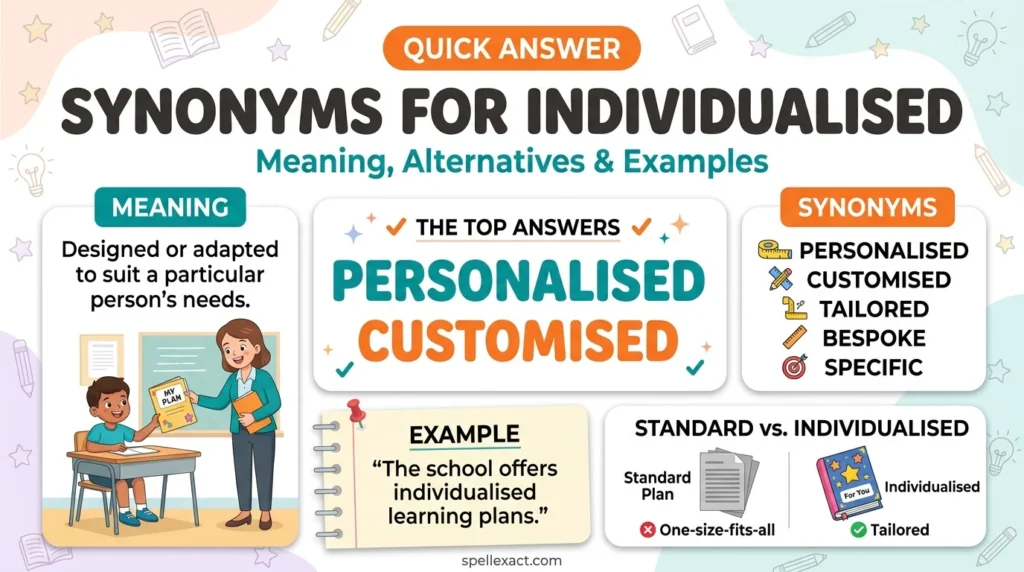
The best general-purpose synonym for individualised is personalised in British English or personalized in American English. Other strong alternatives include tailored, customised, individually designed, and bespoke, depending on the context.
Individualised means designed, adapted, or adjusted to meet the needs, preferences, or circumstances of a particular person.
Example: The teacher created an individualised learning plan for each student.
Alternative: The teacher created a personalised learning plan for each student.
Both sentences are natural. The second uses a familiar alternative while keeping the original meaning.
What Does Individualised Mean?
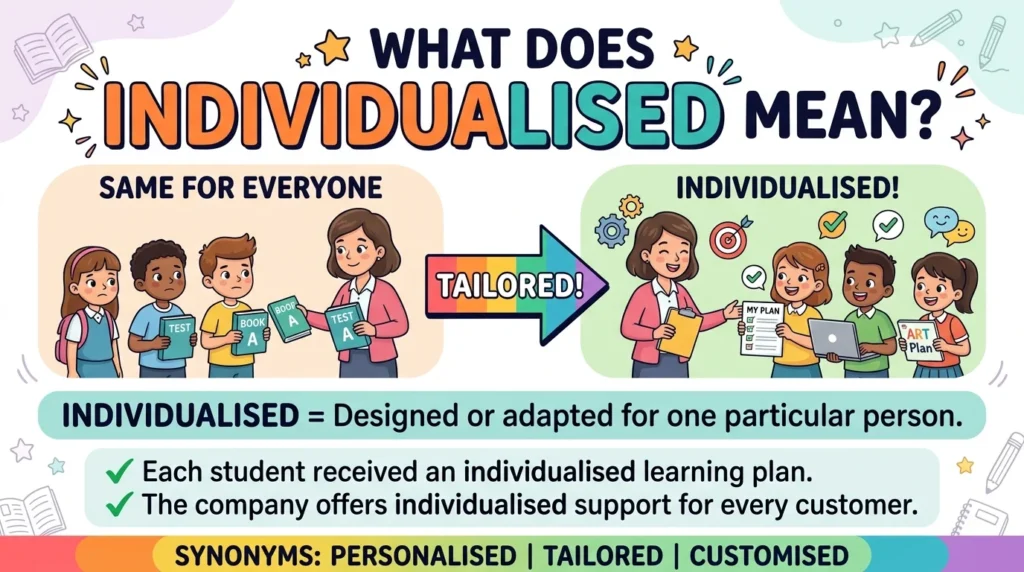
The word individualised is an adjective. It describes something that has been adapted to suit a particular individual rather than provided in exactly the same way to everyone.
Individualised Definition in Simple English
The simplest individualised definition is: designed or changed to suit one person’s particular needs, circumstances, or preferences.
For example:
- An individualised study plan considers a student’s learning needs.
- Individualised care takes a patient’s circumstances into account.
- Individualised support addresses a person’s particular challenges.
- An individualised fitness programme reflects someone’s abilities and goals.
The word is commonly used in education, healthcare, business, customer service, and personal development.
Individualised in a Sentence
These examples show how to use individualised naturally in different situations.
- Education: Each learner receives an individualised study plan.
- Healthcare: The doctor recommends individualised care for the patient.
- Business: The company provides individualised support to its clients.
- Fitness: The trainer develops an individualised exercise routine.
- Technology: The application offers individualised recommendations.
If you want another word for individualised, consider the purpose of the sentence. Personalised is a good general alternative, while tailored emphasises careful adaptation.
Individualised vs Individualized: Which Spelling Is Correct?
Both spellings are correct. The difference is regional.
| British English | American English |
| Individualised | Individualized |
| Personalised | Personalized |
| Customised | Customized |
| Specialised | Specialized |
| Centred | Centered |
Because this article targets the British spelling individualised, British English is used as the default. American alternatives are included where they help explain the difference.
20 Best Synonyms for Individualised
The following words similar to individualised are organised around practical usage. The first group contains close alternatives, while the remaining entries describe related concepts that are appropriate in particular contexts.
1. Personalised
Meaning: Designed or adapted to suit a particular person.
Example: The website offers personalised recommendations based on each user’s interests.
Best usage: Education, customer service, marketing, and everyday communication.
Why choose it? It is a natural, widely understood alternative to individualised when personal needs or preferences are important.
2. Tailored
Meaning: Carefully adapted to suit a person, purpose, or situation.
Example: The school provides tailored support for students who need extra help.
Best usage: Education, professional advice, healthcare, and business services.
Why choose it? It emphasises that something has been thoughtfully adjusted rather than provided as a standard solution.
3. Customised
Meaning: Changed or designed to meet particular requirements.
Example: The company developed a customised training course for its employees.
Best usage: Software, products, business solutions, and training.
Why choose it? It is particularly suitable when a product, service, or system has been changed to meet specific requirements.
4. Individualized
Meaning: Adapted to the needs or characteristics of an individual.
Example: Each child receives an individualized reading plan.
Best usage: American English, education, healthcare, and formal writing.
Why choose it? It is the American English spelling of individualised, not a different word with a different meaning.
5. Tailor-made
Meaning: Specially designed for a particular person or purpose.
Example: The organisation created a tailor-made course for new managers.
Best usage: Education, business, professional training, and specialist services.
Why choose it? It communicates that something has been created with a particular need or objective in mind.
6. Bespoke
Meaning: Made specifically for an individual customer or a particular set of requirements.
Example: The designer created a bespoke suit for the client.
Best usage: Fashion, luxury products, specialist design, and premium services.
Why choose it? It is especially common in British English and often suggests a product or service made to order.
7. Adapted
Meaning: Changed to make something suitable for a particular purpose or situation.
Example: The teacher adapted the lesson for learners with different abilities.
Best usage: Education, accessibility, training, and general communication.
Why choose it? It works well when an existing plan, activity, or resource has been changed to meet different needs.
8. Modified
Meaning: Changed in some way to improve suitability or meet a requirement.
Example: The coach provided a modified exercise routine for beginners.
Best usage: Technical writing, fitness, academic work, and practical instructions.
Why choose it? It highlights a change to an existing item or approach rather than necessarily suggesting that it was designed for one person.
9. Custom-made
Meaning: Made according to particular requirements instead of being produced as a standard item.
Example: She ordered a custom-made desk for her home office.
Best usage: Furniture, clothing, equipment, and specially designed products.
Why choose it? It is a strong option when discussing a physical product made to meet a customer’s specifications.
10. Made-to-measure
Meaning: Made using measurements specific to the customer.
Example: He purchased a made-to-measure jacket for the wedding.
Best usage: Clothing, furniture, and products that require a precise fit.
Why choose it? It is more precise than individualised when the main consideration is the customer’s measurements.
11. Person-specific
Meaning: Relating to or designed for a particular person.
Example: The therapist prepared person-specific exercises for the client.
Best usage: Technical writing, research, healthcare, and formal explanations.
Why choose it? It explicitly connects the plan, information, or intervention to one particular individual.
12. Individually tailored
Meaning: Adjusted separately to suit a person’s particular needs or circumstances.
Example: Each participant receives individually tailored feedback.
Best usage: Education, coaching, professional development, and formal communication.
Why choose it? It is useful when you want to emphasise that adjustments have been made separately for each person.
13. Personally tailored
Meaning: Adapted to reflect someone’s personal needs or preferences.
Example: The adviser offered personally tailored recommendations.
Best usage: Advice, coaching, customer support, and personal development.
Why choose it? It highlights the personal relevance of a recommendation or service.
14. Specialised
Meaning: Designed for a particular purpose, activity, or field.
Example: The clinic offers specialised services for children.
Best usage: Healthcare, education, technology, and professional services.
Why choose it? Use it when the subject focuses on a particular field or purpose, rather than necessarily being adapted for one individual.
15. Needs-based
Meaning: Determined by the needs of a person or group.
Example: The school provides needs-based academic support.
Best usage: Education, social services, healthcare, and resource allocation.
Why choose it? It emphasises the requirements that determine what support is offered.
16. Person-centred
Meaning: Focused on an individual’s needs, preferences, experiences, and choices.
Example: The care team follows a person-centred approach to treatment.
Best usage: Healthcare, social care, education, and support services.
Why choose it? It is particularly useful when describing an approach that respects an individual’s preferences and participation in decisions.
17. Learner-centred
Meaning: Organised around learners’ needs, interests, and learning experiences.
Example: The instructor uses a learner-centred teaching method.
Best usage: Education, teaching strategies, curriculum planning, and training.
Why choose it? It describes an educational approach that focuses on learners, although it does not necessarily mean that every student receives a completely separate plan.
18. Differentiated
Meaning: Varied to accommodate differences in needs, abilities, or circumstances.
Example: The teacher uses differentiated instruction to support learners at different levels.
Best usage: Education, training, and teaching methods.
Why choose it? It is appropriate when teachers adjust materials, activities, or instruction to address differences among learners.
19. Student-specific
Meaning: Designed or selected for a particular student.
Example: The counsellor recommended student-specific learning goals.
Best usage: Schools, tutoring, academic planning, and educational support.
Why choose it? It identifies the student as the person whose circumstances or requirements guide the plan.
20. Context-specific
Meaning: Suitable for a particular situation, environment, or set of circumstances.
Example: The instructor provided context-specific examples for the assignment.
Best usage: Academic writing, research, technical explanations, and professional guidance.
Why choose it? It is useful when the adaptation depends on a situation rather than an individual’s personal preferences.
Comparison Table: Which Synonym Should You Use?
The differences between similar words can be subtle. This individualised synonym comparison table highlights the main emphasis of each alternative.
| Synonym | Main emphasis | Best context |
| Personalised | Personal needs or preferences | Services, recommendations, education |
| Tailored | Careful adaptation | Plans, advice, support |
| Customised | Specific requirements | Products, software, business |
| Individualized | Adaptation for an individual | American English, education |
| Tailor-made | Designed for a particular purpose | Training, services, specialist solutions |
| Bespoke | Made specifically for a customer | Fashion, luxury products |
| Adapted | Changed for suitability | Education, accessibility |
| Modified | Changed from an existing form | Technical and practical writing |
| Custom-made | Made to particular specifications | Furniture, equipment, clothing |
| Made-to-measure | Made to precise measurements | Clothing and fitted products |
| Person-specific | Relating to one person | Research and healthcare |
| Individually tailored | Adjusted separately for each person | Coaching, education |
| Specialised | Designed for a particular field | Professional services |
| Needs-based | Determined by requirements | Support programmes |
| Person-centred | Focused on needs and choices | Healthcare and social care |
| Learner-centred | Focused on learning experiences | Education |
| Differentiated | Adjusted for different needs | Teaching and training |
| Student-specific | Related to one student | Academic support |
| Context-specific | Appropriate to a particular situation | Research and professional writing |
Individualised vs Personalised
Individualised and personalised are close in meaning and can often be used interchangeably.
However, personalised frequently emphasises a person’s preferences, characteristics, or interests.
- Individualised instruction considers a student’s learning needs.
- Personalised recommendations reflect a user’s interests.
The difference is one of emphasis, not a strict rule.
Individualised vs Customised
Customised emphasises changes made to meet particular requirements. Individualised emphasises adapting something to the needs or circumstances of an individual.
For example, customised software may include features requested by a client, while an individualised treatment plan accounts for a particular patient’s circumstances.
Individualised vs Tailored
Tailored is a flexible alternative that works in both everyday and professional English.
- Individualised support addresses each student’s needs.
- Tailored support addresses each student’s needs.
Both sentences are natural. Tailored often sounds concise and professional, particularly when discussing plans, services, advice, and support.
Individualised vs Specialised
Specialised describes something designed for a particular field, purpose, or category. It does not necessarily mean that it has been created for one specific person.
For example, a specialised clinic serves a particular medical field, while individualised care considers a patient’s circumstances and preferences.
How to Choose the Right Synonym for Individualised
Choosing another word for individualised becomes easier when you consider your audience, intended meaning, and writing style.
1. Choose According to Tone
For everyday English: Use personalised, tailored, or adapted. These words are familiar and easy to understand.
For academic writing: Use individualised, person-specific, or differentiated when they accurately describe the concept.
Professional communication: Use tailored, customised, or client-specific when discussing services, plans, and business solutions.
For luxury products: Use bespoke, custom-made, or made-to-measure when referring to products created to meet particular requirements.
2. Choose According to Meaning
Different alternatives emphasise different aspects of individualisation.
- Personal preferences: Choose personalised or personally tailored.
- Specific requirements: Choose customised or client-specific.
- Careful adjustment: Choose tailored or adapted.
- Individual needs in healthcare: Choose person-centred.
- Different learning abilities: Choose differentiated or learner-centred, depending on the teaching approach.
- A particular situation: Choose context-specific.
- Special manufacturing: Choose custom-made or made-to-measure.
- A particular field of expertise: Choose specialised.
3. Choose According to Your Sentence
The best synonym for individualised should fit the sentence naturally.
Example 1: Education
Original: The school provides individualised learning plans.
Alternative: The school provides personalised learning plans.
Both are appropriate if the plans reflect each student’s needs.
Example 2: Business
Original: The company provides individualised solutions.
Alternative: The company provides customised solutions.
The alternative works particularly well when solutions are adjusted to meet client requirements.
Example 3: Healthcare
Original: The clinic offers individualised care.
Alternative: The clinic follows a person-centred approach to care.
The second sentence highlights the importance of individual needs, preferences, and choices.
Example 4: Professional training
Original: The organisation created an individualised course.
Alternative: The organisation created a tailor-made course.
The alternative emphasises that the course was specially designed for its intended purpose.
Before replacing a word, check that the new expression preserves the original meaning and sounds natural to your audience.
Common Mistakes When Using Synonyms for Individualised
Even familiar words similar to individualised can be misleading if their meanings are not understood.
Mistake 1: Assuming All Synonyms Mean Exactly the Same Thing
Personalised, customised, and specialised are related, but they are not interchangeable in every situation.
A specialised course focuses on a particular subject or purpose. A personalised course may reflect a learner’s preferences, while a customised course has been changed to meet specific requirements.
Better approach: Select the word that accurately describes the intended adjustment.
Mistake 2: Using Unique When You Mean Personalised
Unique means distinctive or different from others. It does not necessarily mean that something has been adapted to meet an individual’s needs.
Less precise: The school created a unique timetable for each student.
Clearer: The school created an individualised timetable for each student.
Use unique when you want to emphasise distinctiveness, not simply personal adaptation.
Mistake 3: Confusing Specialised With Individualised
A specialised service serves a particular field or category of need. An individualised service adapts its approach to a particular person.
For example, a specialised clinic may treat a specific type of condition, while individualised care considers a patient’s circumstances and preferences.
Mistake 4: Making Simple Writing Unnecessarily Complicated
Long technical expressions can make a message harder to understand.
Instead of writing, “The institution implemented person-specific educational interventions,” consider, “The school created learning activities for each student.”
Use the simplest expression that communicates the intended meaning accurately.
Mistake 5: Mixing British and American Spellings
Both individualised and individualized are correct. However, mixing spelling conventions can make an article look inconsistent.
For British English, use individualised, personalised, and customised.
For American English, use individualized, personalized, and customized.
Mistake 6: Replacing a Word Without Checking Grammar
A synonym may require a different sentence structure.
- Adjective: The teacher created an individualised plan.
- Phrase: The teacher created a plan tailored to the student.
- Verb: The teacher personalised the plan.
Always check grammar and sentence flow after making a replacement.
Frequently Asked Questions
1. What is the closest synonym for individualised?
Personalised is one of the closest general-purpose alternatives. Tailored and customised are also suitable in many contexts. The best choice depends on whether the sentence emphasises personal preferences, careful adaptation, or specific requirements.
2. What is another word for individualised?
Other alternatives include personalised, tailored, customised, tailor-made, and bespoke. Use the word that fits the subject and preserves the original meaning.
3. What is a simple word for individualised?
Personalised is a simple and widely understood alternative. You can also say made for one person, adapted for someone, or designed for individual needs.
For example, “The teacher created an individualised plan” can become “The teacher created a plan for each student.”
4. What does individualised mean in simple English?
Individualised means designed or changed to suit a particular person’s needs, circumstances, or preferences.
For example, an individualised study plan is created to help a particular student learn effectively.
5. What is a formal synonym for individualised?
Formal alternatives include individually tailored, person-specific, and context-specific. Choose the expression that accurately describes the concept in your academic or professional writing.
6. What is the opposite of individualised?
Possible opposites include standardised, uniform, generic, and one-size-fits-all.
- Standardised means following a common standard.
- Uniform means consistent or the same across people or situations.
- Generic means general rather than specially designed.
- One-size-fits-all describes an approach intended to suit everyone without individual adjustments.
The best opposite depends on the sentence.
7. Is individualised British or American English?
Individualised is the standard British English spelling, while individualized is the standard American English spelling. Both are correct.
British English also commonly uses personalised and customised, whereas American English uses personalized and customized.
8. What is another word for individualised learning?
Common alternatives include personalised learning, individualised instruction, learner-centred learning, and differentiated instruction.
Personalised learning focuses on a learner’s needs and preferences. Differentiated instruction involves adjusting teaching methods, activities, or materials to accommodate differences among learners.
Conclusion
Choosing the right synonym for individualised depends on the message you want to communicate. Personalised is a strong general alternative, customised emphasises specific requirements, and tailored highlights careful adaptation. Other expressions, including bespoke, person-centred, and differentiated, are useful in particular contexts.
By learning these synonyms for individualised, you can expand your vocabulary, avoid unnecessary repetition, and express ideas more precisely. If you are completing an academic assignment, improving your English, preparing teaching materials, or writing professional content, choose words that sound natural and preserve your intended meaning.
The goal is not simply to find another word for individualised. It is to select the word that communicates your idea clearly, accurately, and confidently.

Andrew Anthony is a language enthusiast and content writer specializing in spelling mistakes, grammar, and English usage. He creates clear, practical, and well-researched guides that help readers improve their writing skills with confidence.