Have you ever typed “stary night” and wondered whether it should actually be “starry night”? You are not alone. This is a common spelling confusion because the two words look and sound very similar, especially when spoken quickly.
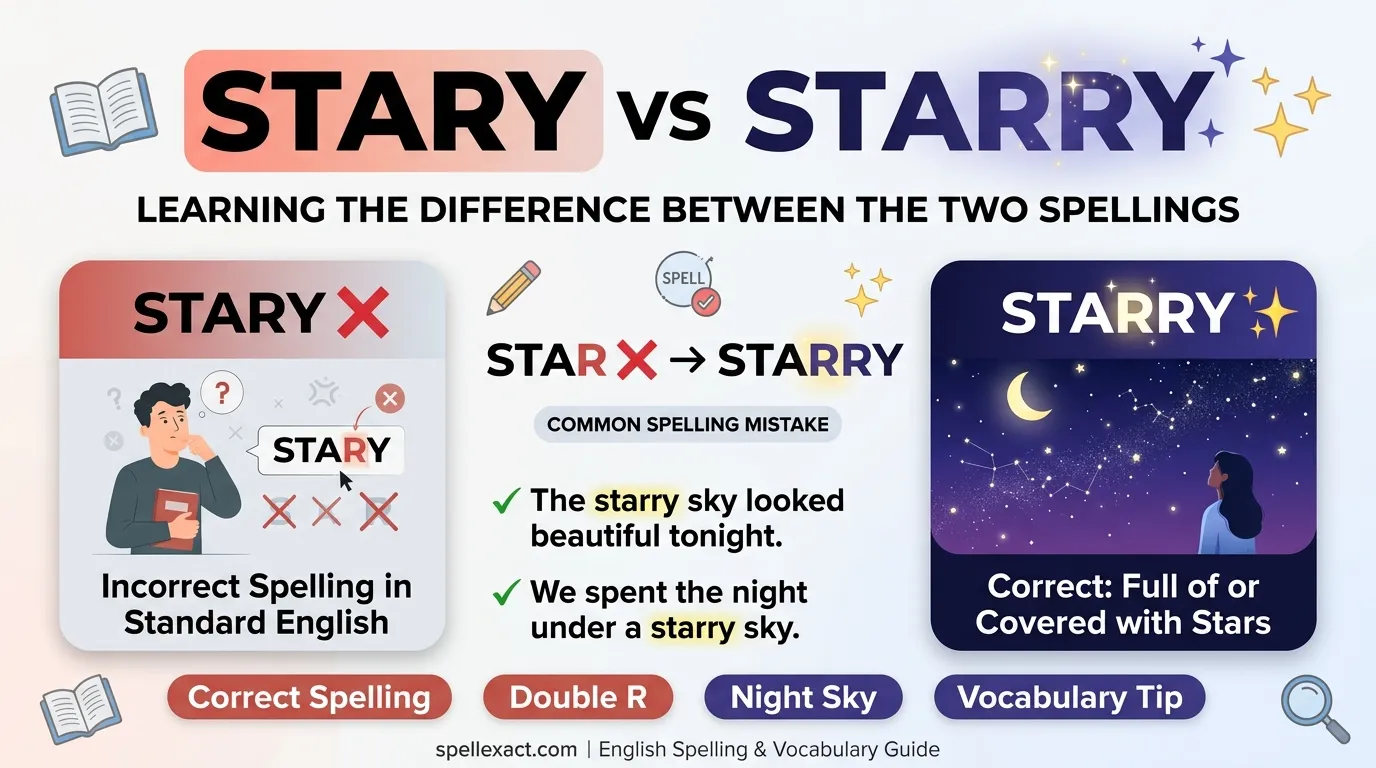
The short answer is simple: starry is the correct English word when describing something filled with, covered by, or resembling stars. Stary is generally considered a misspelling of starry. However, understanding why the extra r is needed can help you avoid making the same mistake again.
Quick Answer:
- Starry is the correct spelling.
- Stary is generally a spelling mistake when you mean “full of stars.”
- Starry means containing many stars or resembling stars.
- Example: We sat outside under a beautiful starry sky.
Easy memory trick: One star becomes starry with a double r. Think of a sky containing many stars—it needs an extra letter too!
What Does Starry Mean?
Starry is an adjective used to describe something that is full of stars, covered with stars, or appears to shine like stars.
The most common expression is “starry sky” or “starry night.” These phrases describe a nighttime sky where many stars are visible.
Examples of Starry in a Sentence
- We spent the evening looking at the starry sky.
- The children slept under a starry night.
- They walked along the beach beneath a starry heaven.
- The artist painted a beautiful starry landscape.
- Her eyes had a starry sparkle when she heard the news.
The word can also be used figuratively. For example, starry-eyed describes someone who is idealistic, dreamy, or full of excitement about something.
Example: He arrived in Hollywood as a starry-eyed young actor with big dreams.
Is Stary a Correct Word?
In standard modern English, stary is not the correct spelling when you mean “full of stars.”
For example:
❌ It was a beautiful stary night.
✅ It was a beautiful starry night.
The confusion usually happens because writers may assume that adding -y directly to star creates stary. However, English spelling rules sometimes require a consonant to be doubled before adding a suffix.
In this case, the accepted adjective is starry, with two r letters.
Stary vs Starry: Side-by-Side Comparison
| Word | Correct? | Meaning | Example |
| Stary | ❌ Generally incorrect | Usually a misspelling of starry | The stary sky looked beautiful. |
| Starry | ✅ Correct | Full of stars or resembling stars | We admired the starry sky. |
When writing standard English, especially for school, professional communication, websites, or published content, you should use starry.
Why Does Starry Have Two R’s?
The spelling of starry comes from the noun star plus the adjective-forming ending -y. English spelling conventions produce starry, with a doubled r.
Similar words include:
- Fur → furry
- Sun → sunny
- Fog → foggy
- Star → starry
The extra consonant often helps preserve the intended pronunciation and follows established English spelling patterns.
A useful way to remember the spelling is to connect starry with furry. Both words contain a double consonant before the final y.
- A furry cat
- A starry sky
This pattern can make starry easier to remember.
Common Phrases Using Starry
The word starry appears in several familiar English expressions. Learning these phrases can help you recognize the correct spelling naturally.
Starry Night
A starry night is a night when many stars can be seen in the sky.
Example: They went camping on a clear, starry night.
This is perhaps the most commonly searched and used phrase involving starry.
Starry Sky
A starry sky means a sky filled with visible stars.
Example: The desert offered an unforgettable view of the starry sky.
Starry-Eyed
Starry-eyed is usually used figuratively to describe someone who is dreamy, hopeful, idealistic, or strongly impressed.
Example: She was a starry-eyed student hoping to become a famous writer.
The phrase can be positive, neutral, or slightly critical depending on the context.
Starry Heaven
Starry heaven is a more poetic or literary expression for the night sky.
Example: They stood quietly beneath the starry heaven.
These common combinations show why starry, not stary, is the spelling you should learn.
Common Mistakes With Stary and Starry
1. Using “Stary Night”
This is the most common mistake.
❌ We enjoyed the stary night.
✅ We enjoyed the starry night.
Because starry is the established English adjective, the double r is necessary.
2. Confusing the Word With “Star”
Some writers think the word should simply be formed as:
star + y = stary
However, English spelling does not always work through simple letter addition. The accepted form is starry.
3. Writing “Starry” When You Mean “Star”
Remember that star and starry have different grammatical roles.
- Star is usually a noun.
- Starry is an adjective.
Example:
I saw a bright star. — noun
I looked at the starry sky. — adjective
4. Forgetting the Double R in Fast Typing
Typos often happen when writing quickly on phones, computers, or social media.
If you are proofreading, search specifically for stary when you intended to write about stars. This can quickly catch the mistake.
Stary vs Starry: How to Remember the Correct Spelling
Here are a few practical memory tricks.
Think: Star + Double R + Y
Break the word into:
Sta + rry
The double r may look unusual at first, but repeated exposure makes it easier to recognize.
Connect It With “Furry”
Both words follow a similar visual pattern:
- furry
- starry
If you remember the double consonant in furry, you may find starry easier to spell correctly.
Remember the Phrase “Starry Night”
The expression starry night is extremely common in English. Memorizing the complete phrase can be more effective than trying to remember the word in isolation.
Think:
A starry night has countless stars—and the word starry has an extra R.
Starry in Everyday Writing
Although starry is often associated with poetry and romantic descriptions, it is useful in many types of writing.
Travel Writing
We escaped the city lights and spent the night beneath a clear, starry sky.
Creative Writing
The starry darkness stretched endlessly above the quiet village.
Personal Writing
Our favorite memory from the trip was sitting together under the starry night sky.
Educational Writing
Light pollution can make it difficult to see a naturally starry sky in large cities.
Using the word correctly helps your writing sound polished and natural.
American English vs British English
There is no spelling difference between American and British English for this word.
Both varieties use:
- 🇺🇸 starry
- 🇬🇧 starry
The spelling stary is not the standard alternative in either American English or British English when referring to something full of stars.
This makes the choice straightforward: regardless of your audience or English variety, starry is the correct word.
Related Words and Common Spelling Confusions
If you are learning English spelling, starry belongs to a broader group of words where double consonants can create confusion.
Star vs Starr
Star is the normal English noun.
She pointed at a bright star.
Starr may appear as a surname or proper name, but it is not the standard spelling of the astronomical object.
Star vs Starred
Starred is the past tense and past participle of the verb star, meaning to feature or perform as a leading actor.
The film starred several famous actors.
Star vs Starry
- Star = a celestial object or famous person.
- Starry = full of stars or resembling stars.
Examples:
That star is unusually bright.
The starry sky was breathtaking.
Understanding these word forms can make your spelling and grammar more accurate.
Is “Stary” Ever Used as a Name?
Although stary is not the standard English adjective for something full of stars, unusual spellings can occasionally appear as usernames, brand names, surnames, place names, or proper nouns.
That does not make stary the correct replacement for starry in normal English writing.
For example, if someone has a username such as StaryDreamer, that spelling may be intentional. But in a sentence describing a sky full of stars, the correct word remains starry.
Frequently Asked Questions
Is it “stary” or “starry”?
The correct standard spelling is starry. Use it to describe something full of stars or resembling stars.
Why is starry spelled with two R’s?
Starry is the established adjective form of star. English spelling conventions use a double r before the ending -y in this word.
Is “stary night” correct?
No. The correct phrase is starry night.
What does starry mean?
Starry means full of stars, covered with stars, or resembling stars. It can also appear in figurative expressions such as starry-eyed.
Is starry an adjective?
Yes. Starry is an adjective because it describes a noun.
Example: They watched the starry sky.
Is “stary” correct in British English?
No. Standard British English uses starry, just like American English.
What is the difference between star and starry?
Star is generally a noun, while starry is an adjective.
- I saw a star.
- I saw a starry sky.
How do you spell “starry-eyed”?
The correct spelling is starry-eyed, with a double r in starry and a hyphen between starry and eyed.
Final Thoughts:
When comparing stary vs starry, the correct choice for standard English is clear: starry is the proper spelling. It is used to describe a sky, night, or other scene filled with stars, as well as figurative expressions such as starry-eyed.
The easiest way to avoid the mistake is to remember the familiar phrase “starry night.” Whenever you are tempted to write stary, pause and check for the missing r. With this simple habit, you can make your writing clearer, more accurate, and more professional.
Actionable takeaway: Before publishing or sending your writing, search for “stary” and replace it with “starry” whenever you mean “full of stars.” Learning common word patterns like furry, sunny, and starry can also improve your overall English spelling confidence.

Aaron Adam is the Administrator of SpellExact, dedicated to helping readers improve their spelling and writing accuracy. He oversees content quality, ensures reliable language resources, and works to make spelling guidance simple, practical, and accessible for everyone.