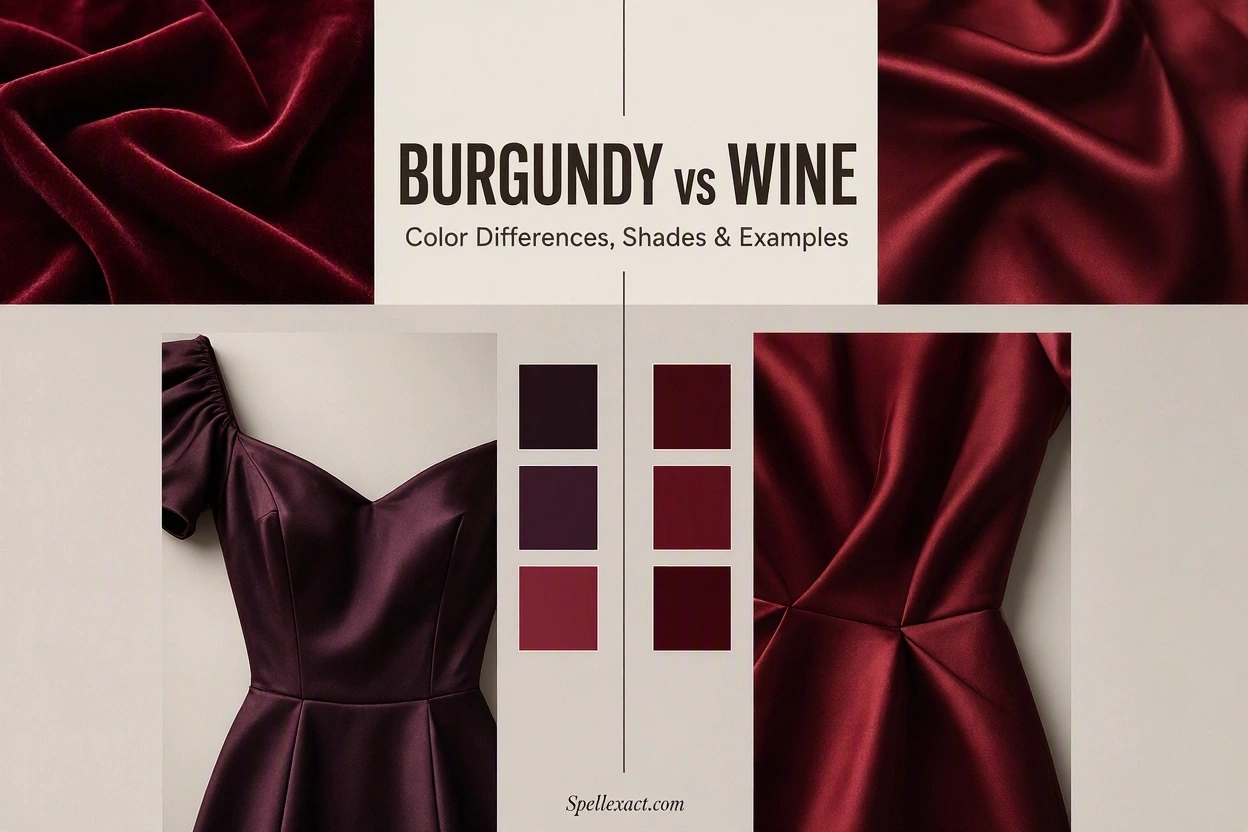
Burgundy and wine are both deep red colors, and many people use the names as if they mean the same thing. They are very close, but not identical. Burgundy is a dark red with a purple-brown tint, while wine is a slightly softer, more muted red with a plum or berry feel. Burgundy is also a famous French wine region, which adds to the confusion.
This guide explains each word in plain English. You will see how the two shades compare, when to choose one over the other, and how to describe them correctly in sentences. Whether you are a student, an English learner, or someone picking paint, clothes, or a lipstick shade, you will leave knowing exactly which word fits best. Short examples make each point easy to remember.
Quick Answer: What Is the Difference Between Burgundy and Wine?
Burgundy is a dark red with purple and brown undertones, named after wine from the Burgundy region of France. Wine is a color name for a deep red similar to red wine, usually a bit softer and more plum-toned. They overlap heavily, so many brands use the names interchangeably.
Why Do People Confuse Burgundy and Wine?
Three things cause the mix-up:
- Shared origin. Both color names come from red wine.
- Similar looks. Both sit between red, purple, and brown on the color wheel.
- Inconsistent labeling. Paint, fashion, and makeup brands often use the names loosely, so one brand’s “wine” may look like another brand’s “burgundy.”
The word wine also has other meanings (the drink), and Burgundy can mean a place, which makes the topic feel more confusing than it is.
What Does “Burgundy” Mean?
Burgundy is a dark, rich red with hints of purple and brown. It is named after red wines from Burgundy, a region in eastern France known for Pinot Noir.
- As a color: written in lowercase (a burgundy dress).
- As a place: written with a capital B (the Burgundy region).
- As a wine: often capitalized when it names the regional wine (a bottle of red Burgundy).
- Typical digital shade: about #800020.
What Does “Wine” Mean as a Color?
Wine (also called wine red) describes a deep red that looks like red wine in a glass. It usually feels a little softer and fruitier than burgundy, with more plum or berry in it.
- It can be written as wine, wine red, or wine-colored.
- It is a descriptive name, not a place name.
- Typical digital shade: around #722F37, though shades vary widely by brand.
Outside of color, wine is simply the alcoholic drink made from grapes.
Burgundy vs Wine: Comparison Table
| Feature | Burgundy | Wine |
| Basic meaning | Dark red with purple-brown tones | Deep red like red wine |
| Overall feel | Rich, bold, formal | Softer, warmer, fruity |
| Common undertone | Purple and brown | Plum and berry |
| Origin of the name | Burgundy region of France | The drink itself |
| Other meanings | A place and a type of wine | A drink |
| Capitalization | Lowercase for color, capital for region | Always lowercase |
| Typical hex code | About #800020 | About #722F37 |
When Should You Use Each One?
Use “burgundy” when:
- You want a specific, widely recognized color name.
- You are describing a bold, dark red with a hint of brown or purple.
- You are talking about the French region or its wine (with a capital B).
Use “wine” when:
- You want a softer, more descriptive phrase, like wine-colored or wine red.
- You are describing a plum-leaning red.
- You mean the drink itself.
If you are unsure, burgundy is the safer color word because most people understand it right away.
12 Examples in Sentences
- She wore a burgundy coat to the winter wedding.
- The living room has deep burgundy curtains.
- He chose a wine-colored sofa to match the rug.
- This lipstick is more wine than burgundy.
- My school’s logo is burgundy and gold.
- Her nails were painted a glossy wine red.
- Burgundy is known for its Pinot Noir.
- We ordered a bottle of red wine with dinner.
- The leaves turned burgundy in late autumn.
- He paired a navy suit with a burgundy tie.
- The walls were painted a warm wine shade.
- A white Burgundy is usually made from Chardonnay.
Common Mistakes to Avoid
- Capitalizing the color. Write a burgundy bag, not a Burgundy bag, unless you mean the region or its wine.
- Treating them as exact opposites. They are neighbors on the color wheel, not different families.
- Mixing up “wine” the drink and “wine” the color. Context usually makes it clear, but add red or -colored if needed.
- Calling burgundy “maroon.” Maroon is more brown-red and has less purple.
- Spelling it “burgandy.” The correct spelling is burgundy.
Easy Memory Trick
Think B for Brown and Bold: burgundy is a bold red with a touch of brown and purple. Think W for Warm and fruity: wine is a softer red that reminds you of plums and berries.
American English vs British English
The color words themselves are the same in both varieties, but a few details differ:
- Spelling of “color”: Americans write color, while British writers use colour. So: burgundy color (US) and burgundy colour (UK).
- Similar term: Claret is a common British word for a deep red, and for red Bordeaux wine.
- Hyphens: Both varieties write wine-colored (US) or wine-coloured (UK) with a hyphen before a noun.
Similar Words You May Confuse
- Maroon: a dark red-brown with little purple.
- Claret: a deep purplish red, also a British term for red Bordeaux wine.
- Oxblood: a very dark red with brown tones.
- Merlot: a deep red named after the grape.
- Mulberry: a dark red-purple like the fruit.
- Crimson: a brighter, vivid red, much lighter than burgundy.
- Bordeaux: a deep red similar to burgundy, named after another French wine region.
Final Verdict
Burgundy and wine are close cousins, not twins. Burgundy is bolder, darker, and slightly browner, and it is the more standard color name. Wine is softer, fruitier, and more descriptive. For writing, design, or shopping, use burgundy when you want a clear, well-known term and wine when you want a gentler, more imaginative one.
FAQs:
Is burgundy the same as wine color?
Not exactly, but they are very similar. Burgundy is usually deeper, with purple-brown tones, while wine looks softer and more plum-like. Many brands use the names interchangeably.
Is burgundy red or purple?
Burgundy is a dark red with purple undertones. It is usually described as red, not purple.
Which is darker, burgundy or wine?
Burgundy is generally the deeper and richer shade, though exact colors vary by brand and product.
What is the difference between burgundy and maroon?
Maroon leans brown and has little or no purple. Burgundy has a noticeable purple tint and feels richer.
Should I capitalize burgundy?
Use lowercase for the color (a burgundy dress). Use a capital B for the French region and for the wine named after it (Burgundy wine).
Is wine a color?
Yes. Wine or wine red describes a deep red like red wine, and it is commonly used in fashion, makeup, and home decor.
What colors go well with burgundy?
Navy, cream, gold, gray, olive green, and blush pink all pair well with burgundy.
Why is burgundy named after wine?
The color was named after red wines from the Burgundy region of France, which are known for their deep red shade.
Remember This
- Burgundy = dark red with purple and brown tones.
- Wine = deep red that feels softer and more plum-like.
- Lowercase for the color, capital B for the region.
- Maroon is browner, and crimson is brighter.
Conclusion:
Burgundy and wine describe two very similar shades, and the difference is mostly about feel. Burgundy is bold and slightly brown-purple, while wine is softer and fruitier. Both names come from the same source, red wine, which is why they overlap so much.
Next time you choose between them, think about the mood you want. Pick burgundy for a strong, classic look or a widely recognized color name, and pick wine for a gentler, more descriptive shade. Either way, you now know how to use both words with confidence.

Aaron Adam is the Administrator of SpellExact, dedicated to helping readers improve their spelling and writing accuracy. He oversees content quality, ensures reliable language resources, and works to make spelling guidance simple, practical, and accessible for everyone.