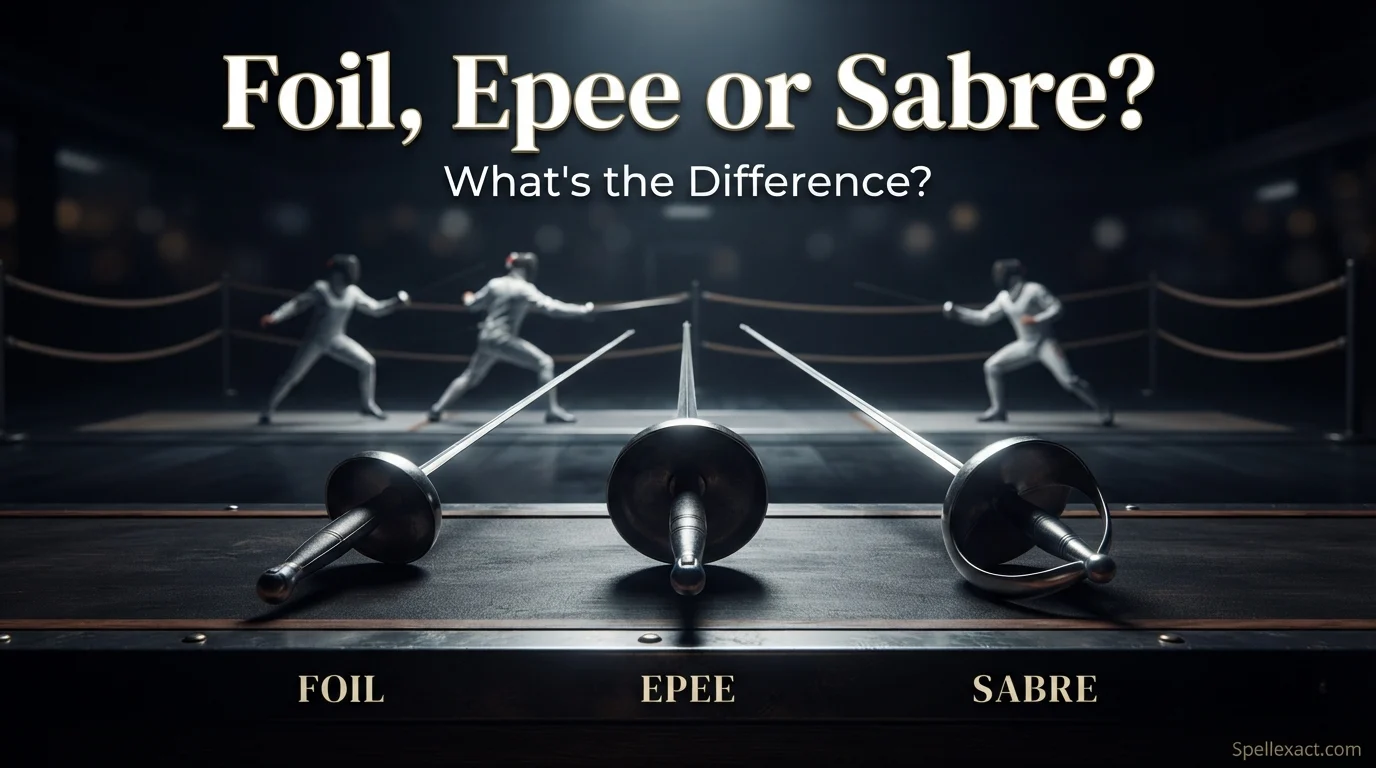
Walking into a fencing club for the first time, you will usually be asked one question: foil, epee or sabre? The best choice depends on how you like to move and think. Choose foil if you enjoy rules and clean technique, epee if you prefer patient strategy and simple scoring, and sabre if you love speed and fast attacks.
All three weapons are used at the Olympic Games, and none is easier or better than the others. They differ in target area, weapon weight, scoring rules, and pace. This guide explains each weapon in plain English, compares them side by side, and gives you practical ways to decide. You will also find common beginner mistakes, a simple memory trick, and a note on American and British spelling.
Quick Answer:
Choose foil for precise technique and rule-based tactics, epee for patient, strategic fencing with the simplest rules, and sabre for fast, aggressive action. Foil targets the torso, epee targets the whole body, and sabre targets everything above the waist. Try all three at a beginner class, then pick the one that feels most natural.
Why Do People Confuse Foil, Epee and Sabre?
Beginners often mix up the three weapons for good reasons:
- They look alike from a distance. All have a long, thin metal blade and a hand guard.
- Fencers wear similar white uniforms and mesh masks.
- The rules are different for each weapon, so the same action can score in one and not in another.
- The words are unfamiliar. “Epee” and “sabre” come from French and are not always easy to spell or say.
The main differences are the target area (where you can score), the way you score (point or edge), and the right of way (who gets the point when both fencers hit at once).
What Is Foil?
Foil is a light thrusting weapon. You score only with the tip of the blade, and only by hitting the torso. The torso includes the chest, stomach, and back, but not the arms, legs, or head.
Foil uses a rule called right of way (also called priority). When both fencers hit at the same time, the fencer who started the attack correctly gets the point. This makes foil a game of timing and logic.
Key facts:
- Weight: up to about 500 grams
- Scoring: tip only (thrust)
- Target: torso
- Uniform: conductive jacket (lamé) over the torso
- Origin: a training weapon for dueling
Foil suits people who like order, detail, and step-by-step technique.
What Is Epee?
Epee (also written épée, the French word for “sword”) is a heavier thrusting weapon. You score with the tip only, but the whole body is the target, from head to toe.
Epee has no right of way. Whoever hits first gets the point. If both fencers hit within a very short time (about 40 milliseconds), both score. This is called a double touch.
Key facts:
- Weight: up to about 770 grams
- Scoring: tip only (thrust)
- Target: entire body
- Uniform: no conductive jacket needed
- Origin: the dueling sword
Epee suits people who like patience, distance control, and simple rules.
What Is Sabre?
Sabre is the fastest of the three weapons. You can score with the tip or with the edge of the blade (a cut), and the target is everything above the waist, including the head and arms.
Sabre also uses right of way, but the action is very quick. Fencers start with fast steps forward and backward, and many points are scored within seconds.
Key facts:
- Weight: up to about 500 grams
- Scoring: tip or edge (cut and thrust)
- Target: head, arms, and torso above the waist
- Uniform: conductive jacket, mask, and glove
- Origin: a cavalry weapon
Sabre suits people who like speed, boldness, and quick decisions.
Foil vs Epee vs Sabre: Comparison Table
| Feature | Foil | Epee | Sabre |
| Type of hit | Thrust (tip) | Thrust (tip) | Cut and thrust |
| Target area | Torso | Whole body | Above the waist |
| Right of way | Yes | No | Yes |
| Maximum weight | About 500 g | About 770 g | About 500 g |
| Pace | Medium, technical | Slow to medium, tactical | Very fast, explosive |
| Best for | Technique lovers | Strategic thinkers | Fast, bold movers |
Weapon weights, target areas, and scoring rules are set by the International Fencing Federation (FIE), the official governing body of the sport. Rules can be updated, so check the FIE website for the latest version.
How Do You Decide Which Weapon to Use?
Think about your personality, your goals, and your local club. Ask yourself these questions:
- Do I like clear rules and timing? Try foil.
- Do I prefer simple rules and calm thinking? Try epee.
- Do I enjoy speed and quick reactions? Try sabre.
- What does my club teach? Some clubs focus on one or two weapons, and a good coach is more important than a perfect weapon choice.
- Is my goal fun, fitness, or competition? Check which weapons are offered at school or college events in your area.
Most beginners benefit from a trial lesson with each weapon. Your body often tells you the answer quickly.
10+ Examples: Which Weapon Fits Which Person?
- You like chess and planning ahead. Epee rewards patience and strategy.
- You enjoy learning exact footwork and technique. Foil is a good match.
- You love sprinting and fast sports. Sabre will feel natural.
- You want the simplest scoring rules. Epee has no right of way.
- You like history and classic duels. Epee comes closest to a real dueling sword.
- You enjoy cavalry-style, slashing action. Sabre is the choice.
- You get frustrated by unclear referee calls. Epee is often easier to follow.
- You want to learn basic blade control first. Many clubs start beginners with foil.
- You are tall with a long reach. Epee can reward long-distance control, but any weapon works.
- You want short, high-energy bouts. Sabre bouts can end quickly.
- You like exact timing and attack-defense rules. Foil is built around them.
- You want to switch weapons later. Foil footwork transfers well to the other two.
Common Mistakes When Choosing a Fencing Weapon
- Choosing by looks alone. A weapon may look exciting, but you may not enjoy fencing with it.
- Believing one weapon is “the hardest.” Each one has its own challenges.
- Ignoring right of way. Foil and sabre fencers who skip this rule lose points they thought they had won.
- Not asking a coach. A short trial class can save months of frustration.
- Buying equipment too early. Most clubs provide loaner gear for beginners.
- Thinking you are locked in. Many fencers change weapons and do well.
Easy Memory Trick
Use the letters:
- Foil = Few targets. Only the torso counts.
- Epee = Everywhere. The entire body is the target.
- Sabre = Slash. You can cut with the edge, above the waist.
American English vs British English
The weapons are the same in both varieties, but the spelling differs:
- Sabre is the British spelling and is the form used in international fencing. Saber is the common American spelling.
- Epee is often written without the accent in American English. The French spelling épée appears in formal and international writing.
- Foil is spelled the same everywhere.
Both spellings are correct. Choose one and use it consistently in your writing.
Similar Words and Related Terms
- Fleuret: the French word for foil.
- Rapier: an older thrusting sword, the ancestor of modern foil and epee.
- Lamé: the metallic jacket that registers hits in foil and sabre.
- Piste: the long, narrow strip where a fencing bout takes place.
- Right of way (priority): the rule that decides who scores when both fencers hit.
- Touch: a scored hit.
- Kendo: a Japanese sword art that is a different sport from Western fencing.
Final Verdict
There is no single best weapon, only the best weapon for you. Choose foil if you enjoy structure and technique. For calm strategy and the simplest rules, epee may be the better choice. If speed and energy appeal to you most, sabre is the way to go. If you are still unsure, take a trial class in each and notice which one you want to repeat.
FAQs
Which fencing weapon is best for beginners?
All three are beginner-friendly. Many clubs start new students with foil because it teaches basic technique, but epee and sabre are also good starting points.
Which fencing weapon is the easiest to learn?
Epee has the simplest rules, since the whole body is the target and there is no right of way. Foil and sabre require learning priority rules.
What is the main difference between foil, epee and sabre?
The main differences are the target area, the way you score, and the right-of-way rule. Foil targets the torso, epee targets the whole body, and sabre targets everything above the waist.
Which fencing weapon is the fastest?
Sabre is usually the fastest, with quick advances and very short bouts.
Can I switch fencing weapons later?
Yes. Many fencers change weapons, and the basic footwork and blade control carry over well.
Which fencing weapon is the heaviest?
Epee is the heaviest, with a maximum weight of about 770 grams. Foil and sabre are lighter, at about 500 grams.
Is it “sabre” or “saber”?
Both are correct. Sabre” is the British and international spelling, and “saber” is common in American English.
Do I need to buy my own equipment to start?
No. Most clubs and schools lend masks, jackets, and weapons to beginners, so you can try before buying.
Remember This
- Foil: torso target, tip only, right of way.
- Epee: whole body, tip only, no right of way.
- Sabre: above the waist, cut and thrust, right of way.
- Try all three before you decide.
- Your coach and club matter as much as the weapon.
Conclusion
Choosing between foil, epee, and sabre is really about matching the weapon to your style. Foil rewards clean technique, epee rewards patience and strategy, and sabre rewards speed and courage. Each one offers a full, exciting sport.
Start with a trial lesson, ask your coach questions, and pay attention to what you enjoy. The right weapon is the one that makes you want to come back to practice. Whichever you pick, you will build balance, focus, and confidence, and you can always try another weapon later.

Maria Megan is a language enthusiast and content writer specializing in spelling, grammar, and English usage. She creates clear, practical articles that help readers identify common spelling mistakes, improve writing accuracy, and communicate with greater confidence.