Have you ever written reoccurrence and wondered whether recurrence would be the better choice? You are not alone. These two words look very similar, and both relate to something happening again. However, they are not always interchangeable in every context.
The good news is that the difference between reoccurrence vs recurrence is easier to understand than it first appears. This guide explains the meanings, correct usage, examples, spelling differences, common mistakes, and practical tips to help you choose the right word with confidence.
Quick Answer
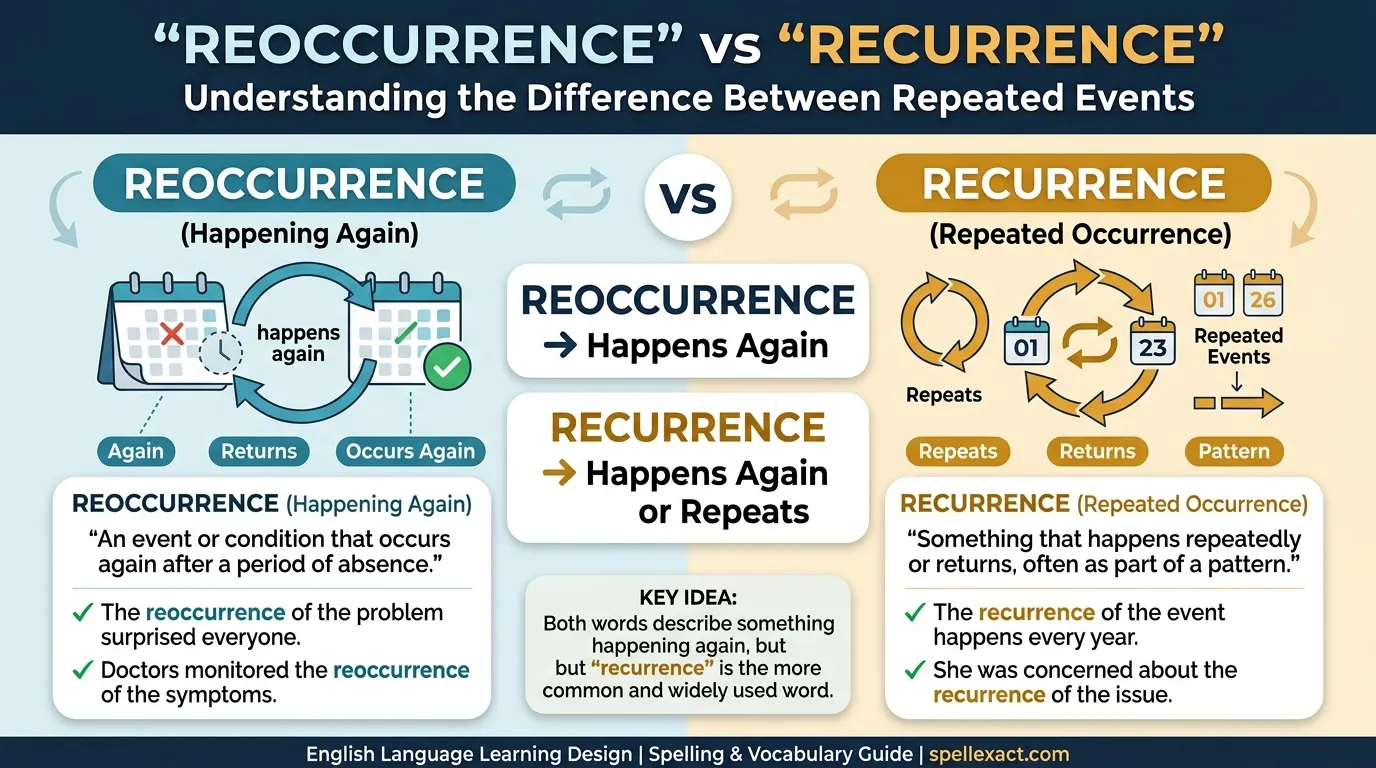
Recurrence is generally the more common and preferred word when something happens again, especially in medical, scientific, mathematical, or formal contexts.
Reoccurrence is also a valid English word and usually refers more literally to something occurring again.
In many everyday situations, recurrence sounds more natural and is the safer choice.
Example:
- The patient experienced a recurrence of the illness. ✅
- The problem had a recurrence after several months. ✅
- The same technical error had a reoccurrence. ✅, but less common
What Does Recurrence Mean?
Recurrence is a noun that means the return or repeated occurrence of something. It comes from the verb recur, meaning “to happen again” or “to return.”
The word is widely used when discussing:
- Medical conditions
- Problems or events
- Patterns
- Mathematical sequences
- Repeated situations
Examples of Recurrence
- There was a recurrence of the disease.
- The company is working to prevent a recurrence of the security issue.
- Her dream showed a strange recurrence of the same symbol.
- Doctors monitored the patient for signs of cancer recurrence.
- The problem’s recurrence suggested that the original solution was incomplete.
In these examples, something has returned after happening previously.
What Does Reoccurrence Mean?
Reoccurrence is also a noun and means “an occurrence that happens again.” It is formed from reoccur, which means “to occur again.”
The meaning is straightforward:
Reoccur → happen again
Reoccurrence → the act or instance of happening again
Examples of Reoccurrence
- The team introduced new measures to prevent a reoccurrence of the error.
- Engineers investigated the reoccurrence of the system failure.
- The unexpected reoccurrence of the issue delayed the project.
- The software update was designed to stop the reoccurrence of similar bugs.
Although these sentences are grammatically correct, many writers would naturally choose recurrence instead.
Reoccurrence vs Recurrence: What Is the Main Difference?
The primary difference is subtle and relates to the verbs behind the nouns.
| Word | Related Verb | Basic Meaning | Common Usage |
| Recurrence | Recur | A return or repeated happening | Very common |
| Reoccurrence | Reoccur | An event occurring again | Less common |
| Recurrence | Recur | Something returns or repeats | Medical, formal, general |
| Reoccurrence | Reoccur | Something specifically occurs again | General or literal repetition |
The key point is that both words are correct. However, recurrence is usually more common, concise, and natural.
For most writing situations, especially formal or professional writing, recurrence is the stronger choice unless you specifically want to emphasize that an event has occurred again.
Reoccur vs Recur: Understanding the Verb Difference
To understand reoccurrence vs recurrence, it helps to look at reoccur vs recur.
Recur
Recur means to happen again or return repeatedly.
Examples:
- The symptoms may recur.
- This problem tends to recur every winter.
- Similar themes recur throughout the novel.
Reoccur
Reoccur means to occur again.
Examples:
- The error may reoccur after the update.
- Scientists wanted to know whether the event would reoccur.
- The same situation could reoccur in the future.
The two verbs overlap heavily in meaning. Because recur and recurrence are generally more established and more frequently used, many writers prefer them.
Which Is More Common: Reoccurrence or Recurrence?
Recurrence is much more common in standard English.
You will frequently see it in phrases such as:
- Cancer recurrence
- Recurrence rate
- Recurrence of symptoms
- Prevent recurrence
- Disease recurrence
- Recurrence relation
- Recurring problem
Reoccurrence, while correct, appears less frequently and can sometimes feel unnecessarily long.
Compare these sentences:
- The treatment reduced the risk of recurrence. ✅
- The treatment reduced the risk of reoccurrence. ✅
Both are understandable, but the first sentence sounds more natural, particularly in medical or professional writing.
Reoccurrence vs Recurrence in Medical Writing
The distinction matters most in situations where established terminology exists. In medicine, recurrence is the standard and widely preferred term.
Correct and natural examples
- The patient showed no evidence of cancer recurrence.
- Doctors discussed the risk of disease recurrence.
- The medication may help prevent a recurrence of symptoms.
Medical professionals commonly use recurrence to describe a disease, symptom, or condition returning after improvement or treatment.
For example:
After a period of remission, the patient experienced a recurrence of the condition.
Using reoccurrence is not necessarily incorrect from a grammatical perspective, but recurrence is the more established term in medical communication.
Reoccurrence vs Recurrence in Everyday Writing
In everyday writing, you can often use recurrence whenever something returns or happens again.
Natural examples
- We want to prevent a recurrence of this mistake.
- The recurrence of the problem frustrated the entire team.
- There has been a recurrence of the same technical issue.
- The recurrence of these events suggests a pattern.
If you are tempted to write reoccurrence, ask yourself a simple question:
Would recurrence communicate the same meaning?
If the answer is yes, recurrence will usually be the cleaner and more natural option.
Common Mistakes to Avoid
Because these words are closely related, writers often make a few predictable mistakes.
1. Assuming Reoccurrence Is Incorrect
This is not true. Reoccurrence is a valid English word.
The issue is not correctness but usage. It is simply less common than recurrence.
2. Using Reoccurrence When Recurrence Is the Established Term
In medical, scientific, and technical contexts, recurrence is often the conventional choice.
For example:
- Risk of cancer recurrence ✅
- Risk of cancer reoccurrence ⚠️ Less conventional
Choosing the established term can make your writing sound clearer and more professional.
3. Confusing Recurrence With Reoccurrence Because of Spelling
The spelling can be confusing because both words contain similar elements.
Recurrence has:
- recur
- rence
Reoccurrence has:
- reoccur
- rence
A useful memory trick is to focus on the verb:
recur → recurrence
reoccur → reoccurrence
4. Overusing the Longer Word
Some writers assume that reoccurrence sounds more formal because it is longer. In reality, longer wording is not automatically better.
When recurrence communicates the meaning clearly, use it.
Examples of Reoccurrence vs Recurrence in Sentences
Here are several side-by-side examples showing how the words can appear in context.
Example 1: A Technical Problem
- The engineers investigated the recurrence of the software failure.
- The engineers investigated the reoccurrence of the software failure.
Both are possible, but recurrence is more concise and natural.
Example 2: An Illness
- Doctors were concerned about a recurrence of the infection. ✅
- Doctors were concerned about a reoccurrence of the infection. ⚠️ Understandable but less standard
For medical language, choose recurrence.
Example 3: A Repeated Event
- The reoccurrence of the same event surprised everyone.
- The recurrence of the same event surprised everyone.
Again, both are grammatically possible. The second version is generally more idiomatic.
American vs British English: Is There a Difference?
There is no major American English vs British English difference between reoccurrence and recurrence.
Both forms are recognized in standard English on both sides of the Atlantic. However, recurrence is generally the more common and conventional choice in both American and British usage.
So, whether you are writing for:
- A US audience
- A UK audience
- An international audience
Recurrence is usually the safest choice when referring to something that returns or happens repeatedly.
This differs from spelling pairs where American and British English have clear variations, such as color/colour or organize/organise. Here, the choice is mainly about nuance, frequency, and established usage rather than regional spelling rules.
When Should You Use Reoccurrence?
Use reoccurrence when you specifically want to emphasize that something has occurred again and the related verb reoccur fits naturally.
For example:
- The investigation focused on preventing a reoccurrence of the accident.
- The update was intended to stop the reoccurrence of the error.
Even in these cases, recurrence may still be an acceptable and more natural alternative.
Because reoccurrence is less common, consider your audience. If clarity and familiarity are your priorities, recurrence is often the better choice.
When Should You Use Recurrence?
Use recurrence when describing:
- The return of an illness
- Repeated symptoms
- A problem happening again
- A recurring event
- A repeated pattern
- A mathematical relationship
- A formal or professional situation
Examples include:
- recurrence of cancer
- recurrence of symptoms
- recurrence rate
- recurrence relation
- recurrence of the problem
- prevent recurrence
In most general writing situations, recurrence is the preferred option.
A Simple Rule to Remember
If you are unsure whether to use reoccurrence or recurrence, follow this simple rule:
Choose recurrence by default. Use reoccurrence only when you have a specific reason to emphasize “occurring again.”
This approach works well because recurrence is shorter, more common, and widely accepted across formal and everyday English.
Frequently Asked Questions
Is reoccurrence a real word?
Yes. Reoccurrence is a real and grammatically correct English word. It means the act or instance of occurring again.
Is recurrence more correct than reoccurrence?
Not exactly. Both words are correct, but recurrence is more common and usually the preferred choice in formal, medical, scientific, and everyday writing.
What is the difference between recurrence and reoccurrence?
A recurrence refers broadly to something returning or happening again, while reoccurrence more literally emphasizes something occurring again. In practice, their meanings overlap considerably.
Should I use recurrence or reoccurrence in medical writing?
Use recurrence. It is the standard and more widely recognized term for the return of a disease, symptom, infection, or medical condition.
Can recurrence and reoccurrence be used interchangeably?
Often, yes. However, recurrence is generally more idiomatic and conventional, while reoccurrence is less common.
Is reoccur the same as recur?
The verbs are very similar. Recur means to return or happen again, while reoccur more specifically means to occur again. Their meanings overlap in many contexts.
Which word should I use in professional writing?
In most professional writing, choose recurrence because it is concise, familiar, and widely accepted.
Is there a British or American spelling difference?
No. Both recurrence and reoccurrence are used in American and British English. The main difference is frequency and nuance, not regional spelling.
Summary:
The difference between reoccurrence vs recurrence is small but useful to understand. Both words describe something happening again, and both are valid English. Reoccurrence is connected to the verb reoccur, while recurrence comes from recur. In everyday practice, however, their meanings overlap significantly.
If you want the most natural, widely accepted, and concise choice, use recurrence. It is especially appropriate for medical conditions, repeated problems, formal writing, scientific discussions, and situations where something returns. Use reoccurrence when you deliberately want to emphasize that a specific event has occurred again, but remember that it is less common.
Actionable Takeaway
When proofreading your writing, replace reoccurrence with recurrence and check whether the meaning changes. In most cases, it will not. If the sentence still communicates exactly what you mean, recurrence is likely the better choice. For spelling and grammar questions, choosing the clearer and more established word is usually the smartest path.

Aaron Adam is the Administrator of SpellExact, dedicated to helping readers improve their spelling and writing accuracy. He oversees content quality, ensures reliable language resources, and works to make spelling guidance simple, practical, and accessible for everyone.