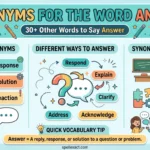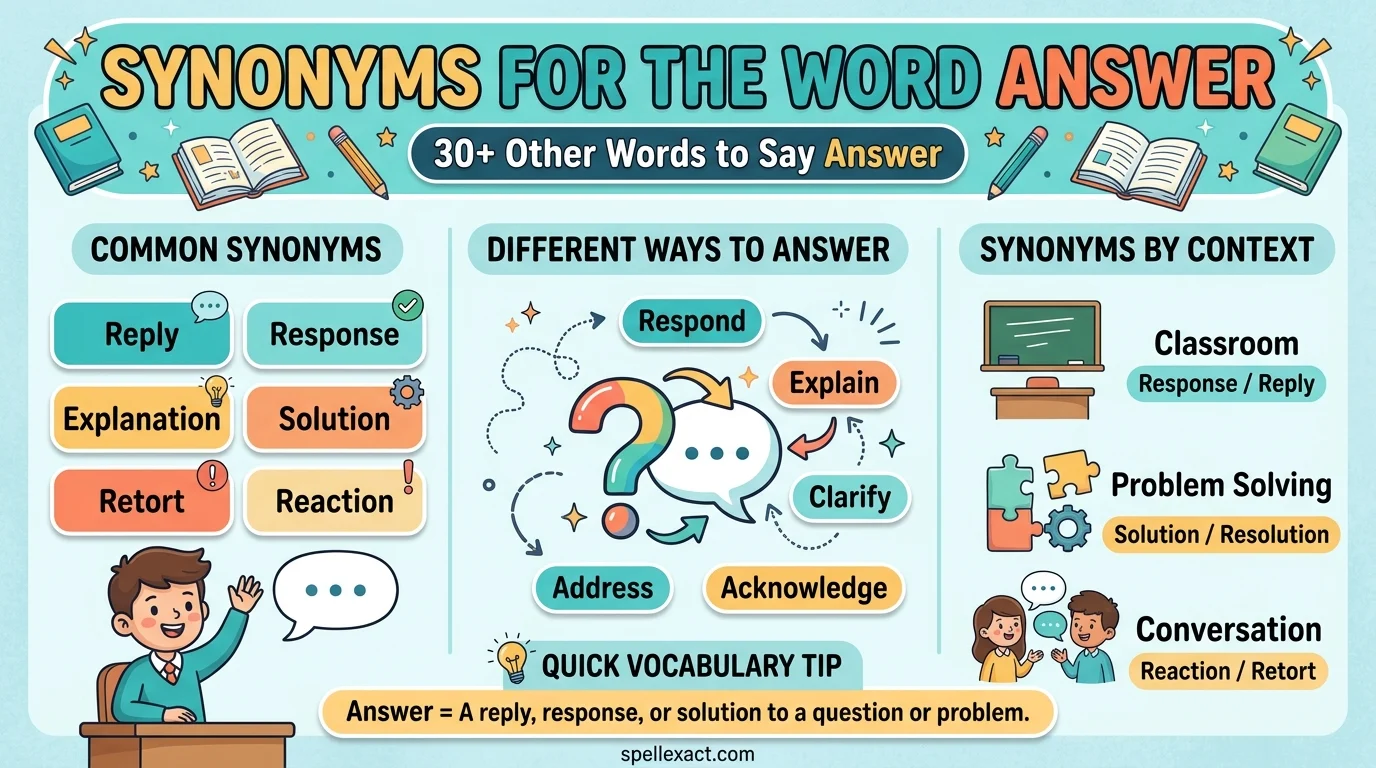
Looking for the best synonyms for the word answer? Common alternatives include response, reply, solution, explanation, clarification, resolution, result, conclusion, and rejoinder. The right choice depends on whether you mean a reply to a question, a solution to a problem, an explanation, or a reaction to something someone says.
This guide covers 30 useful words similar to answer, with simple meanings, example sentences, and practical usage tips. Whether you are a student, ESL learner, writer, or content creator, you will learn how to choose the most natural alternative word for answer in conversations, essays, emails, exams, and professional writing.
Quick Answer: What Is a Synonym for Answer?
The most common synonyms for answer include:
- Response: A general reply to a question, statement, or situation.
- Reply: Something said or written back to someone.
- Solution: A way to solve a problem.
- Explanation: Information that makes something clear.
- Clarification: Additional information that removes confusion.
- Resolution: A way of settling a problem or disagreement.
- Rejoinder: A reply to a comment or argument.
- Retort: A quick, often sharp reply.
- Result: Something produced by a calculation or process.
- Conclusion: A judgment reached after considering information.
For everyday communication, response and reply are usually the closest alternatives. Use solution when discussing a problem, explanation when giving more details, and conclusion when presenting a final judgment.
What Does Answer Mean?
The word answer has several meanings depending on its context. It can refer to information given in response to a question, a solution to a problem, an explanation, or a reaction to something.
The word answer can function as both a noun and a verb.
Answer as a Noun
As a noun, an answer is something said, written, or provided in response to a question or problem.
Examples:
- Reply to a question: She gave the correct answer to the teacher’s question.
- Solution to a problem: We finally found the answer to the difficult puzzle.
- Explanation: His answer helped everyone understand the situation.
- Response to a statement: Her answer to the criticism surprised everyone.
Answer as a Verb
As a verb, answer means to respond to a question, reply to someone, solve a problem, or respond to a call.
Examples:
- Respond to a question: Please answer the teacher’s question.
- Reply to a message: She answered my email yesterday.
- Solve a problem: Can you answer this mathematics question?
- Respond to a call: He did not answer the phone.
Understanding the difference between these meanings helps you choose the correct synonym for answer without changing the original meaning of your sentence.
30 Synonyms for the Word Answer With Meanings and Examples
The following list includes useful alternatives for different meanings of answer. Some are direct synonyms, while others are related expressions suitable for specific situations. Not every word can replace answer in every sentence.
1. Response
Simple meaning: Something said, written, or done in reply to a question, statement, or situation.
Example: The manager gave a positive response to my request.
Best usage/context: Use response in everyday conversations, business communication, emails, interviews, and formal writing. It is one of the most versatile alternatives to answer.
2. Reply
Simple meaning: Something said or written back to another person.
Example: I received a quick reply to my email.
Best usage/context: Use reply for conversations, text messages, emails, letters, and online communication. It is especially natural when someone responds directly to another person’s message.
3. Solution
Simple meaning: A way to solve a problem or deal with a difficult situation.
Example: The team finally found a solution to the technical problem.
Best usage/context: Use solution when answer refers to solving mathematics problems, puzzles, business challenges, technical issues, or everyday difficulties.
4. Explanation
Simple meaning: Information that makes something easier to understand.
Example: The teacher gave a detailed explanation of the correct answer.
Best usage/context: Use explanation in education, academic writing, instructions, and professional communication when an answer needs additional details or reasoning.
5. Clarification
Simple meaning: Additional information that makes something clearer or easier to understand.
Example: The student asked for clarification about the examination question.
Best usage/context: Use clarification when someone needs more precise information or wants to remove confusion about instructions, policies, or a statement.
6. Resolution
Simple meaning: A decision or solution that settles a problem, disagreement, or difficult situation.
Example: Both sides agreed on a peaceful resolution to the dispute.
Best usage/context: Use resolution in business, negotiations, legal discussions, conflicts, and problem-solving situations.
7. Result
Simple meaning: Something produced by an action, calculation, experiment, or process.
Example: The result of the calculation was 125.
Best usage/context: Use result when answer refers to the outcome of a mathematical calculation, examination, experiment, or process.
8. Conclusion
Simple meaning: A final judgment, opinion, or decision reached after considering information.
Example: The researchers reached an important conclusion after reviewing the evidence.
Best usage/context: Use conclusion in essays, research papers, reports, investigations, and discussions that involve reasoning or evidence.
9. Rejoinder
Simple meaning: A reply to a comment, statement, or argument, often made quickly or cleverly.
Example: She offered a clever rejoinder to his criticism.
Best usage/context: Use rejoinder in debates, formal discussions, literature, and exchanges involving opposing opinions. It is more formal than reply.
10. Retort
Simple meaning: A quick, sharp, or sometimes angry reply.
Example: He gave a sharp retort when his colleague questioned his decision.
Best usage/context: Use retort when someone responds immediately to criticism, an insult, or a challenging comment. It often suggests a defensive, sarcastic, or confrontational tone.
11. Reaction
Simple meaning: Something said or done in response to an event, statement, or situation.
Example: Her reaction to the unexpected news was surprising.
Best usage/context: Use reaction when describing an emotional, physical, or behavioral response rather than a direct answer to a question.
12. Outcome
Simple meaning: The final result of an event, action, or process.
Example: The outcome of the discussion was positive.
Best usage/context: Use outcome when referring to the eventual result of a situation, decision, meeting, or process.
13. Finding
Simple meaning: Information or a conclusion discovered through research, examination, or investigation.
Example: The research findings provided an answer to the main question.
Best usage/context: Use finding in academic writing, scientific research, investigations, reports, and professional analysis.
14. Verdict
Simple meaning: A formal decision or judgment, especially in a court case.
Example: The jury delivered its verdict after several hours of discussion.
Best usage/context: Use verdict in legal situations, competitions, evaluations, and discussions involving final judgments. It is not a general replacement for answer.
15. Decision
Simple meaning: A choice or judgment made after considering different possibilities.
Example: The committee reached a final decision about the proposal.
Best usage/context: Use decision when an answer involves choosing what should happen or what action should be taken.
16. Interpretation
Simple meaning: An explanation of the meaning of something.
Example: Her interpretation of the poem provided an interesting perspective.
Best usage/context: Use interpretation when discussing literature, art, language, data, events, or situations that can have different meanings.
17. Statement
Simple meaning: Something expressed in words, either spoken or written.
Example: The company released a statement in response to the public’s concerns.
Best usage/context: Use statement when an answer takes the form of an official declaration, written explanation, or direct expression of information.
18. Acknowledgment
Simple meaning: A statement showing that someone has received, noticed, or recognized something.
Example: The company sent an acknowledgment after receiving my application.
Best usage/context: Use acknowledgment in business emails, formal letters, applications, and customer service when confirming receipt or recognition. It does not necessarily provide the information requested.
19. Admission
Simple meaning: A statement accepting that something is true.
Example: His admission answered several questions about the incident.
Best usage/context: Use admission when an answer involves accepting a fact, mistake, responsibility, or truth.
20. Justification
Simple meaning: A reason or explanation showing why something is reasonable or acceptable.
Example: She provided a clear justification for her decision.
Best usage/context: Use justification when someone explains or defends a choice, action, opinion, or decision.
21. Comeback
Simple meaning: A quick or clever reply, especially to criticism, teasing, or an insult.
Example: She always has a funny comeback when her friends tease her.
Best usage/context: Use comeback in casual conversations, humor, friendly arguments, and informal discussions. It is less suitable for formal writing.
22. Counterargument
Simple meaning: A reason or argument that challenges or disagrees with another argument.
Example: The writer included a strong counterargument to address the opposing opinion.
Best usage/context: Use counterargument in essays, academic writing, debates, persuasive speeches, and critical discussions. It is a specific kind of response, not a general synonym for answer.
23. Rebuttal
Simple meaning: A statement or argument that challenges or explains why another argument may be wrong.
Example: The lawyer presented a detailed rebuttal to the opposing side’s claims.
Best usage/context: Use rebuttal in debates, academic essays, legal discussions, and formal arguments when directly challenging a claim or accusation.
24. Confirmation
Simple meaning: Information that verifies or proves that something is correct or has happened.
Example: I received confirmation that my reservation was complete.
Best usage/context: Use confirmation in emails, appointments, bookings, business transactions, and official communication when verifying information or an arrangement.
25. Affirmation
Simple meaning: A statement that confirms, supports, or expresses agreement with something.
Example: The manager’s affirmation gave the team confidence in their decision.
Best usage/context: Use affirmation in formal discussions, encouragement, and situations involving agreement or support.
26. Account
Simple meaning: A description or report explaining what happened or why something happened.
Example: The witness gave an account of what happened during the incident.
Best usage/context: Use account in reports, interviews, journalism, investigations, history, and formal discussions. It describes events rather than simply answering a question.
27. Remedy
Simple meaning: A way to correct, improve, or solve a problem.
Example: The company introduced a remedy for the recurring technical issue.
Best usage/context: Use remedy when discussing ways to correct a difficulty, mistake, complaint, or unwanted situation. It is particularly useful in legal, medical, and practical contexts, although it is not interchangeable with answer in every sentence.
28. Recommendation
Simple meaning: A suggestion about the best action, choice, or solution.
Example: The consultant gave a recommendation for improving the company’s customer service.
Best usage/context: Use recommendation when an answer offers advice or suggests what someone should do.
29. Respond
Simple meaning: To say or do something in reply to a question, message, or situation.
Example: Please respond to the email before the end of the day.
Best usage/context: Use respond when replacing answer as a verb, especially in formal communication, interviews, discussions, and professional writing.
30. Solve
Simple meaning: To find the correct answer to a problem or discover how to deal with a difficult situation.
Example: The students worked together to solve the difficult mathematics problem.
Best usage/context: Use solve when answer refers to finding a solution to a mathematical question, puzzle, riddle, or problem. It is a verb, not a direct noun synonym.
Answer Synonyms Comparison Table
Use this answer synonyms list to compare meanings, tones, and common contexts before choosing an alternative.
| Synonym | Main meaning | Best context | Tone |
| Response | General reply or reaction | Questions and communication | Neutral |
| Reply | Spoken or written response | Emails and conversations | Neutral |
| Solution | Way to solve a problem | Mathematics and challenges | Neutral |
| Explanation | Information that makes something clear | Education and instructions | Neutral |
| Clarification | Information that removes confusion | Professional communication | Formal |
| Resolution | Solution that settles an issue | Conflicts and negotiations | Formal |
| Result | Something produced by a process | Tests and calculations | Neutral |
| Conclusion | Final judgment based on information | Essays and research | Formal |
| Rejoinder | Reply to a comment or argument | Debates and discussions | Formal |
| Retort | Quick, sharp reply | Arguments and criticism | Strong |
| Reaction | Response to an event or statement | Personal and social situations | Neutral |
| Outcome | Final result | Events and projects | Neutral |
| Finding | Information discovered through research | Academic and scientific writing | Formal |
| Verdict | Official judgment | Legal matters | Formal |
| Decision | Choice or judgment | Business and personal matters | Neutral |
| Interpretation | Explanation of meaning | Literature and research | Formal |
| Statement | Spoken or written expression | Official communication | Formal |
| Acknowledgment | Recognition or confirmation of receipt | Emails and applications | Formal |
| Admission | Acceptance of a fact | Discussions and investigations | Neutral |
| Justification | Reason supporting a choice or action | Decisions and arguments | Formal |
| Comeback | Quick, clever reply | Casual conversations | Informal |
| Counterargument | Argument against another opinion | Essays and debates | Formal |
| Rebuttal | Argument challenging a claim | Legal and academic discussions | Formal |
| Confirmation | Verification of information | Bookings and business communication | Neutral |
| Affirmation | Statement of support or agreement | Formal discussions | Formal |
| Account | Description of events | Reports and investigations | Formal |
| Remedy | Way to correct a problem | Legal and practical situations | Neutral |
| Recommendation | Advice or suggested action | Professional and personal decisions | Neutral |
| Respond | To give a reply | Questions and communication | Neutral |
| Solve | To find a solution | Problems and puzzles | Neutral |
Important: These words are not all interchangeable. Some are direct alternatives for a reply, while others refer to a decision, explanation, argument, result, or action. Always check the meaning and grammar of your sentence before replacing answer.
How to Choose the Right Synonym for Answer
The best synonym for the word answer depends on what you want to communicate. Consider the situation, meaning, and tone before selecting an alternative.
1. For Everyday Conversations
Choose response, reply, reaction, or comeback when talking with friends, family, or colleagues.
Examples:
- She gave a quick reply to my message.
- His response was polite and helpful.
- I was surprised by her reaction to the news.
- He had a funny comeback when his friend teased him.
Use reply for direct communication, response for a general answer, and comeback for a witty or humorous remark.
2. For Formal and Professional Writing
Choose response, explanation, acknowledgment, confirmation, statement, or clarification when writing emails, reports, business documents, or official messages.
Examples:
- We appreciate your response to our request.
- The company issued an official statement.
- Please provide clarification about the updated policy.
- I received confirmation of my appointment.
Use acknowledgment to confirm receipt, confirmation to verify information, and clarification to make something clearer.
3. For Academic Writing and Essays
Choose explanation, interpretation, counterargument, rebuttal, finding, or conclusion when discussing research, questions, and different viewpoints.
Examples:
- The researcher provided an explanation of the results.
- The essay includes a strong counterargument.
- The study’s findings support the main idea.
- The final conclusion addresses the research question.
These alternatives help distinguish between answering a question, explaining an idea, challenging an argument, and presenting research results.
4. For Problems, Mathematics, and Puzzles
Choose solution, result, remedy, solve, or resolution when discussing mathematical questions, puzzles, challenges, and difficult situations.
Examples:
- We found a solution to the problem.
- The result of the calculation was correct.
- The team developed a remedy for the technical issue.
- Can you solve this mathematics problem?
Use solution for a way to fix a problem, result for the outcome of a calculation, and solve when describing the action of finding an answer.
5. For Arguments and Debates
Choose rejoinder, retort, rebuttal, counterargument, or comeback when responding to criticism or opposing opinions.
Examples:
- She made a clever rejoinder during the debate.
- His sharp retort surprised everyone.
- The lawyer presented a strong rebuttal.
- The student included a counterargument in the essay.
Use retort for a sharp reply, rebuttal for challenging a claim, and counterargument for presenting an opposing viewpoint.
6. For Customer Service and Business Communication
Choose response, acknowledgment, confirmation, feedback, or clarification when dealing with customer questions, requests, complaints, and professional communication.
Examples:
- The company sent a quick response to the customer.
- We received an acknowledgment of the application.
- Your feedback will help us improve the service.
- Please send confirmation of your booking.
These words make professional communication more specific. Remember that feedback evaluates something, while an answer directly responds to a question.
Answer vs. Response: What Is the Difference?
Answer and response are closely related, but they are not always interchangeable.
An answer usually provides information in response to a question or problem. A response is broader and can describe something said or done because of a question, statement, event, or situation.
Examples:
- Answer: She gave the correct answer to the mathematics question.
- Response: The company issued a response to the customer’s complaint.
Use answer when someone needs specific information. Choose response when referring to a broader reply or reaction.
Answer vs. Reply: What Is the Difference?
A reply is something communicated back to another person, usually through speech or writing. An answer can also be a reply, but it may refer to a solution or correct information.
Examples:
- Reply: I sent a reply to his email.
- Answer: I know the answer to the question.
Use reply mainly for messages and conversations. Use answer for questions, problems, and requests for information.
Answer vs. Solution: What Is the Difference?
An answer provides information in response to a question, while a solution explains how to solve a problem.
Examples:
- Answer: What is the answer to question five?
- Solution: What is the solution to this difficult problem?
A mathematical answer may be a solution, but not every answer is a solution. Use solution when the sentence focuses on fixing or resolving a problem.
Answer vs. Explanation: What Is the Difference?
An answer may be short and direct, while an explanation provides details about why or how something is true.
Examples:
- Answer: Yes, the meeting starts at nine.
- Explanation: The meeting starts at nine because the earlier session was canceled.
An explanation can be part of an answer, but the two words do not always mean the same thing.
Common Mistakes When Using Synonyms for Answer
Choosing an alternative without considering its meaning can make a sentence confusing or unnatural. Avoid these common mistakes.
1. Treating Answer and Response as Completely Identical
Answer usually responds directly to a question, while response can describe a reply to a question, statement, event, or situation.
- Natural: She gave the correct answer to the mathematics question.
- Natural: The company gave a positive response to the customer’s complaint.
Both words are useful, but their meanings are not always identical.
2. Confusing Answer With Solution
An answer provides a response to a question. A solution explains how to solve a problem.
- Natural: What is the answer to question five?
- Natural: We need a solution to the traffic problem.
Use solution when discussing how to fix something.
3. Using Retort in Formal Situations
A retort is often a sharp or defensive reply. It may sound rude or confrontational.
- Natural: He gave a sharp retort during the argument.
- More professional: He provided a detailed response to the concern.
Choose response for neutral professional communication.
4. Confusing Feedback With an Answer
Feedback provides comments or evaluations, while an answer directly responds to a question.
- Natural: The teacher gave feedback on my essay.
- Natural: The teacher answered my question about the essay.
Feedback may include an answer, but it is not the same thing.
5. Confusing Clarification With Explanation
Clarification makes something unclear easier to understand. An explanation provides details about how or why something happens.
- Natural: I asked for clarification about the deadline.
- Natural: The teacher gave an explanation of the scientific process.
Use clarification when something needs to be made clearer.
6. Using Rebuttal as a General Synonym
A rebuttal specifically challenges an argument or claim. It does not simply mean any answer.
- Natural: The lawyer presented a rebuttal to the accusation.
- Natural: The student gave an answer to the teacher’s question.
Use rebuttal when disagreeing with or challenging a particular argument.
7. Using a Noun Synonym in Place of a Verb
Some alternatives, such as response, reply, solution, and explanation, are nouns. They cannot always replace answer when it is used as a verb.
- Original: Please answer my question.
- Correct alternative: Please respond to my question.
- Incorrect: Please response to my question.
Check whether the sentence needs a noun or a verb before choosing an alternative.
Frequently Asked Questions
1. What is the closest synonym for the word answer?
The closest general synonyms for answer are response and reply. However, the best choice depends on context. Use solution for a problem, explanation for additional details, and response for a general reply.
2. What is another word for answer in formal writing?
Useful formal alternatives include response, explanation, clarification, statement, acknowledgment, conclusion, and rejoinder. Choose the word that matches the purpose of your writing. For example, clarification makes unclear information easier to understand, while acknowledgment confirms receipt.
3. What is a synonym for answer in an essay?
Useful alternatives for answer in an essay include response, explanation, interpretation, conclusion, finding, and rebuttal. Use interpretation when explaining meaning, finding when presenting research results, and rebuttal when challenging an argument.
4. What is another word for answer to a question?
Common alternatives include response, reply, explanation, and clarification. Use response for a general reply, explanation when more details are needed, and clarification when someone wants to remove confusion.
5. What is a synonym for answer to a problem?
The most suitable alternatives include solution, resolution, and remedy, depending on the situation. A solution provides a way to solve a problem, a resolution settles an issue or disagreement, and a remedy helps correct a difficulty.
6. What is a synonym for a quick answer?
Reply, response, retort, rejoinder, and comeback may work depending on the situation. Reply and response are neutral, while retort and comeback suggest a quick or sharp response.
7. Is response the same as answer?
Not always. An answer usually provides information in response to a question, while a response can include a reply, reaction, statement, or action. The two words overlap, but response has a broader meaning.
8. What is a synonym for answer as a verb?
When answer is used as a verb, alternatives include respond, reply, explain, solve, and address. For example, “Please answer the question” can become “Please respond to the question.” Use solve when the task involves finding a solution.
9. What is the opposite of answer?
There is no single opposite of answer for every context. Depending on the meaning, contrasting terms include question, silence, refusal, uncertainty, and nonresponse. A question asks for information, while an answer provides it.
10. What is a more professional word for answer?
Response, clarification, explanation, acknowledgment, and statement are useful professional alternatives. Choose response for a general reply, clarification for removing confusion, and acknowledgment for confirming receipt of a message or request.
Conclusion
The best synonym for the word answer depends on the meaning, context, and tone of your sentence. Response and reply are useful for everyday communication, while explanation and clarification work when someone needs more information. For problems, choose solution or remedy. In debates, rebuttal, rejoinder, and counterargument express more specific types of replies.
When using answer as a verb, alternatives such as respond, reply, explain, and solve can make your writing more precise. Remember that these words are related but not always interchangeable. Consider the intended meaning and grammatical form before choosing a replacement. The right word will help you communicate more clearly, naturally, and effectively.

Andrew Anthony is a language enthusiast and content writer specializing in spelling mistakes, grammar, and English usage. He creates clear, practical, and well-researched guides that help readers improve their writing skills with confidence.