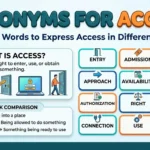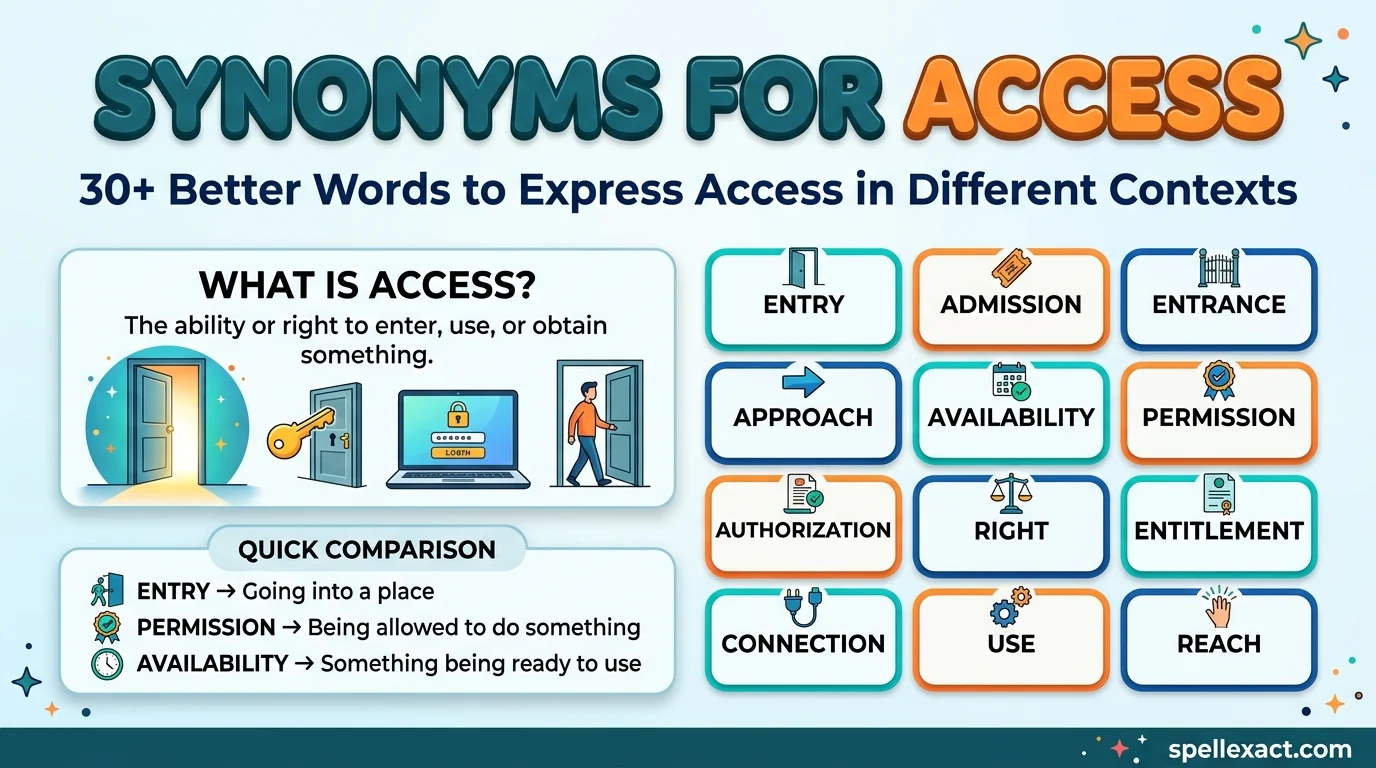
Looking for the best synonym for access? Common alternatives include entry, admission, entrance, permission, authorization, availability, use, reach, and admittance. The right word depends on whether you mean entering a place, getting permission, using a resource, reaching information, or obtaining something.
This guide explains 30 useful synonyms and alternatives for access, with simple definitions, example sentences, and practical usage tips. Whether you are a student, ESL learner, writer, or content creator, you will learn how to choose the right word for everyday conversations, academic writing, professional communication, and technology-related contexts.
Quick Answer: What Is a Synonym for Access?
The best synonym for access depends on the meaning of the sentence:
- Entry: The act or right of going into a place.
- Admission: Permission to enter a place or event.
- Entrance: A physical way or point of entering.
- Permission: Approval to enter or use something.
- Authorization: Official permission to do or use something.
- Availability: The state of being ready or obtainable for use.
- Use: The ability or act of using a resource or service.
- Reach: The ability to get to or contact someone or something.
- Admittance: Permission to enter a place.
- Retrieve: To find and obtain stored information or data.
For example, use entry when discussing a building, permission when someone needs approval, and availability when a resource is ready to use. When access is a verb, alternatives such as enter, use, reach, obtain, and retrieve may be more suitable.
What Does Access Mean?
The word access has several related meanings. It can refer to the ability, opportunity, or permission to enter a place, reach someone, use a service, or obtain information.
It can function as both a noun and a verb.
Access as a Noun
As a noun, access means the right, ability, or opportunity to enter, reach, or use something.
Examples:
- Permission to enter: Visitors need access to the restricted area.
- Use of a resource: Students have access to the university library.
- Availability of a service: The program provides access to affordable healthcare.
- Ability to reach something: The village has limited access to clean water.
- Contact with someone: The journalist requested access to the company director.
Access as a Verb
As a verb, access means to enter, open, reach, or use something, especially a computer system, account, website, or source of information.
Examples:
- Open or use an account: You can access your account from any device.
- Obtain information: Researchers accessed the online database.
- Use a resource: Employees can access the training materials.
- Reach a service: Customers can access support through the website.
Understanding whether access is a noun or a verb helps you choose the correct alternative word for access.
30 Synonyms for Access With Meanings and Examples
The following alternatives cover different meanings of access. Some are close synonyms, while others are related words that work only in particular contexts. Always consider the meaning of the complete sentence before replacing the original word.
1. Entry
Simple meaning: The act or right of going into a place.
Example: Visitors must show identification before entry into the building.
Best usage: Use entry when discussing buildings, rooms, restricted areas, events, or physical locations.
Access vs. entry: Entry focuses on going into a place, while access can also mean having permission or the ability to use something.
2. Admission
Simple meaning: Permission to enter a place, event, or organization.
Example: Admission to the museum is free for children under five.
Best usage: Commonly used for schools, universities, museums, concerts, events, and public attractions.
Access vs. admission: Admission usually refers to permission to enter, while access has a broader meaning that can include the ability to use resources.
3. Entrance
Simple meaning: A physical opening, doorway, or point through which someone enters.
Example: The main entrance is located beside the parking area.
Best usage: Use entrance when describing buildings, offices, schools, public spaces, and physical locations.
Access vs. entrance: An entrance is usually a physical way into a place. Access refers to the ability or permission to reach or use it.
4. Admittance
Simple meaning: Permission or the right to enter a place.
Example: Admittance to the private exhibition is limited to registered guests.
Best usage: Suitable for formal notices, restricted areas, private events, and official entry rules.
Note: Admittance is similar to admission, but it often sounds more formal. It does not describe the physical doorway.
5. Ingress
Simple meaning: The act or means of entering a place.
Example: The building has separate points of ingress and egress.
Best usage: Use ingress in technical, architectural, legal, and formal writing about entering a location.
Note: Ingress is more specialized than ordinary access and is not usually used in casual conversation.
6. Permission
Simple meaning: Approval to do something, enter a place, or use something.
Example: Employees need permission to access confidential files.
Best usage: Useful when access depends on someone’s approval, such as entering private property, viewing restricted information, or using workplace equipment.
Access vs. permission: Permission is approval, while access is the ability or opportunity to enter, reach, or use something.
7. Authorization
Simple meaning: Official approval or permission to do or use something.
Example: Only employees with authorization can enter the secure facility.
Best usage: Common in business, security, legal documents, workplace procedures, and computer systems.
Authorization vs. permission: Both refer to approval, but authorization often sounds more formal and official.
8. Clearance
Simple meaning: Official approval to enter a restricted area or handle protected information.
Example: The employee received security clearance to view confidential documents.
Best usage: Useful in government offices, security procedures, confidential records, and controlled facilities.
Note: Clearance is a specific type of approval that may allow access. It does not necessarily mean someone has already entered or used a resource.
9. Entitlement
Simple meaning: A right to receive, use, or benefit from something.
Example: Employees have an entitlement to certain workplace benefits.
Best usage: Common in legal, employment, benefits, policy, and membership-related contexts.
Access vs. entitlement: Entitlement describes a right, while access describes the ability or opportunity to use or reach something.
10. Privilege
Simple meaning: A special right, benefit, or advantage given to a person or group.
Example: Club members have the privilege of using the private facilities.
Best usage: Suitable for memberships, exclusive services, workplace benefits, and special permissions.
Note: A privilege is a special right rather than a general ability to access something.
11. Use
Simple meaning: The act or ability of using a resource, service, tool, or facility.
Example: Members have access to the gym.
A simpler alternative is:
Members can use the gym.
Best usage: Use use when you want to emphasize operating or benefiting from a service, facility, application, or resource.
Access vs. use: Access focuses on the ability or permission to reach something, while use emphasizes what someone does with it.
12. Availability
Simple meaning: The state of being ready, obtainable, or open for use.
Example: The company improved the availability of its online services.
Best usage: Useful when discussing services, resources, information, products, facilities, and opportunities.
Access vs. availability: Access describes someone’s ability or permission to use something. Availability describes whether that thing is ready or obtainable.
13. Accessibility
Simple meaning: How easy something is to reach, enter, understand, or use.
Example: The website was redesigned to improve accessibility for all users.
Best usage: Common in website design, buildings, public services, technology, education, and inclusive design.
Access vs. accessibility: Access means the ability or permission to use something. Accessibility describes how easy it is for people to reach or use it.
14. Reach
Simple meaning: The ability to get to, contact, or influence someone or something.
Example: The new road makes it easier to reach the remote village.
Best usage: Useful when discussing physical locations, communication, audiences, services, and resources.
Access vs. reach: Reach emphasizes the ability to get to something, while access may also include permission or the ability to use it.
15. Approach
Simple meaning: A way of getting closer to or reaching a place, person, or goal.
Example: The northern approach to the village becomes difficult during winter.
Best usage: Suitable for physical routes, locations, communication, and methods of dealing with a problem.
Note: Approach can replace access when discussing a route or method, but it does not mean permission to use a computer account or private resource.
16. Passage
Simple meaning: A route or way through or into a place.
Example: The narrow passage connects the two buildings.
Best usage: Use passage for corridors, pathways, physical routes, buildings, and travel.
Access vs. passage: Passage describes a way through a space, while access describes the ability or opportunity to reach or enter it.
17. Route
Simple meaning: A way or path used to get from one place to another.
Example: This road provides a direct route to the mountain village.
Best usage: Useful for roads, transportation, travel, buildings, and physical locations.
Note: Route is a suitable alternative when access means a way of reaching a place, not when it means permission to use a resource.
18. Pathway
Simple meaning: A path or route leading to a place or goal.
Example: The new pathway provides easier access to the community center.
Best usage: Suitable for physical routes and figurative discussions about education, careers, and personal development.
Access vs. pathway: A pathway is a route or means of reaching something. Access is the ability or opportunity to reach or use it.
19. Connection
Simple meaning: A link or relationship that allows people, devices, or systems to communicate.
Example: A reliable internet connection gives students access to online learning resources.
Best usage: Common in technology, networks, communication, relationships, and digital services.
Note: Connection is useful when access depends on a link between people, devices, or systems.
20. Connectivity
Simple meaning: The ability of devices, systems, or locations to connect with one another.
Example: Better internet connectivity has improved access to online education.
Best usage: Useful in discussions about internet services, telecommunications, computer networks, and digital infrastructure.
Access vs. connectivity: Connectivity describes the ability to connect, while access describes the ability or permission to use a particular resource.
21. Contact
Simple meaning: Communication or interaction with a person or organization.
Example: The manager has direct contact with the company’s legal team.
Best usage: Use contact when access means the opportunity to communicate with someone or receive support from an organization.
Note: Contact is a context-specific alternative, not a general replacement for access.
22. Opportunity
Simple meaning: A chance to do something, gain something, or benefit from something.
Example: The scholarship gives students an opportunity to receive higher education.
Best usage: Suitable for education, employment, personal development, services, and resources.
Access vs. opportunity: Access can create an opportunity, but the words are not identical. Opportunity emphasizes the chance to do or achieve something.
23. Gateway
Simple meaning: Something that provides a way into or toward something else.
Example: Education can be a gateway to better career opportunities.
Best usage: Common in figurative writing about careers, knowledge, experiences, technology, and personal development.
Note: Gateway is often a metaphorical alternative when access describes a way to reach a new experience or opportunity.
24. Avenue
Simple meaning: A way or method of achieving something.
Example: The scholarship provides an avenue for students to continue their education.
Best usage: Useful in formal and figurative writing about opportunities, methods, goals, and personal development.
Access vs. avenue: An avenue describes a possible way forward, while access describes the ability or opportunity to reach or use something.
25. Means
Simple meaning: A method, way, or resource used to achieve something.
Example: The internet provides a means of accessing information quickly.
Best usage: Suitable for academic, professional, and formal writing when describing how someone can reach or obtain something.
Note: Means is a related alternative when access refers to a method or way of obtaining something.
26. Obtain
Simple meaning: To get or receive something through effort, a request, or a process.
Example: Researchers can obtain the required documents from the public archive.
Best usage: Use obtain when discussing information, documents, resources, services, and official records.
Access as a verb: Obtain works when access means getting something, but it does not always express the meaning of having permission or the ability to use it.
27. Acquire
Simple meaning: To gain, get, or obtain something.
Example: The organization acquired access to a new research database.
Best usage: Common in business, education, research, knowledge, skills, and resources.
Access vs. acquire: Acquire emphasizes gaining or obtaining something, while access emphasizes the ability or permission to reach or use it.
28. Retrieve
Simple meaning: To find and obtain something that has been stored or placed somewhere.
Example: Users can retrieve their saved files from their online accounts.
Best usage: Useful for digital files, databases, documents, archives, and stored information.
Access vs. retrieve: You can access a file without retrieving or downloading it. Retrieve emphasizes finding and getting the stored item.
29. Enter
Simple meaning: To go into a place, building, room, website, or computer system.
Example: Employees can enter the system using their assigned login details.
Best usage: Suitable for buildings, rooms, websites, computer systems, and restricted areas.
Access as a verb: Enter is a natural alternative when access means going into a place or system. It does not always express the broader meaning of being allowed to use something.
30. Consult
Simple meaning: To look at or refer to information, a document, or an expert to obtain knowledge or advice.
Example: Students can access the online handbook whenever they need guidance.
A context-specific alternative is:
Students can consult the online handbook whenever they need guidance.
Best usage: Useful for reports, reference materials, official documents, research, and professional advice.
Access vs. consult: Access means being able to reach or use information, while consult emphasizes looking at or referring to it.
Access Synonyms Comparison Table
Use this table to find the most suitable alternative word for access according to your intended meaning.
| Synonym | Main meaning | Best context |
| Entry | Act or right of going inside | Buildings and restricted areas |
| Admission | Permission to enter | Schools, events, and museums |
| Entrance | Physical way into a place | Buildings and public spaces |
| Admittance | Permission to enter | Formal entry rules |
| Ingress | Act or means of entering | Technical and architectural writing |
| Permission | Approval to enter or use | General and professional writing |
| Authorization | Official approval | Security and workplace systems |
| Clearance | Approval for restricted access | Confidential records and facilities |
| Entitlement | A right or benefit | Legal and workplace contexts |
| Privilege | A special right or advantage | Memberships and exclusive services |
| Use | Ability or act of using something | Tools, services, and facilities |
| Availability | Ready or obtainable for use | Services and resources |
| Accessibility | Ease of reaching or using something | Technology and inclusive design |
| Reach | Ability to get to something | Places, people, and services |
| Approach | Way of getting closer | Routes and methods |
| Passage | Way through a place | Corridors and physical routes |
| Route | Way to reach a location | Travel and transportation |
| Pathway | Path or way toward a place or goal | Physical and figurative contexts |
| Connection | Link between people or systems | Communication and technology |
| Connectivity | Ability to connect | Internet and networks |
| Contact | Communication with someone | People and organizations |
| Opportunity | Chance to do something | Education and careers |
| Gateway | Way into something | Figurative and digital contexts |
| Avenue | Method or way forward | Formal and figurative writing |
| Means | Method of achieving something | Academic and professional writing |
| Obtain | To get something | Information and resources |
| Acquire | To gain or obtain something | Business and education |
| Retrieve | To find and get stored information | Files and databases |
| Enter | To go inside a place or system | Physical and digital locations |
| Consult | To refer to information or advice | Research and reference materials |
Important: These words are not all interchangeable. Some are close synonyms, while others are related alternatives that express a specific part of the meaning of access.
Access as a Noun vs. Access as a Verb
One of the easiest ways to choose the right synonym is to identify whether access is being used as a noun or a verb.
Access as a Noun
When access is a noun, it commonly refers to the ability, right, or opportunity to enter, reach, or use something.
Example:
“Employees have access to the training center.”
Possible alternatives include:
- Employees have permission to use the training center.
- Employees have entry rights to the training center.
- Employees are allowed to use the training center.
The best choice depends on whether you mean permission, physical entry, or the ability to use the facility.
Access as a Verb
When access is a verb, it often means to enter, open, reach, use, obtain, or retrieve something.
Example:
“Please access your account online.”
Possible alternatives include:
- Please open your account online.
- Please use your account online.
- Please enter your account using your login details.
- Please retrieve your account information online.
In technology-related writing, access is often more natural than some of these alternatives. Choose a replacement only when it preserves the intended meaning.
How to Choose the Right Synonym for Access
The best synonym for access depends on the situation, tone, and intended meaning. Use the following guide to select a natural alternative.
1. For Physical Entry
Use entry, entrance, admission, admittance, ingress, passage, route, or pathway when describing ways of entering or reaching a physical location.
Example:
“The building provides easy access for visitors.”
Possible alternatives:
- The building provides easy entry for visitors.
- The building has a convenient entrance for visitors.
- Visitors have admission to the building.
Use entrance for a physical opening, admission for permission to enter, and entry for the act or right of going inside.
2. For Permission and Official Approval
Use permission, authorization, clearance, entitlement, or privilege when access depends on approval or a specific right.
Example:
“Only managers have access to these records.”
Possible alternatives:
- Only managers have authorization to view these records.
- Only managers have permission to view these records.
- Only employees with security clearance can view these records.
Use permission for general approval, authorization for official approval, and clearance for restricted information or locations.
3. For Technology and Digital Resources
Use use, connection, connectivity, retrieval, or availability when discussing websites, applications, online accounts, databases, and computer systems.
Example:
“Students can access the online database.”
Possible alternatives:
- Students can use the online database.
- Students can retrieve information from the online database.
- Students need a reliable connection to use the online database.
Use use when operating a digital resource, retrieval when finding stored information, and connectivity when discussing network connections.
4. For Information and Research
Use availability, retrieval, consultation, use, or obtain when discussing information, academic materials, reports, and public records.
Example:
“Researchers need access to accurate public information.”
Possible alternatives:
- Researchers need the availability of accurate public information.
- Researchers need ways to obtain accurate public information.
- Researchers should be able to consult accurate public information.
Use availability when information is ready to be used, obtain when someone needs to get it, and consult when someone refers to it for knowledge or advice.
5. For Reaching a Place or Person
Use reach, approach, route, passage, pathway, or contact, depending on whether you mean physical movement or communication.
Example:
“The new road provides better access to the village.”
Possible alternatives:
- The new road makes it easier to reach the village.
- The new road provides a better route to the village.
- The northern approach to the village is now safer.
When discussing communication, contact may be more suitable than reach.
6. For Education and Career Opportunities
Use opportunity, gateway, avenue, means, or availability when access describes a chance to learn, develop, or achieve something.
Example:
“Education gives people access to better career opportunities.”
Possible alternatives:
- Education gives people an opportunity to pursue better careers.
- Education can be a gateway to better career opportunities.
- Education provides a means of developing professional skills.
These alternatives are especially useful in academic, professional, and figurative writing.
7. For Obtaining Resources or Documents
Use obtain, acquire, retrieve, or availability, depending on the action being described.
Example:
“Students need access to the research documents.”
Possible alternatives:
- Students need to obtain the research documents.
- Students should be able to retrieve the research documents.
- The research documents should be available to students.
Use obtain when someone gets something, acquire when something is gained, and retrieve when stored information is found and collected.
Common Mistakes When Using Synonyms for Access
Choosing a synonym without considering its exact meaning can make a sentence sound unnatural or change its message. Avoid these common mistakes.
1. Treating Entry and Access as Identical
Entry usually refers to going into a place, while access can also mean permission or the ability to use a service or resource.
- Natural: Visitors need access to the restricted area.
- Natural: Visitors need permission for entry into the restricted area.
Use entry when describing the act of going inside and access when describing the broader ability or permission.
2. Confusing Permission With Authorization
Permission means approval to do something. Authorization often refers to formal or official approval.
- Natural: I asked for permission to use the equipment.
- Natural: The employee received authorization to view confidential files.
Both words are correct, but authorization is often more suitable for formal security procedures.
3. Using Availability as a Direct Replacement for Access
Availability means something is ready or obtainable. Access means someone can reach or use it.
- Natural: The service is available to all customers.
- Natural: All customers have access to the service.
The first sentence describes the service, while the second describes the customers’ ability to use it.
4. Confusing Access With Accessibility
Access refers to the ability or permission to reach or use something. Accessibility describes how easy it is to reach, enter, understand, or use something.
- The website provides access to medical information.
- The website has excellent accessibility for users with disabilities.
These words are related but have different meanings.
5. Confusing Access With Retrieval
Access means being able to reach or use information. Retrieval means finding and obtaining stored information.
- Natural: Employees can access the database.
- Natural: Employees can retrieve records from the database.
You can access a database without retrieving a particular record.
6. Using Entrance When You Mean Permission
An entrance is a physical opening or route into a place. It does not automatically mean someone has permission to enter.
- Natural: The building has a separate entrance for visitors.
- Natural: Visitors need permission to enter the building.
Use entrance for the physical point of entry and permission for approval.
7. Replacing Access With Obtain in Every Sentence
Obtain means to get something. It does not always mean having the ability or permission to use it.
- Natural: Students have access to the online library.
- Natural: Students can obtain a copy of the research report.
The first sentence describes the ability to use a resource, while the second describes getting a specific item.
Access Synonyms for Different Writing Styles
The best alternative can also depend on the tone and purpose of your writing.
| Writing style | Useful alternatives |
| Casual | Use, entry, reach, permission |
| Academic | Availability, means, opportunity, consultation |
| Business | Authorization, permission, availability, use |
| Technical | Connectivity, retrieval, authorization, accessibility |
| Legal | Entitlement, authorization, admission, permission |
| Creative | Gateway, avenue, passage, pathway |
| Travel | Route, entrance, approach, passage |
| Education | Opportunity, availability, use, entry |
| Digital | Accessibility, connectivity, authorization, retrieval |
In everyday English, access is often the clearest word. A more formal alternative is not always better. Choose the word that communicates your intended meaning most accurately.
Frequently Asked Questions
1. What is the closest synonym for access?
The closest synonym depends on the context. Entry is suitable when access means going into a place, permission when it means approval, and availability when something is ready to use. For digital resources, use or reach may also work.
2. What is another word for access in formal writing?
Useful formal alternatives include authorization, admission, permission, clearance, entitlement, and consultation. Choose authorization for official approval, clearance for restricted information, and consultation when referring to examining documents or reports.
3. What is a synonym for access to information?
Useful alternatives include availability of information, retrieval, consultation, and obtaining information. For example, “The website improves access to public information” can become “The website improves the availability of public information,” depending on the intended meaning.
4. What is another word for access in technology?
In technology, useful alternatives include use, connectivity, connection, retrieval, and availability. Use connectivity when discussing networks, retrieval when finding stored data, and use when referring to operating a system or application.
5. What is a synonym for access as a verb?
When access is used as a verb, alternatives include enter, reach, obtain, retrieve, and use. For example, “You can access your account” may become “You can use your account” or “You can enter the system,” depending on the intended meaning.
6. What is the difference between access and entry?
Access refers to the ability, permission, or opportunity to reach or use something. Entry usually means going into a place or the act of entering. For example, a visitor may have access to a building through an authorized entrance.
7. What is the difference between access and availability?
Access means having the ability or permission to use something, while availability means that something is ready or obtainable. A service may be available, but a person might not have permission to use it.
8. Is permission the same as access?
Not exactly. Permission means approval to do or use something, while access can mean the actual ability or opportunity to enter, reach, or use it. Permission may be one condition required to obtain access.
9. What is the opposite of access?
There is no single opposite of access for every meaning. Depending on the context, possible opposites include denial, restriction, exclusion, inaccessibility, and prohibition. For example, denial of access means refusing someone permission to enter or use something.
10. What is another word for full access?
Depending on the context, alternatives include unrestricted access, complete access, full permission, and unlimited use. For example, “Members have full access to the facilities” can become “Members have unrestricted use of the facilities.”
Conclusion
The best synonym for access depends on what you want to express. Entry, entrance, admission, and admittance work well when discussing physical places. Permission, authorization, clearance, entitlement, and privilege describe approval or the right to enter or use something. For information and technology, availability, accessibility, connectivity, retrieval, and use may be more accurate.
When access is a verb, alternatives such as enter, reach, obtain, acquire, retrieve, and consult can make your writing more specific. However, these words do not have identical meanings. Always consider the context before choosing a replacement. The right word will help your sentences sound natural, clear, and precise.

Aaron Adam is the Administrator of SpellExact, dedicated to helping readers improve their spelling and writing accuracy. He oversees content quality, ensures reliable language resources, and works to make spelling guidance simple, practical, and accessible for everyone.