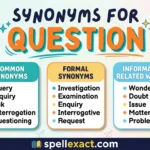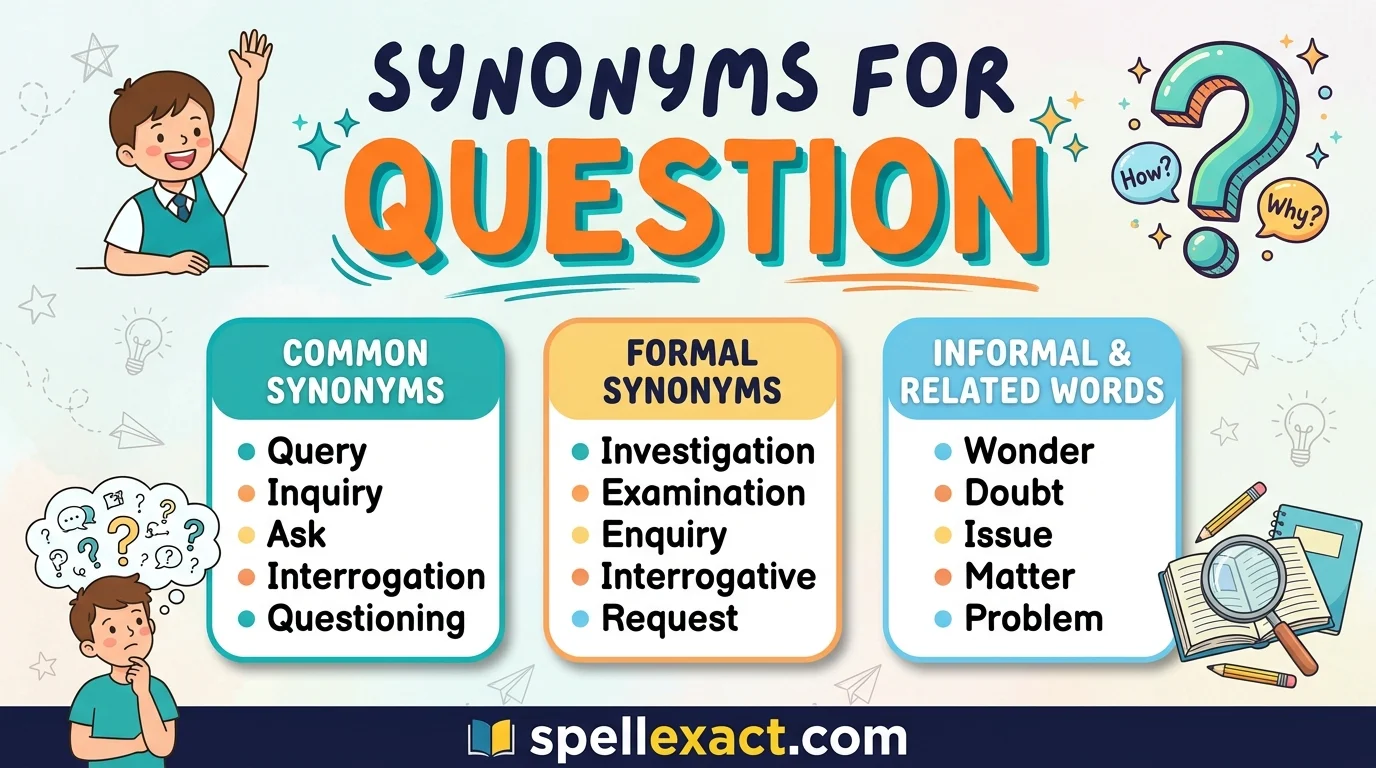
Looking for the best synonym for question? Common alternatives include query, inquiry, problem, puzzle, riddle, conundrum, and interrogative. The right word depends on whether you mean a request for information, a difficult problem, a subject for discussion, or an expression of doubt.
This guide explains 30 synonyms for question and closely related words, with simple definitions, example sentences, and practical usage tips. Whether you are writing an essay, preparing for an interview, learning English, or improving your vocabulary, you will discover which alternative fits your sentence naturally.
Quick Answer: What Is a Synonym for Question?
The closest general alternatives to question include query and inquiry when you mean a request for information. If you mean a difficult question, consider problem, puzzle, riddle, conundrum, or brainteaser. For formal questioning, interrogation or interrogatory may fit, depending on the context.
Here are some useful alternative words for question:
- Query: A question that seeks information or clarification.
- Inquiry: A request for information or an investigation.
- Problem: A question or difficulty that needs to be solved.
- Riddle: A question or statement that requires clever thinking to answer.
- Conundrum: A confusing or difficult problem.
- Brainteaser: A question or puzzle designed to test reasoning.
- Interrogative: A grammatical word, phrase, or sentence used to ask a question.
- Interrogation: Intensive or systematic questioning.
- Poser: A difficult question or problem that makes someone think.
- Quiz: A short test that uses questions to assess knowledge.
Best general choice: Use query or inquiry for requests for information, problem for something that needs solving, and conundrum for a particularly confusing question or situation.
What Does Question Mean?
A question is a sentence or expression used to ask for information, clarification, confirmation, or an opinion. The word can also describe a problem, an issue under discussion, or something whose truth is uncertain.
The meaning depends on how the word is used in a sentence.
- Request for information: The student asked a question about the assignment.
- Request for clarification: Her question helped everyone understand the instructions.
- Problem to solve: The final question on the test was difficult.
- Subject for discussion: The main question is whether the proposal will succeed.
- Uncertainty: There is a question about the accuracy of the report.
Understanding these meanings helps you choose a more precise word similar to question instead of replacing it with a word that changes your intended meaning.
30 Synonyms for Question With Meanings and Examples
The following list combines direct or near synonyms with words related to particular types of questions. Some terms describe a question itself, while others refer to the act of asking, a method of testing knowledge, or a problem that needs an answer.
1. Query
Meaning: A question asked to obtain information or clarification.
Example: I sent a query to the editor about the article’s publication date.
Best usage: Professional emails, technical discussions, customer support, and online searches.
Query vs. question: Query can sound more formal or technical, while question is more common in everyday English.
2. Inquiry
Meaning: A request for information or a process of investigating something.
Example: The customer submitted an inquiry about the company’s refund policy.
Best usage: Business communication, formal requests, research, and official investigations.
Inquiry vs. question: An inquiry may involve more than asking a single question because it can include a broader effort to gather information.
3. Enquiry
Meaning: A request for information; an alternative spelling of inquiry.
Example: The school received an enquiry about its admission requirements.
Best usage: General requests for information, particularly in British English.
Note: Both inquiry and enquiry are accepted spellings. Inquiry is standard in American English and is also used in British English.
4. Interrogative
Meaning: A word, phrase, or sentence used to ask a question.
Example: In “Where are you going?”, the word where is an interrogative word.
Best usage: Grammar lessons, English language learning, and linguistic explanations.
Note: Interrogative is a grammatical term, not a natural replacement for every everyday use of question.
5. Interrogatory
Meaning: A formal question, especially one used in legal proceedings or a structured examination.
Example: The lawyer prepared written interrogatories for the opposing party.
Best usage: Legal writing, civil litigation, and formal questioning.
Note: This is a specialized term. For ordinary conversation, question or query is usually more appropriate.
6. Problem
Meaning: A difficult situation or question that requires a solution.
Example: The final mathematics problem required several steps to solve.
Best usage: Mathematics, science, troubleshooting, education, and analytical writing.
Problem vs. question: A question asks for an answer; a problem usually requires a solution.
7. Puzzle
Meaning: A problem or question that requires thought to solve or understand.
Example: The missing information created a puzzle for the research team.
Best usage: Brain teasers, mysteries, logical challenges, and difficult situations.
Puzzle vs. problem: A puzzle often emphasizes figuring something out, while a problem may involve a practical difficulty.
8. Riddle
Meaning: A question or statement that describes something indirectly and requires a clever answer.
Example: The teacher gave the class a riddle to solve before lunch.
Best usage: Word games, entertainment, children’s activities, and creative writing.
Example of a riddle: What has keys but cannot open a lock? A piano.
Note: A riddle is a specific type of question, not a synonym for every question.
9. Conundrum
Meaning: A confusing or difficult problem that is challenging to resolve.
Example: Choosing between two equally attractive job offers presented a conundrum.
Best usage: Formal writing, complex decisions, debates, and analytical discussions.
Conundrum vs. question: Use conundrum when the issue is especially puzzling or difficult to resolve.
10. Poser
Meaning: A difficult question or problem that makes someone stop and think.
Example: The professor presented a challenging poser to the class.
Best usage: Informal conversation, intellectual discussions, quizzes, and challenging questions.
Note: Poser is less common than question and often suggests that the answer is not immediately obvious.
11. Brainteaser
Meaning: A question, puzzle, or problem designed to test reasoning and creative thinking.
Example: The interview began with a mathematical brainteaser.
Best usage: Logic games, quizzes, interviews, educational activities, and puzzles.
Brainteaser vs. riddle: A brainteaser may involve logic or mathematics, while a riddle often uses wordplay or indirect clues.
12. Stumper
Meaning: A difficult question or problem that is hard to answer.
Example: The final trivia question was a real stumper for the contestants.
Best usage: Trivia competitions, quizzes, informal discussions, and challenging problems.
Note: Stumper is informal American English and is often used when a question leaves people unsure of the answer.
13. Toughie
Meaning: A difficult question, task, or problem.
Example: The last question on the quiz was a toughie.
Best usage: Casual conversation, quizzes, games, and informal writing.
Note: This is an informal alternative. In academic or professional writing, difficult question is often clearer.
14. Quiz
Meaning: A short test or set of questions used to check knowledge.
Example: The teacher gave the students a short quiz on vocabulary.
Best usage: Education, classroom assessments, trivia games, and online knowledge tests.
Quiz vs. question: A quiz contains one or more questions; it is not usually a replacement for a single question.
15. Questionnaire
Meaning: A set of written questions used to collect information from people.
Example: Participants completed a questionnaire about their shopping habits.
Best usage: Surveys, research, customer feedback, applications, and data collection.
Note: A questionnaire is a collection of questions, rather than a synonym for one question.
16. Examination
Meaning: A formal test of knowledge or a careful inspection of something.
Example: The examination included several questions about grammar.
Best usage: Education, assessments, investigations, and detailed reviews.
Note: Examination may refer to the entire test or inspection, while question can refer to an individual item within it.
17. Request
Meaning: An expression asking someone to do something or provide something.
Example: She made a request for more information about the course.
Best usage: Business communication, customer service, polite conversation, and official correspondence.
Request vs. question: A request asks for an action or information; a question specifically seeks an answer or response.
18. Investigation
Meaning: A systematic process of gathering facts to discover the truth about something.
Example: The company launched an investigation into the reported safety issue.
Best usage: Research, legal matters, workplace incidents, and fact-finding.
Note: An investigation may involve many questions, but the word describes the overall process.
19. Interrogation
Meaning: Intensive or systematic questioning, often intended to obtain detailed information.
Example: The detective conducted an interrogation of the suspect.
Best usage: Police investigations, legal contexts, and serious questioning.
Important distinction: Interrogation can sound forceful or intimidating. It is generally unsuitable for a routine customer question or a casual conversation.
20. Probe
Meaning: A careful investigation or a question intended to explore a subject deeply.
Example: The journalist’s probe into the financial records revealed inconsistencies.
Best usage: Journalism, research, investigations, and detailed discussions.
Probe vs. question: A probe suggests an effort to examine something more deeply than a simple question might.
21. Inquest
Meaning: A formal investigation, especially one conducted to establish the facts surrounding a death.
Example: The coroner opened an inquest into the circumstances of the death.
Best usage: Legal proceedings, official inquiries, and investigations.
Note: An inquest is a formal process, not an ordinary question. Use it only when the context supports its specific meaning.
22. Survey
Meaning: A method of collecting information by asking people a series of questions.
Example: The school conducted a survey to learn what students thought about the new schedule.
Best usage: Research, public opinion, customer feedback, and education.
Survey vs. question: A survey is a way to gather answers from multiple people; it usually contains several questions.
23. Poll
Meaning: A method of collecting people’s opinions or votes, often through a set of questions.
Example: The newspaper published a poll asking readers which policy they supported.
Best usage: Elections, public opinion, online voting, and audience feedback.
Note: A poll focuses on measuring opinions or preferences rather than simply asking any kind of question.
24. Issue
Meaning: A subject, concern, or problem that needs attention or discussion.
Example: The manager raised an important issue during the meeting.
Best usage: Workplace discussions, public debates, reports, and problem-solving.
Issue vs. question: An issue is something people discuss or address; a question asks for information or an answer. The two may relate to the same topic without meaning the same thing.
25. Matter
Meaning: A subject or situation that needs consideration.
Example: The committee discussed the matter at its weekly meeting.
Best usage: Formal writing, professional communication, meetings, and general discussions.
Note: Matter is useful when referring to a subject under consideration, but it does not necessarily imply that anyone has asked a question.
26. Point
Meaning: A particular idea, detail, or issue being considered.
Example: That is an interesting point, and I would like to understand it better.
Best usage: Discussions, arguments, explanations, feedback, and academic writing.
Point vs. question: A point is an idea or detail; a question asks for information or invites a response.
27. Doubt
Meaning: A feeling of uncertainty or a lack of confidence about something.
Example: She expressed doubt about whether the figures were correct.
Best usage: Discussions about evidence, beliefs, decisions, and uncertain outcomes.
Doubt vs. question: A question seeks an answer, while doubt expresses uncertainty. For example, “I have a question about the report” is different from “I have doubts about the report.”
28. Challenge
Meaning: A difficult question, task, or problem that tests someone’s knowledge, ability, or ideas.
Example: The professor’s question presented a serious challenge to the class.
Best usage: Education, debates, competitions, problem-solving, and intellectual discussions.
Note: A challenge may be presented as a question, but it can also be a task or a difficult situation.
29. Objection
Meaning: An expression of disagreement or opposition.
Example: The lawyer raised an objection to the witness’s statement.
Best usage: Legal proceedings, formal debates, meetings, and disagreements.
Note: An objection is not a direct synonym for a question. It may be expressed as a statement rather than a request for information.
30. Clarification
Meaning: An explanation or additional information that makes something easier to understand.
Example: I requested clarification about the final paragraph of the instructions.
Best usage: Emails, academic writing, meetings, instructions, and situations involving confusion.
Clarification vs. question: A question can be used to request clarification, but clarification itself refers to making something clearer.
Comparison Table: Which Synonym for Question Is Best?
Use this table to compare common synonyms for question and related terms by meaning and context.
| Word | Simple meaning | Best context |
| Query | A question seeking information | Professional emails and technical contexts |
| Inquiry | A request for information or investigation | Formal communication and research |
| Enquiry | An alternative spelling of inquiry | British English |
| Interrogative | A grammatical form used to ask | Grammar and language learning |
| Interrogatory | A formal written question | Legal proceedings |
| Problem | A difficulty requiring a solution | Mathematics and troubleshooting |
| Puzzle | Something that requires thought to solve | Logic and mysteries |
| Riddle | A question requiring a clever answer | Games and wordplay |
| Conundrum | A confusing problem | Difficult decisions |
| Poser | A challenging question | Informal discussions |
| Brainteaser | A reasoning puzzle | Interviews and games |
| Stumper | A question that is hard to answer | Trivia and quizzes |
| Toughie | A difficult question | Casual conversation |
| Quiz | A short knowledge test | Education and trivia |
| Questionnaire | A set of written questions | Research and feedback |
| Examination | A test or detailed inspection | Education and assessment |
| Request | An ask for action or information | Professional communication |
| Investigation | A process of finding facts | Research and fact-finding |
| Interrogation | Intensive questioning | Police and legal contexts |
| Probe | A deeper investigation | Journalism and research |
| Inquest | A formal investigation | Legal and official proceedings |
| Survey | A way to collect answers | Research and feedback |
| Poll | A way to measure opinions | Elections and public opinion |
| Issue | A matter needing attention | Meetings and discussions |
| Matter | A subject under consideration | Formal writing |
| Point | An idea or detail | Arguments and explanations |
| Doubt | Uncertainty | Evidence and decisions |
| Challenge | A difficult task or question | Education and problem-solving |
| Objection | An expression of disagreement | Legal contexts and debates |
| Clarification | Information that makes something clear | Instructions and professional communication |
Remember: Some entries are direct or near synonyms, while others are related terms. For example, query can replace question in many sentences, but survey refers to a method of collecting answers and clarification refers to making something clear.
How to Choose the Right Synonym for Question
The best alternative word for question depends on your purpose, audience, tone, and intended meaning.
1. For Formal and Professional Writing
Choose inquiry, query, request for information, or clarification when communicating in a professional setting.
Examples:
- Inquiry: I am writing to make an inquiry about the available positions.
- Query: I have a query about the updated payment policy.
- Request for information: We submitted a request for information about the application process.
- Clarification: I would appreciate clarification about the deadline.
Use inquiry when seeking information, query for a specific question, and clarification when something is unclear.
2. For Academic Writing and Education
Choose examination question, problem, brainteaser, puzzle, or prompt, depending on the task.
Examples:
- The examination question tested students’ understanding of grammar.
- The mathematical problem required several steps to solve.
- The brainteaser encouraged students to think logically.
- The puzzle challenged the class to find a hidden pattern.
- The writing prompt asked students to describe a memorable experience.
A prompt gives someone a topic or instruction to respond to, while a problem requires a solution. An examination question tests knowledge or understanding.
3. For Casual Conversations
In everyday English, question is often the clearest and most natural word. You can also use point, thing to ask, or matter, depending on the sentence.
Examples:
- I have a question about your plans.
- There is one thing I would like to ask.
- That is a good point.
- We need to discuss one important matter.
Avoid choosing an unusually formal word simply to sound more sophisticated. A synonym should make your meaning clearer, not make the sentence harder to understand.
4. For Difficult or Confusing Questions
Choose conundrum, poser, brainteaser, stumper, puzzle, or riddle when a question requires extra thought.
Examples:
- The ethical dilemma presented a difficult conundrum.
- The professor gave the students a challenging poser.
- The interviewer began with a brainteaser.
- The final trivia question was a stumper.
- The missing evidence created a puzzle for investigators.
- The teacher shared a riddle with the class.
Use conundrum for a confusing situation, brainteaser for a reasoning challenge, and riddle for a question that often uses clues or wordplay.
5. For Investigations and Serious Situations
Choose inquiry, investigation, probe, interrogation, or inquest according to the situation.
Examples:
- The committee opened an inquiry into the allegations.
- The company launched an investigation into the incident.
- The journalist conducted a probe into the financial records.
- The detectives conducted an interrogation.
- The coroner opened an inquest into the death.
These words are not interchangeable. An inquiry examines a matter or seeks answers, an investigation gathers facts, an interrogation involves intensive questioning, and an inquest is a specific formal investigation.
6. For Uncertainty, Disagreement, and Problems
Choose doubt, issue, challenge, problem, or objection when the sentence concerns uncertainty or disagreement rather than a straightforward request for information.
Examples:
- I have some doubt about the accuracy of the figures.
- The manager raised an important issue.
- The assignment presented a challenge.
- The team solved a difficult problem.
- The lawyer raised an objection to the statement.
Use doubt when you are unsure, issue when a matter needs attention, problem when a solution is needed, and objection when someone disagrees.
Common Mistakes When Using Synonyms for Question
1. Treating Inquiry and Interrogation as Identical
An inquiry can be a simple request for information or a formal investigation. An interrogation usually involves intensive or systematic questioning.
- Natural: I made an inquiry about the course fees.
- Natural: The detectives conducted an interrogation.
Calling a routine customer question an interrogation can sound unnecessarily serious or intimidating.
2. Using Query in Every Everyday Conversation
Query is correct, but it can sound more formal or technical than question.
- Everyday: I have a question about the schedule.
- Professional: I have a query about the schedule.
Choose the word that fits your audience and situation.
3. Confusing a Question With an Issue
A question asks for information or expresses uncertainty. An issue is a subject, concern, or problem that needs attention.
- Question: How can we reduce costs?
- Issue: The rising cost of supplies is a concern.
The words can relate to the same situation without having the same meaning.
4. Using Doubt as a Direct Replacement for Question
A doubt expresses uncertainty, not necessarily a request for information.
- Question: I have a question about the results.
- Doubt: I have doubts about the results.
The first sentence seeks information; the second expresses uncertainty.
5. Confusing a Questionnaire With a Question
A question is an individual request for information, while a questionnaire contains a series of questions used to collect information.
- Question: The teacher asked a question about the reading.
- Questionnaire: The participants completed a questionnaire about their reading habits.
Use the term that matches the actual format.
6. Choosing a Word That Changes the Intended Meaning
Not every related word can replace question without changing the sentence. A riddle requires a particular kind of answer, an objection expresses disagreement, and an investigation describes a process of finding facts.
Before substituting a word, check whether it preserves the meaning of the original sentence.
Frequently Asked Questions
1. What is the closest synonym for question?
Query and inquiry are common alternatives when question means a request for information. However, question remains the most natural choice in many everyday situations. Use query for a specific request for information and inquiry for a request or a broader investigation.
2. What is a more formal word for question?
Inquiry is a useful formal alternative. Query also works in professional communication, while request for information is suitable when you want to state your purpose explicitly.
3. What is another word for asking a question?
Depending on the context, you can use inquiring, making an inquiry, asking for clarification, or raising a question. For example, “She made an inquiry about the course” is a formal alternative to “She asked about the course.”
4. What is a synonym for question in an academic essay?
Useful alternatives include query, inquiry, problem, issue, and point, depending on the intended meaning. Use problem for something that needs a solution, issue for a matter under discussion, and inquiry for a process of seeking information.
5. What is the difference between a question and a query?
A question is a general request for information, an answer, or an opinion. A query is a question or request for clarification, often used in professional, technical, and digital contexts. In many situations, the words can be used interchangeably.
6. What is the difference between inquiry and enquiry?
Both inquiry and enquiry can mean a request for information. Inquiry is the standard spelling in American English and is also used in British English. Enquiry is particularly common in British English for general requests for information.
7. What is the opposite of question?
There is no single direct antonym for question in every context. Answer or response provides a natural contrast when a question seeks information. Solution may contrast with a question when the word refers to a problem that needs solving.
8. What is a synonym for a difficult question?
Useful alternatives include poser, brainteaser, stumper, conundrum, puzzle, and riddle. A brainteaser tests reasoning, a conundrum is a confusing problem, and a riddle usually requires a clever or indirect answer.
9. What is a synonym for a question that asks for information?
Query and inquiry are two of the most useful alternatives. Use query for a specific question and inquiry for a request for information or a broader investigation. Request for information is another clear option in formal writing.
10. Can issue or problem replace question?
Sometimes, but not always. An issue is a subject or concern that needs attention, while a problem is a difficulty that needs a solution. Neither word automatically means a request for information, so check the sentence before using either as a replacement.
Conclusion
The best synonym for question depends on what you want to communicate. Query and inquiry work well when asking for information, problem describes something that needs a solution, and conundrum, brainteaser, and riddle describe different kinds of challenging questions. For formal investigations, words such as investigation, probe, and interrogation have more specific meanings.
For everyday conversation, question is usually the clearest choice. In professional writing, query or inquiry may fit better, while academic and creative writing may call for problem, prompt, puzzle, or brainteaser. Always consider the context before choosing an alternative so your writing remains accurate, natural, and easy to understand.

Caleb Carter is a passionate language enthusiast and content writer specializing in spelling mistakes, grammar, and vocabulary. He creates clear, practical guides that help readers improve their writing skills and communicate confidently every day.