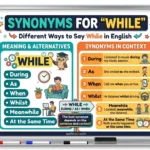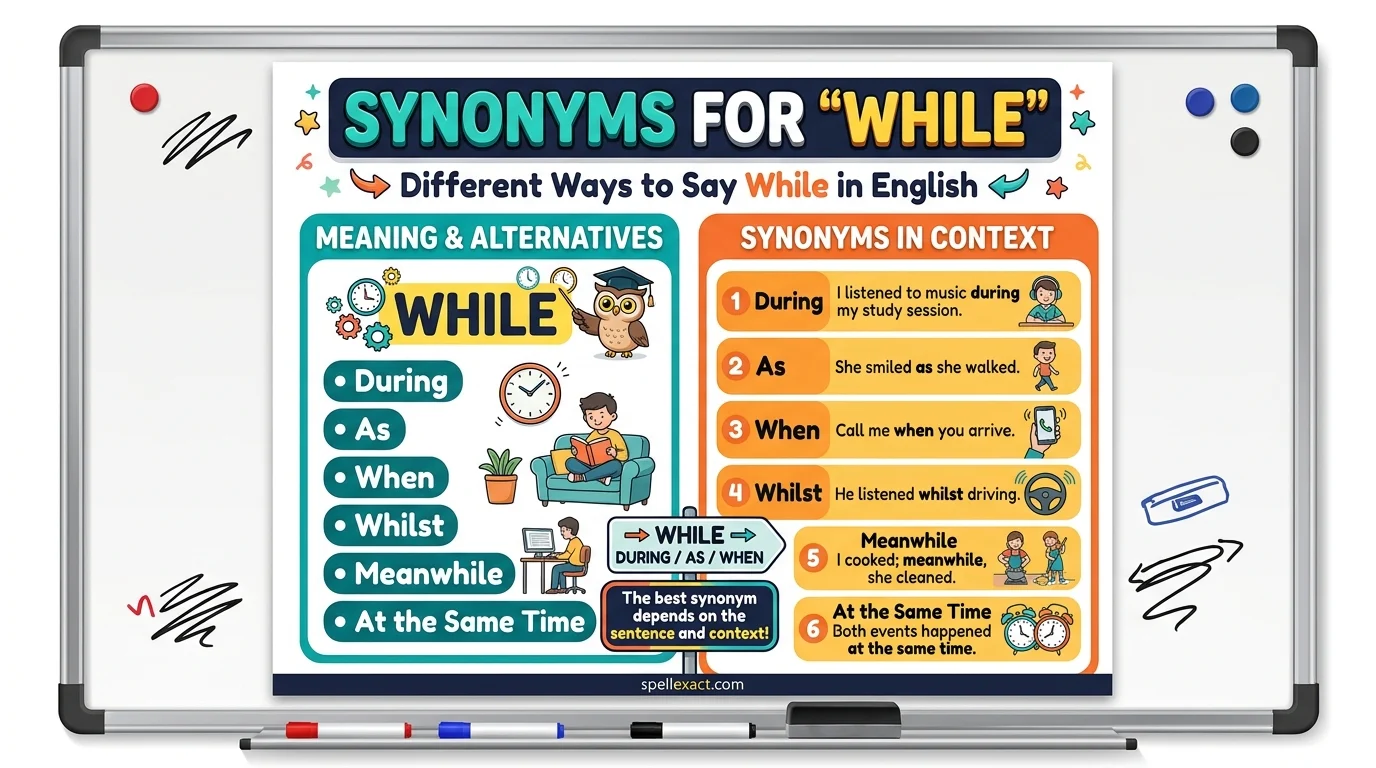
Finding the right synonym for while depends on how the word is used in a sentence. While can describe two actions happening at the same time, introduce a contrast between ideas, or refer to a period of time. Common alternatives include during, as, when, whilst, meanwhile, whereas, although, even though, and throughout. However, these words are not interchangeable in every situation.
This guide explains 30 useful synonyms and alternative expressions for while, with simple meanings, example sentences, and practical usage tips. Whether you are a student, ESL learner, writer, or content creator, you will learn how to choose the right word for everyday conversations, academic assignments, and professional writing.
Quick Answer: What Is a Synonym for While?
The best synonym for while depends on its meaning:
- For time: During, whilst, as, when, over, and throughout.
- For simultaneous actions: Meanwhile, at the same time, simultaneously, and concurrently.
- For contrast: Whereas, although, even though, though, and yet.
- For a period of time: A period, a spell, a stretch of time, and an interval.
- For formal writing: Concurrently, simultaneously, throughout, and in the course of.
Examples:
- Original: While I was studying, my brother watched TV.
- Alternative: During my study session, my brother watched TV.
- Original: While I enjoy tea, my sister prefers coffee.
- Alternative: Whereas I enjoy tea, my sister prefers coffee.
- Original: I cooked while my sister cleaned.
- Alternative: I cooked. Meanwhile, my sister cleaned.
The important point is to identify whether while refers to time, simultaneous actions, contrast, or duration before choosing a replacement.
What Does While Mean?
While is a common English word with several meanings. It is mainly used as a conjunction, but it can also function as a noun in expressions such as a while.
Understanding its different meanings helps you select the most accurate alternative word for while.
1. While as a Time Conjunction
As a conjunction, while means during the time that or at the same time that. It connects two actions or events that happen during overlapping periods.
Examples:
- She listened to music while studying.
- I prepared dinner while my brother cleaned the kitchen.
- While I was sleeping, it started raining.
In these examples, while shows that two activities happen at the same time or that one activity takes place during another.
2. While as a Contrast Conjunction
While can also introduce a contrast between two facts, opinions, people, or situations. In this meaning, it is similar to whereas, although, or even though, depending on the sentence.
Examples:
- While I enjoy reading, my brother prefers watching movies.
- While the first option is affordable, the second is more practical.
- While she is young, she has considerable professional experience.
Here, while does not describe two activities happening together. Instead, it highlights a difference or an unexpected fact.
3. While as a Noun
As a noun, a while means a period of time that is usually not precisely specified.
Examples:
- I haven’t seen her for a while.
- Please wait a little while.
- We talked for quite a while.
In this meaning, possible alternatives include a period, a spell, a stretch of time, and an interval. The best choice depends on the sentence.
30 Synonyms and Alternatives for While With Meanings and Examples
The following alternatives cover the different meanings of while. Some are direct substitutes in particular sentence structures, while others are related expressions that work only for time, contrast, simultaneous actions, or duration.
1. During
Simple meaning: Within a particular period or event.
Example: I read a book during my lunch break.
Best usage/context: Use during when something happens within a specific event, activity, or period. It is a common alternative when while introduces a time clause, but the sentence usually needs restructuring.
Grammar tip: During is followed by a noun or noun phrase, not a complete clause.
- While I was studying, the phone rang.
- During my study session, the phone rang.
2. As
Simple meaning: At the same time that something happens.
Example: As I walked home, it started to rain.
Best usage/context: Use as when two actions happen together or one event occurs during another. It is natural in everyday conversations, storytelling, and descriptive writing.
3. When
Simple meaning: At the time that something happens.
Example: Call me when you arrive.
Best usage/context: Use when to refer to a particular time, event, or situation. It can replace while when the sentence focuses on timing rather than the duration of an ongoing action.
4. Whilst
Simple meaning: During the time that something happens.
Example: She listened to music whilst doing her homework.
Best usage/context: Use whilst as an alternative to while, especially in British English and more formal or literary writing. It can express time or contrast, depending on the sentence.
5. Meanwhile
Simple meaning: During the same period as another activity.
Example: I prepared dinner. Meanwhile, my sister cleaned the kitchen.
Best usage/context: Use meanwhile when describing another activity happening during the same period. It often connects separate sentences or independent clauses rather than introducing a dependent clause.
6. In the Meantime
Simple meaning: During the period before something else happens.
Example: The doctor will arrive soon. In the meantime, please take a seat.
Best usage/context: Use in the meantime when referring to what happens during a waiting period or before an expected event takes place.
7. At the Same Time
Simple meaning: During the same period or at one identical moment.
Example: She was talking on the phone and preparing dinner at the same time.
Best usage/context: Use at the same time when emphasizing that two activities happen simultaneously. It is natural in everyday English and explanatory writing.
8. Simultaneously
Simple meaning: Happening at exactly the same time.
Example: Both students answered the teacher’s question simultaneously.
Best usage/context: Use simultaneously in formal, academic, scientific, and professional writing when two or more actions occur at the same time.
9. Concurrently
Simple meaning: Happening or existing during the same period.
Example: The company developed two projects concurrently.
Best usage/context: Use concurrently in business, technical, and academic contexts. It emphasizes activities that take place during overlapping periods.
10. Throughout
Simple meaning: During the whole period of something.
Example: She remained calm throughout the interview.
Best usage/context: Use throughout when an action or condition continues across an entire period, event, or activity. Unlike while, it emphasizes the full duration.
11. Over
Simple meaning: During a particular period of time or event.
Example: We discussed several important topics over lunch.
Best usage/context: Use over in expressions such as over the weekend, over the summer, and over dinner. It often describes something happening during a period or event.
12. Over the Course of
Simple meaning: During a particular period or process.
Example: She improved significantly over the course of the semester.
Best usage/context: Use over the course of in academic writing, professional reports, and explanations of gradual changes or developments.
13. In the Course of
Simple meaning: During the process or period in which something happens.
Example: We learned several useful skills in the course of the project.
Best usage/context: Use in the course of in formal writing, reports, business communication, and explanations about events or processes.
14. During the Time That
Simple meaning: Throughout the period when something happens.
Example: During the time that I lived abroad, I learned a new language.
Best usage/context: Use during the time that when you want to express the time relationship clearly or emphasize a particular period. It is a longer expression than while and is not always necessary.
15. All the While
Simple meaning: During the entire time that something else happens.
Example: She smiled all the while she was telling the story.
Best usage/context: Use all the while to emphasize that an action or condition continues throughout another activity or period.
16. At the Same Moment
Simple meaning: At one identical point in time.
Example: Both contestants reached the finish line at the same moment.
Best usage/context: Use at the same moment when emphasizing that two events occur at exactly the same time.
17. In Parallel
Simple meaning: Happening or developing alongside another activity.
Example: The research teams worked in parallel on separate parts of the project.
Best usage/context: Use in parallel when two tasks, processes, or developments happen during the same period, especially in business, technology, and project management.
18. Whereas
Simple meaning: In contrast or comparison with something else.
Example: My brother enjoys football, whereas I prefer tennis.
Best usage/context: Use whereas when comparing two people, facts, opinions, or situations. It is particularly useful in academic and formal writing.
19. Although
Simple meaning: Despite the fact that something is true.
Example: Although it was raining, we went outside.
Best usage/context: Use although when introducing a contrast or an unexpected result. It can replace while when the original word means despite the fact that, not when it simply describes time.
20. Even Though
Simple meaning: Despite the fact that something is true, with extra emphasis.
Example: Even though she was tired, she continued working.
Best usage/context: Use even though to emphasize a strong contrast or an unexpected result. It is common in everyday speech and informal writing.
21. Though
Simple meaning: Despite the fact that something is true; similar to although.
Example: Though he was nervous, he gave an excellent presentation.
Best usage/context: Use though to introduce a contrast. It is often more conversational than although and can also appear at the end of a sentence.
22. In Contrast
Simple meaning: In a way that shows a difference between two things.
Example: The first apartment is spacious. In contrast, the second one is quite small.
Best usage/context: Use in contrast when comparing different facts, opinions, results, or characteristics. It works particularly well in essays and analytical writing.
23. By Comparison
Simple meaning: When compared with something else.
Example: The old computer was slow. By comparison, the new model works much faster.
Best usage/context: Use by comparison when explaining how one thing differs from another. It is useful in reports, reviews, academic writing, and evaluations.
24. On the Other Hand
Simple meaning: Used to introduce a different or contrasting idea.
Example: The job offers a good salary. On the other hand, it requires long working hours.
Best usage/context: Use on the other hand in discussions, essays, and comparisons when presenting another perspective or an opposing point.
25. Yet
Simple meaning: But or nevertheless; used to introduce a contrasting idea.
Example: She was exhausted, yet she continued working.
Best usage/context: Use yet when expressing a surprising contrast or unexpected result. It can replace while only when while introduces contrast, not when it describes time.
26. Nevertheless
Simple meaning: Despite what has just been mentioned; still.
Example: The journey was difficult. Nevertheless, we reached our destination.
Best usage/context: Use nevertheless in formal writing, reports, and discussions to introduce an idea that remains true despite a previous fact.
27. For a Time
Simple meaning: During a particular period.
Example: He lived in London for a time before moving to Canada.
Best usage/context: Use for a time when a while refers to an unspecified period. It is useful in storytelling and descriptions of past experiences.
28. For Some Time
Simple meaning: For a period that is not precisely stated.
Example: She stayed there for some time before returning home.
Best usage/context: Use for some time when the exact length of a period is unknown or unimportant. It can suggest a longer period than for a moment.
29. Period
Simple meaning: A length or section of time.
Example: I lived in London for a short period.
Best usage/context: Use period as a noun when a while refers to a length of time. It is common in academic, professional, and everyday writing.
30. Spell
Simple meaning: A period of time, usually a relatively short or specific one.
Example: After a brief spell of rain, the sun came out.
Best usage/context: Use spell as a noun in expressions such as a short spell, a dry spell, or a spell of bad weather. It is especially common in British English.
Comparison Table: While Synonyms at a Glance
Use this table to compare common alternatives to while by their main meanings, tone, and grammatical roles.
| Synonym or phrase | Main meaning | Tone | Best context |
| During | Within a period | Neutral | Events and activities |
| As | At the same time that | Neutral | Simultaneous actions |
| When | At the time that | Neutral | Specific events |
| Whilst | During the time that | British/formal | Time or contrast |
| Meanwhile | During the same period | Neutral | Parallel activities |
| In the meantime | During a waiting period | Neutral | Plans and expected events |
| At the same time | Simultaneously | Neutral | Everyday communication |
| Simultaneously | At exactly the same time | Formal | Academic and technical writing |
| Concurrently | During overlapping periods | Formal | Professional writing |
| Throughout | During the whole period | Neutral/formal | Extended periods |
| Over | During a period or event | Neutral | Time expressions |
| Over the course of | During a particular period | Formal | Academic and professional writing |
| In the course of | During a process | Formal | Reports and explanations |
| During the time that | Throughout a period | Neutral | Clear time references |
| All the while | Throughout the period | Neutral | Continuous actions |
| At the same moment | At one identical time | Neutral | Specific events |
| In parallel | Alongside another activity | Formal | Projects and processes |
| Whereas | In contrast | Neutral/formal | Comparisons |
| Although | Despite the fact that | Neutral | Contrasting ideas |
| Even though | Strong contrast | Neutral | Unexpected situations |
| Though | Although | Conversational | Contrast |
| In contrast | Showing a difference | Formal/neutral | Essays and analysis |
| By comparison | When compared | Formal/neutral | Reviews and reports |
| On the other hand | Another perspective | Neutral | Arguments and comparisons |
| Yet | But or nevertheless | Neutral | Unexpected contrast |
| Nevertheless | Despite that | Formal | Contrast |
| For a time | During a particular period | Neutral | Duration |
| For some time | For an unspecified period | Neutral | Duration |
| Period | Length of time | Neutral/formal | General time reference |
| Spell | A particular period | Neutral/British | Weather and duration |
Important: These alternatives are not all direct synonyms. For example, during requires a noun phrase, whereas introduces a comparison, and period is a noun used when a while refers to a length of time. Always consider the sentence structure and intended meaning.
While vs. During: What Is the Difference?
While and during are closely related when discussing time, but they follow different grammatical structures.
Use while before a clause containing a subject and a verb:
- While I was sleeping, the alarm rang.
- While she was cooking, her brother washed the dishes.
Use during before a noun or noun phrase:
- During my sleep, the alarm rang.
- During dinner, her brother washed the dishes.
A useful grammar rule is:
- While + subject + verb
- During + noun or noun phrase
Both words can describe events happening within the same period, but you cannot usually replace one with the other without changing the sentence structure.
While vs. Whereas: What Is the Difference?
Both while and whereas can introduce a contrast, but whereas is more strongly associated with comparing two different people, things, or situations.
While:
While I enjoy tea, my sister prefers coffee.
Whereas:
I enjoy tea, whereas my sister prefers coffee.
Both sentences compare preferences. However, whereas makes the contrast especially clear and is common in formal and academic writing.
Use while when it introduces either time or contrast. Use whereas when your main purpose is to compare two different facts or ideas.
While vs. Although: What Is the Difference?
When while means despite the fact that, although can be a suitable replacement.
While:
While he was tired, he continued working.
Although:
Although he was tired, he continued working.
Both sentences express contrast rather than simultaneous actions.
However, although cannot replace while when the word describes two activities happening at the same time.
- Correct: She listened to music while studying.
- Incorrect: She listened to music although studying.
While vs. When: What Is the Difference?
While and when both refer to time, but they can emphasize different aspects of an event.
Use while when focusing on an activity or period that is in progress:
- While I was reading, the phone rang.
Use when when referring to a particular time or event:
- When I arrived, the meeting had already started.
Sometimes both words are possible, but the emphasis can change. While often highlights an ongoing activity, whereas when can identify the time at which something happens.
Meanwhile vs. While: What Is the Difference?
While commonly connects two clauses in one sentence. Meanwhile is an adverb that often connects separate sentences or independent clauses.
Using while:
I cooked dinner while my sister set the table.
Using meanwhile:
I cooked dinner. Meanwhile, my sister set the table.
Both sentences describe simultaneous activities, but their grammatical structures are different.
Use while to connect the actions directly. Use meanwhile to introduce another activity happening during the same period.
How to Choose the Right While Synonym
The best synonym for while depends on meaning, tone, and sentence structure. Use the following guide to find the most natural alternative.
1. For Time and Duration
Choose during, as, when, whilst, throughout, over, or in the course of when referring to a period or event.
Examples:
- She took notes during the lecture.
- He remained calm throughout the interview.
- We discussed the project over lunch.
- She learned several skills in the course of the training.
Use during for an event or period, throughout for the entire period, and over for periods such as a meal, weekend, or holiday.
2. For Simultaneous Actions
Choose as, meanwhile, at the same time, simultaneously, concurrently, or in parallel when two activities happen together.
Examples:
- She listened to music as she studied.
- I prepared dinner. Meanwhile, my brother cleaned the kitchen.
- Both machines stopped simultaneously.
- The teams worked concurrently on different tasks.
Use as to connect actions in one sentence and meanwhile when introducing a separate but related activity.
3. For Contrast and Opposing Ideas
Choose whereas, although, even though, though, yet, or nevertheless when presenting different or unexpected ideas.
Examples:
- Although it was raining, we went outside.
- Even though he was tired, he finished the assignment.
- My brother enjoys sports, whereas I prefer reading.
- The task was difficult. Nevertheless, she completed it.
Use although and even though to introduce an unexpected fact. Choose whereas when comparing two different situations.
4. For Formal and Academic Writing
Consider concurrently, simultaneously, throughout, in the course of, and over the course of when the meaning fits.
Examples:
- Both studies were conducted concurrently.
- The results changed throughout the experiment.
- Several improvements occurred over the course of the research.
These alternatives can make academic and professional writing more precise. However, simple words are often clearer than unnecessarily formal expressions.
5. For Casual or Everyday English
Prefer while, as, when, during, meanwhile, and at the same time, depending on the sentence.
Examples:
- I listened to a podcast while driving.
- Call me when you arrive.
- She cooked as I prepared the table.
- We talked during lunch.
These expressions sound natural in everyday conversations and informal writing.
6. When While Means a Short Period of Time
Choose a period, a spell, a stretch of time, or an interval when a while refers to a length of time.
Examples:
- I haven’t seen him for a while.
- I haven’t seen him for a short period.
- We enjoyed a brief spell of warm weather.
- There was a short interval between the meetings.
The best choice depends on whether you mean a general length of time, a specific stretch, or a gap between events.
Common Mistakes When Using Synonyms for While
Some alternatives to while have different grammatical rules or meanings. Avoid these common mistakes to keep your sentences clear and natural.
1. Using During Before a Full Clause
While is generally followed by a subject and verb, whereas during is followed by a noun or noun phrase.
- Incorrect: During I was studying, my phone rang.
- Correct: While I was studying, my phone rang.
- Correct: During my study session, my phone rang.
Remember: write during the meeting, not during we met.
2. Treating Every Synonym as Interchangeable
Not every alternative to while works in every sentence.
- Original: I listened to music while I was cooking.
- Natural: I listened to music as I was cooking.
- Incorrect for the intended time meaning: I listened to music whereas I was cooking.
Always identify whether while means during the time, at the same time, or in contrast.
3. Confusing While With Although
While can describe simultaneous actions or contrast. Although expresses contrast, not simultaneous timing.
- Time: I listened to music while I worked.
- Contrast: Although I was tired, I continued working.
Choose the word that matches the intended relationship between the ideas.
4. Using Whereas to Describe Time
Whereas introduces a comparison or contrast. It does not normally describe two actions happening at the same time.
- Incorrect: I listened to music whereas I was cooking.
- Correct: I listened to music while I was cooking.
- Correct contrast: I enjoy cooking, whereas my brother prefers eating out.
5. Confusing Meanwhile With During
Meanwhile is an adverb, while during is a preposition.
- Correct: I prepared dinner. Meanwhile, my sister set the table.
- Correct: I prepared dinner during the evening.
Do not use during to introduce a complete sentence. Use meanwhile when connecting separate statements about activities happening during the same period.
6. Using Whilst in the Wrong Style
Whilst has the same basic meaning as while in many conjunction uses, but it is more common in British English.
- While I was studying, my brother watched television.
- Whilst I was studying, my brother watched television.
Both sentences are correct. In American English, while is generally the more familiar choice.
7. Confusing While With Until
These words describe different time relationships.
- While: Wait here while I prepare the documents.
- Until: Wait here until I finish preparing the documents.
The first sentence describes an action happening during the preparation. The second describes an action continuing up to the point when the preparation is finished.
8. Overusing Formal Alternatives
Words such as concurrently and simultaneously are correct in suitable contexts, but they may sound unnecessarily formal in everyday conversation.
- Formal: She worked and studied concurrently.
- More conversational: She worked and studied at the same time.
Choose words that fit your audience and the tone of your writing.
9. Using Too Many Contrast Words Together
Words such as although, whereas, yet, and on the other hand can introduce contrast, but combining them unnecessarily makes sentences awkward.
- Awkward: Although it was raining, yet we went outside.
- Better: Although it was raining, we went outside.
- Also correct: It was raining, yet we went outside.
Choose one suitable contrast expression instead of repeating the same relationship.
Frequently Asked Questions
1. What is the best synonym for while?
There is no single best synonym for while because the word has several meanings. During, as, when, and whilst are useful for time-related meanings. Meanwhile and at the same time describe simultaneous actions, while whereas, although, and even though can express contrast.
2. What is a simple synonym for while?
During, as, and when are among the simplest alternatives. The correct choice depends on the grammatical structure of your sentence.
For example:
- While I was eating, the phone rang.
- During dinner, the phone rang.
Both sentences refer to the same general period, but they use different grammatical structures.
3. What is a formal synonym for while?
Useful formal alternatives include concurrently, simultaneously, throughout, in the course of, and over the course of. For comparisons, whereas is also useful. Choose the expression that matches the intended meaning rather than using formal words unnecessarily.
4. Is during the same as while?
They have similar meanings when discussing time, but their grammar differs. While is generally followed by a clause containing a subject and verb, whereas during is normally followed by a noun or noun phrase.
- While I was sleeping, the phone rang.
- During my sleep, the phone rang.
5. What is the synonym of while in contrast?
When while means in contrast, useful alternatives include whereas, although, even though, and though.
For example:
- While I enjoy coffee, my sister prefers tea.
- Whereas I enjoy coffee, my sister prefers tea.
Use whereas for direct comparisons and although when introducing an unexpected fact.
6. Can meanwhile replace while?
Sometimes. Meanwhile describes something happening during the same period as another event, but it usually works as an adverb rather than a conjunction.
- While I cooked, my sister cleaned.
- I cooked. Meanwhile, my sister cleaned.
Both sentences describe simultaneous activities, but their grammatical structures are different.
7. What is another word for a while?
When a while means a period of time, possible alternatives include a period, a spell, a stretch of time, an interval, and some time.
For example:
- I waited for a while.
- I waited for some time.
- I waited for a short period.
The most natural alternative depends on the length and context of the period.
8. Is whilst a synonym for while?
Yes. Whilst can mean the same as while, particularly when while means during the time that. It is more common in British English and can sound more formal or literary. Both words can also introduce contrast in suitable sentences.
Final Thoughts
The best synonym for while depends on what you want to express. If you are talking about time, alternatives such as during, as, when, whilst, and throughout can be useful. For simultaneous activities, choose meanwhile, at the same time, simultaneously, or concurrently. If you are expressing contrast, whereas, although, even though, and though may be more suitable.
When while refers to a period of time, expressions such as for a time, for some time, period, and spell can help you describe the duration more precisely.
The key is not simply to replace while with another word. First, identify the relationship between the ideas in your sentence. Then choose an alternative that preserves the exact meaning and follows the correct grammatical structure. This approach makes your English clearer, more natural, and more precise.

Aaron Adam is the Administrator of SpellExact, dedicated to helping readers improve their spelling and writing accuracy. He oversees content quality, ensures reliable language resources, and works to make spelling guidance simple, practical, and accessible for everyone.