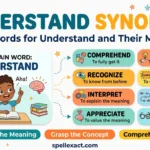
If you are looking for a synonym for understand, the best choice depends on what you mean. You might want to say you grasp a difficult idea, comprehend a text, realize a hidden truth, or appreciate someone’s feelings. Each word looks similar, but each one carries a slightly different meaning, tone, and level of intensity.
The verb understand is one of the most common words in English. It means to know what something means, to see how something works, or to be aware of how a person feels. Because writers use it so often, it can start to sound flat or repetitive in essays, emails, reports, and stories.
This guide gives you more than 80 alternatives to understand, grouped by meaning, tone, and context. You will learn which words are formal, which are casual, and which are strong or soft. You will also find example sentences, comparison tables, common mistakes, useful collocations, and answers to frequently asked questions. By the end, you will know exactly which word fits your sentence, your audience, and your purpose.
Quick Answer
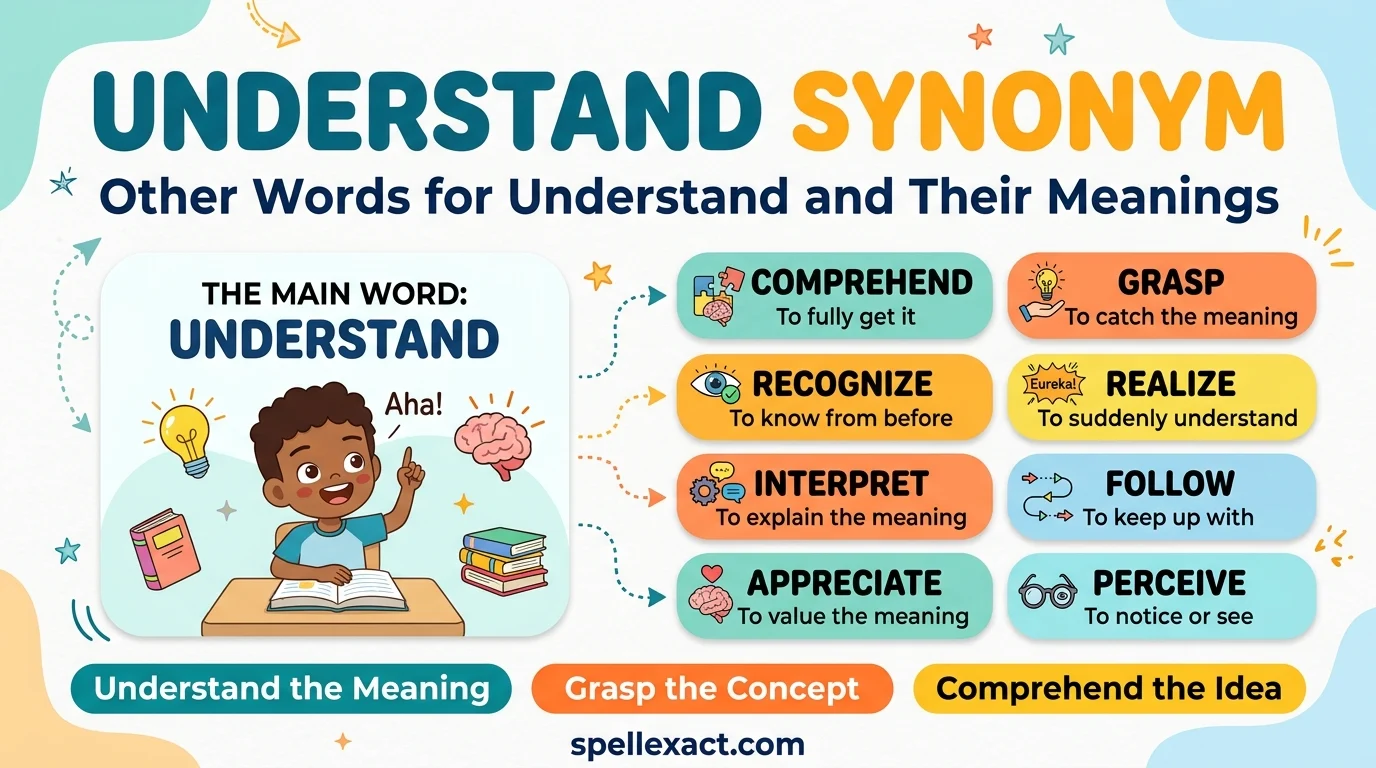
The best synonyms for understand are comprehend, grasp, get, realize, appreciate, follow, and see. Use comprehend in formal writing, grasp for ideas, get in casual speech, realize for sudden awareness, appreciate for deeper value, and follow when you can track an explanation or argument.
What Does “Understand” Mean?
Understand is a verb with several related meanings. Dictionaries usually group them like this:
- To perceive the meaning of something. I understand the instructions.
- To know how something works or why it happens. She understands how engines work.
- To be aware of a person’s feelings or situation. I understand why you are upset.
- To accept or assume something as true. I understand that the meeting is cancelled.
- To know a language. He understands Spanish but does not speak it well.
The forms are understand (present), understood (past and past participle), and understanding (present participle, noun, and adjective). The noun understanding can also mean an agreement, as in “We reached an understanding.
Because understand covers so many ideas, no single synonym fits every sentence. That is why it helps to choose by meaning, not just by sound.
Top 10 Synonyms for Understand at a Glance
| Synonym | Core Meaning | Tone | Best Used For |
| Comprehend | Fully take in meaning | Formal | Texts, speeches, complex topics |
| Grasp | Mentally take hold of an idea | Neutral | Concepts, theories, problems |
| Get | Understand quickly | Informal | Jokes, hints, casual talk |
| Realize | Become aware | Neutral | Sudden discoveries |
| Appreciate | Understand the value or difficulty | Warm, formal | Feelings, efforts, situations |
| Follow | Keep up with an explanation | Neutral | Instructions, arguments, stories |
| See | Understand a point | Neutral, everyday | Reasons, logic, explanations |
| Fathom | Understand something deep or puzzling | Literary | Mysteries, motives |
| Perceive | Notice and interpret | Formal | Patterns, differences, subtle signals |
| Recognize | Identify and accept as true | Neutral | Problems, facts, patterns |
Synonyms for Understand Grouped by Meaning
1. Synonyms for Understanding Ideas and Information
Use these words when you talk about learning, studying, or mastering knowledge.
- Comprehend: to fully understand something, often complex. It is more formal than “understand.”
- Grasp: to understand an idea, especially after some effort.
- Fathom: to understand something deep, strange, or hard to explain.
- Digest: to think about information until you understand it.
- Absorb: to take in information, often a lot of it.
- Assimilate: to fully take in and integrate new knowledge.
- Master: to understand and use a subject or skill very well.
- Take in: to understand and remember new information.
- Make sense of: to find meaning in something confusing.
- Wrap your head around: to understand something complicated (informal).
- Process: to work through information mentally.
- Internalize: to understand something so well it becomes part of how you think.
2. Synonyms for Realizing or Noticing
These words focus on the moment of awareness, not the full process of learning.
- Realize: to become aware of a fact or situation.
- Recognize: to accept that something exists or is true.
- Perceive: to notice or interpret something, often something subtle.
- See: to understand a point or reason.
- Notice: to become aware of something by observing it.
- Discern: to detect or recognize something that is hard to see.
- Detect: to find or sense something hidden.
- Register: to take note of something mentally.
- Awaken to: to become aware of something for the first time.
- Catch on: to begin to understand, often a trick or trend.
- Cotton on: to realize something (British, informal).
- Twig: to suddenly understand (British, informal).
- Come to terms with: to accept and understand a hard truth.
3. Synonyms for Understanding Feelings and People
When you want to show empathy, choose a word that sounds human and sincere.
- Empathize with: to share or understand another person’s feelings.
- Sympathize with: to feel sorrow or support for someone’s situation.
- Relate to: to connect with someone’s experience.
- Appreciate: to understand how difficult or valuable something is.
- Identify with: to see yourself in another person’s situation.
- Feel for: to have compassion for someone.
- Sense: to understand a feeling without being told.
- Tune in to: to become sensitive to someone’s mood or needs.
- Be sensitive to: to understand and respect someone’s feelings.
- See where someone is coming from: to understand a person’s viewpoint (informal).
4. Synonyms for Following an Explanation
These words work when someone is explaining something to you.
- Follow: to keep up with a speaker, story, or argument.
- Get: to understand what someone means (informal).
- Catch: to hear and understand something quickly.
- Make out: to understand something that is unclear.
- Keep up with: to understand something moving at a fast pace.
- Take on board: to accept and understand advice or information.
- Get the picture: to understand the general situation.
- See the point: to understand why something matters.
- Get the message: to understand what someone is really saying.
- Get the gist: to understand the main idea.
5. Synonyms for Knowing Well
Sometimes understand simply means “know.” These words show different depths of knowledge.
- Know: to have information or skill.
- Be familiar with: to know something fairly well.
- Be aware of: to know that something exists.
- Be acquainted with: to have some knowledge of something.
- Be well versed in: to have deep knowledge of a subject.
- Be conversant with: to be knowledgeable and comfortable discussing something.
- Have a handle on: to have good control or understanding (informal).
- Be on top of: to understand and manage something well (informal).
6. Synonyms for Interpreting and Working Things Out
Use these when understanding takes effort, detective work, or problem-solving.
- Interpret: to explain or decide what something means.
- Decipher: to figure out something hard to read or understand.
- Decode: to convert a message or code into understandable form.
- Construe: to interpret something in a particular way (formal).
- Read: to interpret a person or situation.
- Unravel: to solve something complicated or tangled.
- Work out: to understand something through thinking.
- Figure out: to solve a puzzle or find an answer.
- Puzzle out: to understand something confusing after effort.
- Suss out: to discover or understand something (British, informal).
- Crack: to solve a difficult problem or code.
- Make head or tail of: to understand something confusing (usually negative).
7. Synonyms for Accepting or Acknowledging
Sometimes understand means “I accept what you said.”
- Accept: to agree that something is true or valid.
- Acknowledge: to openly admit or recognize something.
- Take it: to assume or believe something (I take it you are ready).
- Gather: to understand from information you have heard (I gather you moved).
- Assume: to believe something without proof.
- Presume: to suppose that something is true.
- Conclude: to decide something is true after thinking.
- Infer: to reach a conclusion from evidence.
That list gives you more than 85 genuine alternatives, so you can match the right word to the right situation.
Synonyms for Understand by Tone and Register
Formal Synonyms
Use these in academic papers, business reports, legal writing, and professional emails.
- Comprehend
- Perceive
- Discern
- Construe
- Apprehend
- Appreciate
- Recognize
- Assimilate
- Interpret
- Acknowledge
Informal Synonyms
Use these in conversation, texts, social media, and relaxed writing.
- Get
- Catch on
- Get the picture
- Wrap your head around
- Figure out
- Suss out
- Twig
- Cotton on
- Get the hang of
- Dig (very casual slang, as in “I dig it”)
Neutral Synonyms
These work almost anywhere.
- See
- Follow
- Grasp
- Realize
- Know
- Notice
- Work out
Formal vs. Informal Comparison
| Situation | Formal Choice | Informal Choice |
| Understanding a joke | Appreciate | Get |
| Understanding a problem | Comprehend | Figure out |
| Understanding a hint | Perceive | Catch on |
| Understanding a plan | Apprehend | Get the picture |
| Understanding a difficult subject | Assimilate | Wrap your head around |
Synonyms for Understand by Intensity
Some words suggest a quick, shallow understanding. Others suggest deep, complete mastery. This ladder helps you choose.
| Level | Words | Meaning |
| Basic | notice, hear, catch, get the gist | You grasp the general idea |
| Moderate | see, follow, realize, recognize, know | You understand clearly |
| Strong | comprehend, grasp, appreciate, perceive | You understand thoroughly |
| Deep | fathom, master, internalize, assimilate | You understand at an expert or emotional level |
Pick a higher-level word only when it is true. Saying you fathom a simple instruction sounds odd.
Positive, Negative, and Powerful Alternatives
Positive Alternatives
These words carry warmth, respect, or skill.
- Appreciate: shows you value the effort or difficulty.
- Empathize: shows emotional care.
- Master: shows achievement.
- Embrace: shows you accept an idea willingly.
Neutral-to-Negative Contexts
Understanding is not always positive. These words fit uncomfortable situations.
- Realize: often used for bad news (She realized she was lost).
- Suspect: to think something is true without proof.
- Admit: to accept an unwelcome truth.
- Come to terms with: to accept a painful reality.
- Face: to accept and deal with a hard fact.
Powerful and Dramatic Alternatives
Use these for speeches, stories, and persuasive writing.
- Fathom
- Penetrate
- Illuminate (to make something clear)
- Unravel
- Awaken to
- Internalize
Professional, Academic, and Creative Alternatives
Academic Writing
Academic writing needs precise, evidence-focused words.
- Comprehend key theories
- Interpret data
- Assimilate research findings
- Infer conclusions
- Discern patterns
- Recognize limitations
Professional and Workplace Writing
Clear and polite wording builds trust.
- Appreciate (I appreciate the challenges your team faces)
- Acknowledge (We acknowledge the delay)
- Take on board (We have taken your feedback on board)
- Be aware of (We are aware of the issue)
- Be familiar with (Candidates should be familiar with project management tools)
Creative and Literary Writing
Fiction and poetry benefit from vivid verbs.
- Fathom (He could not fathom her silence)
- Divine (to discover by intuition)
- Intuit (to understand without being told)
- Perceive
- Unravel
- Sense
Useful Phrases and Idioms That Mean “Understand”
Idioms make speech sound natural, but use them in the right setting.
- Get the picture: to understand a situation.
- See the light: to finally understand or agree.
- Read between the lines: to understand a hidden meaning.
- Get the hang of it: to learn how to do something.
- Know the ropes: to understand how a system works.
- Make sense of it: to find meaning in confusion.
- Click: when something suddenly makes sense (It finally clicked).
- The penny dropped: a sudden realization (British).
- Put two and two together: to reach a logical conclusion.
- Sink in: when information is slowly understood (It took a while to sink in).
- Come to grips with: to start dealing with and understanding something difficult.
- Be on the same page: to share the same understanding.
Which Synonyms Are Interchangeable?
Some words can replace understand with little change. Others change the meaning.
Usually interchangeable:
- Understand / comprehend: She comprehends the rules. The meaning is the same, but “comprehend” is more formal.
- Understand / grasp: He grasps the concept. “Grasp” suggests an effort to catch an idea.
- Understand / see: I see your point. “See” is lighter and conversational.
- Understand / follow: I can follow the story. “Follow” focuses on keeping pace.
Not always interchangeable:
- Understand / know: You can know a fact without understanding it. I know the answer, but I do not understand why.
- Understand / realize: “Realize” marks the moment of awareness. “Understand” describes a state.
- Understand / appreciate: “Appreciate” adds value or gratitude. I understand the cost is not the same as I appreciate the cost.
- Understand / sympathize: You can understand someone without feeling sorry for them.
- Understand / agree: You can understand an argument and still disagree.
Understand vs. Comprehend vs. Grasp vs. Realize
| Word | Focus | Example |
| Understand | General awareness of meaning | I understand the question. |
| Comprehend | Full, formal understanding | Children may not comprehend legal terms. |
| Grasp | Catching an idea mentally | She quickly grasped the main argument. |
| Realize | Sudden awareness | He realized he had left his keys at home. |
25 Example Sentences With Natural Synonyms
Here are practical examples showing how each synonym works in context.
- I understand your concern, and we will fix the problem today. (General, polite)
- Students must comprehend the passage before answering the questions. (Formal, academic)
- It took me a week to grasp how the new software worked. (Effort and learning)
- I do not get the joke. (Informal)
- She realized the meeting had already started. (Sudden awareness)
- I appreciate how hard this decision was for you. (Empathy and respect)
- Can you follow the instructions on page two? (Keeping pace)
- I see why you chose that option. (Everyday logic)
- Scientists still cannot fathom how the signal traveled so far. (Deep mystery)
- He perceived a slight change in her tone. (Subtle noticing)
- The manager recognized the need for extra training. (Accepting a fact)
- We acknowledge that the delay caused problems. (Formal acceptance)
- Researchers interpreted the results as a sign of progress. (Explaining meaning)
- It took hours to decipher the old handwriting. (Hard to read)
- I gather you have already met our director. (Understanding from information heard)
- She empathizes with patients who feel afraid. (Emotional understanding)
- After a few weeks, he got the hang of the schedule. (Informal learning)
- The teacher wanted everyone to get the gist before reading the full text. (Main idea)
- I cannot wrap my head around these tax rules. (Informal difficulty)
- It finally clicked when she saw the diagram. (Sudden clarity)
- We take your feedback on board and will adjust the plan. (Professional)
- He read between the lines and knew they were unhappy. (Hidden meaning)
- The speaker did not make clear what the policy meant, so I could not make sense of it. (Confusion)
- You must be familiar with the safety rules before entering the lab. (Knowledge level)
- The novel invites readers to unravel a decades-old mystery. (Creative writing)
Replacement Examples: Before and After
Replacing understand can improve clarity and style. Here are some examples.
| Original Sentence | Improved Sentence | Why It Works |
| I understand your problem. | I appreciate the difficulty you are facing. | Adds empathy |
| Students must understand the theory. | Students must grasp the theory. | More active and vivid |
| I understood he was angry. | I sensed he was angry. | Suggests intuition |
| We understand the risks. | We recognize the risks. | Sounds confident and professional |
| She did not understand the message. | She could not decipher the message. | Shows effort and difficulty |
| I understand what you mean. | I see what you mean. | Simpler and warmer |
| Do you understand? | Does that make sense? | Less direct, more friendly |
The last example matters in teaching and customer service. “Do you understand?” can sound like a test. “Does that make sense?” or “Are you following me?” feels kinder.
Common Collocations With Understand and Its Synonyms
Collocations are words that naturally go together. Using them makes your English sound fluent.
With understand:
- fully understand
- clearly understand
- barely understand
- fail to understand
- struggle to understand
- easy to understand
- hard to understand
- understand the importance of
- understand the difference between
- understand how/why/what
With synonyms:
- grasp the concept
- grasp the basics
- comprehend a text
- comprehend the scale
- fathom the depths
- appreciate the effort
- appreciate the importance
- realize your mistake
- realize the truth
- recognize the signs
- follow the argument
- follow the instructions
- decipher a message
- interpret the data
- perceive a threat
- take on board feedback
Common Mistakes to Avoid
1. Using formal words in casual speech. I comprehend your joke sounds stiff. Say I get your joke.
2. Confusing “realize” with “understand.” I realized the theory is awkward. Say I understood the theory or I grasped the theory.
3. Using “appreciate” when you do not mean gratitude or value. I appreciate your problem works only if you mean you recognize its difficulty.
4. Using “know” for deep understanding. Knowing a fact is different from understanding it. Choose understand or grasp when the reasoning matters.
5. Overusing fancy synonyms. A sentence like I apprehend the implications of the aforementioned directive may sound unnatural. Clear writing usually wins.
6. Forgetting prepositions. Some synonyms need one: empathize with, relate to, sympathize with, come to terms with.
7. Treating “get” as acceptable everywhere. In an academic essay or formal report, replace get with understand, comprehend, or grasp.
Tips for Choosing the Right Synonym
- Check the meaning first. Ask whether you mean learn, notice, accept, empathize, or interpret.
- Match your audience. Use comprehend for scholars, get for friends, and appreciate for clients.
- Consider intensity. Do you mean a basic understanding or a deep one?
- Think about feeling. Empathize sounds caring. Acknowledge sounds official.
- Read the sentence aloud. If it sounds unnatural, simplify it.
- Do not force variety. Repeating understand once or twice is often better than using an odd substitute.
- Check grammar patterns. Some words take “that,” others take “with” or “of.”
- Learn words in phrases. Remember grasp the concept, not just grasp.
Antonyms of Understand
Knowing opposite words can also strengthen your vocabulary.
- Misunderstand
- Misinterpret
- Misconstrue
- Misread
- Overlook
- Ignore
- Confuse
- Be baffled by
- Be puzzled by
- Be unaware of
Example: Many people misinterpret the instructions because they read too quickly.
Frequently Asked Questions
1. What is the best synonym for understand?
There is no single best word. Comprehend is best for formal writing, grasp works for ideas, get suits casual speech, and appreciate fits emotional or respectful contexts.
2. What is a more formal word for understand?
Comprehend, apprehend, perceive, and discern are more formal. Comprehend is the most common.
3. What is a casual way to say understand?
Say get it, see, catch on, get the picture, or figure it out. These are natural in conversation.
4. Is “comprehend” the same as “understand”?
Mostly, yes. Comprehend is more formal and often suggests full understanding of something complex.
5. What is the difference between “grasp” and “understand”?
Grasp suggests catching or holding an idea mentally, often after effort. Understand is broader and more general.
6. How can I say “I understand” politely?
Try I appreciate your concern, I see your point, That makes sense, or I hear what you are saying.
7. What is a stronger word for understand?
Fathom, master, internalize, and assimilate suggest deeper understanding than the basic verb.
8. What is another word for “understand” in an essay?
Use comprehend, interpret, recognize, discern, or grasp, depending on your meaning.
9. What can I say instead of “do you understand?”
Ask Does that make sense?, Are you following?, Is that clear?, or Would you like me to explain it again?
10. Is “get” a good synonym for understand?
Yes, in informal speech and writing. Avoid it in formal documents and academic papers.
11. What is the difference between “understand” and “realize”?
Understand describes knowing the meaning. Realize describes the moment you become aware of something.
12. What are some idioms for understanding?
Common ones include get the picture, see the light, read between the lines, the penny dropped, and it clicked.
Conclusion
Choosing a good synonym for understand is about meaning, tone, and audience, not just variety. Comprehend gives your writing a formal polish, grasp captures the effort of learning, get keeps conversation relaxed, realize marks a moment of awareness, and appreciate adds warmth and respect. For deeper or more creative effects, words like fathom, perceive, discern, and unravel can make your sentences richer.
Remember that no two synonyms are perfectly identical. Check the context, think about intensity, and read your sentence aloud. When the simple verb understand fits best, use it with confidence. With this guide, you now have a flexible toolkit of alternative words for understand that can make your speaking and writing clearer, more natural, and more expressive.

Aaron Adam is the Administrator of SpellExact, dedicated to helping readers improve their spelling and writing accuracy. He oversees content quality, ensures reliable language resources, and works to make spelling guidance simple, practical, and accessible for everyone.