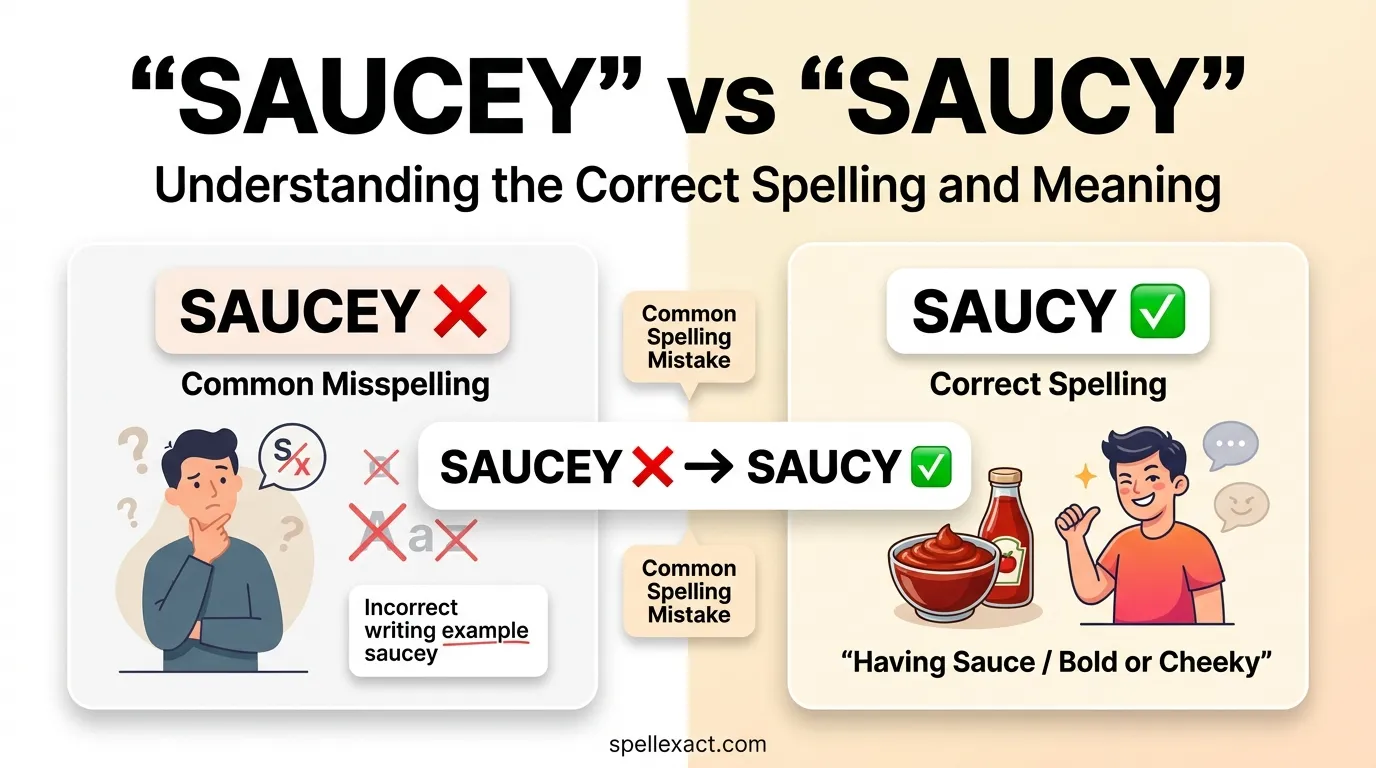
Have you ever typed “saucey” and paused before clicking publish, send, or submit? You are not alone. The confusion between saucey vs saucy is common because both spellings look reasonable, especially when you are thinking of the noun sauce.
The simple answer is that saucy is the standard and correct spelling in English. Saucey is generally considered a misspelling, although it may occasionally appear as a creative or informal brand name. This guide explains the difference, meaning, pronunciation, grammar rules, examples, and common mistakes so you can use the correct spelling with confidence.
Quick Answer:
Saucy is the correct standard English spelling.
- Correct: The pasta was rich and saucy.
- Correct: He made a saucy comment.
- Usually incorrect: The pasta was rich and saucey.
- Usually incorrect: She gave him a saucey reply.
The adjective saucy can describe something containing or covered in a lot of sauce. It can also describe a person or remark that is bold, cheeky, impertinent, or slightly provocative.
Is It Saucey or Saucy?
When choosing between saucey vs saucy, use saucy in standard English.
The confusion happens because saucy comes from the noun sauce, and many writers naturally assume that adding -y creates saucey. However, English spelling rules often change the final letters of a word when a suffix is added.
The standard adjective is:
sauce → saucy
The e is removed before adding -y, producing saucy rather than saucey.
This pattern is similar to:
- ice → icy
- spice → spicy
- juice → juicy
- noise → noisy
English spelling can sometimes feel inconsistent, but these common adjective forms follow familiar patterns.
What Does Saucy Mean?
The word saucy has more than one meaning, depending on the context.
1. Containing a Lot of Sauce
In food-related writing, saucy describes something with plenty of sauce or a noticeable sauce-like texture.
Examples:
- I prefer my pasta extra saucy.
- The chicken was tender and saucy.
- She made a rich, saucy tomato dish.
- Add more broth if you want the curry to become saucier.
In this meaning, synonyms may include sauce-covered, juicy, moist, rich, flavorful, or well-seasoned, depending on the food being described.
2. Bold, Cheeky, or Impudent
When describing a person’s behavior, saucy can mean cheeky, daring, disrespectful, or playfully bold.
Examples:
- The child gave his teacher a saucy answer.
- She had a saucy sense of humor.
- His saucy remark made everyone laugh.
- Don’t be too saucy with your grandmother.
The tone matters here. A saucy comment may be playful and amusing, or it may be considered rude.
3. Slightly Flirtatious or Provocative
In some contexts, saucy can describe clothing, humor, language, or behavior that is mildly provocative or flirtatious.
Examples:
- The magazine used a saucy headline.
- The comedy show had a few saucy jokes.
- She gave him a saucy smile.
This meaning is often informal and depends heavily on cultural context.
Saucey vs Saucy: Side-by-Side Comparison
| Feature | Saucey | Saucy |
| Standard English spelling | No | Yes |
| Dictionary adjective | Generally no | Yes |
| Common meaning | Usually a misspelling or creative name | Full of sauce; cheeky or provocative |
| Suitable for formal writing | No | Yes |
| Suitable for academic writing | No | Yes |
| Example | Incorrect: saucey pasta | Correct: saucy pasta |
| Brand or creative usage | Sometimes | Yes |
For everyday writing, schoolwork, professional communication, and SEO content, saucy is the spelling you should choose.
Why Is “Saucey” Incorrect?
The spelling saucey looks logical because the base word is sauce. However, English often drops a final silent e before adding a suffix beginning with a vowel-like sound or before forming certain adjective patterns.
With sauce + y, the standard form becomes:
sauce → saucy
The same spelling principle appears in several common words:
- ice → icy
- spice → spicy
- lace → lacy
- noise → noisy
This is why saucey is not the standard spelling.
A useful memory trick is this:
Spice becomes spicy, so sauce becomes saucy.
If you can remember spicy, it becomes easier to remember saucy.
Examples of Saucy in Sentences
Seeing the word in context is one of the best ways to remember its correct spelling.
Food Examples
- This recipe makes a thick and saucy barbecue chicken.
- I like my noodles hot and saucy.
- The restaurant serves a rich, saucy beef stew.
- Add the vegetables once the mixture becomes saucy.
- The meatballs were deliciously saucy.
Personality and Behavior Examples
- His saucy response surprised the audience.
- The comedian is known for her saucy humor.
- That was a saucy thing to say!
- She gave him a saucy look before walking away.
- The character has a confident and saucy personality.
These examples show that saucy is a versatile adjective used for both literal and figurative meanings.
Common Mistakes When Writing Saucy
Mistake 1: Adding “-ey” Because the Base Word Is Sauce
Many writers create saucey by simply attaching -y to sauce. This is understandable but incorrect in standard English.
Incorrect: The pizza was saucey.
Correct: The pizza was saucy.
Mistake 2: Confusing Saucy With Sauce
Sauce is primarily a noun, while saucy is an adjective.
Correct: Please pass the sauce.
Correct: The dish is very saucy.
The first sentence needs a thing, so sauce is correct. The second sentence describes the dish, so saucy is correct.
Mistake 3: Assuming Saucy Only Relates to Food
Although the food meaning is common, saucy can also describe attitude, humor, remarks, or behavior.
For example:
- a saucy joke
- a saucy reply
- a saucy personality
Understanding the context helps you choose the right meaning.
Mistake 4: Overusing Saucy in Formal Writing
While saucy is a perfectly correct word, its informal and playful tone may not fit every situation.
Instead of writing:
- The manager made a saucy statement.
A formal report might use:
- The manager made an inappropriate statement.
- The manager made a provocative remark.
Choose the word that best matches your audience and purpose.
Saucey vs Saucy: American and British English
There is no major spelling difference between American and British English in this case.
Both American English and British English use:
Saucy
Not:
Saucey
However, the word’s tone and frequency may vary depending on region and context. In British English, saucy has long been associated with cheeky, impertinent, or slightly provocative behavior. In American English, it can carry similar meanings while also being widely used to describe food with plenty of sauce.
So, regardless of whether you are writing for a US, UK, Canadian, Australian, or international audience, the standard spelling remains saucy.
How to Remember the Correct Spelling
If you regularly confuse saucey vs saucy, try these simple memory tricks.
Think of “Spicy”
You would not write spicey in standard English. The correct word is spicy.
The same pattern applies:
- spice → spicy
- sauce → saucy
Remember the Shorter Form
When adding -y, the silent e disappears:
SAUCE + Y → SAUCY
Use a Simple Sentence
Repeat this phrase:
“The sauce makes the dish saucy.”
Seeing sauce and saucy together can help you remember the relationship between the noun and adjective.
When Can “Saucey” Appear?
Although saucey is not the standard dictionary spelling, you may occasionally see it online. This can happen for several reasons.
First, it may simply be a spelling mistake.
Second, a business, product, username, restaurant, or creative project may intentionally use Saucey as part of its branding. Brand names do not always follow standard spelling conventions.
Third, some writers may use alternative spelling for style or visual impact.
However, creative or branded usage does not change the standard English rule. If you are writing an article, assignment, email, caption, product description, or professional document, saucy remains the safest and correct choice.
Frequently Asked Questions
1. Is saucey a real word?
Saucey is generally not considered the standard English spelling of the adjective. In normal writing, use saucy instead. However, Saucey may appear as a brand name, username, or intentional creative spelling.
2. Which is correct: saucey or saucy?
The correct standard spelling is saucy.
3. Why is saucy spelled without an e?
The final e in sauce is dropped when forming the adjective saucy. This follows a similar pattern to spice → spicy and ice → icy.
4. What does saucy mean in food?
When used for food, saucy means containing, covered in, or having plenty of sauce. For example: The pasta was rich and saucy.
5. What does a saucy person mean?
A saucy person is often cheeky, bold, playful, or slightly disrespectful. The exact meaning depends on tone and context.
6. Is saucy positive or negative?
It can be either. A saucy joke may be funny and playful, while a saucy response may be considered rude or disrespectful.
7. Is saucy used in American English?
Yes. Saucy is correct in American English and British English.
8. What are synonyms for saucy?
Depending on the meaning, synonyms include cheeky, bold, impertinent, playful, provocative, spicy, flavorful, and richly sauced.
Final Thoughts
The answer to saucey vs saucy is straightforward: saucy is the correct standard English spelling. Whether you are describing a delicious pasta dish, a bold comment, a cheeky personality, or playful humor, saucy is the form you should use in standard writing.
The confusion is understandable because the adjective comes from the noun sauce. However, English spelling changes the word to saucy, dropping the final e before adding -y. Remember the similar pattern spice → spicy, and the correct spelling becomes much easier to recall.
Actionable Takeaway
Before publishing or sending your writing, replace “saucey” with “saucy” unless you are intentionally referring to a brand, username, or creative name. A quick proofreading check can prevent this common spelling mistake and make your writing look more polished.
For an easy memory rule, remember: If spice becomes spicy, sauce becomes saucy. Use that simple comparison whenever you hesitate between saucey and saucy.

Aaron Adam is the Administrator of SpellExact, dedicated to helping readers improve their spelling and writing accuracy. He oversees content quality, ensures reliable language resources, and works to make spelling guidance simple, practical, and accessible for everyone.