Have you ever written 13rd and wondered whether it looks right? You’re not alone. Ordinal numbers can be confusing, especially because numbers such as 1st, 2nd, and 3rd use different endings. When you reach 13, it can feel natural to write “13rd”—but English has a special rule that changes the ending.
The correct form is 13th, not 13rd. If you’re writing a birthday invitation, a date, an academic paper, an address, or a formal document, understanding why “13th” is correct can help you avoid a common spelling and grammar mistake.
Quick Answer:
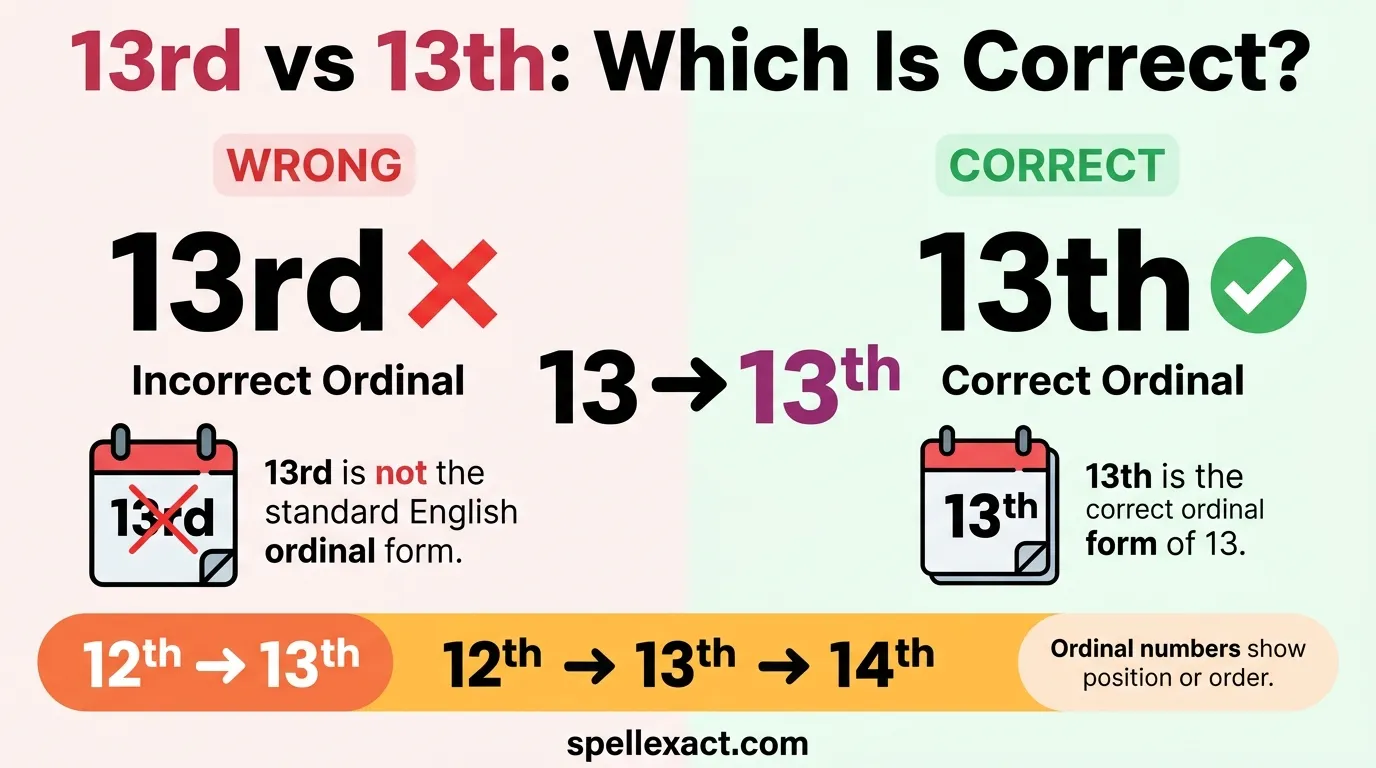
13th is correct. 13rd is incorrect in standard English.
- ✅ 13th — correct ordinal form
- ❌ 13rd — incorrect ordinal form
- 13th is pronounced “thirteenth.”
- The same rule applies to 13, 113, 213, 1,013, and other numbers ending in 13.
For example:
Today is my 13th birthday.
Not:
Today is my 13rd birthday.
What Does 13th Mean?
13th is the ordinal form of the number 13. Ordinal numbers indicate position, order, rank, or sequence rather than quantity.
For example:
- 12 = twelve → cardinal number
- 13 = thirteen → cardinal number
- 12th = twelfth → ordinal number
- 13th = thirteenth → ordinal number
- 14th = fourteenth → ordinal number
When you say someone finished in 13th place, you’re describing their position in a sequence.
Similarly, the 13th day of the month means the day that comes after the 12th and before the 14th.
Why Is 13th Correct Instead of 13rd?
The confusion usually comes from the general ordinal-number pattern.
Many numbers ending in 1 use -st:
- 1st
- 21st
- 31st
- 41st
Numbers ending in 2 commonly use -nd:
- 2nd
- 22nd
- 32nd
- 42nd
Numbers ending in 3 commonly use -rd:
- 3rd
- 23rd
- 33rd
- 43rd
However, there is an important exception.
The “Teen” Exception
Numbers from 11 through 13 do not follow the simple last-digit rule.
They are:
- 11th — eleventh
- 12th — twelfth
- 13th — thirteenth
So although 3rd is correct, 13rd is not.
The reason is that 11th, 12th, and 13th belong to the special “teen” group. The ending is determined by the entire number, not simply its final digit.
This is one of the most useful rules to remember when writing ordinal numbers.
13rd vs 13th Comparison Table
| Form | Correct? | Pronunciation | Usage |
| 13rd | ❌ No | — | Incorrect ordinal form |
| 13th | ✅ Yes | thirteenth | Standard English |
| 3rd | ✅ Yes | third | Correct |
| 23rd | ✅ Yes | twenty-third | Correct |
| 113th | ✅ Yes | one hundred thirteenth | Correct |
The important point is that 13th is treated like 11th and 12th, even though the number ends in 3.
Examples of 13th in a Sentence
Seeing the correct form in everyday sentences makes the rule easier to remember.
Dates
- My appointment is on June 13th.
- The event will take place on September 13th.
- We moved into our new home on the 13th of May.
Birthdays
- She celebrated her 13th birthday with her friends.
- My son will turn 13 on his 13th birthday.
- His 13th birthday party is next weekend.
School and Education
- She finished 13th in her class.
- The student completed the 13th chapter of the book.
- Turn to the 13th page of your workbook.
Rankings and Positions
- Our team finished 13th in the competition.
- He came in 13th place.
- The runner crossed the finish line in 13th position.
Chapters, Floors, and Sections
- Read the 13th chapter before tomorrow’s lesson.
- Their office is on the 13th floor.
- The answer can be found in the 13th section.
Why “13rd” Is a Common Mistake
The mistake 13rd happens because English learners often learn the basic ordinal-number pattern first:
1 → st, 2 → nd, 3 → rd
That pattern works for many numbers, but it has exceptions. If you apply it mechanically to 13, you may naturally produce 13rd.
For example, someone may think:
3 → 3rd
13 → 13rd
But English does not work that way.
The correct pattern is:
3rd → third
13th → thirteenth
The pronunciation itself can also help. We say “thirteenth,” not “thirdteenth” or anything resembling “thirrd.” The spelling 13th matches the standard ordinal form.
The Easy Rule for Remembering 13th
Here’s a simple trick:
When a number ends in 11, 12, or 13, use -th.
Examples:
- 11th
- 12th
- 13th
- 111th
- 112th
- 113th
- 1,111th
- 1,112th
- 1,113th
Notice that 113th is also correct, even though the number ends in 3.
This leads to an important detail: you need to look at the final two digits, not just the final digit.
For example:
- 23rd ✅
- 33rd ✅
- 43rd ✅
- 113th ✅
- 213th ✅
So 113rd would be incorrect.
Ordinal Number Rules: A Quick Guide
For most numbers, these endings are useful:
- Numbers ending in 1 → -st
- Numbers ending in 2 → -nd
- Numbers ending in 3 → -rd
- Most other numbers → -th
But there is a special exception for 11, 12, and 13.
| Number | Ordinal | Correct Ending |
| 1 | 1st | -st |
| 2 | 2nd | -nd |
| 3 | 3rd | -rd |
| 4 | 4th | -th |
| 10 | 10th | -th |
| 11 | 11th | -th |
| 12 | 12th | -th |
| 13 | 13th | -th |
| 14 | 14th | -th |
| 21 | 21st | -st |
| 22 | 22nd | -nd |
| 23 | 23rd | -rd |
This table shows exactly why 13th is correct while 23rd is correct.
Is 13th Used in American and British English?
Yes. 13th is correct in both American English and British English. There is no spelling difference between the two varieties for this ordinal number.
The main difference you may notice is how dates are commonly expressed.
American English often uses the month first:
- June 13th
- June 13
British English commonly places the day before the month:
- 13th June
- 13 June
Both forms are standard within their respective conventions.
In formal writing, many style guides prefer writing dates without ordinal endings:
- June 13, 2026 — common in American English
- 13 June 2026 — common in British English
However, when the number is functioning as an ordinal in a phrase, 13th remains correct:
- 13th birthday
- 13th anniversary
- 13th chapter
- 13th position
13th vs Thirteenth: Which Should You Use?
13th and thirteenth represent the same ordinal number, but they are used differently depending on the writing situation.
Use 13th when you want a concise numerical form:
- My 13th birthday is coming soon.
- She finished 13th.
- Read the 13th chapter.
Use thirteenth when numbers are normally written as words or when a more formal literary style is appropriate:
- She celebrated her thirteenth birthday.
- He finished in thirteenth place.
- This is the thirteenth chapter.
For formal writing, always follow the style requirements of the document or publication you are writing for.
Common Mistakes to Avoid
Mistake 1: Writing 13rd
❌ My 13rd birthday is tomorrow.
✅ My 13th birthday is tomorrow.
Mistake 2: Assuming Every Number Ending in 3 Uses -rd
❌ 113rd
✅ 113th
The final two digits are 13, so the number follows the “teen” rule.
Mistake 3: Confusing 3rd With 13th
3rd means third.
13th means thirteenth.
Adding “1” before 3 changes the ordinal ending.
Mistake 4: Using Ordinal Forms Unnecessarily in Dates
Depending on your preferred style, you may see:
- July 13, 2026
- 13 July 2026
rather than:
- July 13th, 2026
- 13th July 2026
The latter forms are not inherently confusing, but formal date conventions often omit the ordinal suffix.
How to Remember 13th Forever
If you regularly make this spelling mistake, remember one short sentence:
11, 12, and 13 always take -th.
That gives you:
11th → 12th → 13th
After that, the normal pattern resumes:
14th → 15th → 16th → 17th → 18th → 19th
Then:
21st → 22nd → 23rd
This small pattern is enough to prevent most ordinal-number mistakes.
Frequently Asked Questions
Is 13rd correct?
No. 13rd is incorrect in standard English. The correct ordinal form is 13th, pronounced “thirteenth.”
Why is 13th spelled with th?
Because 13 belongs to the special ordinal group of 11th, 12th, and 13th. These numbers use -th, regardless of their final digits.
Is 13th or thirteenth correct?
Both are correct. 13th is the abbreviated numerical form, while thirteenth is the fully spelled-out form.
Is 13th correct in American English?
Yes. 13th is standard in American English. In dates, American style often writes June 13 without the ordinal suffix.
Is 13th correct in British English?
Yes. British English also uses 13th. Dates are commonly written 13 June, especially in formal contexts.
What is the correct ordinal of 113?
The correct form is 113th, not 113rd. The final two digits are 13, so the “13th” rule applies.
How do you write 13th in words?
The word form of 13th is thirteenth.
What is the difference between 3rd and 13th?
3rd means third, while 13th means thirteenth. Although both numbers end in 3, 13 is part of the special 11–13 group and therefore uses -th.
Final Summary
When comparing 13rd vs 13th, there is no real contest: 13th is the correct form, while 13rd is a common ordinal-number mistake. The correct word is thirteenth, and the abbreviation is 13th. This form is used for positions, birthdays, anniversaries, chapters, floors, rankings, and many other situations involving order.
The key rule is simple: 11th, 12th, and 13th always use -th. When dealing with larger numbers, check the final two digits before choosing the ordinal ending. Remembering this rule will help you correctly write forms such as 113th and 213th, too.
Actionable Takeaway
Before writing an ordinal number ending in 1, 2, or 3, check the last two digits. If they are 11, 12, or 13, use -th.
Remember: 13 → 13th → thirteenth. Never 13rd.

Andrew Anthony is a language enthusiast and content writer specializing in spelling mistakes, grammar, and English usage. He creates clear, practical, and well-researched guides that help readers improve their writing skills with confidence.