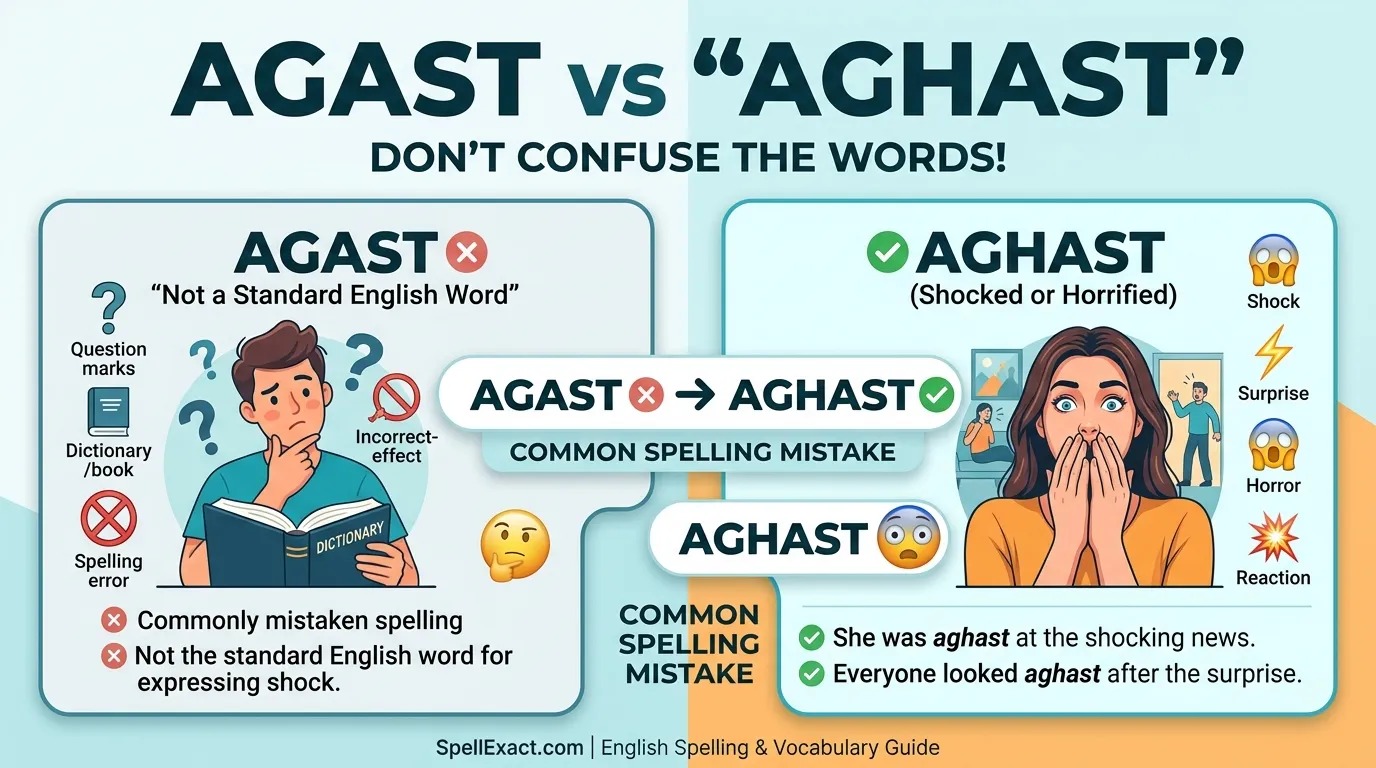
If you are wondering about agast vs aghast, you are not alone. These two words look and sound similar, but only one is a standard English word in modern usage: aghast. It is commonly used to describe someone who feels shocked, horrified, or deeply surprised by something unexpected.
The spelling agast is usually a misspelling of aghast, although historical and obsolete forms have existed in English. Understanding the difference can help you avoid a common spelling mistake and use the correct word confidently in writing, emails, stories, and everyday communication.
Quick Answer:
Aghast is the correct and standard English spelling when you mean shocked, horrified, appalled, or filled with sudden surprise.
- Correct: She was aghast at the terrible news.
- Incorrect in modern standard English: She was agast at the terrible news.
In short, if you mean someone is extremely shocked or horrified, use aghast.
What Does Aghast Mean?
The adjective aghast means filled with horror, shock, alarm, or overwhelming surprise. It often describes a person’s emotional reaction when they see, hear, or experience something disturbing or unexpected.
Simple definition
Aghast = extremely shocked or horrified
For example:
- Everyone was aghast when they heard the announcement.
- I was aghast at the amount of damage.
- She looked aghast after reading the message.
- The audience was aghast at what happened next.
The word usually suggests a stronger reaction than ordinary surprise. If you are merely surprised, you may not necessarily be aghast. However, if you are shocked, horrified, or deeply disturbed, aghast may be the perfect word.
Is Agast a Correct Word?
In modern English, agast is generally not the preferred or standard spelling. Most people who write agast when they mean shocked or horrified have simply misspelled aghast.
The confusion is understandable because English spelling does not always match pronunciation. The letters gh in aghast can make the word look unusual, encouraging writers to remove them and spell the word as agast.
However, modern dictionaries and standard writing generally use:
Aghast
Historical forms related to agast may appear in older English texts, but they should not normally be used in contemporary writing unless you are deliberately quoting or discussing historical language.
Agast vs Aghast: Key Differences
| Feature | Agast | Aghast |
| Modern standard spelling | No | Yes |
| Meaning in modern everyday English | Usually treated as a misspelling | Shocked or horrified |
| Recommended for formal writing | No | Yes |
| Common in historical or obsolete language | May appear in older forms | Yes, modern standard form |
| Example | Usually incorrect today | “She was aghast at the news.” |
The easiest rule to remember is simple: Use aghast, not agast, when describing someone who is shocked or horrified.
Why Do People Misspell Aghast as Agast?
The most obvious reason is pronunciation. When spoken, the gh in aghast is not pronounced like a hard “g” sound. As a result, people may assume the word should be written phonetically as agast.
Another reason is that English contains many confusing gh spellings. Compare words such as:
- ghost
- enough
- though
- through
- laugh
- night
The letters gh behave differently across English words, which makes spelling difficult even for experienced writers.
A useful memory trick is to think of aghast as a word containing an extra visual reminder of shock: A-GH-AST. When in doubt, remember that the standard spelling includes gh.
How to Use Aghast in a Sentence
Seeing a word in context is often the best way to understand how it works. Here are several examples of aghast in natural sentences.
Everyday examples
- I was aghast when I saw the final bill.
- She stood aghast, unable to say a word.
- His parents were aghast at his behavior.
- We were aghast to discover that the documents had disappeared.
- The community was aghast after the shocking incident.
Formal writing examples
- Officials were aghast at the scale of the destruction.
- The researchers were aghast to discover an unexpected error in the data.
- The public was aghast by the details of the report.
Storytelling examples
- Maria stared at the empty room, aghast at what she had discovered.
- He stepped backward, aghast and speechless.
- To her utter amazement, the crowd remained aghast in silence.
In most cases, aghast works particularly well when describing a strong emotional reaction.
Common Phrases Used With Aghast
Although aghast can stand alone, it often appears with certain words and phrases.
Aghast at
This is one of the most common constructions.
- She was aghast at the price.
- They were aghast at his decision.
Aghast by
This structure is also used.
- The viewers were aghast by what they saw.
- He was aghast by the sudden revelation.
Aghast to discover, learn, or find
This construction emphasizes a shocking discovery.
- She was aghast to discover the truth.
- We were aghast to learn what had happened.
- He was aghast to find the door unlocked.
Utterly aghast
The adverb utterly intensifies the feeling.
- I was utterly aghast.
- The family was utterly aghast at the news.
These combinations can make your writing sound more expressive, especially in narratives, journalism, and descriptive writing.
Common Mistakes With Agast and Aghast
Mistake 1: Writing “agast” in modern English
Incorrect: I was agast when I heard the news.
Correct: I was aghast when I heard the news.
If your intended meaning is shocked or horrified, aghast is the correct spelling.
Mistake 2: Confusing aghast with amazed
Although these words can both describe strong reactions, their meanings are different.
Amazed usually suggests surprise or wonder, often positive.
- She was amazed by the beautiful view.
Aghast suggests shock, horror, or alarm.
- She was aghast at the terrible scene.
Someone can be amazed by a magic trick but aghast at a disaster.
Mistake 3: Using aghast for mild surprise
Aghast is a strong word. It is not usually the best choice for a small or pleasant surprise.
For mild surprise, consider:
- surprised
- startled
- amazed
- astonished
For stronger negative reactions, consider:
- aghast
- horrified
- appalled
- shocked
- dismayed
Mistake 4: Forgetting that aghast is an adjective
Aghast describes a person’s emotional state.
- Correct: She was aghast.
- Correct: The witnesses looked aghast.
It is not commonly used as a noun or regular verb in modern English.
Aghast Synonyms and Related Words
Choosing the right synonym depends on the exact feeling you want to express.
Shocked
A broad and common word for sudden surprise.
- I was shocked by the news.
Horrified
Stronger than ordinary surprise and closely related to aghast.
- They were horrified by the accident.
Appalled
Suggests strong shock, disgust, or disapproval.
- She was appalled by his behavior.
Astonished
Means greatly surprised, often without the sense of horror.
- We were astonished by the result.
Dismayed
Suggests disappointment, worry, or distress.
- He was dismayed by the decision.
Stunned
Suggests being temporarily unable to react because of shock.
- The audience was stunned into silence.
These related terms can improve your vocabulary and help you avoid repeating the same word in every sentence.
Agast vs Aghast in American and British English
There is no important American vs British English spelling difference in this case. Both American English and British English use aghast as the standard modern spelling.
So whether you are writing for readers in the United States, the United Kingdom, Canada, Australia, or other English-speaking regions, you can confidently write:
Aghast
This differs from words such as color/colour, organize/organise, or center/centre, where regional spelling conventions may vary.
For agast vs aghast, the modern standard answer remains the same: aghast is the correct spelling for the adjective meaning shocked or horrified.
How to Remember the Correct Spelling of Aghast
If you repeatedly write agast, try one of these simple memory tricks.
Remember the “gh”
Think of the word as:
A + GH + AST
The gh is part of the standard spelling and should not be removed.
Connect aghast with “gasp”
When someone is extremely shocked, they may gasp. Both words begin with a strong “ag” sound, which can help you remember aghast as a word connected with a dramatic reaction.
Learn it through a sentence
Create a sentence such as:
“I was aghast at the ghastly news.”
The similar visual pattern in aghast and ghastly can help reinforce the spelling.
Frequently Asked Questions
Is agast a word?
Agast may appear as a historical or obsolete spelling in older English contexts, but it is generally not the standard spelling used in modern English. Today, use aghast when you mean shocked or horrified.
Which is correct: agast or aghast?
For modern standard English, aghast is correct. Agast is usually a misspelling.
What does aghast mean?
Aghast means extremely shocked, horrified, alarmed, or appalled by something unexpected or disturbing.
How do you use aghast in a sentence?
You can write: “She was aghast at the news.” You can also say: “They were aghast to discover what had happened.”
Is aghast a positive or negative word?
Aghast usually has a negative meaning because it suggests shock, horror, alarm, or strong disapproval.
Is aghast the same as shocked?
They are similar, but aghast usually expresses a stronger and more dramatic reaction. Someone who is aghast may be shocked, horrified, or almost speechless.
Can I use aghast in formal writing?
Yes. Aghast is suitable for formal writing, journalism, essays, and creative writing when its strong meaning fits the context.
Does British English spell aghast differently?
No. Both British and American English use aghast as the standard spelling.
Summary:
The difference between agast vs aghast is straightforward in modern English. Aghast is the correct standard spelling and describes someone who is extremely shocked, horrified, alarmed, or appalled. Agast is generally considered a misspelling in contemporary writing, although related historical forms may occasionally appear in older texts.
The best actionable takeaway is simple: whenever you mean “shocked or horrified,” write aghast with GH. Before publishing or sending important writing, quickly check for agast and correct it to aghast. Learning this small spelling distinction will make your writing more accurate, polished, and confident.

Liam Noah is a passionate language writer at SpellExact, specializing in spelling mistakes, grammar, word confusion, and American vs. British English. He creates clear, practical content that helps readers write and communicate with confidence.