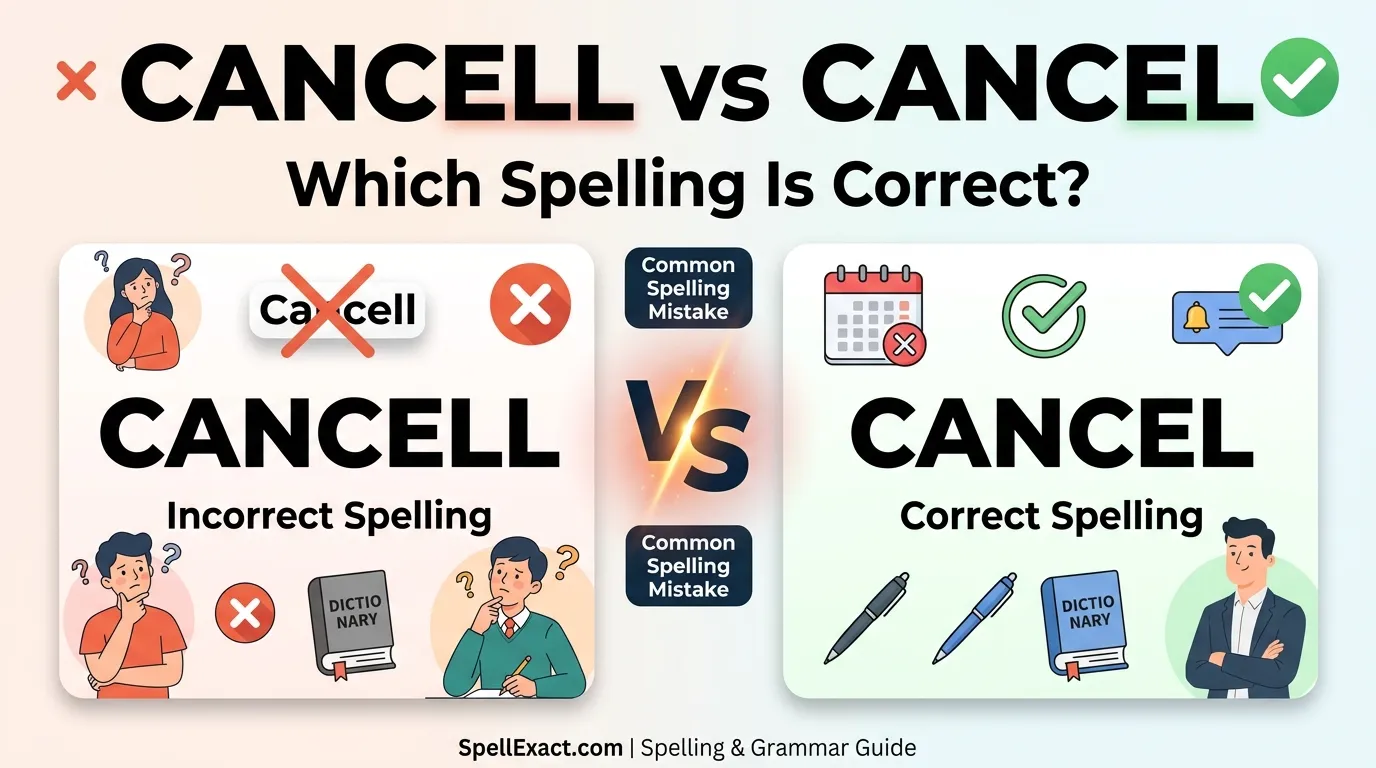
Have you ever typed “cancell” and wondered whether it is an alternative spelling of “cancel”? You are not alone. This is a common spelling mistake, especially because related words such as cancelled and cancelling often contain double l in British English.
The simple answer is that cancel is the correct spelling, while cancell is generally a misspelling. However, the spelling rules become slightly more interesting when we look at forms such as canceled, cancelled, canceling, and cancelling. This guide explains everything clearly, with examples, grammar tips, common mistakes, and American vs British English differences.
Quick Answer:
Cancel is the correct spelling.
Cancell is incorrect in standard English and should not normally be used.
- Correct: I need to cancel my appointment.
- Incorrect: I need to cancell my appointment.
The confusion often comes from other forms of the word:
- American English: canceled, canceling
- British English: cancelled, cancelling
So, while some forms may use a double l, the base verb is always spelled cancel with one l.
What Does “Cancel” Mean?
Cancel is a verb that means to decide that something planned, arranged, ordered, or scheduled will no longer happen or continue.
For example:
- The airline had to cancel the flight.
- Please cancel my subscription.
- She decided to cancel the meeting.
- We may cancel our reservation because of the weather.
The word can also function as a noun in some contexts, although the verb is far more common.
Related meanings and phrases include:
- call off
- discontinue
- terminate
- revoke
- withdraw
- stop
- annul
- invalidate
The best synonym depends on the situation. For example, you might cancel a meeting, terminate a contract, or revoke permission.
Is “Cancell” Ever Correct?
In standard modern English, cancell is not the correct spelling of the verb cancel.
If you are writing an email, school assignment, blog post, business message, social media caption, or formal document, use cancel, not cancell.
Correct examples
- I want to cancel my order.
- They decided to cancel the event.
- Can you cancel my appointment?
- The company may cancel the service.
Incorrect examples
- I want to cancell my order.
- They decided to cancell the event.
- Can you cancell my appointment?
A spelling checker may catch this mistake, but understanding the rule can help you avoid it before pressing send.
Cancell vs Cancel: Side-by-Side Comparison
| Feature | Cancell | Cancel |
| Standard English spelling | Incorrect | Correct |
| Used as the base verb | No | Yes |
| Suitable for formal writing | No | Yes |
| Example | I want to cancell my booking. ❌ | I want to cancel my booking. ✅ |
| Dictionary-standard spelling | No | Yes |
The most important rule is easy to remember: the base word is always cancel, with one l at the end.
Why Do People Write “Cancell”?
The misspelling cancell usually happens because English spelling changes when suffixes are added.
People may see words such as:
- cancelled
- cancelling
and incorrectly assume that the base word must be cancell.
But that is not how the word works.
The base form remains:
cancel
Then spelling conventions determine whether the final l is doubled before certain suffixes.
This creates a pattern that can be confusing:
- cancel → cancelled
- cancel → cancelling
However, these double-l forms are primarily associated with British English conventions.
Cancelled vs Canceled: American and British English
This is where the difference between American and British English becomes important.
British English
British English generally doubles the final l when adding certain suffixes:
- cancel → cancelled
- cancel → cancelling
Examples:
- The concert was cancelled due to heavy rain.
- They are cancelling tomorrow’s meeting.
American English
American English commonly uses a single l in these forms:
- cancel → canceled
- cancel → canceling
Examples:
- The concert was canceled due to heavy rain.
- They are canceling tomorrow’s meeting.
Both styles are widely recognized, but consistency matters. If you are writing primarily for a US audience, canceled and canceling are generally preferred. For British and many other international English audiences, cancelled and cancelling are common.
Importantly, this difference does not change the spelling of the base word.
It is always:
cancel
Never cancell.
Examples of Cancel in Everyday Sentences
Seeing a word in context is one of the best ways to remember its correct spelling.
Appointments
- I need to cancel my doctor’s appointment.
- Please cancel my booking for Friday.
- She forgot to cancel the reservation.
Travel
- The airline had to cancel several flights.
- We may cancel our trip if the weather gets worse.
- You can cancel the ticket online.
Business and Work
- The manager decided to cancel the meeting.
- We cannot cancel the contract without notice.
- Please cancel the previous request.
Subscriptions and Orders
- I want to cancel my membership.
- You can cancel your subscription at any time.
- He contacted customer service to cancel the order.
These examples show that cancel is useful in many everyday situations, from travel plans to online subscriptions.
Common Mistakes Related to Cancel
1. Writing “Cancell”
This is the most direct mistake.
- ❌ I want to cancell my account.
- ✅ I want to cancel my account.
2. Using “Cancelled” and “Canceled” Randomly
Both spellings can be correct, but they represent different regional conventions.
For example, avoid switching styles in the same article:
- The event was cancelled, and the organizers are canceling future events. ⚠️
A consistent British English version would be:
- The event was cancelled, and the organizers are cancelling future events. ✅
A consistent American English version would be:
- The event was canceled, and the organizers are canceling future events. ✅
3. Assuming Double “L” Applies to the Base Word
This is the mistake behind cancell.
Remember:
- cancel = base form
- cancelled/cancelling = British English forms
- canceled/canceling = American English forms
The extra l does not change the original base spelling.
4. Confusing Cancel With Related Words
Some writers may confuse cancel with words such as:
- cease
- quit
- postpone
- terminate
- withdraw
These words have different meanings.
For example:
- Cancel means an event or arrangement will not happen.
- Postpone means moving it to a later time.
- Terminate usually means officially ending something.
- Withdraw means taking back something previously offered or submitted.
If a meeting is moved from Monday to Friday, it has been postponed, not necessarily cancelled.
How to Remember the Correct Spelling
A simple memory trick is:
Cancel has one l, but cancelled may have two.
Think of cancel as the starting point. The word begins with can and ends with cel:
can + cel = cancel
Another useful reminder is to focus on the base verb first:
- cancel
- cancel the order
- cancel the appointment
- cancel the subscription
The more often you see and use the correct form in complete sentences, the easier it becomes to recognize that cancell looks unusual.
Is “Cancel” a Verb or a Noun?
Cancel is most commonly used as a verb.
As a verb
- I need to cancel the meeting.
- They may cancel the event.
It describes the action of stopping something planned or arranged.
As a noun
The noun form is less common in everyday English. In some contexts, cancel can refer to a cancellation mark or an act of cancellation, particularly in specialized usage.
However, in ordinary conversation and writing, people are more likely to use the noun cancellation.
For example:
- We received confirmation of the cancellation.
- There was no fee for the cancellation.
This gives us several useful word forms:
- cancel
- canceled/cancelled
- canceling/cancelling
- cancellation
Related Word: Cancellation
The noun cancellation refers to the act of cancelling something or the fact that something has been cancelled.
Examples:
- The airline announced the cancellation of the flight.
- We received an email confirming the cancellation.
- The sudden cancellation disappointed the audience.
Notice that cancellation contains a double l. This is another reason people sometimes mistakenly write the base verb as cancell.
But again, the spelling pattern is:
cancel → cancellation
The correct base form remains cancel.
Frequently Asked Questions
Is cancell or cancel correct?
Cancel is correct. Cancell is a misspelling in standard English.
Why does cancelled have two l’s but cancel has one?
The extra l appears in certain derived forms according to spelling conventions, especially in British English. The original base verb remains cancel.
Is canceled or cancelled correct?
Both can be correct. Canceled is generally preferred in American English, while cancelled is generally preferred in British English.
Is canceling or cancelling correct?
Both are accepted regional spellings. Canceling is common in American English, while cancelling is common in British English.
How do you spell “cancel my subscription”?
The correct sentence is: I want to cancel my subscription.
Is “cancell” correct in British English?
No. Even in British English, the base word is cancel, not cancell. British English may use cancelled and cancelling, but the base form still has one l.
What is the noun form of cancel?
The most common noun form is cancellation.
Example: The cancellation of the event was announced this morning.
What is the difference between cancel and postpone?
Cancel means something will not happen or continue as planned. Postpone means moving something to a later time or date.
Final Summary:
The correct spelling is cancel, while cancell is a common spelling mistake. If you are cancelling an appointment, canceling a subscription, or writing about a canceled event, the base form always stays the same: cancel.
The main point of confusion comes from American and British spelling differences. American English commonly uses canceled and canceling, while British English commonly uses cancelled and cancelling. Whichever style you choose, stay consistent and remember that cancell is not the standard spelling.
Actionable takeaway:
When in doubt, write cancel for the base verb. Then choose canceled/canceling for American English or cancelled/cancelling for British English, depending on your audience.

Caleb Carter is a passionate language enthusiast and content writer specializing in spelling mistakes, grammar, and vocabulary. He creates clear, practical guides that help readers improve their writing skills and communicate confidently every day.