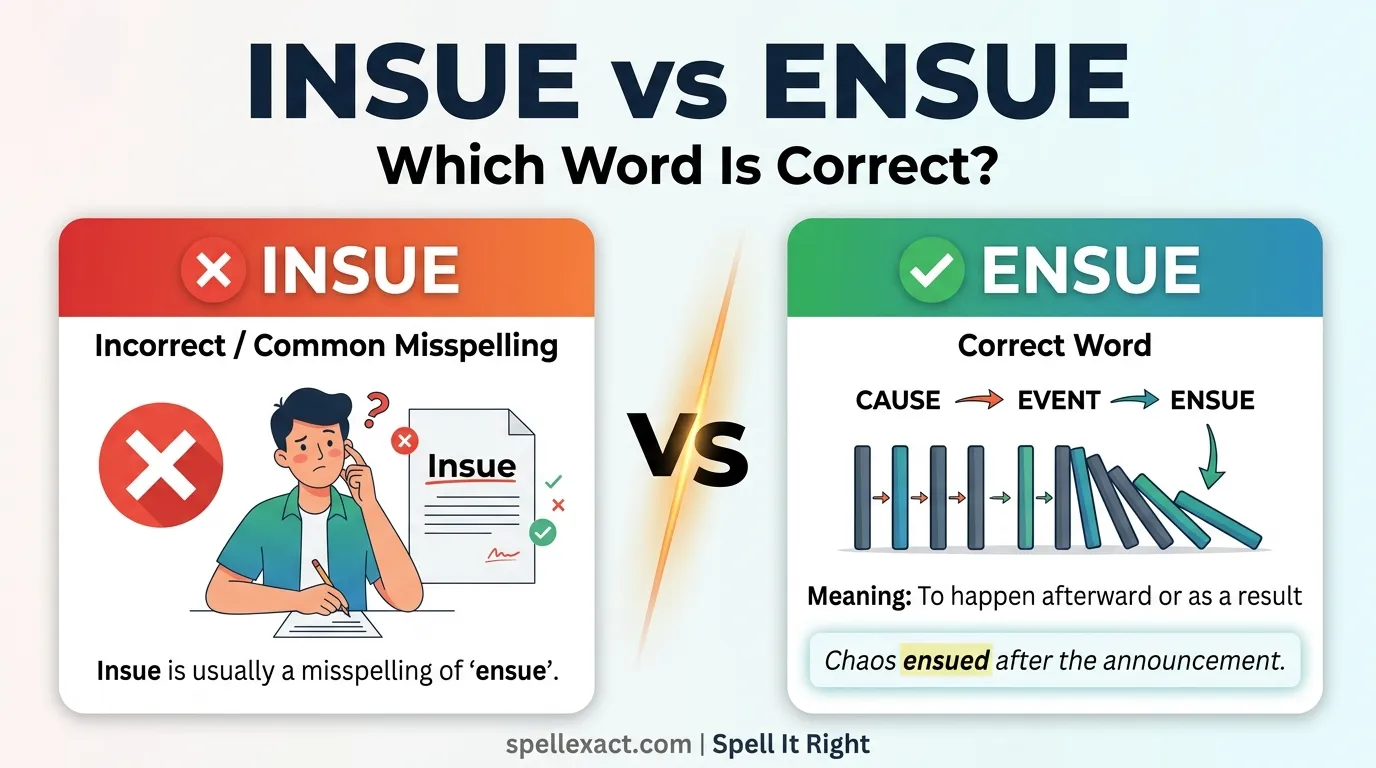
If you are wondering whether to write insue or ensue, the quick answer is simple: ensue is the correct English word, while insue is generally a misspelling. Because the two words look and sound somewhat similar, many writers accidentally type insue when they mean ensue.
Understanding the difference between insue vs ensue can help you avoid a common spelling mistake and communicate more clearly. In this guide, you will learn the meaning of ensue, see practical examples, discover common errors, and understand how to use the word confidently in both American and British English.
Quick Answer:
- Ensue is the correct spelling.
- Insue is generally an incorrect spelling of ensue.
- Ensue means to happen afterward as a result of something, often describing events or consequences that follow.
- Example: A heated debate ensued after the announcement.
In short, if you mean “to happen next” or “to follow as a consequence,” use ensue.
Insue vs Ensue: What Is the Difference?
The main difference is straightforward: ensue is a standard English verb, while insue is not the correct spelling in modern English when referring to something that follows or happens afterward.
| Word | Correct Spelling? | Meaning | Example |
| Ensue | Yes | To happen or follow afterward | Confusion ensued after the changes. |
| Insue | No | Usually a misspelling of ensue | Incorrect: A problem insued. |
Although insue may appear in search queries because people frequently misspell ensue, it should not normally be used in formal, academic, professional, or everyday writing.
What Does Ensue Mean?
Ensue means to happen afterward, to follow, or to occur as a result of something that happened before.
The word is often used when one event leads to another. It can describe a direct consequence, a sequence of events, or a situation that develops after an earlier action.
For example:
- A long silence ensued after her question.
- Heavy rain caused flooding, and widespread disruption ensued.
- When the referee made the decision, an argument ensued.
- Several technical problems ensued during the presentation.
In each example, something happens first, and another event follows. That second event ensues.
How to Use Ensue Correctly
The verb ensue is commonly used in both formal and general writing. You may see it in news reports, literature, legal writing, academic articles, and everyday descriptions.
Here are several common sentence patterns.
Something Ensues
This structure simply states that an event follows.
- Chaos ensued.
- Laughter ensued.
- Confusion ensued.
- A brief discussion ensued.
This is one of the most natural ways to use the word.
Something Ensues After Another Event
You can also explain what happened first and what followed.
- After the announcement, a lively discussion ensued.
- The alarm sounded, and panic ensued.
- The meeting ended, but further disagreement ensued.
Something Ensues From a Cause
In some contexts, ensue can emphasize the result or consequence of an earlier event.
- The damage that ensued from the storm was extensive.
- The confusion that ensued from the new policy delayed the project.
- The conflict that ensued affected the entire community.
These examples show why follow, occur, result, develop, and happen afterward are useful related words when learning the meaning of ensue.
Why Do People Misspell Ensue as Insue?
The misspelling insue may happen for several reasons.
First, English spelling does not always match pronunciation perfectly. A writer may hear the sound of ensue and incorrectly assume that it begins with in- rather than en-.
Second, many English words begin with the prefix in-, such as include, increase, inform, and insecure. This can make insue look believable even though it is incorrect in this context.
Another reason is simple typing error. When writing quickly, people may accidentally replace the e in ensue with an i.
A helpful memory trick is:
En in ensue = remember that something ensues or follows next.
You can also remember the phrase “what ensued next?” This natural expression reinforces the correct spelling.
Insue vs Ensue: Common Mistakes to Avoid
Knowing the correct spelling is useful, but understanding common mistakes can help you avoid them permanently.
Mistake 1: Writing “Insue” Instead of “Ensue”
Incorrect:
- An argument insued after the meeting.
Correct:
- An argument ensued after the meeting.
Because argument happened after the meeting, ensued is the appropriate verb.
Mistake 2: Confusing Ensue With Ensure
Ensue and ensure are completely different words.
- Ensue = to happen afterward or follow.
- Ensure = to make certain that something happens.
Examples:
- A disagreement ensued after the announcement.
- Please ensure that the door is locked.
The words may look similar, but their meanings are very different.
Mistake 3: Using Ensue When You Mean Result In
The grammar can sometimes become awkward when writers use ensue in the wrong structure.
Less natural:
- The decision ensued a major problem.
Better:
- A major problem ensued after the decision.
- The decision resulted in a major problem.
Generally, ensue describes what happens afterward rather than functioning exactly like cause or result in.
Mistake 4: Forgetting the Correct Past Tense
The past tense of ensue is ensued, not ensueded or another variation.
Correct forms include:
- Present: ensue
- Present third person: ensues
- Present participle: ensuing
- Past tense: ensued
- Past participle: ensued
Examples:
- Problems may ensue.
- A disagreement ensues.
- The ensuing discussion lasted an hour.
- Confusion ensued.
Ensue vs Ensure: A Helpful Comparison
Because ensue and ensure are frequently confused, this comparison can make the distinction clearer.
| Word | Meaning | Example |
| Ensue | To happen afterward; to follow | A debate ensued after the speech. |
| Ensure | To make certain; to guarantee | Please ensure that all details are correct. |
A quick way to remember the difference is:
- Ensue = happen next
- Ensure = make sure
These two words serve different grammatical and semantic purposes, so they should not be used interchangeably.
Is Ensue Used in American and British English?
Yes. Ensue is spelled the same way and has the same meaning in both American English and British English.
There is no standard spelling difference such as ensue vs insue between the United States and the United Kingdom.
This makes the word easier to use internationally:
- American English: Confusion ensued.
- British English: Confusion ensued.
The spelling remains ensue in both varieties of English.
However, writers should remember that style preferences may differ in other areas of vocabulary and spelling. For example, American English often uses color, while British English uses colour. With ensue, though, there is no such distinction.
Examples of Ensue in Everyday Sentences
Seeing a word in context is often the best way to understand and remember it.
Here are some practical examples:
- If the instructions are unclear, confusion may ensue.
- A short period of silence ensued.
- The announcement was followed by applause, and a celebration ensued.
- When the internet connection failed, several problems ensued.
- Nobody expected the chaos that ensued.
- The disagreement quickly ensued into a broader discussion.
For the final example, a more natural phrasing would usually be:
- The disagreement quickly developed into a broader discussion.
- A broader discussion ensued after the disagreement.
This demonstrates an important point: knowing a word’s meaning is helpful, but learning its natural sentence patterns is equally important.
Related Words and Synonyms for Ensue
Depending on the context, several words and phrases can express a similar idea to ensue.
Possible alternatives include:
- Follow
- Happen
- Occur
- Develop
- Arise
- Result
- Come about
- Take place
However, these words are not always interchangeable.
For example:
- Chaos ensued after the announcement.
- Chaos followed the announcement.
Both sentences work well.
But:
- Please ensure the chaos ensues.
This sentence changes the meaning because ensure means “make certain.”
When choosing a synonym, always consider the relationship between events. Ensue is especially useful when one event naturally follows another.
How to Remember the Correct Spelling of Ensue
If you regularly search for insue vs ensue, try one of these simple memory techniques.
Think: “What Happened Next?”
Ask yourself:
What ensued next?
The phrase sounds natural and helps connect ensue with the idea of something happening afterward.
Remember “E” for Event
You can create a simple personal memory trick:
E in ensue = an event that follows.
This is not an official grammar rule, but mnemonic devices can be very useful for remembering difficult spellings.
Learn the Word Family
Seeing related forms can strengthen your memory:
- ensue
- ensues
- ensued
- ensuing
For example:
- Several problems ensued.
- The ensuing problems were difficult to solve.
The adjective ensuing means “following” or “occurring afterward.”
Frequently Asked Questions
Is “insue” a correct word?
No. In modern standard English, insue is generally considered a misspelling of ensue when you mean “to happen afterward” or “to follow.”
Which is correct: insue or ensue?
Ensue is the correct spelling. Use it when describing something that happens or follows as a consequence of an earlier event.
What does ensue mean?
Ensue means to happen afterward, follow, or occur as a result of something else.
How do you use ensue in a sentence?
You can write: A heated discussion ensued after the announcement.
This means that a heated discussion happened afterward.
Is ensue the same as ensure?
No. Ensue means “to follow or happen afterward,” while ensure means “to make certain.”
What is the past tense of ensue?
The past tense of ensue is ensued.
Example: Confusion ensued after the instructions were changed.
Is ensue formal or informal?
Ensue is often more common in formal, written, or narrative contexts, but it is still a standard English word that can be used in general writing.
Is ensue spelled differently in British English?
No. Both American and British English use the spelling ensue.
Final Thoughts
When comparing insue vs ensue, the correct choice is ensue. The word means to happen afterward, follow, or arise as a consequence of an earlier event. Insue, on the other hand, is generally a spelling mistake and should be avoided in standard English writing.
The easiest way to use the word correctly is to remember that ensue describes what happens next. When one event is followed by confusion, discussion, chaos, laughter, or another consequence, that event may ensue.
As an actionable takeaway, remember this simple rule: If you mean “to happen afterward,” write ensue not insue. Before publishing an email, article, assignment, or social media post, quickly check the spelling and ask yourself whether follow or happen next fits the sentence. This small habit can prevent a common English spelling mistake and make your writing clearer and more professional.

Aaron Adam is the Administrator of SpellExact, dedicated to helping readers improve their spelling and writing accuracy. He oversees content quality, ensures reliable language resources, and works to make spelling guidance simple, practical, and accessible for everyone.